
nur für Forschungszwecke
ABT-751 (E7010) Microtubule Associated Inhibitor
Kat.-Nr.S1165
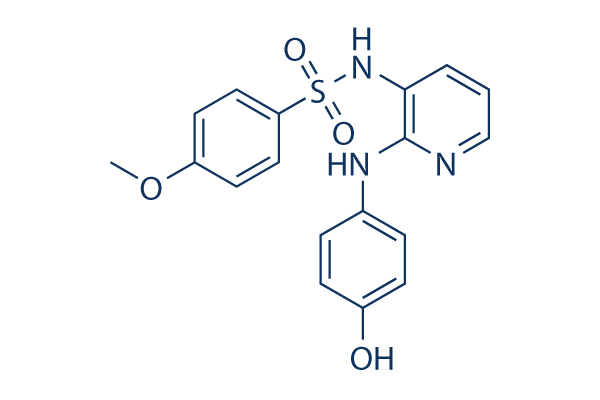
Chemische Struktur
Molekulargewicht: 371.41
Qualitätskontrolle
- In Nature Medicine für seine erstklassige Qualität zitiert
- COA
- NMR
- SDS
- Datenblatt
| Verwandte Ziele | Akt Wnt/beta-catenin PKC HSP ROCK Integrin Bcr-Abl Actin FAK Kinesin |
|---|---|
| Weitere Microtubule Associated Inhibitoren | Nocodazole MMAF Patupilone (Epothilone B) Lexibulin (CYT997) CW069 Combretastatin A4 Epothilone A TAI-1 Cucurbitacin B INH1 |
Zellkultur, Behandlung & Arbeitskonzentration
| Zelllinien | Assay-Typ | Konzentration | Inkubationszeit | Formulierung | Aktivitätsbeschreibung | PMID |
|---|---|---|---|---|---|---|
| HCT-15 cell | Proliferation assay | Antiproliferative activity against human colon carcinoma HCT-15 cell line(MDR(-)), IC50=0.34 μM | ||||
| HCT116-C9 cell | Function assay | Effective concentration to inhibit cell proliferation by 50% relative to untreated control cell after 72 hr of continuous exposure in HCT116-C9 cell line, IC50=0.9 μM | ||||
| NCI-H460 cell | Proliferation assay | Antiproliferative activity against human lung carcinoma NCI-H460 cell line (MDR(+)), IC50=0.35 μM | ||||
| P388 cell line | Function assay | 72 h | Effective concentration to inhibit cell proliferation by 50% relative to untreated control cell after 72 hr of continuous exposure in P388 cell line, IC50=0.19 μM | |||
| P388/4.0 r-M cell line | Function assay | 72 h | Effective concentration to inhibit cell proliferation by 50% relative to untreated control cell after 72 hr of continuous exposure in P388/4.0 r-M cell line, IC50=15 μM | |||
| human HL60 cells | Proliferation assay | Antiproliferative activity against human HL60 cells, IC50=0.34 μM | ||||
| HeLa cells | Cytotoxicity assay | 48-72 h | Cytotoxicity against human HeLa cells after 48 to 72 hrs by WAT-1 assay, IC50=0.27 μM | |||
| MDR1 cells | Cytotoxicity assay | 48-72 h | Cytotoxicity against human NCI-ADR-RES expressing MDR1 cells after 48 to 72 hrs by WAT-1 assay, IC50=0.29 μM | |||
| Jurkat cells | Function assay | 24 h | Cell cycle arrest in human Jurkat cells assessed as accumulation at G2/M phase after 24 hrs using propidium iodide staining by FACS analysis, IC50=0.16 μM | |||
| SW620 cells | Cytotoxicity assay | 48-72 h | Cytotoxicity against human SW620 cells after 48 to 72 hrs by WAT-1 assay, IC50=0.19 μM | |||
| A2780 cells | Cytotoxicity assay | 48-72 h | Cytotoxicity against human A2780 cells after 48 to 72 hrs by WAT-1 assay, IC50=0.17 μM | |||
| HT-29 cells | Proliferation assay | 72 h | Antiproliferative activity against human HT-29 cells after 72 hrs by MTT assay, IC50=0.21 μM | |||
| HUVEC | Function assay | 100-1000 nM | 4 h | Induction of vascular disrupting activity in HUVEC assessed as VEGF-induced tube formation at 100 to 1000 nM after 4 hrs by microscopic analysis | ||
| H460 cells | Cytotoxicity assay | 72 h | Cytotoxicity against human H460 cells assessed as growth inhibition after 72 hrs by methylene blue staining-based assay, IC50=0.2177 μM | |||
| MKN45 cells | Cytotoxicity assay | 72 h | Cytotoxicity against human MKN45 cells assessed as growth inhibition after 72 hrs by methylene blue staining-based assay, IC50=0.166 μM | |||
| HT-29 cells | Cytotoxicity assay | 72 h | Cytotoxicity against human HT-29 cells assessed as growth inhibition after 72 hrs by methylene blue staining-based assay, IC50=0.3387 μM | |||
| human A549 cells | Cytotoxicity assay | 48 h | Cytotoxicity against human A549 cells after 48 hrs by MTT assay, IC50=1.31 μM | |||
| ACHN cells | Cytotoxicity assay | 48 h | Cytotoxicity against human ACHN cells after 48 hrs by MTT assay, IC50=2.13 μM | |||
| MCF7 cells | Cytotoxicity assay | 48 h | Cytotoxicity against human MCF7 cells after 48 hrs by MTT assay, IC50=1.25 μM | |||
| HT-29 cells | Cytotoxicity assay | 48 h | Cytotoxicity against human HT-29 cells after 48 hrs by MTT assay, IC50=1.62 μM | |||
| A549 cells | Proliferation assay | 24 h | Antiproliferative activity against human A549 cells assessed as growth inhibition after 24 hrs by SRB assay, GI50=1.31 μM | |||
| human MCF7 cells | Proliferation assay | 24 h | Antiproliferative activity against human MCF7 cells assessed as growth inhibition after 24 hrs by SRB assay, GI50=1.25 μM | |||
| KB-S15 cells | Cytotoxicity assay | 72 h | Cytotoxicity against human KB-S15 cells overexpressing P-gp170/MDR assessed as growth inhibition after 72 hrs by methylene blue staining-based assay, IC50=0.206 μM | |||
| KB-7d cells | Cytotoxicity assay | 72 h | Cytotoxicity against human KB-7d cells overexpressing MRP assessed as growth inhibition after 72 hrs by methylene blue staining-based assay, IC50=0.205 μM | |||
| KB-VIN10 cells | Cytotoxicity assay | 72 h | Cytotoxicity against human KB-VIN10 cells overexpressing P-gp170/MDR assessed as growth inhibition after 72 hrs by methylene blue staining-based assay, IC50=0.227 μM | |||
| human PC3 cells | Cytotoxicity assay | 48 h | Cytotoxicity against human PC3 cells assessed as growth inhibition after 48 hrs by sulforhodamine B assay, GI50=0.62 μM | |||
| human AsPC1 cells | Cytotoxicity assay | 48 h | Cytotoxicity against human AsPC1 cells assessed as growth inhibition after 48 hrs by sulforhodamine B assay, GI50=4.11 μM | |||
| human A549 cells | Cytotoxicity assay | 48 h | Cytotoxicity against human A549 cells assessed as growth inhibition after 48 hrs by sulforhodamine B assay, GI50=5.33 μM | |||
| Hep3B cells | Cytotoxicity assay | 48 h | Cytotoxicity against human Hep3B cells assessed as growth inhibition after 48 hrs by sulforhodamine B assay, GI50=0.84 μM | |||
| KB cells | Cytotoxicity assay | 72 h | Cytotoxicity against human KB cells assessed as growth inhibition after 72 hrs by methylene blue staining-based assay, IC50=0.2513 μM | |||
| DU145 cells | Proliferation assay | 24 h | Antiproliferative activity against human DU145 cells assessed as growth inhibition after 24 hrs by SRB assay, GI50=1.81 μM | |||
| DU145 cells | Cytotoxicity assay | 48 h | Cytotoxicity against human DU145 cells after 48 hrs by MTT assay, GI50=1.81 μM | |||
| human SKBR3 cells | Growth inhibition assay | 48 h | Growth inhibition of human SKBR3 cells after 48 hrs by MTT assay, IC50=0.74 μM | |||
| Klicken Sie hier, um weitere experimentelle Daten zu Zelllinien anzuzeigen | ||||||
Chemische Informationen, Lagerung & Stabilität
| Molekulargewicht | 371.41 | Formel | C18H17N3O4S |
Lagerung (Ab dem Eingangsdatum) | |
|---|---|---|---|---|---|
| CAS-Nr. | 141430-65-1 | SDF herunterladen | Lagerung von Stammlösungen |
|
|
| Synonyme | N/A | Smiles | COC1=CC=C(C=C1)S(=O)(=O)NC2=C(N=CC=C2)NC3=CC=C(C=C3)O | ||
Löslichkeit
|
In vitro |
DMSO
: 74 mg/mL
(199.24 mM)
Ethanol : 12 mg/mL Water : Insoluble |
Molaritätsrechner
|
In vivo |
|||||
In-vivo-Formulierungsrechner (Klare Lösung)
Schritt 1: Geben Sie die untenstehenden Informationen ein (Empfohlen: Ein zusätzliches Tier zur Berücksichtigung von Verlusten während des Experiments)
Schritt 2: Geben Sie die In-vivo-Formulierung ein (Dies ist nur der Rechner, keine Formulierung. Bitte kontaktieren Sie uns zuerst, wenn es im Abschnitt "Löslichkeit" keine In-vivo-Formulierung gibt.)
Berechnungsergebnisse:
Arbeitskonzentration: mg/ml;
Methode zur Herstellung der DMSO-Stammlösung: mg Wirkstoff vorgelöst in μL DMSO ( Konzentration der Stammlösung mg/mL, Bitte kontaktieren Sie uns zuerst, wenn die Konzentration die DMSO-Löslichkeit der Wirkstoffcharge überschreitet. )
Methode zur Herstellung der In-vivo-Formulierung: Nehmen Sie μL DMSO Stammlösung, dann hinzufügenμL PEG300, mischen und klären, dann hinzufügenμL Tween 80, mischen und klären, dann hinzufügen μL ddH2O, mischen und klären.
Methode zur Herstellung der In-vivo-Formulierung: Nehmen Sie μL DMSO Stammlösung, dann hinzufügen μL Maisöl, mischen und klären.
Hinweis: 1. Bitte stellen Sie sicher, dass die Flüssigkeit klar ist, bevor Sie das nächste Lösungsmittel hinzufügen.
2. Achten Sie darauf, das/die Lösungsmittel der Reihe nach hinzuzufügen. Sie müssen sicherstellen, dass die bei der vorherigen Zugabe erhaltene Lösung eine klare Lösung ist, bevor Sie mit der Zugabe des nächsten Lösungsmittels fortfahren. Physikalische Methoden wie Vortex, Ultraschall oder ein heißes Wasserbad können zur Unterstützung des Lösens verwendet werden.
Wirkmechanismus
| Merkmale |
An orally bioavailable tubulin-binding and antimitotic sulfonamide.
|
|---|---|
| Targets/IC50/Ki |
Microtubules
|
| In vitro |
In vitro zeigt ABT-751 (E7010) eine selektive Zytotoxizität mit IC50-Werten von 0,6–2,6 μM bei Neuroblastomen und 0,7–4,6 μM bei anderen soliden Tumorzelllinien. Darüber hinaus zeigt es auch eine selektive Wirkung auf dynamische Mikrotubuli und verschont stabile Mikrotubuli, was die Persistenz von acetylierten und detyrosinierten α-Tubulin-positiven polymerisierten Tubuli bei seiner IC90-Konzentration erklärt.
|
| In vivo |
In diesem Calu-6-Xenograftmodell zeigt ABT-751 (E7010) als Einzelwirkstoff bei 100 und 75 mg/kg/Tag eine signifikante Antitumoraktivität, während es in Kombination mit Cisplatin eine dosisabhängige Verstärkung der Wachstumsverzögerung zeigt. Im HT-29-Kolon-Xenograftmodell zeigt diese Verbindung auch als Einzelwirkstoff eine signifikante Antitumoraktivität und führte in Kombination mit 5-FU zu einer dosisabhängigen Verstärkung der Wachstumsverzögerung. Bei Hunden mit Lymphom zeigte es dosislimitierende Toxizitäten, darunter Erbrechen, Durchfall, Anorexie oder eine Kombination davon, mit einer maximal tolerierten Dosis (MTD) von 350 mg/m2 PO alle 24 Stunden. Darüber hinaus betragen die mittlere AUC und Cmax für ABT-751 bei der MTD von 350 mg/m2 5,55 μg-Stunde/ml bzw. 0,9 μg/ml.
|
Literatur |
|
Klinische Studieninformationen
(Daten von https://clinicaltrials.gov, aktualisiert am 2024-05-22)
| NCT-Nummer | Rekrutierung | Erkrankungen | Sponsor/Kooperationspartner | Startdatum | Phasen |
|---|---|---|---|---|---|
| NCT00436852 | Completed | Disseminated Neuroblastoma|Recurrent Neuroblastoma |
Children''s Oncology Group|National Cancer Institute (NCI) |
January 2007 | Phase 2 |
| NCT00735878 | Terminated | Non Small Cell Lung Cancer|Lung Cancer |
Konstantin Dragnev|Abbott|Dartmouth-Hitchcock Medical Center |
September 2004 | Phase 1|Phase 2 |
Technischer Support
Tel: +1-832-582-8158 Ext:3
Wenn Sie weitere Fragen haben, hinterlassen Sie bitte eine Nachricht.

Produkte sind nur für Forschungszwecke bestimmt. Nicht für den menschlichen Gebrauch. Wir verkaufen nicht an Patienten.
©Copyright 2013 Selleck Chemicals. Alle Rechte vorbehalten.