
nur für Forschungszwecke
AG-14361 PARP Inhibitor
Kat.-Nr.S2178
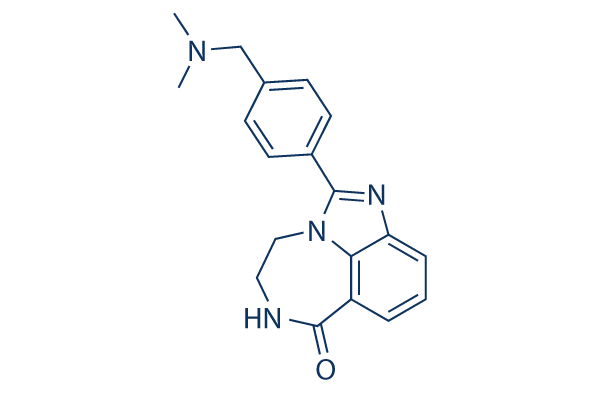
Chemische Struktur
Molekulargewicht: 320.39
Qualitätskontrolle
| Verwandte Ziele | HDAC ATM/ATR DNA-PK WRN DNA/RNA Synthesis Topoisomerase PPAR Sirtuin Casein Kinase eIF |
|---|---|
| Weitere PARP Inhibitoren | XAV-939 AZD5305 (Saruparib) Veliparib (ABT-888) PJ34 HCl Iniparib (BSI-201) G007-LK Pamiparib UPF 1069 A-966492 Stenoparib (E7449) |
Zellkultur, Behandlung & Arbeitskonzentration
| Zelllinien | Assay-Typ | Konzentration | Inkubationszeit | Formulierung | Aktivitätsbeschreibung | PMID |
|---|---|---|---|---|---|---|
| LoVo cells | Function assay | Concentration that gives 50% growth inhibition in LoVo cells, activity expressed as GI50, GI50=11.2 μM | ||||
| Klicken Sie hier, um weitere experimentelle Daten zu Zelllinien anzuzeigen | ||||||
Chemische Informationen, Lagerung & Stabilität
| Molekulargewicht | 320.39 | Formel | C19H20N4O |
Lagerung (Ab dem Eingangsdatum) | |
|---|---|---|---|---|---|
| CAS-Nr. | 328543-09-5 | SDF herunterladen | Lagerung von Stammlösungen |
|
|
| Synonyme | N/A | Smiles | CN(C)CC1=CC=C(C=C1)C2=NC3=CC=CC4=C3N2CCNC4=O | ||
Löslichkeit
|
In vitro |
DMSO
: 51 mg/mL
(159.18 mM)
Ethanol : 21 mg/mL Water : Insoluble |
Molaritätsrechner
|
In vivo |
|||||
In-vivo-Formulierungsrechner (Klare Lösung)
Schritt 1: Geben Sie die untenstehenden Informationen ein (Empfohlen: Ein zusätzliches Tier zur Berücksichtigung von Verlusten während des Experiments)
Schritt 2: Geben Sie die In-vivo-Formulierung ein (Dies ist nur der Rechner, keine Formulierung. Bitte kontaktieren Sie uns zuerst, wenn es im Abschnitt "Löslichkeit" keine In-vivo-Formulierung gibt.)
Berechnungsergebnisse:
Arbeitskonzentration: mg/ml;
Methode zur Herstellung der DMSO-Stammlösung: mg Wirkstoff vorgelöst in μL DMSO ( Konzentration der Stammlösung mg/mL, Bitte kontaktieren Sie uns zuerst, wenn die Konzentration die DMSO-Löslichkeit der Wirkstoffcharge überschreitet. )
Methode zur Herstellung der In-vivo-Formulierung: Nehmen Sie μL DMSO Stammlösung, dann hinzufügenμL PEG300, mischen und klären, dann hinzufügenμL Tween 80, mischen und klären, dann hinzufügen μL ddH2O, mischen und klären.
Methode zur Herstellung der In-vivo-Formulierung: Nehmen Sie μL DMSO Stammlösung, dann hinzufügen μL Maisöl, mischen und klären.
Hinweis: 1. Bitte stellen Sie sicher, dass die Flüssigkeit klar ist, bevor Sie das nächste Lösungsmittel hinzufügen.
2. Achten Sie darauf, das/die Lösungsmittel der Reihe nach hinzuzufügen. Sie müssen sicherstellen, dass die bei der vorherigen Zugabe erhaltene Lösung eine klare Lösung ist, bevor Sie mit der Zugabe des nächsten Lösungsmittels fortfahren. Physikalische Methoden wie Vortex, Ultraschall oder ein heißes Wasserbad können zur Unterstützung des Lösens verwendet werden.
Wirkmechanismus
| Merkmale |
The 1st high-potency PARP-1 inhibitor with the specificity & in vivo activity to enhance chemotherapy and radiation therapy of human cancers.
|
|---|---|
| Targets/IC50/Ki |
PARP1
(Cell-free assay) <5 nM(Ki)
|
| In vitro |
AG14361 ist mindestens 1000-fach potenter als Benzamide. Die IC50 für AG14361 beträgt 29 nM in permeabilisierten SW620-Zellen und 14 nM in intakten SW620-Zellen. Die kristallographische Analyse von AG14361, gebunden an die katalytische Domäne der Hühner-PARP-1, zeigt, dass das trizyklische Ringsystem von AG14361 in einer Tasche liegt, die aus den Aminosäureresten Trp861, His862, Gly863, Tyr896, Phe897, Ala898, Lys903, Ser904, Tyr907 und Glu988 besteht. AG14361 bildet wichtige Wasserstoffbrückenbindungen mit Ser904 und Gly863 und eine wasservermittelte Wasserstoffbrückenbindung mit Glu988. Die durch AG14361 induzierte Wachstumshemmung wird nicht auf PARP-1-bezogene Effekte zurückgeführt, da eine maximale PARP-1-Inhibition bei viel niedrigeren Konzentrationen (≤1 µM) als die GI50 beobachtet wird. AG14361 bei 0,4 µM beeinflusst weder die Genexpression noch das Wachstum von Krebszellen, aber es erhöht die antiproliferative Aktivität und hemmt die Erholung von potenziell letalen γ-Strahlenschäden in LoVo-Zellen um 73 %. Darüber hinaus verändert 0,4 µM AG14361 die Genexpression nicht wesentlich, wie die Microarray-Analyse zeigt. Eine 17-stündige Exposition von A549-Zellen gegenüber 0,4 µM AG14361 verändert die Expression der 6800 Gene nicht. Obwohl 0,4 µM AG14361 die zelluläre PARP-1-Aktivität um mehr als 85 % hemmt, verändert es im Wesentlichen weder die Genexpression noch die Zellproliferation, was darauf hindeutet, dass die zellulären Effekte dieser niedrigen Konzentration von AG14361 spezifisch für die PARP-1-Inhibition sind. Höhere, wachstumshemmende Konzentrationen von AG14361 beeinflussen die Genexpression, aber diese Effekte sind wahrscheinlich nicht mit der PARP-1-Inhibition verbunden, da die Zellproliferation in PARP-/- und PARP-1+/+-Zellen gleichermaßen betroffen ist. AG14361 wird schnell in den Blutkreislauf aufgenommen und verteilt sich im Tumor und in der Leber, wobei geringere Konzentrationen im Gehirn nachgewiesen werden. Das Gewebe-Plasma-Konzentrationsverhältnis zeigt, dass AG14361 in Tumorgewebe über die Zeit in beiden Xenograft-Modellen retentiert wird, mit Tumorkonzentrationen (≥15 µM für 2 Stunden), die über denen liegen, die zur In-vitro-Inhibition der PARP-1-Aktivität erforderlich sind. AG14361 verstärkt die Aktivität in allen MMR-profizienten Zellen (1,5–3,3-fach), ist aber in MMR-defizienten Zellen wirksamer (3,7–5,2-fache Potenzierung) und überwindet so die Resistenz. Im Gegensatz dazu erhöht Benzylguanin die Wirksamkeit nur in MMR-profizienten Zellen, ist aber in MMR-defizienten Zellen unwirksam. AG14361 verstärkt die wachstumshemmenden und zytotoxischen Wirkungen von Topoisomerase-I-Giften. AG14361 erhöht die Persistenz von Camptothecin-induzierten DNA-Einzelstrangbrüchen. |
| Kinase-Assay |
PARP-1 Aktivitätsassays
|
|
Die Aktivität der rekombinanten humanen PARP-1 in voller Länge wird in einer Reaktionsmischung gemessen, die 20 nM PARP-1, 500 μM NAD+ plus [32P]NAD+ (0,1–0,3 μCi pro Reaktionsmischung) und aktivierte Kalbsthymus-DNA (10 μg/mL) bei 25oC enthält; die Reaktion wird nach 4 Minuten durch Zugabe von eiskalter 10%iger (Gew./Vol.) Trichloressigsäure beendet. Das Reaktionsprodukt [32P]ADP-Ribose, das in säureunlösliches Material eingebaut wurde, wird auf Whatman GF/C-Glasfaserfiltern mit einem Bio-Dot-Mikrofiltrationsgerät abgeschieden und mit einem PhosphorImager quantifiziert. Die Hemmung der PARP-1-Aktivität durch AG14361 bei 0–600 nM wird gemessen, und der Ki für AG14361 wird durch nichtlineare Regressionsanalyse berechnet.
|
|
| In vivo |
Die AG14361-Behandlung vor der Bestrahlung erhöht die Empfindlichkeit der Mäuse mit LoVo-Xenografts gegenüber der Strahlentherapie statistisch signifikant. AG14361 erhöht den Blutfluss in Xenografts statistisch signifikant und erhöht somit potenziell die Medikamentenabgabe an Tumorxenografts. In vivo erhöhen nichttoxische Dosen von AG14361 die durch Röntgenbestrahlung induzierte Verzögerung des LoVo-Xenograft-Wachstums um das 2- bis 3-fache. Die gleichzeitige Verabreichung von AG14361 erhöht die Aktivität gegen LoVo-Xenografts statistisch signifikant, wobei die Tumorwachstumsverzögerung durch AG14361 bei 5 mg/kg von 3 Tagen auf 9 Tage und durch AG14361 bei 15 mg/kg auf 10 Tage erhöht wird. Die Kombination von AG14361 führt zu einer vollständigen Regression von SW620-Xenograft-Tumoren. Die PARP-1-Aktivität, nachgewiesen durch einen pharmakodynamischen Assay in SW620-Xenografts, wird für mindestens 4 Stunden nach intraperitonealer Verabreichung von AG14361 (10 mg/kg) um mehr als 75 % gehemmt, was mit der Konzentration von AG14361 im Tumor übereinstimmt. |
Literatur |
|
Technischer Support
Tel: +1-832-582-8158 Ext:3
Wenn Sie weitere Fragen haben, hinterlassen Sie bitte eine Nachricht.

Produkte sind nur für Forschungszwecke bestimmt. Nicht für den menschlichen Gebrauch. Wir verkaufen nicht an Patienten.
©Copyright 2013 Selleck Chemicals. Alle Rechte vorbehalten.