
nur für Forschungszwecke
GSK690693 pan-Akt-Inhibitor
Kat.-Nr.S1113
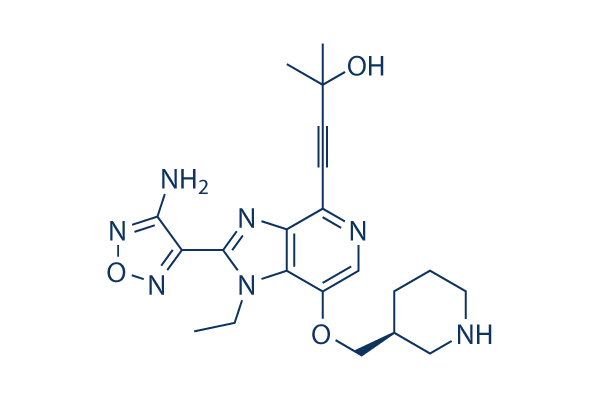
Chemische Struktur
Molekulargewicht: 425.48
Qualitätskontrolle
| Verwandte Ziele | PI3K mTOR GSK-3 ATM/ATR DNA-PK AMPK PDPK1 PTEN PP2A PDK |
|---|---|
| Weitere Akt Inhibitoren | SC79 AZD5363 (Capivasertib) MK-2206 Dihydrochloride Ipatasertib (GDC-0068) Perifosine Triciribine (API-2) Afuresertib (GSK2110183) CCT128930 A-674563 HCl Akti-1/2 |
Zellkultur, Behandlung & Arbeitskonzentration
| Zelllinien | Assay-Typ | Konzentration | Inkubationszeit | Formulierung | Aktivitätsbeschreibung | PMID |
|---|---|---|---|---|---|---|
| LNCaP | Proliferation assay | Antiproliferative activity against human LNCaP cells, IC50=20 nM | 18800763 | |||
| BT474 | Proliferation assay | Antiproliferative activity against human BT474 cells, IC50=50 nM | 18800763 | |||
| Sf9 | Function assay | Inhibition of human recombinant ROCK1 expressed in Sf9 cells, IC50=0.89 μM | 18800763 | |||
| NCI-H460 | Growth inhibition assay | 72 h | Growth inhibition of human NCI-H460 cells after 72 hrs by coulter counter method, IC50=5.4 μM | 24900862 | ||
| PC3 | Proliferation assay | 72 h | Antiproliferative activity against human PC3 cells after 72 hrs by MTT assay, IC50=15.5 μM | 24308997 | ||
| HFF | Cytotoxic assay | Cytotoxicity against HFF cells, IC50=16.3 μM | 18800763 | |||
| LNCAP | Antiproliferative assay | Antiproliferative activity against human LNCAP cells, IC50 = 0.021 μM. | 19179070 | |||
| BT474 | Antiproliferative assay | Antiproliferative activity against human BT474 cells, IC50 = 0.069 μM. | 19179070 | |||
| BT474 | Function assay | Inhibition of GSK3-beta phosphorylation in human BT474 cells, IC50 = 0.138 μM. | 19179070 | |||
| JVM2 | Antiproliferative assay | 72 hrs | Antiproliferative activity against human JVM2 cells after 72 hrs by CellTiter Glo assay, IC50 = 1.6 μM. | 28704757 | ||
| JeKo1 | Antiproliferative assay | 72 hrs | Antiproliferative activity against human JeKo1 cells after 72 hrs by CellTiter Glo assay, IC50 = 3 μM. | 28704757 | ||
| Z138 | Antiproliferative assay | 72 hrs | Antiproliferative activity against human Z138 cells after 72 hrs by CellTiter Glo assay, IC50 = 3.1 μM. | 28704757 | ||
| SP49 | Antiproliferative assay | 72 hrs | Antiproliferative activity against human SP49 cells after 72 hrs by CellTiter Glo assay, IC50 = 4.8 μM. | 28704757 | ||
| Maver1 | Antiproliferative assay | 72 hrs | Antiproliferative activity against human Maver1 cells after 72 hrs by CellTiter Glo assay, IC50 = 5.1 μM. | 28704757 | ||
| C6 | Function assay | 24 hrs | Inhibition of Akt in rat C6 cells after 24 hrs by ELISA, IC50 = 6.97 μM. | 29966916 | ||
| C6 | Cytotoxicity assay | 24 hrs | Cytotoxicity against rat C6 cells assessed as decrease in cell viability after 24 hrs by MTT assay, IC50 = 14.5 μM. | 29966916 | ||
| A549 | Function assay | 24 hrs | Inhibition of Akt in human A549 cells after 24 hrs by ELISA, IC50 = 17.33 μM. | 29966916 | ||
| Mino | Antiproliferative assay | 72 hrs | Antiproliferative activity against human Mino cells after 72 hrs by CellTiter Glo assay, IC50 = 20.8 μM. | 28704757 | ||
| A673 | qHTS assay | qHTS of pediatric cancer cell lines to identify multiple opportunities for drug repurposing: Primary screen for A673 cells | 29435139 | |||
| RD | qHTS assay | qHTS of pediatric cancer cell lines to identify multiple opportunities for drug repurposing: Primary screen for RD cells | 29435139 | |||
| NB1643 | qHTS assay | qHTS of pediatric cancer cell lines to identify multiple opportunities for drug repurposing: Primary screen for NB1643 cells | 29435139 | |||
| SJ-GBM2 | qHTS assay | qHTS of pediatric cancer cell lines to identify multiple opportunities for drug repurposing: Primary screen for SJ-GBM2 cells | 29435139 | |||
| SK-N-MC | qHTS assay | qHTS of pediatric cancer cell lines to identify multiple opportunities for drug repurposing: Primary screen for SK-N-MC cells | 29435139 | |||
| NB-EBc1 | qHTS assay | qHTS of pediatric cancer cell lines to identify multiple opportunities for drug repurposing: Primary screen for NB-EBc1 cells | 29435139 | |||
| LAN-5 | qHTS assay | qHTS of pediatric cancer cell lines to identify multiple opportunities for drug repurposing: Primary screen for LAN-5 cells | 29435139 | |||
| MCL | Antiproliferative assay | 24 hrs | Antiproliferative activity against primary human MCL cells up to 60 uM after 24 hrs by CellTiter Glo assay | 28704757 | ||
| Klicken Sie hier, um weitere experimentelle Daten zu Zelllinien anzuzeigen | ||||||
Chemische Informationen, Lagerung & Stabilität
| Molekulargewicht | 425.48 | Formel | C21H27N7O3 |
Lagerung (Ab dem Eingangsdatum) | |
|---|---|---|---|---|---|
| CAS-Nr. | 937174-76-0 | SDF herunterladen | Lagerung von Stammlösungen |
|
|
| Synonyme | N/A | Smiles | CCN1C2=C(C(=NC=C2OCC3CCCNC3)C#CC(C)(C)O)N=C1C4=NON=C4N | ||
Löslichkeit
|
In vitro |
DMSO
: 21 mg/mL
(49.35 mM)
Water : Insoluble Ethanol : Insoluble |
Molaritätsrechner
|
In vivo |
|||||
In-vivo-Formulierungsrechner (Klare Lösung)
Schritt 1: Geben Sie die untenstehenden Informationen ein (Empfohlen: Ein zusätzliches Tier zur Berücksichtigung von Verlusten während des Experiments)
Schritt 2: Geben Sie die In-vivo-Formulierung ein (Dies ist nur der Rechner, keine Formulierung. Bitte kontaktieren Sie uns zuerst, wenn es im Abschnitt "Löslichkeit" keine In-vivo-Formulierung gibt.)
Berechnungsergebnisse:
Arbeitskonzentration: mg/ml;
Methode zur Herstellung der DMSO-Stammlösung: mg Wirkstoff vorgelöst in μL DMSO ( Konzentration der Stammlösung mg/mL, Bitte kontaktieren Sie uns zuerst, wenn die Konzentration die DMSO-Löslichkeit der Wirkstoffcharge überschreitet. )
Methode zur Herstellung der In-vivo-Formulierung: Nehmen Sie μL DMSO Stammlösung, dann hinzufügenμL PEG300, mischen und klären, dann hinzufügenμL Tween 80, mischen und klären, dann hinzufügen μL ddH2O, mischen und klären.
Methode zur Herstellung der In-vivo-Formulierung: Nehmen Sie μL DMSO Stammlösung, dann hinzufügen μL Maisöl, mischen und klären.
Hinweis: 1. Bitte stellen Sie sicher, dass die Flüssigkeit klar ist, bevor Sie das nächste Lösungsmittel hinzufügen.
2. Achten Sie darauf, das/die Lösungsmittel der Reihe nach hinzuzufügen. Sie müssen sicherstellen, dass die bei der vorherigen Zugabe erhaltene Lösung eine klare Lösung ist, bevor Sie mit der Zugabe des nächsten Lösungsmittels fortfahren. Physikalische Methoden wie Vortex, Ultraschall oder ein heißes Wasserbad können zur Unterstützung des Lösens verwendet werden.
Wirkmechanismus
| Targets/IC50/Ki |
ULK1
STING
AMPK
Akt1
(Cell-free assay) 2 nM
PKCη
(Cell-free assay) 2 nM
PKCθ
(Cell-free assay) 2 nM
PrkX
(Cell-free assay) 5 nM
Akt3
(Cell-free assay) 9 nM
Akt2
(Cell-free assay) 13 nM
PKCδ
(Cell-free assay) 14 nM
PKCβ
(Cell-free assay) 19 nM
PKCε
(Cell-free assay) 21 nM
PKA
(Cell-free assay) 24 nM
PKG1β
(Cell-free assay) 33 nM
|
|---|---|
| In vitro |
GSK690693 ist sehr selektiv für die Akt-Isoformen gegenüber der Mehrheit der Kinasen in anderen Familien. Allerdings ist diese Verbindung weniger selektiv für Mitglieder der AGC-Kinase-Familie, einschließlich PKA, PrkX und PKC-Isoenzyme, mit IC50 von 24 nM, 5 nM bzw. 2-21 nM. Es hemmt auch potent AMPK und DAPK3 aus der CAMK-Familie mit IC50 von 50 nM bzw. 81 nM, und PAK4, 5 und 6 aus der STE-Familie mit IC50 von 10 nM, 52 nM bzw. 6 nM. Diese Chemikalie hemmt die Phosphorylierung von GSK3β in Tumorzellen mit IC50-Werten von 43 nM bis 150 nM. Ihre Behandlung führt zu einer dosisabhängigen Zunahme der nukleären Akkumulation des Transkriptionsfaktors FOXO3A. Diese Verbindung hemmt potent die Proliferation von T47D-, ZR-75-1-, BT474-, HCC1954-, MDA-MB-453- und LNCaP-Zellen mit IC50 von 72 nM, 79 nM, 86 nM, 119 nM, 975 nM bzw. 147 nM. Ihre Behandlung induziert Apoptose bei Konzentrationen >100 nM sowohl in LNCaP- als auch in BT474-Zellen. Im Einklang mit der Rolle von AKT beim Überleben von Zellen induziert es Apoptose in empfindlichen ALL-Zelllinien. |
| Kinase-Assay |
In-vitro-Kinase-Assays
|
|
His-markierte, vollständige Akt1, 2 oder 3 werden aus Baculovirus exprimiert und gereinigt. Die Aktivierung erfolgt mit gereinigtem PDK1 zur Phosphorylierung von Thr308 und gereinigtem MK2 zur Phosphorylierung von Ser473. Um die zeitabhängige Hemmung von Akt genauer zu messen, werden aktivierte Akt-Enzyme mit GSK690693 in verschiedenen Konzentrationen bei Raumtemperatur für 30 Minuten inkubiert, bevor die Reaktion durch Zugabe des Substrats eingeleitet wird. Die Endreaktion enthält 5 nM bis 15 nM Akt1-, 2- und 3-Enzyme; 2 μM ATP; 0,15 μCi/μL [γ-33P]ATP; 1 μM Peptid (Biotin-aminohexansäure-ARKR-ERAYSFGHHA-amid); 10 mM MgCl2; 25 mM MOPS (pH 7,5); 1 mM DTT; 1 mM CHAPS; und 50 mM KCl. Die Reaktionen werden 45 Minuten bei Raumtemperatur inkubiert und anschließend mit Leadseeker-Beads in PBS, das EDTA enthält (Endkonzentration: 2 mg/mL Beads und 75 mM EDTA), abgebrochen. Die Platten werden dann versiegelt, die Beads dürfen sich mindestens 5 Stunden lang absetzen, und die Produktbildung wird mit einem Viewlux Imager quantifiziert.
|
|
| In vivo |
Eine einzige Verabreichung von GSK690693 hemmt die GSK3β-Phosphorylierung in menschlichen Brustkarzinom- (BT474) Xenografts dosis- und zeitabhängig. In ähnlicher Weise induziert diese Verbindung eine Reduktion der Phosphorylierung der Akt-Substrate PRAS40 und FKHR/FKHRL1. Sie führt auch zu einem akuten Anstieg des Blutzuckerspiegels, der 8 bis 10 Stunden nach der Medikamentenverabreichung auf den Ausgangswert zurückkehrt. Die Verabreichung dieser Chemikalie induziert in vivo Reduktionen der phosphorylierten Akt-Substrate und hemmt potent das Wachstum von menschlichen SKOV-3-Ovarial-, LNCaP-Prostata- sowie BT474- und HCC-1954-Brustkarzinom-Xenografts, mit einer maximalen Hemmung von 58 % bis 75 % bei einer Dosis von 30 mg/kg/Tag. Diese Verbindung zeigt Wirksamkeit unabhängig vom Mechanismus der Akt-Aktivierung. Sie ist am effektivsten bei der Verzögerung der Tumorprogression in Lck-MyrAkt2-Mäusen, die eine membrangebundene, konstitutiv aktive Form von Akt exprimieren. |
Literatur |
|
Anwendungen
| Methoden | Biomarker | Bilder | PMID |
|---|---|---|---|
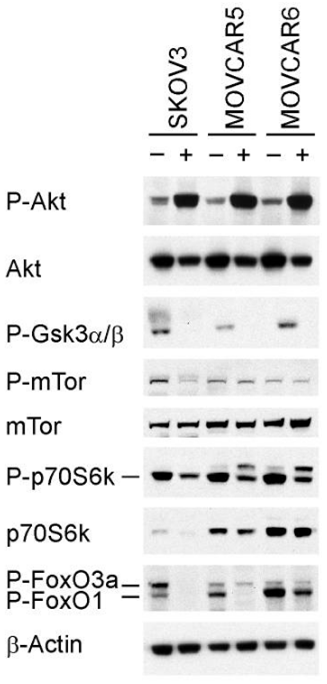
| Western blot | p-Akt / Akt / p-GSK3 / p-mTOR / mTOR / p-p70S6K / p-FoxO3a / p-FoxO1 pPRAS40 / PRAS40 / pBAD / BAD |
|
20075391 |
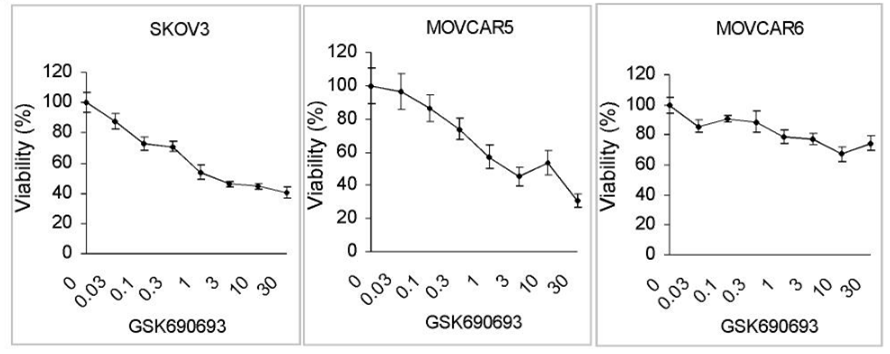
| Growth inhibition assay | Cell viability |
|
20075391 |
Klinische Studieninformationen
(Daten von https://clinicaltrials.gov, aktualisiert am 2024-05-22)
| NCT-Nummer | Rekrutierung | Erkrankungen | Sponsor/Kooperationspartner | Startdatum | Phasen |
|---|---|---|---|---|---|
| NCT00666081 | Withdrawn | Cancer |
GlaxoSmithKline |
April 2008 | Phase 1 |
| NCT00493818 | Terminated | Cancer |
GlaxoSmithKline |
April 2007 | Phase 1 |
Technischer Support
Tel: +1-832-582-8158 Ext:3
Wenn Sie weitere Fragen haben, hinterlassen Sie bitte eine Nachricht.
Häufig gestellte Fragen
Frage 1:
Why did pAKT increase after treatment with it?
Antwort:
It actually inhibits AKT, but does not necessarily decrease p-Akt level. Treatment with this compound caused AKT hyper phosphorylation which has already been reported in some papers. (For example, http://www.bloodjournal.org/content/113/8/1723.short?sso-checked=true). To test the inhibition of AKT activity, you might have to look at the level of AKT substrates.

Produkte sind nur für Forschungszwecke bestimmt. Nicht für den menschlichen Gebrauch. Wir verkaufen nicht an Patienten.
©Copyright 2013 Selleck Chemicals. Alle Rechte vorbehalten.