
nur für Forschungszwecke
Ipatasertib (GDC-0068) Akt Inhibitor
Kat.-Nr.S2808
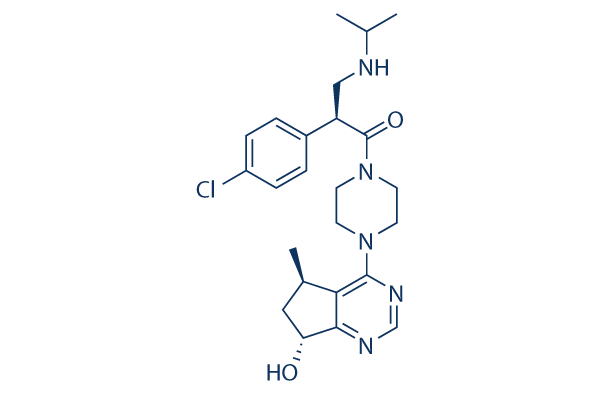
Chemische Struktur
Molekulargewicht: 458
Qualitätskontrolle
| Verwandte Ziele | PI3K mTOR GSK-3 ATM/ATR DNA-PK AMPK PDPK1 PTEN PP2A PDK |
|---|---|
| Weitere Akt Inhibitoren | SC79 AZD5363 (Capivasertib) MK-2206 Dihydrochloride Perifosine GSK690693 Triciribine (API-2) Afuresertib (GSK2110183) CCT128930 A-674563 HCl Akti-1/2 |
Zellkultur, Behandlung & Arbeitskonzentration
| Zelllinien | Assay-Typ | Konzentration | Inkubationszeit | Formulierung | Aktivitätsbeschreibung | PMID |
|---|---|---|---|---|---|---|
| HCC70 | Function Assay | 1 μM | 24 h | increases the abundance of HER3 and induces the phosphorylation (activation) of both EGFR and HER3 | 24667376 | |
| MDA-MB-468 | Function Assay | 1 μM | 24 h | increases the abundance of HER3 | 24667376 | |
| HCC70 | Growth Inhibition Assay | 1 μM | 5 d | enhances the antiproliferative response | 24667376 | |
| MDA-MB-468 | Growth Inhibition Assay | 1 μM | 5 d | enhances the antiproliferative response | 24667376 | |
| PC-3 | Function Assay | 0.0038-2.5 μM | 1 h | DMSO | induces a dose-dependent increase in Akt phosphorylation at both Thr308 (T308) and Ser473 | 23287563 |
| BT474M1 | Function Assay | 0.0038-2.5 μM | 1 h | DMSO | induces a dose-dependent increase in Akt phosphorylation at both Thr308 (T308) and Ser473 | 23287563 |
| IGROV-1 | Function Assay | 0.0038-2.5 μM | 1 h | DMSO | induces a dose-dependent increase in Akt phosphorylation at both Thr308 (T308) and Ser473 | 23287563 |
| PC-3 | Growth Inhibition Assay | 1/5/10 μM | 24/48/72 h | DMSO | dose-dependently increases the G0–G1 phase population | 23287563 |
| MCF7-neo/HER2 | Growth Inhibition Assay | 1/5/10 μM | 24/48/72 h | DMSO | dose-dependently increases the G0–G1 phase population | 23287563 |
| BT474M1 | Growth Inhibition Assay | 1/5/10 μM | 24/48/72 h | DMSO | dose-dependently increases the G0–G1 phase population | 23287563 |
| PC-3 | Apoptosis Assay | 1/5/10 μM | 15/48/72 h | DMSO | causes a dose- and time-dependent increase in apoptotic and necrotic populations | 23287563 |
| MCF7-neo/HER2 | Apoptosis Assay | 1/5/10 μM | 15/48/72 h | DMSO | causes a dose- and time-dependent increase in apoptotic and necrotic populations | 23287563 |
| BT474M1 | Apoptosis Assay | 1/5/10 μM | 15/48/72 h | DMSO | causes a dose- and time-dependent increase in apoptotic and necrotic populations | 23287563 |
| LNCAP | Cytotoxicity assay | 72 hrs | Cytotoxicity against human LNCAP cells assessed as reduction of resazurin to resorufin after 72 hrs, IC50 = 0.095 μM. | 22934575 | ||
| LNCAP | Function assay | 1.5 hrs | Inhibition of Akt1 in human LNCAP cells assessed as phosphorylation of PRAS40 at Thr246 after 1.5 hrs, IC50 = 0.157 μM. | 22934575 | ||
| PC3 | Function assay | 50 mg/kg | 9 hrs | Plasma concentration in nu/nu mouse xenografted with human PC3 cells at 50 mg/kg, po at 9 hrs by LC/MS/MS analysis, Cp = 0.5 μM. | 22934575 | |
| BT474M1 | Cytotoxicity assay | 96 hrs | Cytotoxicity against human BT474M1 cells assessed as decrease in cell viability after 96 hrs by CellTitre-Glo assay, IC50 = 1 μM. | 22934575 | ||
| PC3 | Cytotoxicity assay | 96 hrs | Cytotoxicity against human PC3 cells assessed as decrease in cell viability after 96 hrs by CellTitre-Glo assay, IC50 = 1 μM. | 22934575 | ||
| MCF7 | Cytotoxicity assay | 96 hrs | Cytotoxicity against human MCF7 cells overexpressing Her2 assessed as decrease in cell viability after 96 hrs by CellTitre-Glo assay, IC50 = 1 μM. | 22934575 | ||
| PC3 | Function assay | 50 mg/kg | 1 hr | Plasma concentration in nu/nu mouse xenografted with human PC3 cells at 50 mg/kg, po at 1 hr by LC/MS/MS analysis, Cp = 7.4 μM. | 22934575 | |
| PC3 | Function assay | 100 mg/kg | 8 hrs | Inhibition of Akt in nu/nu mouse xenografted with human PC3 cells assessed as decrease in tumor p-S6RP level at 100 mg/kg, po at 8 hrs by ELISA relative to total S6RP | 22934575 | |
| MCF7 | Function assay | Inhibition of Akt1-mediated PRAS40 phosphorylation in human MCF7 cells overexpressing Her2 | 22934575 | |||
| BT474M1 | Function assay | Inhibition of Akt1-mediated PRAS40 phosphorylation in human BT474M1 cells | 22934575 | |||
| PC3 | Function assay | Inhibition of Akt1-mediated PRAS40 phosphorylation in human PC3 cells | 22934575 | |||
| LNCAP | Function assay | Inhibition of Akt1-mediated PRAS40 phosphorylation in human LNCAP cells | 22934575 | |||
| A673 | qHTS assay | qHTS of pediatric cancer cell lines to identify multiple opportunities for drug repurposing: Primary screen for A673 cells | 29435139 | |||
| DAOY | qHTS assay | qHTS of pediatric cancer cell lines to identify multiple opportunities for drug repurposing: Primary screen for DAOY cells | 29435139 | |||
| Saos-2 | qHTS assay | qHTS of pediatric cancer cell lines to identify multiple opportunities for drug repurposing: Primary screen for Saos-2 cells | 29435139 | |||
| BT-37 | qHTS assay | qHTS of pediatric cancer cell lines to identify multiple opportunities for drug repurposing: Primary screen for BT-37 cells | 29435139 | |||
| RD | qHTS assay | qHTS of pediatric cancer cell lines to identify multiple opportunities for drug repurposing: Primary screen for RD cells | 29435139 | |||
| SK-N-SH | qHTS assay | qHTS of pediatric cancer cell lines to identify multiple opportunities for drug repurposing: Primary screen for SK-N-SH cells | 29435139 | |||
| BT-12 | qHTS assay | qHTS of pediatric cancer cell lines to identify multiple opportunities for drug repurposing: Primary screen for BT-12 cells | 29435139 | |||
| MG 63 (6-TG R) | qHTS assay | qHTS of pediatric cancer cell lines to identify multiple opportunities for drug repurposing: Primary screen for MG 63 (6-TG R) cells | 29435139 | |||
| NB1643 | qHTS assay | qHTS of pediatric cancer cell lines to identify multiple opportunities for drug repurposing: Primary screen for NB1643 cells | 29435139 | |||
| OHS-50 | qHTS assay | qHTS of pediatric cancer cell lines to identify multiple opportunities for drug repurposing: Primary screen for OHS-50 cells | 29435139 | |||
| LAN-5 | qHTS assay | qHTS of pediatric cancer cell lines to identify multiple opportunities for drug repurposing: Confirmatory screen for LAN-5 cells | 29435139 | |||
| SK-N-SH | qHTS assay | qHTS of pediatric cancer cell lines to identify multiple opportunities for drug repurposing: Confirmatory screen for SK-N-SH cells | 29435139 | |||
| Rh41 | qHTS assay | qHTS of pediatric cancer cell lines to identify multiple opportunities for drug repurposing: Primary screen for Rh41 cells | 29435139 | |||
| MG 63 (6-TG R) | qHTS assay | qHTS of pediatric cancer cell lines to identify multiple opportunities for drug repurposing: Confirmatory screen for MG 63 (6-TG R) cells | 29435139 | |||
| Rh30 | qHTS assay | qHTS of pediatric cancer cell lines to identify multiple opportunities for drug repurposing: Confirmatory screen for Rh30 cells | 29435139 | |||
| Rh41 | qHTS assay | qHTS of pediatric cancer cell lines to identify multiple opportunities for drug repurposing: Confirmatory screen for Rh41 cells | 29435139 | |||
| SJ-GBM2 | qHTS assay | qHTS of pediatric cancer cell lines to identify multiple opportunities for drug repurposing: Primary screen for SJ-GBM2 cells | 29435139 | |||
| SK-N-MC | qHTS assay | qHTS of pediatric cancer cell lines to identify multiple opportunities for drug repurposing: Primary screen for SK-N-MC cells | 29435139 | |||
| NB-EBc1 | qHTS assay | qHTS of pediatric cancer cell lines to identify multiple opportunities for drug repurposing: Primary screen for NB-EBc1 cells | 29435139 | |||
| LAN-5 | qHTS assay | qHTS of pediatric cancer cell lines to identify multiple opportunities for drug repurposing: Primary screen for LAN-5 cells | 29435139 | |||
| Rh18 | qHTS assay | qHTS of pediatric cancer cell lines to identify multiple opportunities for drug repurposing: Primary screen for Rh18 cells | 29435139 | |||
| SK-N-MC | qHTS assay | qHTS of pediatric cancer cell lines to identify multiple opportunities for drug repurposing: Confirmatory screen for SK-N-MC cells | 29435139 | |||
| TC32 | qHTS assay | qHTS of pediatric cancer cell lines to identify multiple opportunities for drug repurposing: Confirmatory screen for TC32 cells | 29435139 | |||
| Saos-2 | qHTS assay | qHTS of pediatric cancer cell lines to identify multiple opportunities for drug repurposing: Confirmatory screen for Saos-2 cells | 29435139 | |||
| Klicken Sie hier, um weitere experimentelle Daten zu Zelllinien anzuzeigen | ||||||
Chemische Informationen, Lagerung & Stabilität
| Molekulargewicht | 458 | Formel | C24H32ClN5O2 |
Lagerung (Ab dem Eingangsdatum) | |
|---|---|---|---|---|---|
| CAS-Nr. | 1001264-89-6 | SDF herunterladen | Lagerung von Stammlösungen |
|
|
| Synonyme | RG7440 | Smiles | CC1CC(C2=C1C(=NC=N2)N3CCN(CC3)C(=O)C(CNC(C)C)C4=CC=C(C=C4)Cl)O | ||
Löslichkeit
|
In vitro |
DMSO
: 91 mg/mL
(198.68 mM)
Ethanol : 91 mg/mL Water : Insoluble |
Molaritätsrechner
|
In vivo |
|||||
In-vivo-Formulierungsrechner (Klare Lösung)
Schritt 1: Geben Sie die untenstehenden Informationen ein (Empfohlen: Ein zusätzliches Tier zur Berücksichtigung von Verlusten während des Experiments)
Schritt 2: Geben Sie die In-vivo-Formulierung ein (Dies ist nur der Rechner, keine Formulierung. Bitte kontaktieren Sie uns zuerst, wenn es im Abschnitt "Löslichkeit" keine In-vivo-Formulierung gibt.)
Berechnungsergebnisse:
Arbeitskonzentration: mg/ml;
Methode zur Herstellung der DMSO-Stammlösung: mg Wirkstoff vorgelöst in μL DMSO ( Konzentration der Stammlösung mg/mL, Bitte kontaktieren Sie uns zuerst, wenn die Konzentration die DMSO-Löslichkeit der Wirkstoffcharge überschreitet. )
Methode zur Herstellung der In-vivo-Formulierung: Nehmen Sie μL DMSO Stammlösung, dann hinzufügenμL PEG300, mischen und klären, dann hinzufügenμL Tween 80, mischen und klären, dann hinzufügen μL ddH2O, mischen und klären.
Methode zur Herstellung der In-vivo-Formulierung: Nehmen Sie μL DMSO Stammlösung, dann hinzufügen μL Maisöl, mischen und klären.
Hinweis: 1. Bitte stellen Sie sicher, dass die Flüssigkeit klar ist, bevor Sie das nächste Lösungsmittel hinzufügen.
2. Achten Sie darauf, das/die Lösungsmittel der Reihe nach hinzuzufügen. Sie müssen sicherstellen, dass die bei der vorherigen Zugabe erhaltene Lösung eine klare Lösung ist, bevor Sie mit der Zugabe des nächsten Lösungsmittels fortfahren. Physikalische Methoden wie Vortex, Ultraschall oder ein heißes Wasserbad können zur Unterstützung des Lösens verwendet werden.
Wirkmechanismus
| Targets/IC50/Ki |
Akt1
(Cell-free assay) 5 nM
Akt3
(Cell-free assay) 8 nM
Akt2
(Cell-free assay) 18 nM
|
|---|---|
| In vitro |
Ipatasertib (GDC-0068) wurde an einer breiten Palette von 230 Kinasen getestet und hemmt bei einer Konzentration von 1 μM nur 3 Kinasen um >70 % (PRKG1α, PRKG1β und p70S6K mit IC50-Werten von 98 nM, 69 nM bzw. 860 nM). Diese Verbindung zeigt eine >100-fache Selektivität für Akt gegenüber PKA mit einer IC50 von 3,1 μM. In LNCaP-, PC3- und BT474M1-Zellen hemmt sie die Phosphorylierung des Akt-Substrats PRAS40 mit IC50-Werten von 157 nM, 197 nM bzw. 208 nM. Darüber hinaus hemmt sie selektiv den Zellzyklusfortschritt und die Viabilität von Krebszelllinien, die durch Akt-Signalwege angetrieben werden, einschließlich solcher mit Defekten im Tumorsuppressor PTEN, onkogenen Mutationen in PIK3CA und HER2-Amplifikation, mit den stärksten Effekten bei HER2+- und Luminal-Subtypen. |
| In vivo |
Die orale Verabreichung von Ipatasertib (GDC-0068) im PC3-Prostatatumor-Xenotransplantatmodell induziert eine Herunterregulierung von p-PRAS40. In BT474-Tr-Xenotransplantaten reduziert diese Verbindung die pS6- und peIF4G-Spiegel, verlagert FOXO3a in den Zellkern und induziert eine Feedback-Hochregulierung von HER3 und pERK. Es zeigt eine potente Antitumorwirksamkeit in mehreren Xenotransplantat-Tumormodellen, einschließlich der PTEN-defizienten Prostatakrebsmodelle LNCaP und PC3, des PIK3CA H1047R-mutanten Brustkrebsmodells KPL-4 und des MCF7-neo/HER2-Tumormodells. |
Literatur |
|
Anwendungen
| Methoden | Biomarker | Bilder | PMID |
|---|---|---|---|
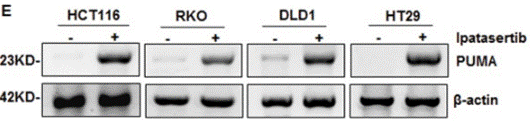
| Western blot | PUMA p-AKT / AKT / p-FoxO3a / FoxO3a / p-p65 / p65 Noxa / Bid / Bad / Bim / Bcl-2 / Bcl-xl / Mcl-1 cleaved-caspase3 p-PRAS40(T246) / PRAS40 / p-ERK / ERK / pFOXO1 / pFOXO3a / pGSK3b(S9) / pAS160(S318) / pBAD(S136) / pS6 / p4E-BP1 |
|
30185800 |
Klinische Studieninformationen
(Daten von https://clinicaltrials.gov, aktualisiert am 2024-05-22)
| NCT-Nummer | Rekrutierung | Erkrankungen | Sponsor/Kooperationspartner | Startdatum | Phasen |
|---|---|---|---|---|---|
| NCT01090960 | Completed | Solid Cancers |
Genentech Inc. |
March 2010 | Phase 1 |
Technischer Support
Tel: +1-832-582-8158 Ext:3
Wenn Sie weitere Fragen haben, hinterlassen Sie bitte eine Nachricht.

Produkte sind nur für Forschungszwecke bestimmt. Nicht für den menschlichen Gebrauch. Wir verkaufen nicht an Patienten.
©Copyright 2013 Selleck Chemicals. Alle Rechte vorbehalten.