
nur für Forschungszwecke
Ispinesib (SB-715992) Kinesin Inhibitor
Kat.-Nr.S1452
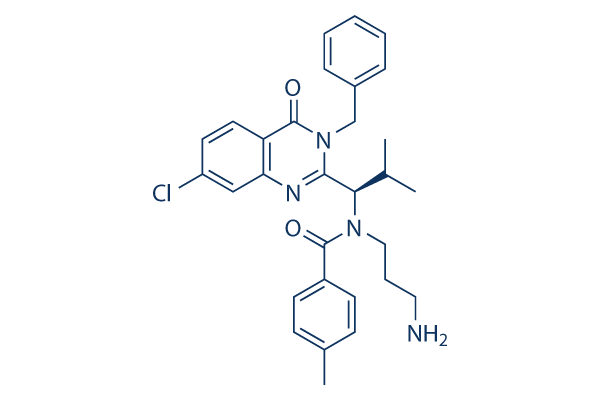
Chemische Struktur
Molekulargewicht: 517.06
Qualitätskontrolle
| Verwandte Ziele | Akt Wnt/beta-catenin PKC HSP ROCK Microtubule Associated Integrin Bcr-Abl Actin FAK |
|---|---|
| Weitere Kinesin Inhibitoren | GSK923295 SB743921 HCl Monastrol ARQ 621 K 858 BTB-1 VLS-1488(KIF18A-IN-6 ) H-Cys(Trt)-OH Filanesib hydrochloride GW406108X |
Zellkultur, Behandlung & Arbeitskonzentration
| Zelllinien | Assay-Typ | Konzentration | Inkubationszeit | Formulierung | Aktivitätsbeschreibung | PMID |
|---|---|---|---|---|---|---|
| HCT116 | Antiproliferative assay | 72 hrs | Antiproliferative activity against human HCT116 cells after 72 hrs by Alamar blue assay, GI50=0.025μM | 22248262 | ||
| hTERT-HME1 | Antiproliferative assay | 72 hrs | Antiproliferative activity against human hTERT-HME1 cells after 72 hrs by Alamar blue assay, GI50=0.032μM | 22248262 | ||
| K562 | Antiproliferative assay | 72 hrs | Antiproliferative activity against human K562 cells after 72 hrs by Alamar blue assay, GI50=0.071μM | 22248262 | ||
| BxPC3 | Antiproliferative assay | 72 hrs | Antiproliferative activity against human BxPC3 cells after 72 hrs by Alamar blue assay, GI50=0.08μM | 22248262 | ||
| NCI-H1299 | Antiproliferative assay | 72 hrs | Antiproliferative activity against human NCI-H1299 cells after 72 hrs by Alamar blue assay, GI50=0.082μM | 22248262 | ||
| LNCAP | Growth inhibition assay | 72 hrs | Growth inhibition of human LNCAP cells after 72 hrs by Alamar blue assay, GI50=0.022μM | 23394180 | ||
| HCT116 | Growth inhibition assay | 72 hrs | Growth inhibition of human HCT116 cells after 72 hrs by Alamar blue assay, GI50=0.025μM | 23394180 | ||
| PC3 | Growth inhibition assay | 72 hrs | Growth inhibition of human PC3 cells after 72 hrs by Alamar blue assay, GI50=0.05μM | 23394180 | ||
| BxPC3 | Growth inhibition assay | 72 hrs | Growth inhibition of human BxPC3 cells after 72 hrs by Alamar blue assay, GI50=0.08μM | 23394180 | ||
| NCI-H1299 | Growth inhibition assay | 72 hrs | Growth inhibition of human NCI-H1299 cells after 72 hrs by Alamar blue assay, GI50=0.082μM | 23394180 | ||
| LXFS 538 | Antitumor assay | 6 mg/kg | Antitumor activity against human LXFS 538 cells xenografted in NMRI nu/nu mouse assessed as tumor regression at 6 mg/kg, ip measured on day 13 | 23394180 | ||
| HeLa | Antiproliferative assay | 48 hrs | Antiproliferative activity against human HeLa cells after 48 hrs by MTT assay, IC50=1μM | 24184776 | ||
| MCF7 | Antiproliferative assay | 48 hrs | Antiproliferative activity against human MCF7 cells after 48 hrs by MTT assay, IC50=1.3μM | 24184776 | ||
| HCT116 | Growth inhibition assay | 72 hrs | Growth inhibition of human HCT116 cells after 72 hrs by MTS assay, IC50=0.0011μM | 26396688 | ||
| TC32 | qHTS assay | qHTS of pediatric cancer cell lines to identify multiple opportunities for drug repurposing: Primary screen for TC32 cells | 29435139 | |||
| DAOY | qHTS assay | qHTS of pediatric cancer cell lines to identify multiple opportunities for drug repurposing: Primary screen for DAOY cells | 29435139 | |||
| SJ-GBM2 | qHTS assay | qHTS of pediatric cancer cell lines to identify multiple opportunities for drug repurposing: Primary screen for SJ-GBM2 cells | 29435139 | |||
| A673 | qHTS assay | qHTS of pediatric cancer cell lines to identify multiple opportunities for drug repurposing: Primary screen for A673 cells | 29435139 | |||
| SK-N-MC | qHTS assay | qHTS of pediatric cancer cell lines to identify multiple opportunities for drug repurposing: Primary screen for SK-N-MC cells | 29435139 | |||
| NB-EBc1 | qHTS assay | qHTS of pediatric cancer cell lines to identify multiple opportunities for drug repurposing: Primary screen for NB-EBc1 cells | 29435139 | |||
| Saos-2 | qHTS assay | qHTS of pediatric cancer cell lines to identify multiple opportunities for drug repurposing: Primary screen for Saos-2 cells | 29435139 | |||
| LAN-5 | qHTS assay | qHTS of pediatric cancer cell lines to identify multiple opportunities for drug repurposing: Primary screen for LAN-5 cells | 29435139 | |||
| BT-12 | qHTS assay | qHTS of pediatric cancer cell lines to identify multiple opportunities for drug repurposing: Primary screen for BT-12 cells | 29435139 | |||
| OHS-50 | qHTS assay | qHTS of pediatric cancer cell lines to identify multiple opportunities for drug repurposing: Primary screen for OHS-50 cells | 29435139 | |||
| A673 | qHTS assay | qHTS of pediatric cancer cell lines to identify multiple opportunities for drug repurposing: Confirmatory screen for A673 cells) | 29435139 | |||
| SK-N-MC | qHTS assay | qHTS of pediatric cancer cell lines to identify multiple opportunities for drug repurposing: Confirmatory screen for SK-N-MC cells | 29435139 | |||
| BT-12 | qHTS assay | qHTS of pediatric cancer cell lines to identify multiple opportunities for drug repurposing: Confirmatory screen for BT-12 cells | 29435139 | |||
| DAOY | qHTS assay | qHTS of pediatric cancer cell lines to identify multiple opportunities for drug repurposing: Confirmatory screen for DAOY cells | 29435139 | |||
| BT-37 | qHTS assay | qHTS of pediatric cancer cell lines to identify multiple opportunities for drug repurposing: Confirmatory screen for BT-37 cells | 29435139 | |||
| TC32 | qHTS assay | qHTS of pediatric cancer cell lines to identify multiple opportunities for drug repurposing: Confirmatory screen for TC32 cells | 29435139 | |||
| MG 63 (6-TG R) | qHTS assay | qHTS of pediatric cancer cell lines to identify multiple opportunities for drug repurposing: Confirmatory screen for MG 63 (6-TG R) cells | 29435139 | |||
| U-2 OS | qHTS assay | qHTS of pediatric cancer cell lines to identify multiple opportunities for drug repurposing: Confirmatory screen for U-2 OS cells | 29435139 | |||
| Rh41 | qHTS assay | qHTS of pediatric cancer cell lines to identify multiple opportunities for drug repurposing: Confirmatory screen for Rh41 cells | 29435139 | |||
| RD | qHTS assay | qHTS of pediatric cancer cell lines to identify multiple opportunities for drug repurposing: Confirmatory screen for RD cells | 29435139 | |||
| Rh30 | qHTS assay | qHTS of pediatric cancer cell lines to identify multiple opportunities for drug repurposing: Confirmatory screen for Rh30 cells | 29435139 | |||
| Saos-2 | qHTS assay | qHTS of pediatric cancer cell lines to identify multiple opportunities for drug repurposing: Confirmatory screen for Saos-2 cells | 29435139 | |||
| SK-N-SH | qHTS assay | qHTS of pediatric cancer cell lines to identify multiple opportunities for drug repurposing: Confirmatory screen for SK-N-SH cells | 29435139 | |||
| Klicken Sie hier, um weitere experimentelle Daten zu Zelllinien anzuzeigen | ||||||
Chemische Informationen, Lagerung & Stabilität
| Molekulargewicht | 517.06 | Formel | C30H33ClN4O2 |
Lagerung (Ab dem Eingangsdatum) | |
|---|---|---|---|---|---|
| CAS-Nr. | 336113-53-2 | SDF herunterladen | Lagerung von Stammlösungen |
|
|
| Synonyme | CK0238273 | Smiles | CC1=CC=C(C=C1)C(=O)N(CCCN)C(C2=NC3=C(C=CC(=C3)Cl)C(=O)N2CC4=CC=CC=C4)C(C)C | ||
Löslichkeit
|
In vitro |
DMSO
: 103 mg/mL
(199.2 mM)
Ethanol : 103 mg/mL Water : Insoluble |
Molaritätsrechner
|
In vivo |
|||||
In-vivo-Formulierungsrechner (Klare Lösung)
Schritt 1: Geben Sie die untenstehenden Informationen ein (Empfohlen: Ein zusätzliches Tier zur Berücksichtigung von Verlusten während des Experiments)
Schritt 2: Geben Sie die In-vivo-Formulierung ein (Dies ist nur der Rechner, keine Formulierung. Bitte kontaktieren Sie uns zuerst, wenn es im Abschnitt "Löslichkeit" keine In-vivo-Formulierung gibt.)
Berechnungsergebnisse:
Arbeitskonzentration: mg/ml;
Methode zur Herstellung der DMSO-Stammlösung: mg Wirkstoff vorgelöst in μL DMSO ( Konzentration der Stammlösung mg/mL, Bitte kontaktieren Sie uns zuerst, wenn die Konzentration die DMSO-Löslichkeit der Wirkstoffcharge überschreitet. )
Methode zur Herstellung der In-vivo-Formulierung: Nehmen Sie μL DMSO Stammlösung, dann hinzufügenμL PEG300, mischen und klären, dann hinzufügenμL Tween 80, mischen und klären, dann hinzufügen μL ddH2O, mischen und klären.
Methode zur Herstellung der In-vivo-Formulierung: Nehmen Sie μL DMSO Stammlösung, dann hinzufügen μL Maisöl, mischen und klären.
Hinweis: 1. Bitte stellen Sie sicher, dass die Flüssigkeit klar ist, bevor Sie das nächste Lösungsmittel hinzufügen.
2. Achten Sie darauf, das/die Lösungsmittel der Reihe nach hinzuzufügen. Sie müssen sicherstellen, dass die bei der vorherigen Zugabe erhaltene Lösung eine klare Lösung ist, bevor Sie mit der Zugabe des nächsten Lösungsmittels fortfahren. Physikalische Methoden wie Vortex, Ultraschall oder ein heißes Wasserbad können zur Unterstützung des Lösens verwendet werden.
Wirkmechanismus
| Merkmale |
An allosteric, potent, specific, and reversible inhibitor of the mitotic kinesin spindle protein (KSP) (HsEg5).
|
|---|---|
| Targets/IC50/Ki |
KSP (HsEg5)
(Cell-free assay) 1.7 nM(Ki app)
|
| In vitro |
Ispinesib (SB-715992) ist ein potenter, allosterischer, reversibler und spezifischer Inhibitor von KSP, der die Bindungseigenschaft von KSP an Mikrotubuli verändert und deren Bewegung stört, indem er die ADP-Freisetzung hemmt, ohne die Freisetzung des KSP-ADP-Komplexes aus den Mikrotubuli zu verändern. Diese Verbindung zeigt potente zytotoxische Aktivität in einer Reihe von Tumorzelllinien, einschließlich Colo205, Colo201, HT-29, M5076, Madison-109 und MX-1, mit IC50-Werten von 1,2 nM bis 9,5 nM. In PC-3-Prostatakrebszellen blockiert es (15 nM und 30 nM) die Zellproliferation und induziert Apoptose durch die Regulierung der Expressionsniveaus von Genen, die Apoptose, Zellproliferation, Zellzyklus und Zellsignalisierung steuern, wie EGFR, p27, p15 und IL-11. In einer Reihe von 53 Brustzelllinien zeigt Ispinesib (7,4 nM–600 nM) eine breite hemmende Aktivität. In BT-474- und MDA-MB-468-Zellen induziert es (150 nM) Apoptose, wie durch einen höheren Anteil apoptotischer Zellen, einen niedrigeren antiapoptotischen Bcl-XL-Spiegel und höhere proapoptotische Bax- und Bid-Spiegel offenbart wird. |
| Kinase-Assay |
Kinetische Analyse der ATPase-Aktivität von humanem KSP im Steady-State und Hemmung durch Ispinesib
|
|
Die Kinesin-Spezifitätsanalyse wird unter Verwendung eines Pyruvatkinase-Laktatdehydrogenase-Nachweissystems durchgeführt, das die Produktion von ADP mit der Oxidation von NADH koppelt. Änderungen der Absorption werden bei 340 nm überwacht. Steady-State-Studien mit nanomolaren Konzentrationen von KSP werden unter Verwendung eines empfindlichen fluoreszenzbasierten Assays durchgeführt, der ein Pyruvatkinase-, Pyruvatoxidase- und Meerrettichperoxidase (HRP)-gekoppeltes Nachweissystem nutzt, das die Generierung von ADP mit der Oxidation von Amplex Red zu fluoreszierendem Resorufin koppelt. Die Generierung von Resorufin wird durch Fluoreszenz überwacht (λAnregung = 520 nm und λEmission = 580 nm). Biochemische Steady-State-Experimente werden in PEM25-Puffer [25 mM Pipes-K+ (pH 6,8), 2 mM MgCl2, 1 mM EGTA] für Experimente mit Mikrotubuli durchgeführt. Der IC50 für die Steady-State-Hemmung wird bei 500 µM ATP, 5 µM Mikrotubuli und 1 nM KSP in PEM25-Puffer bestimmt. Ki app (scheinbare Inhibitor-Dissoziationskonstante)-Werte von Ispinesib (SB-715992) werden aus den Dosis-Wirkungs-Kurven extrahiert, mit expliziter Korrektur für die Enzymkonzentration unter Verwendung der Morrison-Gleichung. Die Inhibitor-Modalität (z. B. kompetitiv, nicht-kompetitiv, unkompetitiv oder gemischt) unter Steady-State-Bedingungen wird durch Messung des Effekts seiner Konzentration auf die Anfangsgeschwindigkeit als Funktion der Substratkonzentrationen bestimmt. Die Daten werden unter Verwendung von Gleichungen in GraFit an Geschwindigkeitsgleichungen für die verschiedenen Hemmungsmodi angepasst.
|
|
| In vivo |
Ispinesib (SB-715992) (4,5 mg/kg–15 mg/kg) zeigt hemmende Wirkungen gegen Colo205, Colo201, HT-29, aber nicht gegen MX-1-Zellen in Maus-Xenograft-Modellen. Diese Verbindung (6 mg/kg–10 mg/kg) hemmt auch murine solide Tumoren, einschließlich Madison 109 Lungenkarzinom, M5076-Sarkom sowie L1210- und P388-Leukämien. In Maus-Xenograft-Modellen von Brustkrebszellen MCF-7, HCC1954, MDA-MB-468 und KPL4 hemmt es (8 mg/kg–10 mg/kg) das Tumorwachstum. |
Literatur |
|
Klinische Studieninformationen
(Daten von https://clinicaltrials.gov, aktualisiert am 2024-05-22)
| NCT-Nummer | Rekrutierung | Erkrankungen | Sponsor/Kooperationspartner | Startdatum | Phasen |
|---|---|---|---|---|---|
| NCT00607841 | Terminated | Breast Neoplasms |
Cytokinetics |
December 2007 | Phase 1 |
| NCT00354250 | Completed | Recurrent Renal Cell Cancer|Stage III Renal Cell Cancer|Stage IV Renal Cell Cancer |
National Cancer Institute (NCI) |
May 2006 | Phase 2 |
| NCT00097409 | Completed | Ovarian Cancer |
GlaxoSmithKline |
December 2004 | Phase 2 |
| NCT00119171 | Completed | Solid Tumor Cancer |
GlaxoSmithKline |
November 2004 | Phase 1 |
Technischer Support
Tel: +1-832-582-8158 Ext:3
Wenn Sie weitere Fragen haben, hinterlassen Sie bitte eine Nachricht.

Produkte sind nur für Forschungszwecke bestimmt. Nicht für den menschlichen Gebrauch. Wir verkaufen nicht an Patienten.
©Copyright 2013 Selleck Chemicals. Alle Rechte vorbehalten.