
nur für Forschungszwecke
Kaempferol Estrogen/progestogen Receptor Modulator
Kat.-Nr.S2314
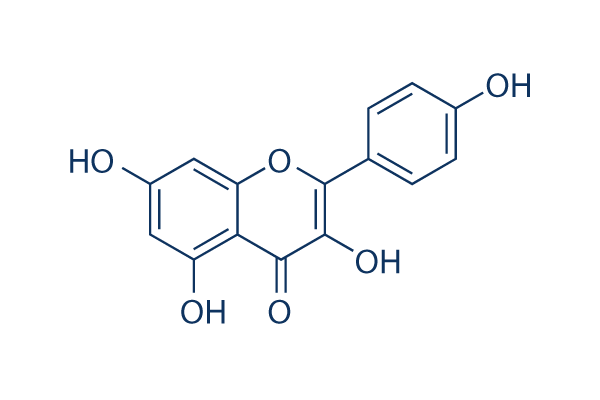
Chemische Struktur
Molekulargewicht: 286.23
Qualitätskontrolle
| Verwandte Ziele | Adrenergic Receptor GPR Androgen Receptor Glucocorticoid Receptor ACE RAAS Progesterone Receptor Opioid Receptor PGES THR |
|---|---|
| Weitere Estrogen/progestogen Receptor Inhibitoren | Elacestrant (RAD1901) Dihydrochloride Vepdegestrant (ARV-471) MPP dihydrochloride Cholesterol G15 Endoxifen HCl Licochalcone A Chrysin Pregnenolone AZD9496 |
Zellkultur, Behandlung & Arbeitskonzentration
| Zelllinien | Assay-Typ | Konzentration | Inkubationszeit | Formulierung | Aktivitätsbeschreibung | PMID |
|---|---|---|---|---|---|---|
| HEK293 FS cells | Function assay | Inhibition of NOX4 expressed in HEK293 FS cells assessed as H2O2 production by H2O2/Tyr/LPO assay, IC50=1.2 μM | ||||
| human HeLa cells | Function assay | Inhibition of MRP1 transfected in human HeLa cells assessed as inhibition of [3H]LTC4 transport by rapid filtration assay, Ki=2.4 μM | ||||
| human MV4-11 cells | Cytotoxicity assay | 72 h | Cytotoxicity against human MV4-11 cells harboring FLT3 mutation after 72 hrs by tetrazolium based Ez CyTox cell viability assay, GI50=3.34 μM | |||
| MDCK cells | Function assay | Inhibition of BCRP expressed in MDCK cells using Hoechst 33342 staining, IC50=4.7 μM | ||||
| human MDA-kb2 cells | Function assay | Antagonist activity at androgen receptor in human MDA-kb2 cells assessed as inhibition of DHT-induced luciferase activity by luciferase reporter gene assay, IC50=9.7 μM | ||||
| B16-4A5 cells | Function assay | Inhibition of melanogenesis in theophylline-stimulated mouse B16-4A5 cells after 72 hrs, IC50=20 μM | ||||
| human HL60 cells | Cytotoxicity assay | Cytotoxicity against human HL60 cells assessed as cell survival at 50 uM after 72 hrs by CCK8 assay | ||||
| mouse 3T3L1 cells | Function assay | Inhibition of AMPK-mediated adipocyte differentiation in mouse 3T3L1 cells | ||||
| mouse RAW264.7 cells | Function assay | Antiinflammatory activity in LPS-stimulated mouse RAW264.7 cells assessed as nitrite level at 1 to 100 uM after 24 hrs by Griess method | ||||
| mouse L929 cells | Function assay | Inhibition of recombinant human TNF-alpha-induced cytotoxicity of mouse L929 cells assessed as survivality treated with drug after 2 hrs of TNFalpha treatment | ||||
| human U87 cells | Cytotoxicity assay | 5-40 μM | 72 h | Cytotoxicity against human U87 cells assessed as reduction in cell viability at 5 to 40 uM after 72 hrs by MTT assay | ||
| human A549 cells | Cytotoxicity assay | 5-40 μM | 72 h | Cytotoxicity against human A549 cells assessed as reduction in cell viability at 5 to 40 uM after 72 hrs by MTT assay | ||
| human MCF7 cells | Cytotoxicity assay | 5-40 μM | 72 h | Cytotoxicity against human MCF7 cells assessed as reduction in cell viability at 5 to 40 uM after 72 hrs by MTT assay | ||
| MDA-MB-231 cells | Cytotoxicity assay | 5-40 μM | 72 h | Cytotoxicity against human MDA-MB-231 cells assessed as reduction in cell viability at 5 to 40 uM after 72 hrs by MTT assay | ||
| MDCK cells | Function assay | 50 μM | Antiviral activity against influenza A virus H1N1 A/PR/8/34 infected in MDCK cells assessed as reduction in fluorescence positive cells at 50 uM immunofluorescence assay | |||
| human NCI-H2126 cells | Cytotoxicity assay | 5-40 μM | 72 h | Cytotoxicity against human NCI-H2126 cells assessed as reduction in cell viability at 5 to 40 uM after 72 hrs by MTT assay | ||
| human SMMC7721 cells | Cytotoxicity assay | 5-40 μM | 72 h | Cytotoxicity against human SMMC7721 cells assessed as reduction in cell viability at 5 to 40 uM after 72 hrs by MTT assay | ||
| human PANC1 cells | Cytotoxicity assay | 5-40 μM | 72 h | Cytotoxicity against human PANC1 cells assessed as reduction in cell viability at 5 to 40 uM after 72 hrs by MTT assay | ||
| human BxPC3 cells | Cytotoxicity assay | 5-40 μM | 72 h | Cytotoxicity against human BxPC3 cells assessed as reduction in cell viability at 5 to 40 uM after 72 hrs by MTT assay | ||
| Klicken Sie hier, um weitere experimentelle Daten zu Zelllinien anzuzeigen | ||||||
Chemische Informationen, Lagerung & Stabilität
| Molekulargewicht | 286.23 | Formel | C15H10O6 |
Lagerung (Ab dem Eingangsdatum) | |
|---|---|---|---|---|---|
| CAS-Nr. | 520-18-3 | SDF herunterladen | Lagerung von Stammlösungen |
|
|
Löslichkeit
|
In vitro |
Ethanol : 28 mg/mL
DMSO
: 27 mg/mL
(94.32 mM)
Water : Insoluble |
Molaritätsrechner
|
In vivo |
|||||
In-vivo-Formulierungsrechner (Klare Lösung)
Schritt 1: Geben Sie die untenstehenden Informationen ein (Empfohlen: Ein zusätzliches Tier zur Berücksichtigung von Verlusten während des Experiments)
Schritt 2: Geben Sie die In-vivo-Formulierung ein (Dies ist nur der Rechner, keine Formulierung. Bitte kontaktieren Sie uns zuerst, wenn es im Abschnitt "Löslichkeit" keine In-vivo-Formulierung gibt.)
Berechnungsergebnisse:
Arbeitskonzentration: mg/ml;
Methode zur Herstellung der DMSO-Stammlösung: mg Wirkstoff vorgelöst in μL DMSO ( Konzentration der Stammlösung mg/mL, Bitte kontaktieren Sie uns zuerst, wenn die Konzentration die DMSO-Löslichkeit der Wirkstoffcharge überschreitet. )
Methode zur Herstellung der In-vivo-Formulierung: Nehmen Sie μL DMSO Stammlösung, dann hinzufügenμL PEG300, mischen und klären, dann hinzufügenμL Tween 80, mischen und klären, dann hinzufügen μL ddH2O, mischen und klären.
Methode zur Herstellung der In-vivo-Formulierung: Nehmen Sie μL DMSO Stammlösung, dann hinzufügen μL Maisöl, mischen und klären.
Hinweis: 1. Bitte stellen Sie sicher, dass die Flüssigkeit klar ist, bevor Sie das nächste Lösungsmittel hinzufügen.
2. Achten Sie darauf, das/die Lösungsmittel der Reihe nach hinzuzufügen. Sie müssen sicherstellen, dass die bei der vorherigen Zugabe erhaltene Lösung eine klare Lösung ist, bevor Sie mit der Zugabe des nächsten Lösungsmittels fortfahren. Physikalische Methoden wie Vortex, Ultraschall oder ein heißes Wasserbad können zur Unterstützung des Lösens verwendet werden.
Wirkmechanismus
| Targets/IC50/Ki |
ERRα
ERRγ
Topo I
fatty acid synthase
|
Literatur |
|
|---|
Klinische Studieninformationen
(Daten von https://clinicaltrials.gov, aktualisiert am 2024-05-22)
| NCT-Nummer | Rekrutierung | Erkrankungen | Sponsor/Kooperationspartner | Startdatum | Phasen |
|---|---|---|---|---|---|
| NCT05073523 | Completed | Healthy |
Chalmers University of Technology |
September 27 2021 | Not Applicable |
Technischer Support
Tel: +1-832-582-8158 Ext:3
Wenn Sie weitere Fragen haben, hinterlassen Sie bitte eine Nachricht.

Produkte sind nur für Forschungszwecke bestimmt. Nicht für den menschlichen Gebrauch. Wir verkaufen nicht an Patienten.
©Copyright 2013 Selleck Chemicals. Alle Rechte vorbehalten.