
nur für Forschungszwecke
Torkinib (PP242) mTOR Inhibitor
Kat.-Nr.S2218
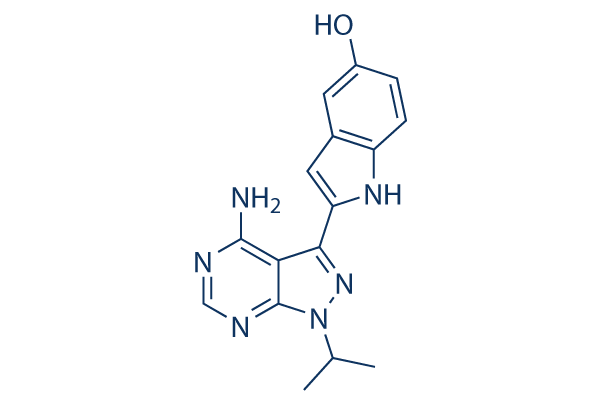
Chemische Struktur
Molekulargewicht: 308.34
Qualitätskontrolle
| Verwandte Ziele | PI3K Akt GSK-3 ATM/ATR DNA-PK AMPK PDPK1 PTEN PP2A PDK |
|---|---|
| Weitere mTOR Inhibitoren | Torin 1 Torin 2 AZD8055 Ridaforolimus (Deforolimus, MK-8669) Sapanisertib (MLN0128, INK-128) MHY1485 Vistusertib (AZD2014) KU-0063794 OSI-027 WYE-354 |
Zellkultur, Behandlung & Arbeitskonzentration
| Zelllinien | Assay-Typ | Konzentration | Inkubationszeit | Formulierung | Aktivitätsbeschreibung | PMID |
|---|---|---|---|---|---|---|
| HT-p21 | Function Assay | 50-1250 nM | 24 h | DMSO | inhibits phosphorylation of S6 kinase (target of mTORC1) and its downstream target phospho-S6 | |
| U87vIII | Function Assay | 0.04-2.5 μM | 24 h | inhibits mTORC1 and mTORC2 activities | ||
| U87vIII | Function Assay | 2.5/5 μM | 12 h | inhibits gap closing in a dose-dependent manner | ||
| PC12 | Function Assay | 40 nM | induces lysosomal biogenesis and alleviated α-SYN accumulation | |||
| 3T3-L1 | Function Assay | 15 μM | 4 h | suppresses expression of the Egr1 protein | ||
| Rh30 | Function Assay | 1 μM | 2 h | inhibits both mTORC1-mediated phosphorylation of S6K1 and mTORC2-mediated phosphorylation of Akt | ||
| HT29 | Function Assay | 1 μM | 2 h | inhibits both mTORC1-mediated phosphorylation of S6K1 and mTORC2-mediated phosphorylation of Akt | ||
| Rh30 | Function Assay | 1 μM | 2 h | suppresses the basal or IGF-1-stimulated cell adhesion | ||
| HT29 | Function Assay | 1 μM | 2 h | suppresses the basal or IGF-1-stimulated cell adhesion | ||
| U87 | Growth Inhibition Assay | 25 nM | 24 h | increases DUSP10 knocked-down induced cell inhibition | ||
| AGS | Cell Viability Assay | 0-1000 nM | 24/48 h | DMSO | decreases cell viability in time and dose dependent manner | |
| MKN45 | Cell Viability Assay | 0-1000 nM | 24/48 h | DMSO | decreases cell viability in time and dose dependent manner | |
| MKN28 | Cell Viability Assay | 0-1000 nM | 24/48 h | DMSO | decreases cell viability in time and dose dependent manner | |
| KATO3 | Cell Viability Assay | 0-1000 nM | 24/48 h | DMSO | decreases cell viability in time and dose dependent manner | |
| SGC7901 | Cell Viability Assay | 0-1000 nM | 24/48 h | DMSO | decreases cell viability in time and dose dependent manner | |
| N87 | Cell Viability Assay | 0-1000 nM | 24/48 h | DMSO | decreases cell viability in time and dose dependent manner | |
| HMEC | Cell Viability Assay | 0-1000 nM | 24/48 h | DMSO | decreases cell viability in time and dose dependent manner | |
| HUVEC | Cell Viability Assay | 0-1000 nM | 24/48 h | DMSO | decreases cell viability in time and dose dependent manner | |
| MG63 | Function Assay | 50-1000 nM | 0.5 h | dose dependently (50–1000 nM) inhibits phosphorylation of Akt | ||
| U2OS | Function Assay | 50-1000 nM | 0.5 h | dose dependently (50–1000 nM) inhibits phosphorylation of Akt | ||
| Saos-2 | Function Assay | 50-1000 nM | 0.5 h | dose dependently (50–1000 nM) inhibits phosphorylation of Akt | ||
| Saos-2 | Function Assay | 100 nM | 0.5 h | prevents osteosarcoma cell migration | ||
| MG63 | Apoptosis Assay | 100 nM | 36 h | promotes apoptosis | ||
| U2OS | Apoptosis Assay | 100 nM | 36 h | promotes apoptosis | ||
| Saos-2 | Apoptosis Assay | 100 nM | 36 h | promotes apoptosis | ||
| HT1376 | Growth Inhibition Assay | IC50=1.88 ± 1.1 μM | ||||
| T24 | Growth Inhibition Assay | IC50=1.37 ± 0.4 μM | ||||
| UM-UC-3 | Growth Inhibition Assay | IC50=0.63 ±0.1 μM | ||||
| DLD-1 | Cell Viability Assay | 0-1000 nM | 24 h | inhibits the growth in a dose-dependent manner | ||
| Caco2 | Cell Viability Assay | 0-1000 nM | 24 h | inhibits the growth in a dose-dependent manner | ||
| HT29 | Cell Viability Assay | 0-1000 nM | 24 h | inhibits the growth in a dose-dependent manner | ||
| H116 | Cell Viability Assay | 0-1000 nM | 24 h | inhibits the growth in a dose-dependent manner | ||
| Hct-8 | Cell Viability Assay | 0-1000 nM | 24 h | inhibits the growth in a dose-dependent manner | ||
| Colo320 | Cell Viability Assay | 0-1000 nM | 24 h | inhibits the growth in a dose-dependent manner | ||
| Sw948 | Cell Viability Assay | 0-1000 nM | 24 h | inhibits the growth in a dose-dependent manner | ||
| Colo205 | Cell Viability Assay | 0-1000 nM | 24 h | inhibits the growth in a dose-dependent manner | ||
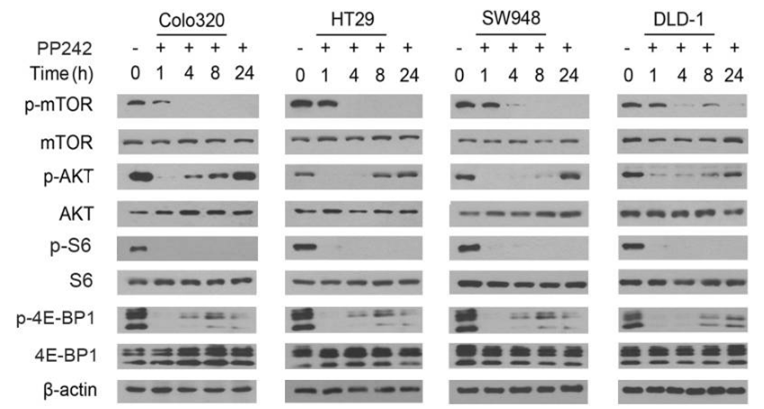
| Colo320 | Function Assay | 1 μM | 0-24 h | abolishes the S6S235/236 but partially reduces the 4E-BP1T36/45 | ||
| HT29 | Function Assay | 1 μM | 0-24 h | abolishes the S6S235/236 but partially reduces the 4E-BP1T36/45 | ||
| Sw948 | Function Assay | 1 μM | 0-24 h | abolishes the S6S235/236 but partially reduces the 4E-BP1T36/45 | ||
| DLD-1 | Function Assay | 1 μM | 0-24 h | abolishes the S6S235/236 but partially reduces the 4E-BP1T36/45 | ||
| SW620 | Growth Inhibition Assay | IC50=7.8 μM | ||||
| SW480 | Growth Inhibition Assay | IC50=4.6 μM | ||||
| SK-CO-1 | Growth Inhibition Assay | IC50=4 μM | ||||
| LS-513 | Growth Inhibition Assay | IC50=3.9 μM | ||||
| SW1116 | Growth Inhibition Assay | IC50=0.84 μM | ||||
| LS-174T | Growth Inhibition Assay | IC50=0.84 μM | ||||
| HCT 116 | Growth Inhibition Assay | IC50=0.41 μM | ||||
| HCT 15 | Growth Inhibition Assay | IC50=0.3 μM | ||||
| COLO 205 | Growth Inhibition Assay | IC50=0.24 μM | ||||
| HT-29 | Growth Inhibition Assay | IC50=0.23 μM | ||||
| COLO 201 | Growth Inhibition Assay | IC50=0.23 μM | ||||
| Caco-2 | Growth Inhibition Assay | IC50=0.22 μM | ||||
| SW48 | Growth Inhibition Assay | IC50=0.09 μM | ||||
| DND-1 | Growth Inhibition Assay | 0.25/0.5/1 μM | DMSO | inhibits cell growth dose dependently | ||
| TMD8 | Growth Inhibition Assay | 0.25/0.5/1 μM | DMSO | inhibits cell growth dose dependently | ||
| Jurkat | Growth Inhibition Assay | 0.25/0.5/1 μM | DMSO | inhibits cell growth dose dependently | ||
| KOPT-K1 | Growth Inhibition Assay | 0.25/0.5/1 μM | DMSO | inhibits cell growth dose dependently | ||
| TMD7 | Growth Inhibition Assay | 0.25/0.5/1 μM | DMSO | inhibits cell growth dose dependently | ||
| THP-1 | Growth Inhibition Assay | 0.25/0.5/1 μM | DMSO | inhibits cell growth dose dependently | ||
| 786-O | Function Assay | 0.1/0.5 μM | 24 h | DMSO | increases E-cadherin mRNA levels dose dependently | |
| 786-O | Function Assay | 0-0.5 μM | 24 h | DMSO | results in a dose dependent increase in E-cadherin protein expression | |
| OCI-AML3 | Apoptosis Assay | 2.5 μM | 72 h | induces apoptosis | ||
| Jurkat | Function Assay | 100/200/400 nM | 18 h | inhibits mTORC1-dependent S6 S235/236 phosphorylation | ||
| p210 BCR-Abl | Function Assay | 100/200/400 nM | 18 h | inhibits mTORC1-dependent S6 S235/236 phosphorylation | ||
| Jurkat | Growth Inhibition Assay | 400nM | 24/48 h | synergize with 17-AAG to suppress cell proliferation | ||
| p210 BCR-Abl | Growth Inhibition Assay | 400nM | 24/48 h | synergize with 17-AAG to suppress cell proliferation | ||
| 8226 | Function Assay | 100-1000 nM | 30 min | DMSO | activates ERK | |
| MM1.S | Function Assay | 100-1000 nM | 30 min | DMSO | activates ERK | |
| 8226 | Function Assay | 0.5 μM | 30 min | DMSO | induces activation of RAF and phosphorylation of MEK | |
| MM1.S | Function Assay | 0.5 μM | 30 min | DMSO | induces activation of RAF and phosphorylation of MEK | |
| MCF-7 | Function Assay | 50/200/500 nM | 30 min | dose-dependently (50–500 nM) suppresses phosphorylation of Akt | ||
| T47D | Function Assay | 50/200/500 nM | 30 min | dose-dependently (50–500 nM) suppresses phosphorylation of Akt | ||
| MDA-MB-231 | Function Assay | 50/200/500 nM | 30 min | dose-dependently (50–500 nM) suppresses phosphorylation of Akt | ||
| Bcap-37 | Function Assay | 50/200/500 nM | 30 min | dose-dependently (50–500 nM) suppresses phosphorylation of Akt | ||
| MCF-7 | Apoptosis Assay | 200 nM | 36 h | DMSO | induces apoptosis | |
| MDA-MB-231 | Apoptosis Assay | 200 nM | 36 h | DMSO | induces apoptosis | |
| Bcap-37 | Apoptosis Assay | 200 nM | 36 h | DMSO | induces apoptosis | |
| LS174T | Function Assay | 10/100/1000 nM | 6 h | DMSO | inhibits mTORC1 activity by the dephosphorylation of S6 ribosomal protein | |
| DLD-1 | Function Assay | 10/100/1000 nM | 6 h | DMSO | inhibits mTORC1 activity by the dephosphorylation of S6 ribosomal protein | |
| SW480 | Function Assay | 10/100/1000 nM | 6 h | DMSO | inhibits mTORC1 activity by the dephosphorylation of S6 ribosomal protein | |
| SW-48 | Growth Inhibition Assay | IC50=0.1 μM | ||||
| HCT-15 | Growth Inhibition Assay | IC50=0.3 μM | ||||
| HCT 116 | Growth Inhibition Assay | IC50=0.6 μM | ||||
| SW620-R | Growth Inhibition Assay | IC50=1.3 μM | ||||
| SK-CO-1 | Growth Inhibition Assay | IC50=2.1 μM | ||||
| SW620 | Growth Inhibition Assay | IC50=11 μM | ||||
| BaF3 | Growth Inhibition Assay | GI50=1.449 μM | ||||
| NIH 3T3 | Function Assay | 2 μM | 18 h | inhibits mTORC2 phosphorylation of Akt on Ser473 and mTORC1 phosphorylation of 4E-BP1 on Thr37/46 | ||
| HCT15 | Function Assay | 0.5/2 μM | 4 h | prevents S6K1 phosphorylation of ribosomal protein S6 at Ser240/244 and mTORC2 phosphorylation of Akt at Ser473 | ||
| SW620 | Function Assay | 0.5/2 μM | 4 h | blocks all three mTOR outputs | ||
| Klicken Sie hier, um weitere experimentelle Daten zu Zelllinien anzuzeigen | ||||||
Chemische Informationen, Lagerung & Stabilität
| Molekulargewicht | 308.34 | Formel | C16H16N6O |
Lagerung (Ab dem Eingangsdatum) | |
|---|---|---|---|---|---|
| CAS-Nr. | 1092351-67-1 | SDF herunterladen | Lagerung von Stammlösungen |
|
|
| Synonyme | N/A | Smiles | CC(C)N1C2=NC=NC(=C2C(=N1)C3=CC4=C(N3)C=CC(=C4)O)N | ||
Löslichkeit
|
In vitro |
DMSO
: 61 mg/mL
(197.83 mM)
Water : Insoluble Ethanol : Insoluble |
Molaritätsrechner
|
In vivo |
|||||
In-vivo-Formulierungsrechner (Klare Lösung)
Schritt 1: Geben Sie die untenstehenden Informationen ein (Empfohlen: Ein zusätzliches Tier zur Berücksichtigung von Verlusten während des Experiments)
Schritt 2: Geben Sie die In-vivo-Formulierung ein (Dies ist nur der Rechner, keine Formulierung. Bitte kontaktieren Sie uns zuerst, wenn es im Abschnitt "Löslichkeit" keine In-vivo-Formulierung gibt.)
Berechnungsergebnisse:
Arbeitskonzentration: mg/ml;
Methode zur Herstellung der DMSO-Stammlösung: mg Wirkstoff vorgelöst in μL DMSO ( Konzentration der Stammlösung mg/mL, Bitte kontaktieren Sie uns zuerst, wenn die Konzentration die DMSO-Löslichkeit der Wirkstoffcharge überschreitet. )
Methode zur Herstellung der In-vivo-Formulierung: Nehmen Sie μL DMSO Stammlösung, dann hinzufügenμL PEG300, mischen und klären, dann hinzufügenμL Tween 80, mischen und klären, dann hinzufügen μL ddH2O, mischen und klären.
Methode zur Herstellung der In-vivo-Formulierung: Nehmen Sie μL DMSO Stammlösung, dann hinzufügen μL Maisöl, mischen und klären.
Hinweis: 1. Bitte stellen Sie sicher, dass die Flüssigkeit klar ist, bevor Sie das nächste Lösungsmittel hinzufügen.
2. Achten Sie darauf, das/die Lösungsmittel der Reihe nach hinzuzufügen. Sie müssen sicherstellen, dass die bei der vorherigen Zugabe erhaltene Lösung eine klare Lösung ist, bevor Sie mit der Zugabe des nächsten Lösungsmittels fortfahren. Physikalische Methoden wie Vortex, Ultraschall oder ein heißes Wasserbad können zur Unterstützung des Lösens verwendet werden.
Wirkmechanismus
| Merkmale |
One of the first selective inhibitors that targets ATP domain of mTOR.
|
|---|---|
| Targets/IC50/Ki |
mTOR
(Cell-free assay) 8 nM
p110δ
(Cell-free assay) 0.10 μM
DNA-PK
(Cell-free assay) 0.41 μM
PDGFR
(Cell-free assay) 0.41 μM
|
| In vitro |
PP242 zeigt eine starke Selektivität für mTOR gegenüber anderen PI3K-Familienkinasen wie p110α, p110β, p110γ, p110δ und DNA-PK mit IC50-Werten von 1,96 μM, 2,2 μM, 1,27 μM, 0,102 μM bzw. 0,408 μM. Diese Verbindung zeigt eine gewisse hemmende Aktivität gegen Ret, PKCα, PKCβ und JAK2, während sie eine bemerkenswerte Selektivität gegen 215 andere Proteinkinasen aufweist. Im Gegensatz zu Rapamycin hemmt dieser Inhibitor sowohl mTORC1 als auch mTORC2. In BT549-Zellen hemmt diese chemische Behandlung (0,04-10 μM) die Phosphorylierung von Akt, dem mTOR-Substrat p70S6K und seinem nachgeschalteten Ziel S6 dosisabhängig. Es hemmt PKCα stark mit einem IC50-Wert von 49 nM. Niedrige Konzentrationen dieser Verbindung hemmen die Phosphorylierung von Akt S473 und höhere Konzentrationen hemmen teilweise Akt T308-P zusätzlich zu S473-P. Da dieses Mittel ein wirksamerer mTORC1-Inhibitor als Rapamycin ist, hemmt es die Proliferation primärer MEFs und die Phosphorylierung von 4EBP1 an T36/45 und S65 wirksamer als Rapamycin. Diese Verbindung, aber nicht Rapamycin, hemmt die cap-abhängige Translation stark, indem sie eine höhere Bindung zwischen 4EBP1 und eIF4E verursacht als Rapamycin. Es hemmt stark die Proliferation von p190-transformierten murinen BM-, SUP-B15- und K562-Zellen mit GI50-Werten von 12 nM, 90 nM bzw. 85 nM. Dieser Inhibitor hemmt auch das Wachstum solider Tumorzelllinien wie SKOV3, PC3, 786-O und U87 mit GI50-Werten von 0,49 μM, 0,19 μM, 2,13 μM bzw. 1,57 μM. Es ist auch wirksamer als Rapamycin bei der Zytoreduktion und Apoptose in multiplen Myelom (MM)-Zellen.
|
| Kinase-Assay |
In vitro mTOR (FRAP1) Kinase-Assay
|
|
Rekombinantes mTOR wird mit dieser Verbindung in 2-fachen Verdünnungen über einen Konzentrationsbereich von 50-0,001 μM in einem Assay inkubiert, der 50 mM HEPES, pH 7,5, 1 mM EGTA, 10 mM MgCl2, 0,01% Tween, 10 μM ATP (2,5 μCi γ-32P-ATP) und 3 μg/mL BSA enthält. Rekombinantes Ratten-PHAS-1/4EBP1 (2 mg/mL) wird als Substrat verwendet. Die Reaktionen werden durch Auftropfen auf Nitrozellulose beendet, die mit 1 M NaCl/1% Phosphorsäure gewaschen wird (etwa 6 Mal, jeweils 5-10 Minuten). Die Blätter werden getrocknet und die übertragene Radioaktivität durch Phosphorimaging quantifiziert. Der IC50-Wert wird durch Anpassung der Daten an eine sigmoide Dosis-Wirkungs-Kurve mit dem Prism-Softwarepaket berechnet.
|
|
| In vivo |
Die Verabreichung von PP242 ist in der Lage, die Phosphorylierung von Akt an S473 und T308 in Fett und Leber von Mäusen vollständig zu hemmen. Diese Verbindung hemmt die Phosphorylierung von Akt in der Skelettmuskulatur nur teilweise und ist wirksamer bei der Hemmung der Phosphorylierung von T308 als von S473, obwohl sie die Phosphorylierung von 4EBP1 und S6 vollständig hemmen kann. Die orale Verabreichung dieser Chemikalie verzögert die Leukämieentwicklung im Mausmodell stark und induziert eine Leukämieregression durch Hemmung der mTORC2- und mTORC1-Aktivierung, die mit einem Verlust der Zellgröße korreliert. Diese Behandlung hemmt das Wachstum von 8226-Zellen in Mäusen stark.
|
Literatur |
|
Anwendungen
| Methoden | Biomarker | Bilder | PMID |
|---|---|---|---|
| Western blot | p-mTOR / mTOR / p-AKT / AKT / p-S6 / S6 / p-4E-BP1 / 4E-BP-1 |
|
23991179 |
| Growth inhibition assay | Cell viability |

|
23991179 |
Technischer Support
Tel: +1-832-582-8158 Ext:3
Wenn Sie weitere Fragen haben, hinterlassen Sie bitte eine Nachricht.
Häufig gestellte Fragen
Frage 1:
Do you have any suggestions about potential candidates for vehicles that we could use for in vivo studies of it?
Antwort:
In the recommended solvent (30% PEG400 + 0.5% Tween80 + 5% Propylene glycol), it is a suspension, and this formulation is for oral gavage. For IV injection, this compound can be dissolved in 2% DMSO+30% PEG 300+5% Tween 80+ddH2O at 5mg/ml as a clear solution.

Produkte sind nur für Forschungszwecke bestimmt. Nicht für den menschlichen Gebrauch. Wir verkaufen nicht an Patienten.
©Copyright 2013 Selleck Chemicals. Alle Rechte vorbehalten.