
nur für Forschungszwecke
Sapanisertib (MLN0128, INK-128) mTOR Inhibitor
Kat.-Nr.S2811
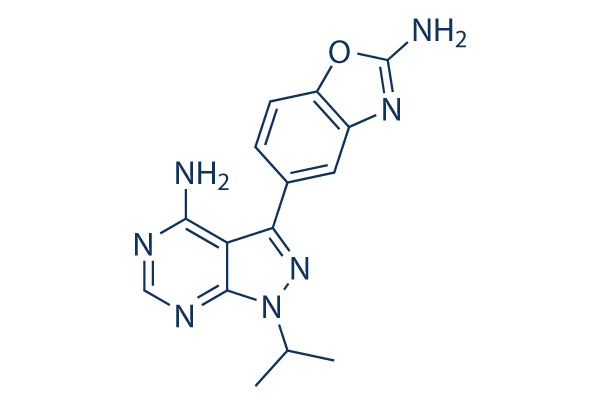
Chemische Struktur
Molekulargewicht: 309.33
Qualitätskontrolle
| Verwandte Ziele | PI3K Akt GSK-3 ATM/ATR DNA-PK AMPK PDPK1 PTEN PP2A PDK |
|---|---|
| Weitere mTOR Inhibitoren | Torin 1 Torin 2 AZD8055 Ridaforolimus (Deforolimus, MK-8669) Torkinib (PP242) MHY1485 Vistusertib (AZD2014) KU-0063794 OSI-027 WYE-354 |
Zellkultur, Behandlung & Arbeitskonzentration
| Zelllinien | Assay-Typ | Konzentration | Inkubationszeit | Formulierung | Aktivitätsbeschreibung | PMID |
|---|---|---|---|---|---|---|
| U87 | Function assay | Inhibition of mTOR in human U87 cells assessed as reduction in p4EBP1 phosphorylation by Western blot method | ChEMBL | |||
| U87 | Function assay | Inhibition of mTOR in human U87 cells assessed as reduction in pAKT phosphorylation at residue 47 by Western blot method | ChEMBL | |||
| PC3 | Antiproliferative assay | 72 hrs | Antiproliferative activity against human PC3 cells measured after 72 hrs by Alamar blue dye-based fluorescence analysis, EC50 = 0.1 μM. | ChEMBL | ||
| SKOV3 | Function assay | 1 hr | Inhibition of TORC2 in human SKOV3 cells assessed as decrease in PKB/Akt phosphorylation at Ser473 after 1 hr by Western blot analysis | 30359003 | ||
| A2058 | Function assay | 1 hr | Inhibition of TORC1 in human A2058 cells assessed as decrease in S6K phosphorylation after 1 hr by Western blot analysis | 30359003 | ||
| SKOV3 | Function assay | 1 hr | Inhibition of TORC1 in human SKOV3 cells assessed as decrease in S6K phosphorylation after 1 hr by Western blot analysis | 30359003 | ||
| SKOV3 | Function assay | 1 hr | Inhibition of TORC1 in human SKOV3 cells assessed as decrease in S6 phosphorylation at Ser235/236 after 1 hr by Western blot analysis | 30359003 | ||
| SKOV3 | Function assay | 1 hr | Inhibition of TORC1 in human SKOV3 cells assessed as decrease in 4E-BP1 phosphorylation after 1 hr by Western blot analysis | 30359003 | ||
| A2058 | Function assay | 1 hr | Inhibition of TORC1 in human A2058 cells assessed as decrease in 4E-BP1 phosphorylation after 1 hr by Western blot analysis | 30359003 | ||
| A2058 | Function assay | 1 hr | Inhibition of TORC1 in human A2058 cells assessed as decrease in S6 phosphorylation at Ser235/236 after 1 hr by Western blot analysis | 30359003 | ||
| A2058 | Function assay | 1 hr | Inhibition of TORC2 in human A2058 cells assessed as decrease in PKB/Akt phosphorylation at Ser473 after 1 hr by Western blot analysis | 30359003 | ||
| Saos-2 | qHTS assay | qHTS of pediatric cancer cell lines to identify multiple opportunities for drug repurposing: Confirmatory screen for Saos-2 cells | 29435139 | |||
| Rh18 | qHTS assay | qHTS of pediatric cancer cell lines to identify multiple opportunities for drug repurposing: Confirmatory screen for Rh18 cells | 29435139 | |||
| TC32 | qHTS assay | qHTS of pediatric cancer cell lines to identify multiple opportunities for drug repurposing: Confirmatory screen for TC32 cells | 29435139 | |||
| SJ-GBM2 | qHTS assay | qHTS of pediatric cancer cell lines to identify multiple opportunities for drug repurposing: Confirmatory screen for SJ-GBM2 cells | 29435139 | |||
| SK-N-MC | qHTS assay | qHTS of pediatric cancer cell lines to identify multiple opportunities for drug repurposing: Confirmatory screen for SK-N-MC cells | 29435139 | |||
| Rh18 | qHTS assay | qHTS of pediatric cancer cell lines to identify multiple opportunities for drug repurposing: Primary screen for Rh18 cells | 29435139 | |||
| LAN-5 | qHTS assay | qHTS of pediatric cancer cell lines to identify multiple opportunities for drug repurposing: Primary screen for LAN-5 cells | 29435139 | |||
| NB-EBc1 | qHTS assay | qHTS of pediatric cancer cell lines to identify multiple opportunities for drug repurposing: Primary screen for NB-EBc1 cells | 29435139 | |||
| SK-N-MC | qHTS assay | qHTS of pediatric cancer cell lines to identify multiple opportunities for drug repurposing: Primary screen for SK-N-MC cells | 29435139 | |||
| SJ-GBM2 | qHTS assay | qHTS of pediatric cancer cell lines to identify multiple opportunities for drug repurposing: Primary screen for SJ-GBM2 cells | 29435139 | |||
| RD | qHTS assay | qHTS of pediatric cancer cell lines to identify multiple opportunities for drug repurposing: Confirmatory screen for RD cells | 29435139 | |||
| Rh41 | qHTS assay | qHTS of pediatric cancer cell lines to identify multiple opportunities for drug repurposing: Confirmatory screen for Rh41 cells | 29435139 | |||
| OHS-50 | qHTS assay | qHTS of pediatric cancer cell lines to identify multiple opportunities for drug repurposing: Confirmatory screen for OHS-50 cells | 29435139 | |||
| U-2 OS | qHTS assay | qHTS of pediatric cancer cell lines to identify multiple opportunities for drug repurposing: Confirmatory screen for U-2 OS cells | 29435139 | |||
| Rh30 | qHTS assay | qHTS of pediatric cancer cell lines to identify multiple opportunities for drug repurposing: Confirmatory screen for Rh30 cells | 29435139 | |||
| MG 63 (6-TG R) | qHTS assay | qHTS of pediatric cancer cell lines to identify multiple opportunities for drug repurposing: Confirmatory screen for MG 63 (6-TG R) cells | 29435139 | |||
| Rh30 | qHTS assay | qHTS of pediatric cancer cell lines to identify multiple opportunities for drug repurposing: Primary screen for Rh30 cells | 29435139 | |||
| BT-37 | qHTS assay | qHTS of pediatric cancer cell lines to identify multiple opportunities for drug repurposing: Confirmatory screen for BT-37 cells | 29435139 | |||
| A673 | qHTS assay | qHTS of pediatric cancer cell lines to identify multiple opportunities for drug repurposing: Confirmatory screen for A673 cells) | 29435139 | |||
| Rh41 | qHTS assay | qHTS of pediatric cancer cell lines to identify multiple opportunities for drug repurposing: Primary screen for Rh41 cells | 29435139 | |||
| SK-N-SH | qHTS assay | qHTS of pediatric cancer cell lines to identify multiple opportunities for drug repurposing: Confirmatory screen for SK-N-SH cells | 29435139 | |||
| DAOY | qHTS assay | qHTS of pediatric cancer cell lines to identify multiple opportunities for drug repurposing: Confirmatory screen for DAOY cells | 29435139 | |||
| LAN-5 | qHTS assay | qHTS of pediatric cancer cell lines to identify multiple opportunities for drug repurposing: Confirmatory screen for LAN-5 cells | 29435139 | |||
| OHS-50 | qHTS assay | qHTS of pediatric cancer cell lines to identify multiple opportunities for drug repurposing: Primary screen for OHS-50 cells | 29435139 | |||
| BT-12 | qHTS assay | qHTS of pediatric cancer cell lines to identify multiple opportunities for drug repurposing: Confirmatory screen for BT-12 cells | 29435139 | |||
| MG 63 (6-TG R) | qHTS assay | qHTS of pediatric cancer cell lines to identify multiple opportunities for drug repurposing: Primary screen for MG 63 (6-TG R) cells | 29435139 | |||
| BT-12 | qHTS assay | qHTS of pediatric cancer cell lines to identify multiple opportunities for drug repurposing: Primary screen for BT-12 cells | 29435139 | |||
| SK-N-SH | qHTS assay | qHTS of pediatric cancer cell lines to identify multiple opportunities for drug repurposing: Primary screen for SK-N-SH cells | 29435139 | |||
| RD | qHTS assay | qHTS of pediatric cancer cell lines to identify multiple opportunities for drug repurposing: Primary screen for RD cells | 29435139 | |||
| BT-37 | qHTS assay | qHTS of pediatric cancer cell lines to identify multiple opportunities for drug repurposing: Primary screen for BT-37 cells | 29435139 | |||
| Saos-2 | qHTS assay | qHTS of pediatric cancer cell lines to identify multiple opportunities for drug repurposing: Primary screen for Saos-2 cells | 29435139 | |||
| DAOY | qHTS assay | qHTS of pediatric cancer cell lines to identify multiple opportunities for drug repurposing: Primary screen for DAOY cells | 29435139 | |||
| A673 | qHTS assay | qHTS of pediatric cancer cell lines to identify multiple opportunities for drug repurposing: Primary screen for A673 cells | 29435139 | |||
| U-2 OS | qHTS assay | qHTS of pediatric cancer cell lines to identify multiple opportunities for drug repurposing: Primary screen for U-2 OS cells | 29435139 | |||
| TC32 | qHTS assay | qHTS of pediatric cancer cell lines to identify multiple opportunities for drug repurposing: Primary screen for TC32 cells | 29435139 | |||
| PANC-1 | Cell Viability Assay | 1-100 nM | 72 h | inhibits cell viability dose dependently | 24971544 | |
| PANC-1 | Cell Viability Assay | 50 nM | 24-96 h | inhibits cell viability time dependently | 24971544 | |
| MIA PaCa-2 | Cell Viability Assay | 1-100 nM | 72 h | inhibits cell viability dose dependently | 24971544 | |
| PANC-1 | Apoptosis Assay | 10-100 nM | 72 h | induces apoptosis dose dependently | 24971544 | |
| PANC-1 | Function Assay | 10/50 nM | 24 h | dramatically inhibits phosphorylation of 4E-BP1-S6K1 (mTORC1 activation indicators) and Akt at Ser 473 (the mTORC2 activation indicator) | 24971544 | |
| PANC-1 | Function Assay | 10 nM | 72 h | increases LY 188011 sensitivity | 24971544 | |
| PANC-1 | Function Assay | 50 nM | 48 h | disrupts cell cycle progression | 24971544 | |
| U87 | Function assay | Inhibition of mTOR pS6K in human U87 cells assessed as inhibition of 4EBP1 phosphorylation by Western blot analysis | ChEMBL | |||
| U87 | Function assay | Inhibition of mTOR in human U87 cells assessed as reduction in pRAS40 phosphorylation by Western blot method | ChEMBL | |||
| U87 | Function assay | Inhibition of mTOR pS6K in human U87 cells assessed as inhibition of RAS40 phosphorylation by Western blot analysis | ChEMBL | |||
| U87 | Antitumor assay | 0.3 to 3 mg/kg | 14 days | Antitumor activity against human U87 cells xenografted in mouse assessed as tumor growth inhibition at 0.3 to 3 mg/kg measured after 14 days | ChEMBL | |
| Klicken Sie hier, um weitere experimentelle Daten zu Zelllinien anzuzeigen | ||||||
Chemische Informationen, Lagerung & Stabilität
| Molekulargewicht | 309.33 | Formel | C15H15N7O |
Lagerung (Ab dem Eingangsdatum) | |
|---|---|---|---|---|---|
| CAS-Nr. | 1224844-38-5 | SDF herunterladen | Lagerung von Stammlösungen |
|
|
| Synonyme | INK 128,TAK-228 | Smiles | CC(C)N1C2=NC=NC(=C2C(=N1)C3=CC4=C(C=C3)OC(=N4)N)N | ||
Löslichkeit
|
In vitro |
DMSO
: 62 mg/mL
(200.43 mM)
Ethanol : 2 mg/mL Water : Insoluble |
Molaritätsrechner
|
In vivo |
|||||
In-vivo-Formulierungsrechner (Klare Lösung)
Schritt 1: Geben Sie die untenstehenden Informationen ein (Empfohlen: Ein zusätzliches Tier zur Berücksichtigung von Verlusten während des Experiments)
Schritt 2: Geben Sie die In-vivo-Formulierung ein (Dies ist nur der Rechner, keine Formulierung. Bitte kontaktieren Sie uns zuerst, wenn es im Abschnitt "Löslichkeit" keine In-vivo-Formulierung gibt.)
Berechnungsergebnisse:
Arbeitskonzentration: mg/ml;
Methode zur Herstellung der DMSO-Stammlösung: mg Wirkstoff vorgelöst in μL DMSO ( Konzentration der Stammlösung mg/mL, Bitte kontaktieren Sie uns zuerst, wenn die Konzentration die DMSO-Löslichkeit der Wirkstoffcharge überschreitet. )
Methode zur Herstellung der In-vivo-Formulierung: Nehmen Sie μL DMSO Stammlösung, dann hinzufügenμL PEG300, mischen und klären, dann hinzufügenμL Tween 80, mischen und klären, dann hinzufügen μL ddH2O, mischen und klären.
Methode zur Herstellung der In-vivo-Formulierung: Nehmen Sie μL DMSO Stammlösung, dann hinzufügen μL Maisöl, mischen und klären.
Hinweis: 1. Bitte stellen Sie sicher, dass die Flüssigkeit klar ist, bevor Sie das nächste Lösungsmittel hinzufügen.
2. Achten Sie darauf, das/die Lösungsmittel der Reihe nach hinzuzufügen. Sie müssen sicherstellen, dass die bei der vorherigen Zugabe erhaltene Lösung eine klare Lösung ist, bevor Sie mit der Zugabe des nächsten Lösungsmittels fortfahren. Physikalische Methoden wie Vortex, Ultraschall oder ein heißes Wasserbad können zur Unterstützung des Lösens verwendet werden.
Wirkmechanismus
| Targets/IC50/Ki |
mTOR
(Cell-free assay) 1.4 nM(Ki)
mTOR
(Cell-free assay) 1.4 nM(Ki)
PI3Kα
(Cell-free assay) 219 nM
PI3Kγ
(Cell-free assay) 221 nM
PI3Kδ
(Cell-free assay) 230 nM
PI3Kβ
(Cell-free assay) 5293 nM
|
|---|---|
| In vitro |
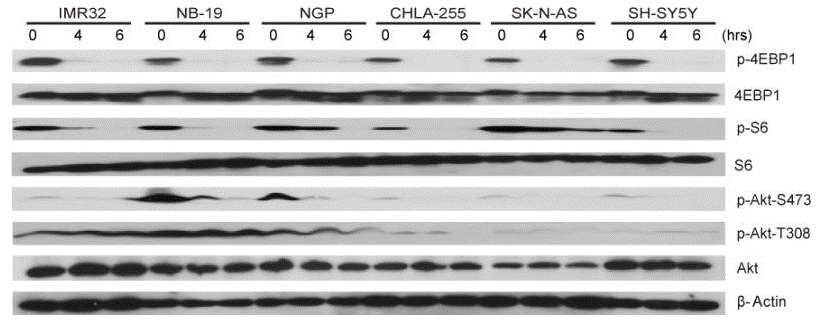
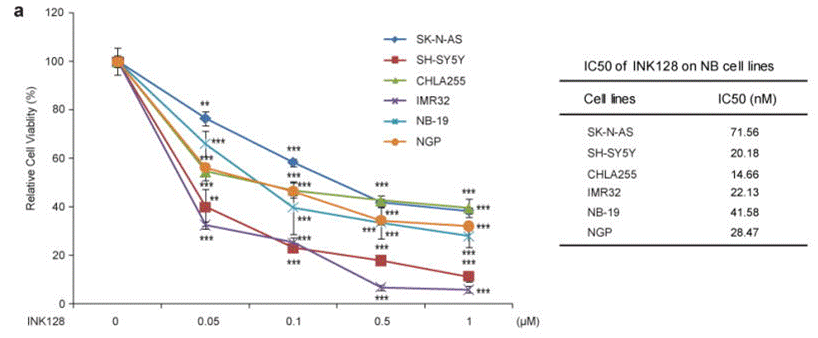
INK 128 weist eine enzymatische Hemmaktivität gegen mTOR und eine mehr als 100-fache Selektivität gegenüber PI3K-Kinasen auf. Als TORC1/2-Inhibitor hemmt INK 128 sowohl die Phosphorylierung von S6 und 4EBP1, den nachgeschalteten Substraten von TORC1, als auch selektiv die AKT-Phosphorylierung an Ser473, dem nachgeschalteten Substrat von TORC2. Darüber hinaus zeigt INK 128 auch potente Hemmwirkungen auf Zelllinien, die gegen Rapamycin und Pan-PI3K-Inhibitoren resistent sind. |
| In vivo |
In einem ZR-75-1-Brustkrebs-Xenograft-Modell zeigt INK 128 eine Hemmwirkung des Tumorwachstums bei einer Dosis von 0,3 mg/kg/Tag. Die tägliche orale Verabreichung von INK 128 hemmt die Angiogenese und das Tumorwachstum in Multiplex-Xenograft-Modellen. |
Literatur |
|
Anwendungen
| Methoden | Biomarker | Bilder | PMID |
|---|---|---|---|
| Western blot | p-4EBP1 / 4EBP1 / p-S6 / S6 / p-Akt-S473 / p-Akt-T308 / Akt CD44 / Vimentin c-Jun p-mTOR(Ser2448) / mTOR / p-p70S6K(Thr389) / p70S6K / p-RPS / RPS6 FKBP1 / MARS / CDC25A / TCL1A |
|
25425103 |
| Growth inhibition assay | Cell viability |
|
25425103 |
Klinische Studieninformationen
(Daten von https://clinicaltrials.gov, aktualisiert am 2024-05-22)
| NCT-Nummer | Rekrutierung | Erkrankungen | Sponsor/Kooperationspartner | Startdatum | Phasen |
|---|---|---|---|---|---|
| NCT04250545 | Recruiting | Leptomeningeal Neoplasm|Metastatic Lung Non-Small Cell Carcinoma|Metastatic Malignant Neoplasm in the Brain|Recurrent Lung Non-Small Cell Carcinoma|Stage IV Lung Cancer AJCC v8|Stage IVA Lung Cancer AJCC v8|Stage IVB Lung Cancer AJCC v8 |
National Cancer Institute (NCI) |
October 26 2020 | Phase 1 |
| NCT02575339 | Terminated | Hepatocellular Carcinoma|Liver Cancer|HCC |
Kathy Miller|Millennium Pharmaceuticals Inc.|Big Ten Cancer Research Consortium |
July 18 2016 | Phase 1|Phase 2 |
| NCT02719691 | Completed | Metastatic Breast Cancer|Solid Tumors |
University of Colorado Denver |
May 13 2016 | Phase 1 |
| NCT02514824 | Completed | Merkel Cell Carcinoma |
Dana-Farber Cancer Institute|Millennium Pharmaceuticals Inc. |
October 2015 | Phase 1|Phase 2 |
Technischer Support
Tel: +1-832-582-8158 Ext:3
Wenn Sie weitere Fragen haben, hinterlassen Sie bitte eine Nachricht.
Häufig gestellte Fragen
Frage 1:
What is the recommendation method to formulate it for oral administration?
Antwort:
For oral administration, it can be tried with this vehicle: 30% PEG400+0.5% Tween80 +5% Propylene glycol.

Produkte sind nur für Forschungszwecke bestimmt. Nicht für den menschlichen Gebrauch. Wir verkaufen nicht an Patienten.
©Copyright 2013 Selleck Chemicals. Alle Rechte vorbehalten.