
nur für Forschungszwecke
Torin 2 mTOR Inhibitor
Kat.-Nr.S2817
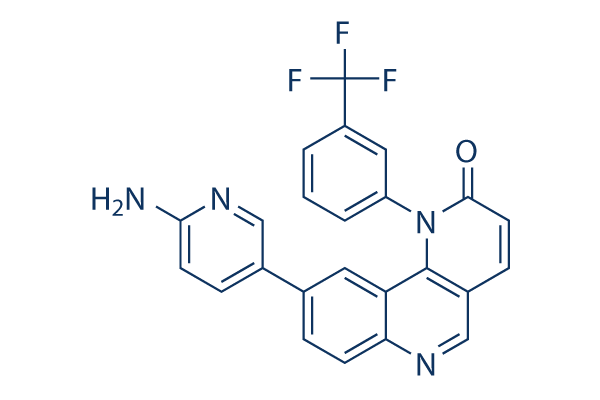
Chemische Struktur
Molekulargewicht: 432.4
Qualitätskontrolle
| Verwandte Ziele | PI3K Akt GSK-3 ATM/ATR DNA-PK AMPK PDPK1 PTEN PP2A PDK |
|---|---|
| Weitere mTOR Inhibitoren | Torin 1 AZD8055 Ridaforolimus (Deforolimus, MK-8669) Sapanisertib (MLN0128, INK-128) Torkinib (PP242) MHY1485 Vistusertib (AZD2014) KU-0063794 OSI-027 WYE-354 |
Zellkultur, Behandlung & Arbeitskonzentration
| Zelllinien | Assay-Typ | Konzentration | Inkubationszeit | Formulierung | Aktivitätsbeschreibung | PMID |
|---|---|---|---|---|---|---|
| HCT116 | Function assay | 1 hr | Inhibition of mTORC1 in human HCT116 cells assessed as reduction in T389 phosphorylation on RPS6KB1 after 1 hr by Western blot analysis, EC50=0.00025μM | 29211480 | ||
| MOLM13 | Antiproliferative assay | Antiproliferative activity against human MOLM13 cells by Cell-Titer Glo assay, IC50<0.001μM | 30370766 | |||
| MOLM14 | Antiproliferative assay | Antiproliferative activity against human MOLM14 cells by Cell-Titer Glo assay, IC50<0.001μM | 30370766 | |||
| MV4-11 | Antiproliferative assay | Antiproliferative activity against human MV4-11 cells by Cell-Titer Glo assay, IC50<0.001μM | 30370766 | |||
| HEK293T | Function assay | 20 mins | Inhibition of N-terminally FLAG-tagged mTORC1 (unknown origin) expressed in HEK293T cells using S6K1 or Akt1 as substrate after 20 mins by immunoblotting assay, IC50<0.01μM | 29211480 | ||
| HeLa | Function assay | 20 mins | Inhibition of N-terminally FLAG-tagged mTORC2 (unknown origin) expressed in human HeLa cells using S6K1 or Akt1 as substrate after 20 mins by immunoblotting assay, IC50<0.01μM | 29211480 | ||
| RD | Antiviral assay | 4 days | Antiviral activity against Enterovirus A71 infected in human RD cells assessed as reduction in virus-induced cell death incubated for 4 days by CellTiter-Glo luminescence assay, IC50=0.01μM | 31082764 | ||
| HCT116 | Function assay | 1 hr | Inhibition of ATM in human HCT116 cells assessed as after 1 hr by Western blot analysis, EC50=0.028μM | 29211480 | ||
| HCT116 | Function assay | 1 hr | Inhibition of ATR in human HCT116 cells assessed as after 1 hr by Western blot analysis, EC50=0.035μM | 29211480 | ||
| RD | Cytotoxicity assay | 4 days | Cytotoxicity against human RD cells incubated for 4 days by CellTiter-Glo luminescence assay, CC50=0.04μM | 31082764 | ||
| HCT116 | Function assay | 1 hr | Inhibition of DNAPK in human HCT116 cells assessed as after 1 hr by Western blot analysis, EC50=0.118μM | 29211480 | ||
| PC3 | Function assay | Inhibition of PI3Kalpha in human PC3 cells expressing Akt1 S473D mutant assessed as phosphorylation of Akt Thr308 by immunoblotting, EC50=0.2μM | 21322566 | |||
| TC32 | qHTS assay | qHTS of pediatric cancer cell lines to identify multiple opportunities for drug repurposing: Primary screen for TC32 cells | 29435139 | |||
| DAOY | qHTS assay | qHTS of pediatric cancer cell lines to identify multiple opportunities for drug repurposing: Primary screen for DAOY cells | 29435139 | |||
| SJ-GBM2 | qHTS assay | qHTS of pediatric cancer cell lines to identify multiple opportunities for drug repurposing: Primary screen for SJ-GBM2 cells | 29435139 | |||
| A673 | qHTS assay | qHTS of pediatric cancer cell lines to identify multiple opportunities for drug repurposing: Primary screen for A673 cells | 29435139 | |||
| SK-N-MC | qHTS assay | qHTS of pediatric cancer cell lines to identify multiple opportunities for drug repurposing: Primary screen for SK-N-MC cells | 29435139 | |||
| BT-37 | qHTS assay | qHTS of pediatric cancer cell lines to identify multiple opportunities for drug repurposing: Primary screen for BT-37 cells | 29435139 | |||
| NB-EBc1 | qHTS assay | qHTS of pediatric cancer cell lines to identify multiple opportunities for drug repurposing: Primary screen for NB-EBc1 cells | 29435139 | |||
| U-2 OS | qHTS assay | qHTS of pediatric cancer cell lines to identify multiple opportunities for drug repurposing: Primary screen for U-2 OS cells | 29435139 | |||
| Saos-2 | qHTS assay | qHTS of pediatric cancer cell lines to identify multiple opportunities for drug repurposing: Primary screen for Saos-2 cells | 29435139 | |||
| NB1643 | qHTS assay | qHTS of pediatric cancer cell lines to identify multiple opportunities for drug repurposing: Primary screen for NB1643 cells | 29435139 | |||
| LAN-5 | qHTS assay | qHTS of pediatric cancer cell lines to identify multiple opportunities for drug repurposing: Primary screen for LAN-5 cells | 29435139 | |||
| BT-12 | qHTS assay | qHTS of pediatric cancer cell lines to identify multiple opportunities for drug repurposing: Primary screen for BT-12 cells | 29435139 | |||
| Rh18 | qHTS assay | qHTS of pediatric cancer cell lines to identify multiple opportunities for drug repurposing: Primary screen for Rh18 cells | 29435139 | |||
| OHS-50 | qHTS assay | qHTS of pediatric cancer cell lines to identify multiple opportunities for drug repurposing: Primary screen for OHS-50 cells | 29435139 | |||
| RD | qHTS assay | qHTS of pediatric cancer cell lines to identify multiple opportunities for drug repurposing: Primary screen for RD cells | 29435139 | |||
| MG 63 (6-TG R) | qHTS assay | qHTS of pediatric cancer cell lines to identify multiple opportunities for drug repurposing: Primary screen for MG 63 (6-TG R) cells | 29435139 | |||
| Rh30 | qHTS assay | qHTS of pediatric cancer cell lines to identify multiple opportunities for drug repurposing: Primary screen for Rh30 cells | 29435139 | |||
| Rh41 | qHTS assay | qHTS of pediatric cancer cell lines to identify multiple opportunities for drug repurposing: Primary screen for Rh41 cells | 29435139 | |||
| NB1643 | qHTS assay | qHTS of pediatric cancer cell lines to identify multiple opportunities for drug repurposing: Confirmatory screen for NB1643 cells | 29435139 | |||
| A673 | qHTS assay | qHTS of pediatric cancer cell lines to identify multiple opportunities for drug repurposing: Confirmatory screen for A673 cells) | 29435139 | |||
| SK-N-MC | qHTS assay | qHTS of pediatric cancer cell lines to identify multiple opportunities for drug repurposing: Confirmatory screen for SK-N-MC cells | 29435139 | |||
| LAN-5 | qHTS assay | qHTS of pediatric cancer cell lines to identify multiple opportunities for drug repurposing: Confirmatory screen for LAN-5 cells | 29435139 | |||
| DAOY | qHTS assay | qHTS of pediatric cancer cell lines to identify multiple opportunities for drug repurposing: Confirmatory screen for DAOY cells | 29435139 | |||
| NB-EBc1 | qHTS assay | qHTS of pediatric cancer cell lines to identify multiple opportunities for drug repurposing: Confirmatory screen for NB-EBc1 cells | 29435139 | |||
| SJ-GBM2 | qHTS assay | qHTS of pediatric cancer cell lines to identify multiple opportunities for drug repurposing: Confirmatory screen for SJ-GBM2 cells | 29435139 | |||
| BT-37 | qHTS assay | qHTS of pediatric cancer cell lines to identify multiple opportunities for drug repurposing: Confirmatory screen for BT-37 cells | 29435139 | |||
| TC32 | qHTS assay | qHTS of pediatric cancer cell lines to identify multiple opportunities for drug repurposing: Confirmatory screen for TC32 cells | 29435139 | |||
| MG 63 (6-TG R) | qHTS assay | qHTS of pediatric cancer cell lines to identify multiple opportunities for drug repurposing: Confirmatory screen for MG 63 (6-TG R) cells | 29435139 | |||
| U-2 OS | qHTS assay | qHTS of pediatric cancer cell lines to identify multiple opportunities for drug repurposing: Confirmatory screen for U-2 OS cells | 29435139 | |||
| Rh41 | qHTS assay | qHTS of pediatric cancer cell lines to identify multiple opportunities for drug repurposing: Confirmatory screen for Rh41 cells | 29435139 | |||
| RD | qHTS assay | qHTS of pediatric cancer cell lines to identify multiple opportunities for drug repurposing: Confirmatory screen for RD cells | 29435139 | |||
| Rh18 | qHTS assay | qHTS of pediatric cancer cell lines to identify multiple opportunities for drug repurposing: Confirmatory screen for Rh18 cells | 29435139 | |||
| Rh30 | qHTS assay | qHTS of pediatric cancer cell lines to identify multiple opportunities for drug repurposing: Confirmatory screen for Rh30 cells | 29435139 | |||
| Saos-2 | qHTS assay | qHTS of pediatric cancer cell lines to identify multiple opportunities for drug repurposing: Confirmatory screen for Saos-2 cells | 29435139 | |||
| OHS-50 | qHTS assay | qHTS of pediatric cancer cell lines to identify multiple opportunities for drug repurposing: Confirmatory screen for OHS-50 cells | 29435139 | |||
| SK-N-SH | qHTS assay | qHTS of pediatric cancer cell lines to identify multiple opportunities for drug repurposing: Confirmatory screen for SK-N-SH cells | 29435139 | |||
| Klicken Sie hier, um weitere experimentelle Daten zu Zelllinien anzuzeigen | ||||||
Chemische Informationen, Lagerung & Stabilität
| Molekulargewicht | 432.4 | Formel | C24H15F3N4O |
Lagerung (Ab dem Eingangsdatum) | |
|---|---|---|---|---|---|
| CAS-Nr. | 1223001-51-1 | SDF herunterladen | Lagerung von Stammlösungen |
|
|
| Synonyme | N/A | Smiles | C1=CC(=CC(=C1)N2C(=O)C=CC3=CN=C4C=CC(=CC4=C32)C5=CN=C(C=C5)N)C(F)(F)F | ||
Löslichkeit
|
In vitro |
DMSO
: 30 mg/mL
(69.38 mM)
Water : Insoluble Ethanol : Insoluble |
Molaritätsrechner
|
In vivo |
|||||
In-vivo-Formulierungsrechner (Klare Lösung)
Schritt 1: Geben Sie die untenstehenden Informationen ein (Empfohlen: Ein zusätzliches Tier zur Berücksichtigung von Verlusten während des Experiments)
Schritt 2: Geben Sie die In-vivo-Formulierung ein (Dies ist nur der Rechner, keine Formulierung. Bitte kontaktieren Sie uns zuerst, wenn es im Abschnitt "Löslichkeit" keine In-vivo-Formulierung gibt.)
Berechnungsergebnisse:
Arbeitskonzentration: mg/ml;
Methode zur Herstellung der DMSO-Stammlösung: mg Wirkstoff vorgelöst in μL DMSO ( Konzentration der Stammlösung mg/mL, Bitte kontaktieren Sie uns zuerst, wenn die Konzentration die DMSO-Löslichkeit der Wirkstoffcharge überschreitet. )
Methode zur Herstellung der In-vivo-Formulierung: Nehmen Sie μL DMSO Stammlösung, dann hinzufügenμL PEG300, mischen und klären, dann hinzufügenμL Tween 80, mischen und klären, dann hinzufügen μL ddH2O, mischen und klären.
Methode zur Herstellung der In-vivo-Formulierung: Nehmen Sie μL DMSO Stammlösung, dann hinzufügen μL Maisöl, mischen und klären.
Hinweis: 1. Bitte stellen Sie sicher, dass die Flüssigkeit klar ist, bevor Sie das nächste Lösungsmittel hinzufügen.
2. Achten Sie darauf, das/die Lösungsmittel der Reihe nach hinzuzufügen. Sie müssen sicherstellen, dass die bei der vorherigen Zugabe erhaltene Lösung eine klare Lösung ist, bevor Sie mit der Zugabe des nächsten Lösungsmittels fortfahren. Physikalische Methoden wie Vortex, Ultraschall oder ein heißes Wasserbad können zur Unterstützung des Lösens verwendet werden.
Wirkmechanismus
| Targets/IC50/Ki |
mTOR
(p53−/− MEFs) 0.25 nM
ATM
(PC3 cells) 28 nM(EC50)
ATR
(PC3 cells) 35 nM(EC50)
DNA-PK
(PC3 cells) 118 nM(EC50)
|
|---|---|
| In vitro |
Torin 2 hat den gleichen Bindungsmodus wie PI3Kγ, V882 dient als Scharnier-Bindungspunkt und in der inneren hydrophoben Tasche liefern Y867, D841 und D964 drei weitere Wasserstoffbrückenbindungen mit der Aminopyridin-Seitenkette, analog zu Y2225, D2195 und D2357 von mTOR. Diese Verbindung hemmt mTORC1 und aktiviert somit TFEB, indem sie dessen nukleäre Translokation mit einer EC50 von 1,666 mM fördert. Diese Chemikalie (< 50 nM) verursacht eine signifikante Reduktion der Lebensfähigkeit sowohl von MZ-CRC-1- als auch von TT-Zellen. Sie (100 nM) bewirkt eine signifikante Reduktion der Migration sowohl von MZ-CRC-1- als auch von TT-Zellen. |
| Kinase-Assay |
mTOR- und PI3K-Zellassays
|
|
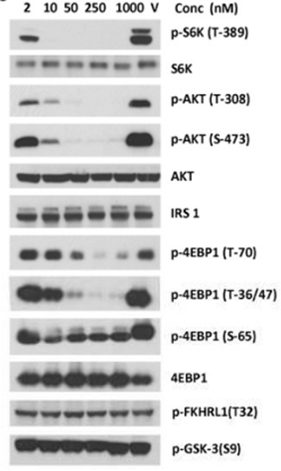
Zelluläre IC50-Werte für mTOR werden unter Verwendung von p53−/− MEFs bestimmt. Zellen werden 1 Stunde lang mit Vehikel oder steigenden Konzentrationen von Torin 2 behandelt und dann lysiert. Die Phosphorylierung von S6K1 Thr-389 wird mittels Immunoblotting unter Verwendung eines phospho-spezifischen Antikörpers überwacht. In der Zwischenzeit werden zelluläre IC50-Werte für PI3Ka basierend auf der Phosphorylierung von Akt Thr-308 in p53−/−/mLST8−/− MEFs oder menschlichen PC3-Zellen, die die S473D-Mutante von Akt1 exprimieren, bestimmt.
|
|
| In vivo |
Torin 2 zeigt eine pharmakodynamische Reaktion von >95 % und eine Halbwertszeit von 11,7 min in der Stabilitätsstudie mit Mauslebermikrosomen. Diese Verbindung weist die beste Bioverfügbarkeit (51 %), eine kurze Halbwertszeit (0,72 Stunden) und eine geringe Clearance (19,6 mL/min/kg) bei männlichen Swiss-Albino-Mäusen nach intravenöser und oraler Verabreichung auf. Diese Chemikalie (20 mg/kg) beseitigt MYCN-Tumoren mit einer Reduktion der MYCN-Proteinspiegel und Induktion der Apoptose bei Th-MYCN-Mäusen. |
Literatur |
|
Anwendungen
| Methoden | Biomarker | Bilder | PMID |
|---|---|---|---|
| Western blot | p-S6K / S6K / p-AKT / AKT / IRS1 / p-4EBP1 / 4EBP1 / p-GSK3 p-Chk1 / Chk1 / p-Chk2 / Chk2 / p-DNA-PK |
|
23436801 |
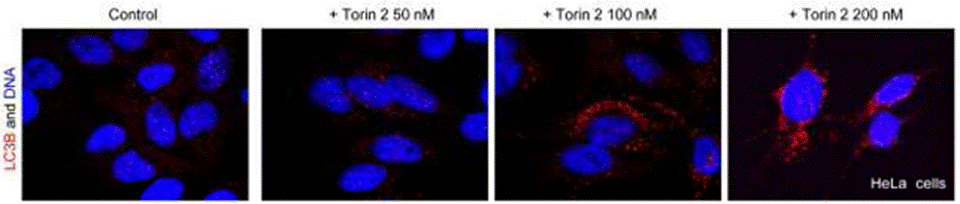
| Immunofluorescence | LC3B |
|
23436801 |
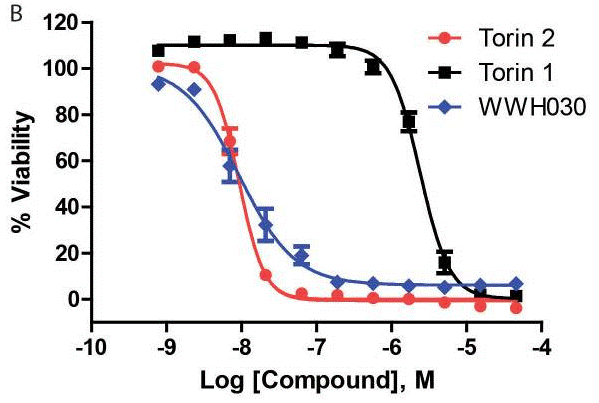
| Growth inhibition assay | Cell viability |
|
24434750 |
Technischer Support
Tel: +1-832-582-8158 Ext:3
Wenn Sie weitere Fragen haben, hinterlassen Sie bitte eine Nachricht.

Produkte sind nur für Forschungszwecke bestimmt. Nicht für den menschlichen Gebrauch. Wir verkaufen nicht an Patienten.
©Copyright 2013 Selleck Chemicals. Alle Rechte vorbehalten.