
nur für Forschungszwecke
Progesterone Estrogen/progestogen Receptor Agonist
Kat.-Nr.S1705
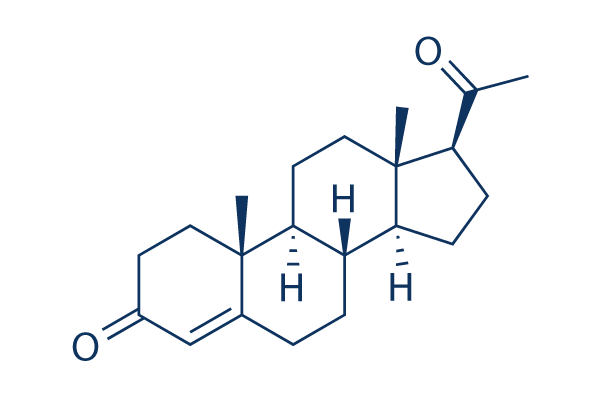
Chemische Struktur
Molekulargewicht: 314.46
Qualitätskontrolle
| Verwandte Ziele | Adrenergic Receptor GPR Androgen Receptor Glucocorticoid Receptor ACE RAAS Progesterone Receptor Opioid Receptor PGES THR |
|---|---|
| Weitere Estrogen/progestogen Receptor Inhibitoren | Elacestrant (RAD1901) Dihydrochloride Vepdegestrant (ARV-471) MPP dihydrochloride Kaempferol Cholesterol G15 Endoxifen HCl Licochalcone A Chrysin Pregnenolone |
Zellkultur, Behandlung & Arbeitskonzentration
| Zelllinien | Assay-Typ | Konzentration | Inkubationszeit | Formulierung | Aktivitätsbeschreibung | PMID |
|---|---|---|---|---|---|---|
| human T47D cells | Function assay | 20 h | Activation of progesterone receptor in human T47D cells after 20 hrs by PRE-tagged luciferase reporter gene assay, EC50=0.1 nM | |||
| CV-1 cells | Function assay | Effective concentration for half-maximal activation of human progesterone receptor expressed in CV-1 cells, EC50=1.5 nM | ||||
| HEK293 cells | Function assay | Agonist activity at human PRGR expressed in HEK293 cells by luciferase reporter gene assay, EC50=2 nM | ||||
| SF-12 cells | Function assay | Displacement of DHT from human androgen receptor expressed in baculovirus SF-12 cells, Ki=9.5 nM | ||||
| CHO cells | Function assay | Agonist activity at human TGR5 expressed in CHO cells by luciferase assay, EC50=2.77 μM | ||||
| human K562/R7 cells | Function assay | 1 μM | 72 h | Potentiation of doxorubicin-induced cytotoxicity against doxorubicin-resistant human K562/R7 cells assessed as doxorubicin IC50 at 1 uM after 72 hrs by MTT assay, IC50=10.6 μM | ||
| A2780 cells | Function assay | Inhibition of P-gp in human adriamycin-resistant A2780 cells by Hoechst 33342 assay, IC50=47.863 μM | ||||
| HeLa cells | Cytotoxicity assay | Cytotoxicity against human HeLa cells assessed as inhibition of DNA replication by imaging analysis | ||||
| Klicken Sie hier, um weitere experimentelle Daten zu Zelllinien anzuzeigen | ||||||
Chemische Informationen, Lagerung & Stabilität
| Molekulargewicht | 314.46 | Formel | C21H30O2 |
Lagerung (Ab dem Eingangsdatum) | |
|---|---|---|---|---|---|
| CAS-Nr. | 57-83-0 | SDF herunterladen | Lagerung von Stammlösungen |
|
|
| Synonyme | NSC 64377, Pregn-4-ene-3,20-dione,NSC 9704 | Smiles | CC(=O)C1CCC2C1(CCC3C2CCC4=CC(=O)CCC34C)C | ||
Löslichkeit
|
In vitro |
DMSO
: 40 mg/mL
(127.2 mM)
Ethanol : 20 mg/mL Water : Insoluble |
Molaritätsrechner
|
In vivo |
|||||
In-vivo-Formulierungsrechner (Klare Lösung)
Schritt 1: Geben Sie die untenstehenden Informationen ein (Empfohlen: Ein zusätzliches Tier zur Berücksichtigung von Verlusten während des Experiments)
Schritt 2: Geben Sie die In-vivo-Formulierung ein (Dies ist nur der Rechner, keine Formulierung. Bitte kontaktieren Sie uns zuerst, wenn es im Abschnitt "Löslichkeit" keine In-vivo-Formulierung gibt.)
Berechnungsergebnisse:
Arbeitskonzentration: mg/ml;
Methode zur Herstellung der DMSO-Stammlösung: mg Wirkstoff vorgelöst in μL DMSO ( Konzentration der Stammlösung mg/mL, Bitte kontaktieren Sie uns zuerst, wenn die Konzentration die DMSO-Löslichkeit der Wirkstoffcharge überschreitet. )
Methode zur Herstellung der In-vivo-Formulierung: Nehmen Sie μL DMSO Stammlösung, dann hinzufügenμL PEG300, mischen und klären, dann hinzufügenμL Tween 80, mischen und klären, dann hinzufügen μL ddH2O, mischen und klären.
Methode zur Herstellung der In-vivo-Formulierung: Nehmen Sie μL DMSO Stammlösung, dann hinzufügen μL Maisöl, mischen und klären.
Hinweis: 1. Bitte stellen Sie sicher, dass die Flüssigkeit klar ist, bevor Sie das nächste Lösungsmittel hinzufügen.
2. Achten Sie darauf, das/die Lösungsmittel der Reihe nach hinzuzufügen. Sie müssen sicherstellen, dass die bei der vorherigen Zugabe erhaltene Lösung eine klare Lösung ist, bevor Sie mit der Zugabe des nächsten Lösungsmittels fortfahren. Physikalische Methoden wie Vortex, Ultraschall oder ein heißes Wasserbad können zur Unterstützung des Lösens verwendet werden.
Wirkmechanismus
| Targets/IC50/Ki |
progestogen Receptor
|
|---|---|
| In vitro |
Progesterone hat biphasische Wirkungen auf die Proliferation von Brustkrebszellen; es stimuliert das Wachstum im ersten Zellzyklus, arretiert dann die Zellen in G1/S des zweiten Zyklus, begleitet von einer Hochregulation des Cyclin-abhängigen Kinase-Inhibitors p21. Diese Verbindung-vermittelte Transkription wird durch Überexpression von E1A weiter verhindert, was darauf hindeutet, dass CBP/p300 erforderlich ist. Es treibt eine Reihe von Ereignissen an, bei denen luminale Zellen wahrscheinlich Wnt4- und RANKL-Signale an basale Zellen liefern, die wiederum mit einer Hochregulierung ihrer kognaten Rezeptoren, transkriptionellen Ziele und Zellzyklusmarker reagieren. Diese Hormonbehandlung erhöht die Empfindlichkeit kortikaler Synaptoneurosomen gegenüber GABA (d.h. verringerte den EC50) und erhöht die maximale Wirksamkeit, mit der GABA den Cl--Transport stimulierte (d.h. erhöhte den Emax). |
| In vivo |
Progesterone blockiert die vorteilhafte Wirkung von Estrogen auf die Abeta-Akkumulation, aber nicht auf die Verhaltensleistung bei weiblichen 3xTg-AD-Mäusen. Diese Verbindung reduziert die Tau-Hyperphosphorylierung signifikant, wenn sie sowohl allein als auch in Kombination mit Estrogen verabreicht wird. Progesterone-behandelte Ratten sind bei einer Morris-Wasserlabyrinth-Aufgabe zur räumlichen Navigation weniger beeinträchtigt als Ratten, die mit dem Öl-Vehikel behandelt wurden. Diese Verbindung-behandelten Ratten zeigen auch weniger neuronale Degeneration 21 Tage nach der Verletzung im medialen dorsalen Thalamuskern, einer Struktur, die reziproke Verbindungen mit dem kontusionellen Bereich hat. |
Literatur |
|
Klinische Studieninformationen
(Daten von https://clinicaltrials.gov, aktualisiert am 2024-05-22)
| NCT-Nummer | Rekrutierung | Erkrankungen | Sponsor/Kooperationspartner | Startdatum | Phasen |
|---|---|---|---|---|---|
| NCT06089395 | Not yet recruiting | Poor Ovarian Response |
Shi Yun|Capital Medical University|Dongzhimen Hospital Beijing |
June 1 2024 | Early Phase 1 |
| NCT06359457 | Not yet recruiting | Primary Dysmenorrhea |
Cairo University |
May 2024 | -- |
| NCT06334315 | Not yet recruiting | Contraception|Pharmacogenomic Drug Interaction |
Yale University|Eunice Kennedy Shriver National Institute of Child Health and Human Development (NICHD) |
May 2024 | Phase 4 |
Technischer Support
Tel: +1-832-582-8158 Ext:3
Wenn Sie weitere Fragen haben, hinterlassen Sie bitte eine Nachricht.

Produkte sind nur für Forschungszwecke bestimmt. Nicht für den menschlichen Gebrauch. Wir verkaufen nicht an Patienten.
©Copyright 2013 Selleck Chemicals. Alle Rechte vorbehalten.