
nur für Forschungszwecke
SB216763 GSK-3 Inhibitor
Kat.-Nr.S1075
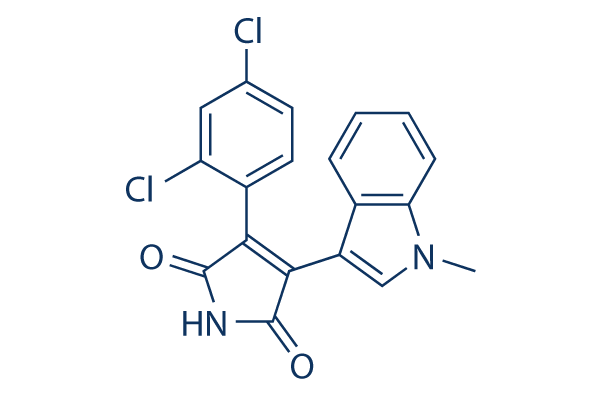
Chemische Struktur
Molekulargewicht: 371.22
Qualitätskontrolle
| Verwandte Ziele | PI3K Akt mTOR ATM/ATR DNA-PK AMPK PDPK1 PTEN PP2A PDK |
|---|---|
| Weitere GSK-3 Inhibitoren | CHIR-99021 (Laduviglusib) Laduviglusib (CHIR-99021) Hydrochloride CHIR-98014 TWS119 GSK-3 Inhibitor IX (BIO) LY2090314 Tideglusib SB415286 AR-A014418 IM-12 |
Zellkultur, Behandlung & Arbeitskonzentration
| Zelllinien | Assay-Typ | Konzentration | Inkubationszeit | Formulierung | Aktivitätsbeschreibung | PMID |
|---|---|---|---|---|---|---|
| HEK293 | Function assay | Glycogen synthase activity of HEK293 cells, inhibition of GSK3-beta, EC50=0.2μM | 12941331 | |||
| HEK293 | Function assay | Effective concentration of compound against glycogen synthase kinase-3 in HEK293 cells, EC50=0.2μM | 15149684 | |||
| MIAPaCa2 | Growth inhibition assay | 72 hrs | Growth inhibition of human MIAPaCa2 cells after 72 hrs by MTS assay, IC50=25μM | 19338355 | ||
| ST14A | Function assay | 6 hrs | Inhibition of GSK-3-beta-mediated Wnt signaling in human ST14A cells assessed as increase in accumulation of beta-casein around nucleus after 6 hrs by microscopic analysis | 20708937 | ||
| neural precursor cells | Function assay | Inhibition of neurosphere proliferation of mouse neural precursor cells by MTT assay | 17417631 | |||
| ReNcell VM | Antiproliferative assay | 3 uM | 72 hrs | Antiproliferative activity against human ReNcell VM cells assessed as reduction of cell proliferation at 3 uM after 72 hrs | 20708937 | |
| HepG2 | Function assay | 34 uM | 12 hrs | Increase in glucose incorporation in human HepG2 cells at 34 uM after 12 hrs by glucose assay | 25467150 | |
| 3T3L1 | Function assay | 34 uM | 12 hrs | Increase in glucose incorporation in mouse 3T3L1 cells at 34 uM after 12 hrs by glucose assay | 25467150 | |
| HepG2 | Function assay | 34 uM | 12 hrs | Inhibition of GSK3beta in human HepG2 cells assessed as decrease in ratio of phosphorylated GS/GS at 34 uM after 12 hrs by Western blot analysis | 25467150 | |
| Sf9 | Function assay | 30 min | Inhibition of GSK3beta (unknown origin) expressed in Sf9 cells using GS1 as substrate and [gamma32]ATP after 30 min by scinitllation counting, IC50=0.03388μM | SANGER | ||
| human HDLM-2 cell | Growth inhibition assay | Inhibition of human HDLM-2 cell growth in a cell viability assay, IC50=0.20984 μM | SANGER | |||
| human NCI-H1770 cell | Growth inhibition assay | Inhibition of human NCI-H1770 cell growth in a cell viability assay. IC50=0.29392 μM | SANGER | |||
| human HOP-62 cell | Growth inhibition assay | Inhibition of human HOP-62 cell growth in a cell viability assay, IC50=0.85256 μM | SANGER | |||
| human JAR cell | Growth inhibition assay | Inhibition of human JAR cell growth in a cell viability assay, IC50=1.21044 μM | SANGER | |||
| human K5 cell | Growth inhibition assay | Inhibition of human K5 cell growth in a cell viability, IC50=1.53698 μM | SANGER | |||
| human MV-4-11 cell | Growth inhibition assay | Inhibition of human MV-4-11 cell growth in a cell viability assay, IC50=2.69685 μM | SANGER | |||
| human BT-549 cell | Growth inhibition assay | Inhibition of human BT-549 cell growth in a cell viability assay, IC50=5.29376 μM | SANGER | |||
| human LB2241-RCC cell | Growth inhibition assay | Inhibition of human LB2241-RCC cell growth in a cell viability assay, IC50=6.42874 μM | SANGER | |||
| human GAMG cell | Growth inhibition assay | Inhibition of human GAMG cell growth in a cell viability assay, IC50=6.65409 μM | SANGER | |||
| human HMV-II cell | Growth inhibition assay | Inhibition of human HMV-II cell growth in a cell viability assay, IC50=7.67607 μM | SANGER | |||
| human RS4-11 cell | Growth inhibition assay | Inhibition of human RS4-11 cell growth in a cell viability assay, IC50=8.24141 μM | SANGER | |||
| human NCI-H1993 cell | Growth inhibition assay | Inhibition of human NCI-H1993 cell growth in a cell viability assay, IC50=8.36534 μM | SANGER | |||
| human IST-SL1 cell | Growth inhibition assay | Inhibition of human IST-SL1 cell growth in a cell viability assay, IC50=9.0204 μM | SANGER | |||
| human SK-OV-3 cell | Growth inhibition assay | Inhibition of human SK-OV-3 cell growth in a cell viability assay, IC50=9.1002 μM | SANGER | |||
| human ESS-1 cell | Growth inhibition assay | Inhibition of human ESS-1 cell growth in a cell viability assay, IC50=9.59872 μM | SANGER | |||
| human G-361 cell | Growth inhibition assay | Inhibition of human G-361 cell growth in a cell viability assay, IC50=10.1798 μM | SANGER | |||
| human ALL-PO cell | Growth inhibition assay | Inhibition of human ALL-PO cell growth in a cell viability assay, IC50=10.3477 μM | SANGER | |||
| human NB5 cell | Growth inhibition assay | Inhibition of human NB5 cell growth in a cell viability assay, IC50=11.2157 μM | SANGER | |||
| human DU-145 cell | Growth inhibition assay | Inhibition of human DU-145 cell growth in a cell viability assay, IC50=11.6535 μM | SANGER | |||
| human NMC-G1 cell | Growth inhibition assay | Inhibition of human NMC-G1 cell growth in a cell viability assay, IC50=11.7264 μM | SANGER | |||
| human RPMI-7951 cell | Growth inhibition assay | Inhibition of human RPMI-7951 cell growth in a cell viability assay. IC50=11.7864 μM | SANGER | |||
| human NCI-H2009 cell | Growth inhibition assay | Inhibition of human NCI-H2009 cell growth in a cell viability assay, IC50=13.2427 μM | SANGER | |||
| human LoVo cell | Growth inhibition assay | Inhibition of human LoVo cell growth in a cell viability assay, IC50=13.3771 μM | SANGER | |||
| human A2058 cell | Growth inhibition assay | Inhibition of human A2058 cell growth in a cell viability assay, IC50=13.469 μM | SANGER | |||
| human D-566MG cell | Growth inhibition assay | Inhibition of human D-566MG cell growth in a cell viability assay, IC50=13.9481 μM | SANGER | |||
| human QIMR-WIL cell | Growth inhibition assay | Inhibition of human QIMR-WIL cell growth in a cell viability assay, IC50=15.6394 μM | SANGER | |||
| human S-117 cell | Growth inhibition assay | Inhibition of human S-117 cell growth in a cell viability assay, IC50=16.4022 μM | SANGER | |||
| human YH-13 cell | Growth inhibition assay | Inhibition of human YH-13 cell growth in a cell viability assay, IC50=16.6865 μM | SANGER | |||
| human IGROV-1 cell | Growth inhibition assay | Inhibition of human IGROV-1 cell growth in a cell viability assay, IC50=17.2001 μM | SANGER | |||
| human BHT-101 cell | Growth inhibition assay | Inhibition of human BHT-101 cell growth in a cell viability assay, IC50=17.6099 μM | SANGER | |||
| human MKN45 cell | Growth inhibition assay | Inhibition of human MKN45 cell growth in a cell viability assay, IC50=18.4128 μM | SANGER | |||
| human A498 cell | Growth inhibition assay | Inhibition of human A498 cell growth in a cell viability assay, IC50=19.4549 μM | SANGER | |||
| human U-266 cell | Growth inhibition assay | Inhibition of human U-266 cell growth in a cell viability assay, IC50=20.8797 μM | SANGER | |||
| human BFTC-905 cell | Growth inhibition assay | Inhibition of human BFTC-905 cell growth in a cell viability assay, IC50=21.1879 μM | SANGER | |||
| human BxPC-3 cell | Growth inhibition assay | Inhibition of human BxPC-3 cell growth in a cell viability assay, IC50=21.3554 μM | SANGER | |||
| human NCI-SNU-1 cell | Growth inhibition assay | Inhibition of human NCI-SNU-1 cell growth in a cell viability assay, IC50=21.5558 μM | SANGER | |||
| human SF539 cell | Growth inhibition assay | Inhibition of human SF539 cell growth in a cell viability assay, IC50=22.0198 μM | SANGER | |||
| human VA-ES-BJ cell | Growth inhibition assay | Inhibition of human VA-ES-BJ cell growth in a cell viability assay, IC50=22.5763 μM | SANGER | |||
| human HuO-3N1 cell | Growth inhibition assay | Inhibition of human HuO-3N1 cell growth in a cell viability assay, IC50=22.6151 μM | SANGER | |||
| human EM-2 cell | Growth inhibition assay | Inhibition of human EM-2 cell growth in a cell viability assay, IC50=22.6689 μM | SANGER | |||
| human T98G cell | Growth inhibition assay | Inhibition of human T98G cell growth in a cell viability assay, IC50=23.3009 μM | SANGER | |||
| human SW1783 cell | Growth inhibition assay | Inhibition of human SW1783 cell growth in a cell viability assay, IC50=23.5243 μM | SANGER | |||
| human NKM-1 cell | Growth inhibition assay | Inhibition of human NKM-1 cell growth in a cell viability assay, IC50=23.8512 μM | SANGER | |||
| human KOSC-2 cell | Growth inhibition assay | Inhibition of human KOSC-2 cell growth in a cell viability assay, IC50=24.1292 μM | SANGER | |||
| human SW48 cell | Growth inhibition assay | Inhibition of human SW48 cell growth in a cell viability assay, IC50=24.6067 μM | SANGER | |||
| human NCI-H28 cell | Growth inhibition assay | Inhibition of human NCI-H28 cell growth in a cell viability assay, IC50=25.2104 μM | SANGER | |||
| human 5637 cell | Growth inhibition assay | Inhibition of human 5637 cell growth in a cell viability assay, IC50=25.8111 μM | SANGER | |||
| human NB69 cell | Growth inhibition assay | Inhibition of human NB69 cell growth in a cell viability assay, IC50=26.1764 μM | SANGER | |||
| human HT-29 cell | Growth inhibition assay | Inhibition of human HT-29 cell growth in a cell viability assay, IC50=27.1752 μM | SANGER | |||
| human PFSK-1 cell | Growth inhibition assay | Inhibition of human PFSK-1 cell growth in a cell viability assay, IC50=27.593 μM | SANGER | |||
| human UACC-257 cell | Growth inhibition assay | Inhibition of human UACC-257 cell growth in a cell viability assay, IC50=27.743 μM | SANGER | |||
| human D-423MG cell | Growth inhibition assay | Inhibition of human D-423MG cell growth in a cell viability assay, IC50=27.9106 μM | SANGER | |||
| human NH-12 cell | Growth inhibition assay | Inhibition of human NH-12 cell growth in a cell viability assay, IC50=28.4059 μM | SANGER | |||
| human DEL cell | Growth inhibition assay | Inhibition of human DEL cell growth in a cell viability assay, IC50=29.0474 μM | SANGER | |||
| human LS-513 cell | Growth inhibition assay | Inhibition of human LS-513 cell growth in a cell viability assay, IC50=30.1334 μM | SANGER | |||
| human NBsusSR cell | Growth inhibition assay | Inhibition of human NBsusSR cell growth in a cell viability assay, IC50=30.5678 μM | SANGER | |||
| human BV-173 cell | Growth inhibition assay | Inhibition of human BV-173 cell growth in a cell viability assay, IC50=30.7649 μM | SANGER | |||
| human A101D cell | Growth inhibition assay | Inhibition of human A101D cell growth in a cell viability assay, IC50=30.9784 μM | SANGER | |||
| human LU-134-A cell | Growth inhibition assay | Inhibition of human LU-134-A cell growth in a cell viability assay, IC50=31.0238 μM | SANGER | |||
| human ES3 cell | Growth inhibition assay | Inhibition of human ES3 cell growth in a cell viability assay, IC50=31.3376 μM | SANGER | |||
| human NY cell | Growth inhibition assay | Inhibition of human NY cell growth in a cell viability assay, IC50=32.2965 μM | SANGER | |||
| human NCI-H1975 cell | Growth inhibition assay | Inhibition of human NCI-H1975 cell growth in a cell viability assay, IC50=32.3582 μM | SANGER | |||
| human A704 cell | Growth inhibition assay | Inhibition of human A704 cell growth in a cell viability assay, IC50=34.2059 μM | SANGER | |||
| human SK-MEL-24 cell | Growth inhibition assay | Inhibition of human SK-MEL-24 cell growth in a cell viability assay, IC50=34.2523 μM | SANGER | |||
| human SW1088 cell | Growth inhibition assay | Inhibition of human SW1088 cell growth in a cell viability assay, IC50=34.3452 μM | SANGER | |||
| human SK-MEL-1 cell | Growth inhibition assay | Inhibition of human SK-MEL-1 cell growth in a cell viability, IC50=34.714 μM | SANGER | |||
| human MOLT-4 cell | Growth inhibition assay | Inhibition of human MOLT-4 cell growth in a cell viability assay, IC50=36.1467 μM | SANGER | |||
| human T47D cell | Growth inhibition assay | Inhibition of human T47D cell growth in a cell viability assay, IC50=37.1647 μM | SANGER | |||
| human SW1710 cell | Growth inhibition assay | Inhibition of human SW1710 cell growth in a cell viability assay, IC50=37.3608 μM | SANGER | |||
| human MKN7 cell | Growth inhibition assay | Inhibition of human MKN7 cell growth in a cell viability assay, IC50=38.0909 μM | SANGER | |||
| human CAL-72 cell | Growth inhibition assay | Inhibition of human CAL-72 cell growth in a cell viability assay, IC50=38.1178 μM | SANGER | |||
| human AGS cell | Growth inhibition assay | Inhibition of human AGS cell growth in a cell viability assay, IC50=38.2039 μM | SANGER | |||
| human BE-13 cell | Growth inhibition assay | Inhibition of human BE-13 cell growth in a cell viability assay, IC50=38.7783 μM | SANGER | |||
| human Calu-6 cell | Growth inhibition assay | Inhibition of human Calu-6 cell growth in a cell viability assay, IC50=39.6964 μM | SANGER | |||
| human CAL-27 cell | Growth inhibition assay | Inhibition of human CAL-27 cell growth in a cell viability assay, IC50=44.0054 μM | SANGER | |||
| human BB49-HNC cell | Growth inhibition assay | Inhibition of human BB49-HNC cell growth in a cell viability assay, IC50=44.0278 μM | SANGER | |||
| Klicken Sie hier, um weitere experimentelle Daten zu Zelllinien anzuzeigen | ||||||
Chemische Informationen, Lagerung & Stabilität
| Molekulargewicht | 371.22 | Formel | C19H12N2O2Cl2 |
Lagerung (Ab dem Eingangsdatum) | |
|---|---|---|---|---|---|
| CAS-Nr. | 280744-09-4 | SDF herunterladen | Lagerung von Stammlösungen |
|
|
| Synonyme | N/A | Smiles | CN1C=C(C2=CC=CC=C21)C3=C(C(=O)NC3=O)C4=C(C=C(C=C4)Cl)Cl | ||
Löslichkeit
|
In vitro |
DMSO
: 23 mg/mL
(61.95 mM)
Water : Insoluble Ethanol : Insoluble |
Molaritätsrechner
|
In vivo |
|||||
In-vivo-Formulierungsrechner (Klare Lösung)
Schritt 1: Geben Sie die untenstehenden Informationen ein (Empfohlen: Ein zusätzliches Tier zur Berücksichtigung von Verlusten während des Experiments)
Schritt 2: Geben Sie die In-vivo-Formulierung ein (Dies ist nur der Rechner, keine Formulierung. Bitte kontaktieren Sie uns zuerst, wenn es im Abschnitt "Löslichkeit" keine In-vivo-Formulierung gibt.)
Berechnungsergebnisse:
Arbeitskonzentration: mg/ml;
Methode zur Herstellung der DMSO-Stammlösung: mg Wirkstoff vorgelöst in μL DMSO ( Konzentration der Stammlösung mg/mL, Bitte kontaktieren Sie uns zuerst, wenn die Konzentration die DMSO-Löslichkeit der Wirkstoffcharge überschreitet. )
Methode zur Herstellung der In-vivo-Formulierung: Nehmen Sie μL DMSO Stammlösung, dann hinzufügenμL PEG300, mischen und klären, dann hinzufügenμL Tween 80, mischen und klären, dann hinzufügen μL ddH2O, mischen und klären.
Methode zur Herstellung der In-vivo-Formulierung: Nehmen Sie μL DMSO Stammlösung, dann hinzufügen μL Maisöl, mischen und klären.
Hinweis: 1. Bitte stellen Sie sicher, dass die Flüssigkeit klar ist, bevor Sie das nächste Lösungsmittel hinzufügen.
2. Achten Sie darauf, das/die Lösungsmittel der Reihe nach hinzuzufügen. Sie müssen sicherstellen, dass die bei der vorherigen Zugabe erhaltene Lösung eine klare Lösung ist, bevor Sie mit der Zugabe des nächsten Lösungsmittels fortfahren. Physikalische Methoden wie Vortex, Ultraschall oder ein heißes Wasserbad können zur Unterstützung des Lösens verwendet werden.
Wirkmechanismus
| Targets/IC50/Ki |
GSK-3α
(Cell-free assay) 34.3 nM
GSK-3β
(Cell-free assay) ~34.3 nM
|
|---|---|
| In vitro |
SB 216763 zeigt eine ähnliche Potenz für GSK-3β mit 96%iger Hemmung bei 10 μM, während es eine minimale Aktivität gegen 24 andere Proteinkinasen, einschließlich PKBα und PDK1, mit einer IC50 von >10 μM aufweist. Diese Verbindung stimuliert die Glykogensynthese in menschlichen Leberzellen mit einer EC50 von 3,6 μM und induziert eine dosisabhängige Transkription eines β-Catenin-LEF/TCF-regulierten Reportergens in HEK293-Zellen mit einer maximalen 2,5-fachen Induktion bei 5 μM. Es schützt die zerebellären Granulaneuronen vor dem apoptotischen Zelltod, der durch LY-294002 oder Kaliummangel induziert wird, auf konzentrationsabhängige Weise, mit einem maximalen Neuroschutz bei 3 μM, im Gegensatz zur Wirkung von Lithiumchlorid, bei dem 10 mM erforderlich sind. Diese Chemikalie bei 3 μM verhindert auch vollständig den Tod von sensorischen Neuronen des dorsalen Wurzelganglions bei Hühnern, der durch LY-294002 induziert wird, unabhängig von NGF. Die Behandlung bei 5 μM hemmt die GSK-3-abhängige Phosphorylierung des neuronal-spezifischen Mikrotubuli-assoziierten Proteins Tau in zerebellären Granulaneuronen oder rekombinantem Tau in HEK293-Zellen erheblich und induziert erhöhte Spiegel von zytoplasmatischem β-Catenin in beiden Zellen, was die Wirkung der Wnt-vermittelten Hemmung von GSK-3 nachahmt. In Bauchspeicheldrüsenkrebszelllinien, einschließlich BXPC-3, MIA-PaCa2, PANC1, ASPC1 und CFPAC, reduziert die Behandlung mit dieser Verbindung bei 25-50 μM die Zellviabilität dosisabhängig und führt zu einem signifikanten Anstieg der Apoptose um 50% nach 72 Stunden aufgrund der spezifischen Herunterregulierung von GSK-3β, während sie in HMEC- oder WI38-Zelllinien keine Wirkung hat.
|
| Kinase-Assay |
GSK-3-Aktivitätsassay
|
|
Die GSK-3-Kinaseaktivität wird in Gegenwart verschiedener Konzentrationen von SB 216763 in einem Reaktionsgemisch gemessen, das Endkonzentrationen von 1 nM humanem GSK-3α, 50 mM MOPS pH 7,0, 0,2 mM EDTA, 10 mM Mg-Acetat, 7,5 mM β-Mercaptoethanol, 5% (w/v) Glycerin, 0,01% (w/v) Tween-20, 10% (v/v) DMSO und 28 μM GS-2-Peptidsubstrat enthält. Die GS-2-Peptidsequenz entspricht einer Region der Glykogensynthase, die durch GSK-3 phosphoryliert wird. Der Assay wird durch die Zugabe von 0,34 μCi [33P]γ-ATP initiiert. Die Gesamt-ATP-Konzentration beträgt 10 μM. Nach 30 Minuten Inkubation bei Raumtemperatur wird der Assay durch die Zugabe eines Drittels des Assayvolumens von 2,5% (v/v) H3PO4, das 21 mM ATP enthält, gestoppt. Proben werden auf P30-Phosphozellulosematten aufgetragen und sechsmal in 0,5% (v/v) H3PO4 gewaschen. Die Filtermatten werden in Probenbeutel mit Wallac-Betaplate-Szintillationsflüssigkeit eingeschweißt. Der 33P-Einbau in das Substratpeptid wird durch Zählen der Matten in einem Wallac-Microbeta-Szintillationszähler bestimmt.
|
|
| In vivo |
Die Verabreichung von SB 216763 in einer Dosis von 20 mg/kg verhindert signifikant Lungenentzündungen und die nachfolgende Fibrose in einem Bleomycin (BLM)-induzierten Lungenentzündungs- und Fibrosemodell bei Mäusen, indem sie die Produktion der entzündlichen Zytokine MCP-1 und TNF-α durch Makrophagen signifikant blockiert und die Überlebensrate von BLM-behandelten Mäusen signifikant verbessert. Die Behandlung mit dieser Verbindung führt zu einer signifikanten Reduzierung der BLM-induzierten Alveolitis durch Hemmung der Schädigung der alveolären Epithelzellen.
|
Literatur |
|
Anwendungen
| Methoden | Biomarker | Bilder | PMID |
|---|---|---|---|
| Western blot | c-Myb pGSK-3β / GSK-3β / E2F1 / β-catenin |

|
21795403 |
| Growth inhibition assay | Cell viability |

|
24779365 |
Technischer Support
Tel: +1-832-582-8158 Ext:3
Wenn Sie weitere Fragen haben, hinterlassen Sie bitte eine Nachricht.

Produkte sind nur für Forschungszwecke bestimmt. Nicht für den menschlichen Gebrauch. Wir verkaufen nicht an Patienten.
©Copyright 2013 Selleck Chemicals. Alle Rechte vorbehalten.