
nur für Forschungszwecke
GSK-3 Inhibitor IX (BIO) GSK-3 Inhibitor
Kat.-Nr.S7198
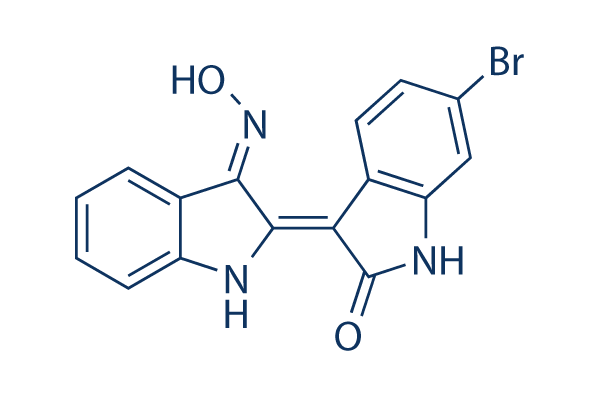
Chemische Struktur
Molekulargewicht: 356.17
Qualitätskontrolle
| Verwandte Ziele | PI3K Akt mTOR ATM/ATR DNA-PK AMPK PDPK1 PTEN PP2A PDK |
|---|---|
| Weitere GSK-3 Inhibitoren | CHIR-99021 (Laduviglusib) Laduviglusib (CHIR-99021) Hydrochloride SB216763 CHIR-98014 TWS119 LY2090314 Tideglusib SB415286 AR-A014418 IM-12 |
Zellkultur, Behandlung & Arbeitskonzentration
| Zelllinien | Assay-Typ | Konzentration | Inkubationszeit | Formulierung | Aktivitätsbeschreibung | PMID |
|---|---|---|---|---|---|---|
| HEI-OC1 | Function assay | Protection against cisplatin-induced cell death in neonatal mouse HEI-OC1 cells assessed as reduction in caspase-3/7 activity, EC50 = 0.192 μM. | 30091915 | |||
| SH-SY5Y | Function assay | Inhibition of GSK3-mediated beta-casein phosphorylation in human SH-SY5Y cells in presence of MG132 by Western blot analysis, IC50 = 0.29 μM. | 18816110 | |||
| K562 | Antiproliferative assay | 72 hrs | Antiproliferative activity against human K562 cells after 72 hrs by MTT assay, IC50 = 1.3 μM. | 19783149 | ||
| IMR90 | Antiproliferative assay | 72 hrs | Antiproliferative activity against human IMR90 cells after 72 hrs by MTT assay, IC50 = 1.9 μM. | 19783149 | ||
| HCT116 | Antiproliferative assay | 72 hrs | Antiproliferative activity against human HCT116 cells after 72 hrs by MTT assay, IC50 = 5.2 μM. | 19783149 | ||
| HepG2 | Cytotoxicity assay | 24 hrs | Cytotoxicity against human HepG2 cells assessed as cell growth inhibition after 24 hrs by alamar blue assay, IC50 = 5.3 μM. | 28743492 | ||
| HL60 | Antiproliferative assay | 5 days | Antiproliferative activity against human HL60 cells after 5 days by MTT assay, IC50 = 5.4 μM. | 19783149 | ||
| HuH7 | Antiproliferative assay | 72 hrs | Antiproliferative activity against human HuH7 cells after 72 hrs by MTT assay, IC50 = 6.2 μM. | 19783149 | ||
| SH-SY5Y | Cytotoxicity assay | 48 hrs | Cytotoxicity against human SH-SY5Y cells after 48 hrs by MTS reduction assay, IC50 = 9 μM. | 18816110 | ||
| SH-SY5Y | Function assay | 48 hrs | Survival of human SH-SY5Y cells after 48 hrs by MTS reduction assay, IC50 = 9.5 μM. | 16854069 | ||
| SH-SY5Y | Function assay | Death of human SH-SY5Y cells in absence of 20 uM Q-VD-OPh by MTS reduction assay, IC50 = 10 μM. | 16854069 | |||
| SH-SY5Y | Function assay | Death of human SH-SY5Y cells in presence of 20 uM Q-VD-OPh by MTS reduction assay, IC50 = 13 μM. | 16854069 | |||
| SH-SY5Y | Function assay | 24 hrs | Survival of human SH-SY5Y cells after 24 hrs by MTS reduction assay, IC50 = 18 μM. | 16854069 | ||
| IMR32 | Cytotoxicity assay | 48 hrs | Cytotoxicity against human IMR32 cells assessed as cell viability after 48 hrs by MTT assay | 21802947 | ||
| SK-N-SH | Cytotoxicity assay | 48 hrs | Cytotoxicity against human SK-N-SH cells assessed as cell viability after 48 hrs by MTT assay | 21802947 | ||
| NB39 | Cytotoxicity assay | 48 hrs | Cytotoxicity against human NB39 cells assessed as cell viability after 48 hrs by MTT assay | 21802947 | ||
| A673 | qHTS assay | qHTS of pediatric cancer cell lines to identify multiple opportunities for drug repurposing: Primary screen for A673 cells | 29435139 | |||
| DAOY | qHTS assay | qHTS of pediatric cancer cell lines to identify multiple opportunities for drug repurposing: Primary screen for DAOY cells | 29435139 | |||
| Saos-2 | qHTS assay | qHTS of pediatric cancer cell lines to identify multiple opportunities for drug repurposing: Primary screen for Saos-2 cells | 29435139 | |||
| BT-37 | qHTS assay | qHTS of pediatric cancer cell lines to identify multiple opportunities for drug repurposing: Primary screen for BT-37 cells | 29435139 | |||
| RD | qHTS assay | qHTS of pediatric cancer cell lines to identify multiple opportunities for drug repurposing: Primary screen for RD cells | 29435139 | |||
| SK-N-SH | qHTS assay | qHTS of pediatric cancer cell lines to identify multiple opportunities for drug repurposing: Primary screen for SK-N-SH cells | 29435139 | |||
| BT-12 | qHTS assay | qHTS of pediatric cancer cell lines to identify multiple opportunities for drug repurposing: Primary screen for BT-12 cells | 29435139 | |||
| MG 63 (6-TG R) | qHTS assay | qHTS of pediatric cancer cell lines to identify multiple opportunities for drug repurposing: Primary screen for MG 63 (6-TG R) cells | 29435139 | |||
| NB1643 | qHTS assay | qHTS of pediatric cancer cell lines to identify multiple opportunities for drug repurposing: Primary screen for NB1643 cells | 29435139 | |||
| OHS-50 | qHTS assay | qHTS of pediatric cancer cell lines to identify multiple opportunities for drug repurposing: Primary screen for OHS-50 cells | 29435139 | |||
| Rh41 | qHTS assay | qHTS of pediatric cancer cell lines to identify multiple opportunities for drug repurposing: Primary screen for Rh41 cells | 29435139 | |||
| Rh30 | qHTS assay | qHTS of pediatric cancer cell lines to identify multiple opportunities for drug repurposing: Primary screen for Rh30 cells | 29435139 | |||
| SJ-GBM2 | qHTS assay | qHTS of pediatric cancer cell lines to identify multiple opportunities for drug repurposing: Primary screen for SJ-GBM2 cells | 29435139 | |||
| SK-N-MC | qHTS assay | qHTS of pediatric cancer cell lines to identify multiple opportunities for drug repurposing: Primary screen for SK-N-MC cells | 29435139 | |||
| NB-EBc1 | qHTS assay | qHTS of pediatric cancer cell lines to identify multiple opportunities for drug repurposing: Primary screen for NB-EBc1 cells | 29435139 | |||
| LAN-5 | qHTS assay | qHTS of pediatric cancer cell lines to identify multiple opportunities for drug repurposing: Primary screen for LAN-5 cells | 29435139 | |||
| Rh18 | qHTS assay | qHTS of pediatric cancer cell lines to identify multiple opportunities for drug repurposing: Primary screen for Rh18 cells | 29435139 | |||
| A549 | Function assay | 10 uM | 15 mins | Inhibition of human mPGES1 from human A549 cells assessed as PGE2 at 10 uM after 15 mins by HPLC | 24697244 | |
| HEK293 | Function assay | 0.5 to 1 uM | Inhibition of human GSK3 activity in HEK293 cells containing the Wnt/beta-catenin activated reporter pSuperTOPFLASH (STF293 cells) at 0.5 to 1 uM by Wnt reporter gene assay | 24697244 | ||
| sf9 | Function assay | 1 uM | Inhibition of recombinant human N-terminal GST-tagged CDK4 (S4 to E303 residues)/Cyclin D1 (Q4 to I295 residues) expressed in sf9 cells at 1 uM using RB-CTF as substrate by filter binding assay | 28557430 | ||
| sf9 | Function assay | 1 uM | Inhibition of human N-terminal GST/His6-tagged GSK3beta (M1 to T420 residues) expressed in baculovirus infected sf9 cells at 1 uM using RBER-IRStide as substrate by filter binding assay | 28557430 | ||
| sf9 | Function assay | 1 uM | Inhibition of recombinant human N-terminal GST-tagged CDK2 (M1 to L298 residues)/Cyclin A2 (M1 to L432 residues) expressed in baculovirus infected sf9 cells at 1 uM using Histone H1 as substrate by filter binding assay | 28557430 | ||
| sf9 | Function assay | 1 uM | Inhibition of recombinant human N-terminal GST-tagged CDK5 (M1 to P292 residues)/p35NCK (M1 to R307 residues) expressed in baculovirus infected sf9 cells at 1 uM using RB-CTF as substrate by filter binding assay | 28557430 | ||
| sf9 | Function assay | 1 uM | Inhibition of human N-terminal GST/His6-tagged Aurora B (A2 to A344 residues) expressed in sf9 cells at 1 uM using tetra(LRRLSLG) as substrate by filter binding assay | 28557430 | ||
| sf9 | Function assay | 1 uM | Inhibition of human N-terminal GST/His6-tagged FGFR1 (G400 to R820 residues) expressed in baculovirus infected sf9 cells at 1 uM using Poly(Glu,Tyr)4:1 as substrate by filter binding assay | 28557430 | ||
| sf9 | Function assay | 1 uM | Inhibition of recombinant human N-terminal GST/His6-tagged CDK1 (M1 to M297 residues)/Cyclin B1 (M1 to V433 residues) expressed in sf9 cells at 1 uM using RB-CTF as substrate by filter binding assay | 28557430 | ||
| sf9 | Function assay | 1 uM | Inhibition of recombinant human N-terminal GST-tagged CDK2 (M1 to L298 residues)/Cyclin E1 (M1 to A395 residues) expressed in sf9 cells at 1 uM using RB-CTF as substrate by filter binding assay | 28557430 | ||
| sf9 | Function assay | 1 uM | Inhibition of human N-terminal GST/His6-tagged Aurora A (M1 to S403 residues) expressed in baculovirus infected sf9 cells at 1 uM using tetra(LRRLSLG) as substrate by filter binding assay | 28557430 | ||
| sf9 | Function assay | 1 uM | Inhibition of human N-terminal GST-tagged Aurora B (M1 to S27 residues) expressed in sf9 cells at 1 uM using CDC25C-derived peptide as substrate by filter binding assay | 28557430 | ||
| HT22 | Function assay | 10 uM | 24 hrs | Inhibition of GSK3-mediated beta casein phosphorylation in mouse HT22 cells at 10 uM after 24 hrs by Western blot analysis in presence of MG132 | 22998443 | |
| Klicken Sie hier, um weitere experimentelle Daten zu Zelllinien anzuzeigen | ||||||
Chemische Informationen, Lagerung & Stabilität
| Molekulargewicht | 356.17 | Formel | C16H10BrN3O2 |
Lagerung (Ab dem Eingangsdatum) | |
|---|---|---|---|---|---|
| CAS-Nr. | 667463-62-9 | SDF herunterladen | Lagerung von Stammlösungen |
|
|
| Synonyme | GSK-3 Inhibitor IX, 6-bromoindirubin-3-oxime, 6-Bromoindirubin-3'-oxime, MLS 2052 | Smiles | C1=CC=C2C(=C1)C(=C(N2)C3=C(NC4=C3C=CC(=C4)Br)O)N=O | ||
Löslichkeit
|
In vitro |
DMSO
: 71 mg/mL
(199.34 mM)
Ethanol : 7 mg/mL Water : Insoluble |
Molaritätsrechner
|
In vivo |
|||||
In-vivo-Formulierungsrechner (Klare Lösung)
Schritt 1: Geben Sie die untenstehenden Informationen ein (Empfohlen: Ein zusätzliches Tier zur Berücksichtigung von Verlusten während des Experiments)
Schritt 2: Geben Sie die In-vivo-Formulierung ein (Dies ist nur der Rechner, keine Formulierung. Bitte kontaktieren Sie uns zuerst, wenn es im Abschnitt "Löslichkeit" keine In-vivo-Formulierung gibt.)
Berechnungsergebnisse:
Arbeitskonzentration: mg/ml;
Methode zur Herstellung der DMSO-Stammlösung: mg Wirkstoff vorgelöst in μL DMSO ( Konzentration der Stammlösung mg/mL, Bitte kontaktieren Sie uns zuerst, wenn die Konzentration die DMSO-Löslichkeit der Wirkstoffcharge überschreitet. )
Methode zur Herstellung der In-vivo-Formulierung: Nehmen Sie μL DMSO Stammlösung, dann hinzufügenμL PEG300, mischen und klären, dann hinzufügenμL Tween 80, mischen und klären, dann hinzufügen μL ddH2O, mischen und klären.
Methode zur Herstellung der In-vivo-Formulierung: Nehmen Sie μL DMSO Stammlösung, dann hinzufügen μL Maisöl, mischen und klären.
Hinweis: 1. Bitte stellen Sie sicher, dass die Flüssigkeit klar ist, bevor Sie das nächste Lösungsmittel hinzufügen.
2. Achten Sie darauf, das/die Lösungsmittel der Reihe nach hinzuzufügen. Sie müssen sicherstellen, dass die bei der vorherigen Zugabe erhaltene Lösung eine klare Lösung ist, bevor Sie mit der Zugabe des nächsten Lösungsmittels fortfahren. Physikalische Methoden wie Vortex, Ultraschall oder ein heißes Wasserbad können zur Unterstützung des Lösens verwendet werden.
Wirkmechanismus
| Merkmale |
The first pharmacological agent shown to maintain self-renewal in human and mouse embryonic stem cells.
|
|---|---|
| Targets/IC50/Ki |
GSK-3
(Cell-free assay) 5 nM
TYK2
(Cell-free assay) 30 nM
CDK5/p35
(Cell-free assay) 0.08 μM
CDK2/CyclinA
(Cell-free assay) 0.30 μM
CDK1/CyclinB
(Cell-free assay) 0.32 μM
JAK3
(Cell-free assay) 0.5 μM
|
| In vitro |
BIO (6-Bromindirubin-3'-oxim) ist ein spezifischer Inhibitor der Glykogensynthase-Kinase-3 (GSK-3) mit einer IC50 von 5 nM für GSK-3α/β und zeigt eine >16-fache Selektivität gegenüber CDK5. Diese Verbindung interagiert innerhalb der ATP-Bindungstasche dieser Kinasen, reduziert die β-Catenin-Phosphorylierung an einer GSK-3-spezifischen Stelle in zellulären Modellen und imitiert die Wnt-Signalgebung in Xenopus-Embryonen eng. In menschlichen und murinen embryonalen Stammzellen erhält diese Chemikalie den undifferenzierten Phänotyp und unterstützt die Expression der pluripotenten Zustands-spezifischen Transkriptionsfaktoren Oct-3/4, Rex-1 und Nanog. Diese compound-vermittelte Wnt-Aktivierung ist funktionell reversibel, da der Entzug des Compounds zu normalen Multidifferenzierungsprogrammen sowohl in menschlichen als auch in murinen embryonalen Stammzellen führt. Es fördert die Proliferation in Säugetier-Kardiomyozyten. 6BIO ist auch ein Pan-JAK-Inhibitor mit IC50-Werten von 0,03, 1,5, 8,0, 0,5 μM für TYK2, JAK1, JAK2 und JAK3. Diese Verbindung hemmt selektiv die Phosphorylierung von STAT3 und induziert die Apoptose menschlicher Melanomzellen.
|
| Kinase-Assay |
Kinase-Assay
|
|
Kinase-Aktivitäten werden in Puffer A oder C bei 30 °C und einer finalen ATP-Konzentration von 15 μM bestimmt. Leerwerte werden subtrahiert und Aktivitäten als pmol Phosphat berechnet, das während einer 10-minütigen Inkubation eingebaut wurde. Kontrollen werden mit geeigneten Verdünnungen von Dimethylsulfoxid durchgeführt. In einigen Fällen wird die Phosphorylierung des Substrats durch Autoradiographie nach SDS-PAGE beurteilt. GSK-3α/β wird aus Schweinehirn durch Affinitätschromatographie an immobilisiertem Axin gereinigt. Es wird nach einer 1/100-Verdünnung in 1 mg BSA/ml 10 mM DTT mit 5 μl 40 μM GS-1-Peptid, einem spezifischen GSK-3-Substrat, (YRRAAVPPSPSLSRHSSPHQSpEDEEE), in Puffer A, in Gegenwart von 15 μM [γ-32P] ATP (3.000 Ci/mmol; 1 mCi/ml) in einem Endvolumen von 30 μl bestimmt. Nach 30 Minuten Inkubation bei 30 °C werden 25 μl Aliquots des Überstands auf 2,5 × 3 cm große Stücke Whatman P81 Phosphocellulosepapier getropft, und 20 Sekunden später werden die Filter fünfmal (für mindestens 5 Minuten jedes Mal) in einer Lösung von 10 ml Phosphorsäure/Liter Wasser gewaschen. Die nassen Filter werden in Gegenwart von 1 ml ACS-Szintillationsflüssigkeit gezählt.
|
|
| In vivo |
BIO unterdrückt das Wachstum von Melanomtumoren in einem Maus-Xenograft-Modell.
|
Literatur |
|
Anwendungen
| Methoden | Biomarker | Bilder | PMID |
|---|---|---|---|
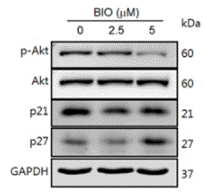
| Western blot | p-AKT / AKT / p21 / p27 p-β-catenin / β-catenin FoxO3a / FoxO1 / p-FoxO3a / p-FoxO1 |
|
27510556 |
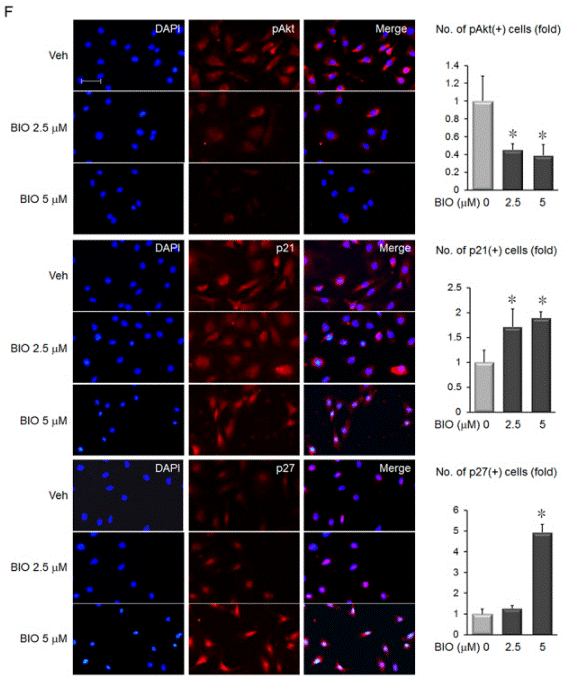
| Immunofluorescence | pAKT / p21 / p27 TNF-α E-cadherin / Nanog Oct3/4 |
|
27510556 |
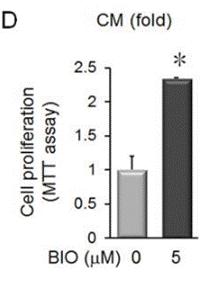
| Growth inhibition assay | Cell proliferation |
|
27510556 |
Klinische Studieninformationen
(Daten von https://clinicaltrials.gov, aktualisiert am 2024-05-22)
| NCT-Nummer | Rekrutierung | Erkrankungen | Sponsor/Kooperationspartner | Startdatum | Phasen |
|---|---|---|---|---|---|
| NCT06337422 | Not yet recruiting | Healthy Volunteer |
International Bio service |
September 23 2024 | Phase 1 |
| NCT04276857 | Not yet recruiting | Locally Advanced Pancreatic Cancer|Irreversible Electroporation |
University of Saskatchewan |
September 1 2024 | Not Applicable |
| NCT06359041 | Not yet recruiting | Generalized Myasthenia Gravis (gMG) |
Cabaletta Bio |
August 2024 | Phase 1|Phase 2 |
Technischer Support
Tel: +1-832-582-8158 Ext:3
Wenn Sie weitere Fragen haben, hinterlassen Sie bitte eine Nachricht.

Produkte sind nur für Forschungszwecke bestimmt. Nicht für den menschlichen Gebrauch. Wir verkaufen nicht an Patienten.
©Copyright 2013 Selleck Chemicals. Alle Rechte vorbehalten.