
nur für Forschungszwecke
Tideglusib GSK-3 Inhibitor
Kat.-Nr.: S2823
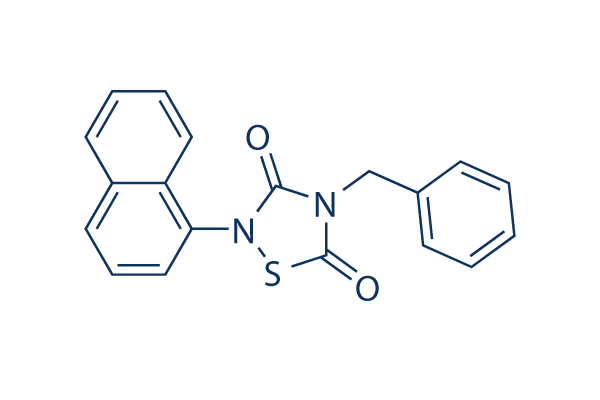
Chemische Struktur
Molekulargewicht: 334.39
Qualitätskontrolle (Quality Control)
| Verwandte Ziele | PI3K Akt mTOR ATM/ATR DNA-PK AMPK PDPK1 PTEN PI4K PP2A |
|---|---|
| Weitere GSK-3 Inhibitoren | CHIR-99021 (Laduviglusib) Laduviglusib (CHIR-99021) Hydrochloride SB216763 TWS119 CHIR-98014 GSK-3 Inhibitor IX (BIO) LY2090314 AR-A014418 SB415286 1-Azakenpaullone |
Zellkultur, Behandlung & Arbeitskonzentration
(Cell Culture, Treatment & Working Concentration)
| Zelllinien | Assay-Typ | Konzentration | Inkubationszeit | Formulierung | Aktivitätsbeschreibung | PMID |
|---|---|---|---|---|---|---|
| SH-SY5Y | Function assay | 10 uM | 1 hrs | Inhibition of GSK-3beta in human SH-SY5Y cells assessed as reduction in amyloid beta (25 to 35) -induced toxicity at 10 uM pre-incubated for 1 hrs before amyloid beta (25 to 35) addition and measured after 72 hrs post Abeta25-35 addition by MTT assay | 29208522 | |
| SH-SY5Y | Function assay | 30 uM | 1 hrs | Inhibition of GSK-3beta in human SH-SY5Y cells assessed as reduction in amyloid beta (25 to 35) -induced toxicity at 30 uM pre-incubated for 1 hrs before amyloid beta (25 to 35) addition and measured after 72 hrs post Abeta25-35 addition by MTT assay | 29208522 | |
| Klicken Sie hier, um weitere experimentelle Daten zu Zelllinien anzuzeigen | ||||||
Chemische Informationen, Lagerung & Stabilität (Chemical Information, Storage & Stability)
| Molekulargewicht | 334.39 | Formel | C19H14N2O2S |
Lagerung (Ab dem Eingangsdatum) | |
|---|---|---|---|---|---|
| CAS-Nr. | 865854-05-3 | SDF herunterladen | Lagerung von Stammlösungen |
|
|
| Synonyme | NP031112, NP-12 | Smiles | C1=CC=C(C=C1)CN2C(=O)N(SC2=O)C3=CC=CC4=CC=CC=C43 | ||
Löslichkeit (Solubility)
|
In vitro |
DMSO
: 1 mg/mL
(2.99 mM)
Water : Insoluble Ethanol : Insoluble |
Molaritätsrechner
|
In vivo |
|||||
In-vivo-Formulierungsrechner (Klare Lösung)
Schritt 1: Geben Sie die untenstehenden Informationen ein (Empfohlen: Ein zusätzliches Tier zur Berücksichtigung von Verlusten während des Experiments)
Schritt 2: Geben Sie die In-vivo-Formulierung ein (Dies ist nur der Rechner, keine Formulierung. Bitte kontaktieren Sie uns zuerst, wenn es im Abschnitt "Löslichkeit" keine In-vivo-Formulierung gibt.)
Berechnungsergebnisse:
Arbeitskonzentration: mg/ml;
Methode zur Herstellung der DMSO-Stammlösung: mg Wirkstoff vorgelöst in μL DMSO ( Konzentration der Stammlösung mg/mL, Bitte kontaktieren Sie uns zuerst, wenn die Konzentration die DMSO-Löslichkeit der Wirkstoffcharge überschreitet. )
Methode zur Herstellung der In-vivo-Formulierung: Nehmen Sie μL DMSO Stammlösung, dann hinzufügenμL PEG300, mischen und klären, dann hinzufügenμL Tween 80, mischen und klären, dann hinzufügen μL ddH2O, mischen und klären.
Methode zur Herstellung der In-vivo-Formulierung: Nehmen Sie μL DMSO Stammlösung, dann hinzufügen μL Maisöl, mischen und klären.
Hinweis: 1. Bitte stellen Sie sicher, dass die Flüssigkeit klar ist, bevor Sie das nächste Lösungsmittel hinzufügen.
2. Achten Sie darauf, das/die Lösungsmittel der Reihe nach hinzuzufügen. Sie müssen sicherstellen, dass die bei der vorherigen Zugabe erhaltene Lösung eine klare Lösung ist, bevor Sie mit der Zugabe des nächsten Lösungsmittels fortfahren. Physikalische Methoden wie Vortex, Ultraschall oder ein heißes Wasserbad können zur Unterstützung des Lösens verwendet werden.
Wirkmechanismus (Mechanism of Action)
| Targets/IC50/Ki |
GSK-3β
(Cell-free assay) 60 nM
|
|---|---|
| In vitro |
Tideglusib irreversibly inhibits GSK-3, reduces tau phosphorylation, and prevents apoptotic death in human neuroblastoma cells and murineprimary neurons. This compound (2.5 μM) inhibits glutamate-induced glial activation as evidenced by decreased TNF-α and COX-2 expression in rat primary astrocyte or microglial cultures. It (2.5 μM) also exerts a potent neuroprotective effect on cortical neurons from glutamate-induced excitotoxicity as evidenced by significant reduction in the number of Annexin-V-positive cells in rat primary astrocyte or microglial cultures. |
| Kinase-Assay |
Bindungsexperimente mit radioaktiv markiertem Tideglusib
|
|
[35S]Tideglusib (207 Bq/nmol) bei 55 μM wird mit 5 μM GSK-3β für 1 h bei 25 °C in 315 μL 50 mM Tris-HCl, pH 7,5, enthaltend 150 mM NaCl und 0,1 mM EGTA inkubiert. Die Inkubation wird nach Zugabe von 35 μL desselben Puffers mit oder ohne 100 mM DTE um weitere 30 min verlängert. Schließlich wird ein drittes 40-μL-Aliquot jeder ursprünglichen Probe mit 10 μL denaturierendem Elektrophorese-Probenpuffer ohne Reduktionsmittel gemischt, und 35 μL dieses Gemischs werden auf ein 10%-Polyacrylamidgel aufgetragen und einer SDS-PAGE unterzogen, gefolgt von einer Fluorographie des getrockneten Gels.
|
|
| In vivo |
Tideglusib (50 mg/kg) injected into the adult male Wistar rats hippocampus dramatically reduces kainic acid-induced inflammation and has a neuroprotective effect in the damaged areas of the hippocampus. This compound (200 mg/kg, oral) results in lower levels of tau phosphorylation, decreased amyloid deposition and plaque-associated astrocytic proliferation, protection of neurons in the entorhinal cortex and CA1 hippocampal subfield against cell death, and prevention of memory deficits in APP/tau double transgenic mice. |
Literatur |
|
Anwendungen (Applications)
| Methoden | Biomarker | Bilder | PMID |
|---|---|---|---|
| Western blot | KDM1A / Nestin / OCT4 / CD133 / Tuj-1 |

|
27501329 |
| Growth inhibition assay | Cell viability |

|
27501329 |
Klinische Studieninformationen (Clinical Trial Information)
(Daten von https://clinicaltrials.gov, aktualisiert am 2026-03-12)
| NCT-Nummer | Rekrutierung | Erkrankungen | Sponsor/Kooperationspartner | Startdatum | Phasen |
|---|---|---|---|---|---|
| NCT06174220 | RECRUITING | Arrhythmogenic Cardiomyopathy; Arrhythmogenic Right Ventricular Cardiomyopathy |
Hamilton Health Sciences Corporation |
2025-03-21 | PHASE2 |
| NCT05004129 | RECRUITING | Congenital Myotonic Dystrophy |
AMO Pharma Limited |
2021-08-23 | PHASE2; PHASE3 |
| NCT05105958 | NOT_YET_RECRUITING | Amyotrophic Lateral Sclerosis |
University of Zurich |
2025-12-01 | PHASE2 |
| NCT03692312 | COMPLETED | Congenital Myotonic Dystrophy |
AMO Pharma Limited |
2021-03-03 | PHASE2; PHASE3 |
| NCT02586935 | COMPLETED | Autism Spectrum Disorders |
Holland Bloorview Kids Rehabilitation Hospital |
2016-02-10 | PHASE2 |
| NCT02858908 | COMPLETED | Myotonic Dystrophy 1 |
AMO Pharma Limited |
2016-07-20 | PHASE2 |
Häufig gestellte Fragen (Frequently Asked Questions)
Frage 1:
I want to deliver it via i.p. injection, can you suggest one?
Antwort:
This compound can be dissolved in 4% DMSO+corn oil at 2.5 mg/ml clearly. This is the highest concentration, since its solubility in DMSO is pretty low.

Produkte sind nur für Forschungszwecke bestimmt. Nicht für den menschlichen Gebrauch. Wir verkaufen nicht an Patienten.
©Copyright 2013 Selleck Chemicals. Alle Rechte vorbehalten.