
nur für Forschungszwecke
CHIR-98014 GSK-3 Inhibitor
Kat.-Nr.S2745
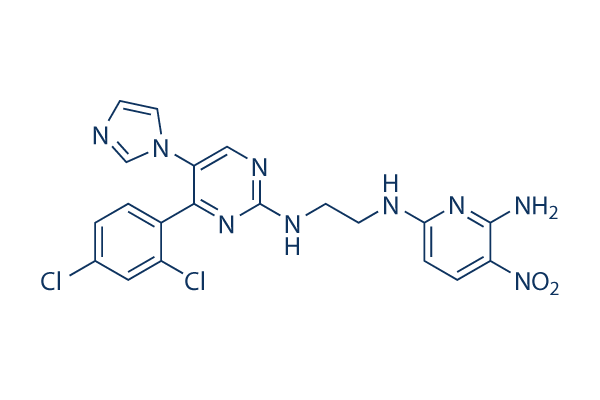
Chemische Struktur
Molekulargewicht: 486.31
Qualitätskontrolle
| Verwandte Ziele | PI3K Akt mTOR ATM/ATR DNA-PK AMPK PDPK1 PTEN PP2A PDK |
|---|---|
| Weitere GSK-3 Inhibitoren | CHIR-99021 (Laduviglusib) Laduviglusib (CHIR-99021) Hydrochloride SB216763 TWS119 GSK-3 Inhibitor IX (BIO) LY2090314 Tideglusib SB415286 AR-A014418 IM-12 |
Zellkultur, Behandlung & Arbeitskonzentration
| Zelllinien | Assay-Typ | Konzentration | Inkubationszeit | Formulierung | Aktivitätsbeschreibung | PMID |
|---|---|---|---|---|---|---|
| BGC-823 | Proliferation assay | 50 nM | 48 h | abrogated rLMO3 protein-induced proliferation | 29436606 | |
| HGC-27 | Proliferation assay | 50 nM | 48 h | abrogated rLMO3 protein-induced proliferation | 29436606 | |
| DAOY | qHTS assay | qHTS of pediatric cancer cell lines to identify multiple opportunities for drug repurposing: Primary screen for DAOY cells | 29435139 | |||
| SJ-GBM2 | qHTS assay | qHTS of pediatric cancer cell lines to identify multiple opportunities for drug repurposing: Primary screen for SJ-GBM2 cells | 29435139 | |||
| A673 | qHTS assay | qHTS of pediatric cancer cell lines to identify multiple opportunities for drug repurposing: Primary screen for A673 cells | 29435139 | |||
| SK-N-MC | qHTS assay | qHTS of pediatric cancer cell lines to identify multiple opportunities for drug repurposing: Primary screen for SK-N-MC cells | 29435139 | |||
| NB-EBc1 | qHTS assay | qHTS of pediatric cancer cell lines to identify multiple opportunities for drug repurposing: Primary screen for NB-EBc1 cells | 29435139 | |||
| Saos-2 | qHTS assay | qHTS of pediatric cancer cell lines to identify multiple opportunities for drug repurposing: Primary screen for Saos-2 cells | 29435139 | |||
| NB1643 | qHTS assay | qHTS of pediatric cancer cell lines to identify multiple opportunities for drug repurposing: Primary screen for NB1643 cells | 29435139 | |||
| LAN-5 | qHTS assay | qHTS of pediatric cancer cell lines to identify multiple opportunities for drug repurposing: Primary screen for LAN-5 cells | 29435139 | |||
| BT-12 | qHTS assay | qHTS of pediatric cancer cell lines to identify multiple opportunities for drug repurposing: Primary screen for BT-12 cells | 29435139 | |||
| Rh18 | qHTS assay | qHTS of pediatric cancer cell lines to identify multiple opportunities for drug repurposing: Primary screen for Rh18 cells | 29435139 | |||
| OHS-50 | qHTS assay | qHTS of pediatric cancer cell lines to identify multiple opportunities for drug repurposing: Primary screen for OHS-50 cells | 29435139 | |||
| RD | qHTS assay | qHTS of pediatric cancer cell lines to identify multiple opportunities for drug repurposing: Primary screen for RD cells | 29435139 | |||
| MG 63 (6-TG R) | qHTS assay | qHTS of pediatric cancer cell lines to identify multiple opportunities for drug repurposing: Primary screen for MG 63 (6-TG R) cells | 29435139 | |||
| Klicken Sie hier, um weitere experimentelle Daten zu Zelllinien anzuzeigen | ||||||
Chemische Informationen, Lagerung & Stabilität
| Molekulargewicht | 486.31 | Formel | C20H17Cl2N9O2 |
Lagerung (Ab dem Eingangsdatum) | |
|---|---|---|---|---|---|
| CAS-Nr. | 252935-94-7 | SDF herunterladen | Lagerung von Stammlösungen |
|
|
| Synonyme | CT98014 | Smiles | C1=CC(=C(C=C1Cl)Cl)C2=NC(=NC=C2N3C=CN=C3)NCCNC4=NC(=C(C=C4)[N+](=O)[O-])N | ||
Löslichkeit
|
In vitro |
DMSO
: 10 mg/mL
(20.56 mM)
Water : Insoluble Ethanol : Insoluble |
Molaritätsrechner
|
In vivo |
|||||
In-vivo-Formulierungsrechner (Klare Lösung)
Schritt 1: Geben Sie die untenstehenden Informationen ein (Empfohlen: Ein zusätzliches Tier zur Berücksichtigung von Verlusten während des Experiments)
Schritt 2: Geben Sie die In-vivo-Formulierung ein (Dies ist nur der Rechner, keine Formulierung. Bitte kontaktieren Sie uns zuerst, wenn es im Abschnitt "Löslichkeit" keine In-vivo-Formulierung gibt.)
Berechnungsergebnisse:
Arbeitskonzentration: mg/ml;
Methode zur Herstellung der DMSO-Stammlösung: mg Wirkstoff vorgelöst in μL DMSO ( Konzentration der Stammlösung mg/mL, Bitte kontaktieren Sie uns zuerst, wenn die Konzentration die DMSO-Löslichkeit der Wirkstoffcharge überschreitet. )
Methode zur Herstellung der In-vivo-Formulierung: Nehmen Sie μL DMSO Stammlösung, dann hinzufügenμL PEG300, mischen und klären, dann hinzufügenμL Tween 80, mischen und klären, dann hinzufügen μL ddH2O, mischen und klären.
Methode zur Herstellung der In-vivo-Formulierung: Nehmen Sie μL DMSO Stammlösung, dann hinzufügen μL Maisöl, mischen und klären.
Hinweis: 1. Bitte stellen Sie sicher, dass die Flüssigkeit klar ist, bevor Sie das nächste Lösungsmittel hinzufügen.
2. Achten Sie darauf, das/die Lösungsmittel der Reihe nach hinzuzufügen. Sie müssen sicherstellen, dass die bei der vorherigen Zugabe erhaltene Lösung eine klare Lösung ist, bevor Sie mit der Zugabe des nächsten Lösungsmittels fortfahren. Physikalische Methoden wie Vortex, Ultraschall oder ein heißes Wasserbad können zur Unterstützung des Lösens verwendet werden.
Wirkmechanismus
| Targets/IC50/Ki |
GSK-3β
(Cell-free assay) 0.58 nM
GSK-3α
(Cell-free assay) 0.65 nM
|
|---|---|
| In vitro |
CHIR-98014 hemmt humane GSK-3β mit einem Ki von 0,87 nM. Diese Verbindung ist sehr wirksam bei der Prävention von murinem und Ratten-GSK-3. Obwohl es als einfacher kompetitiver Inhibitor der ATP-Bindung fungiert, zeigt es eine 500- bis >1000-fache Selektivität für GSK-3 gegenüber 20 anderen Proteinkinasen, einschließlich Cdc2, ERK2, Tie-2 und KDR. Dieser Inhibitor verhindert Cdc2 mit einer IC50 von 3,7 μM. Es zeigt jedoch eine ähnliche Potenz gegen die hochhomologen ɑ- und β-Isoformen von GSK-3. Bemerkenswert ist, dass es stark zwischen GSK-3 und seinen engsten Homologen CDC2 und ERK2 diskriminierte. Die Exposition von Insulinrezeptor-exprimierenden CHO-IR-Zellen oder primären Rattenhepatozyten gegenüber zunehmenden Konzentrationen dieser Chemikalie führt zu einer zwei- bis dreifachen Stimulation des GS-Aktivitätsverhältnisses über dem Grundwert. Die Konzentrationen, die zu einer halbmaximalen GS-Stimulation (EC50) führen, betragen 106 nM und 107 nM für CHO-IR- und Rattenhepatozyten.
|
| Kinase-Assay |
Kinase-Assays
|
|
Polypropylen-96-Well-Platten werden mit 300 μL/Well Puffer (50 mM Tris-HCl, 10 mM MgCl2, 1 mM EGTA, 1 mM Dithiothreitol, 25 mM β-Glycerophosphat, 1 mM NaF, 0,01 % BSA, pH 7,5) gefüllt, der Kinase, Peptidsubstrat und alle Aktivatoren enthält. CHIR-98014 oder Kontrollen werden in 3,5 μL DMSO zugegeben, gefolgt von 50 μL ATP-Stammlösung, um eine Endkonzentration von 1 μM ATP in allen zellfreien Assays zu erreichen. Nach der Inkubation werden dreifache 100-μL-Aliquote auf Combiplate-Acht-Platten übertragen, die 100 μL/Well 50 μM ATP und 20 mM EDTA enthalten. Nach 1 Stunde werden die Wells fünfmal mit PBS gespült, mit 200 μL Szintillationsflüssigkeit gefüllt, versiegelt, 30 Minuten stehengelassen und in einem Szintillationszähler gezählt. Alle Schritte werden bei Raumtemperatur durchgeführt.
|
|
| In vivo |
GSK-3-Inhibitor CHIR-98014 aktiviert das GS-Aktivitätsverhältnis in isoliertem Typ-I-Skelettmuskel von insulinsensiblen schlanken Zucker- und von insulinresistenten ZDF-Ratten. Soleus-Muskel, isoliert von ZDF-Ratten, zeigt eine signifikante Insulinresistenz für die Aktivierung von GS, reagierte aber auf 500 nM dieser Verbindung im gleichen Ausmaß (40 % Zunahme) wie Muskel von schlanken Zucker-Ratten. Bemerkenswerterweise ist die GS-Aktivierung durch Insulin plus diese Chemikalie im Muskel von schlanken Zucker-Ratten additiv und im Muskel von ZDF-Ratten größer als additiv. Die totale GS-Aktivität wird weder durch diesen Inhibitor noch durch Insulin in diesen Zellen und Muskeln verändert. In der Zwischenzeit beeinflusst diese Verbindung die Insulin-Dosis-Wirkungsbeziehung im Muskel von schlanken Tieren nicht. Die Reduktion der Hyperglykämie und die verbesserte Glukoseentsorgung sind nicht auf db/db-Mäuse und ZDF-Ratten beschränkt, da ähnliche Ergebnisse bei ob/ob-Mäusen, diätinduzierten diabetischen C57BL/6-Mäusen und glukoseintoleranten SHHF-Ratten beobachtet werden, die mit dieser Chemikalie behandelt wurden. Zusätzlich verringert diese Verbindung die Phosphorylierung (Ser396) des Tau-Proteins im Kortex und Hippocampus von postnatalen Ratten.
|
Literatur |
|
Anwendungen
| Methoden | Biomarker | Bilder | PMID |
|---|---|---|---|
| Western blot | p-AKT / AKT / p-GSK3β / GSK3β / β-catenin |
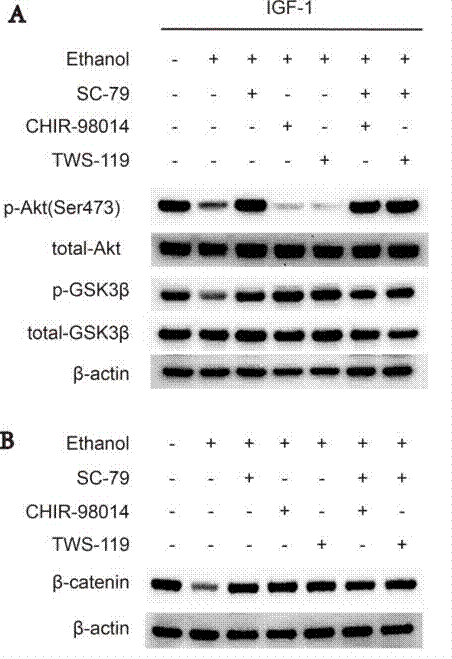
|
28415692 |
| Growth inhibition assay | Cell viability |
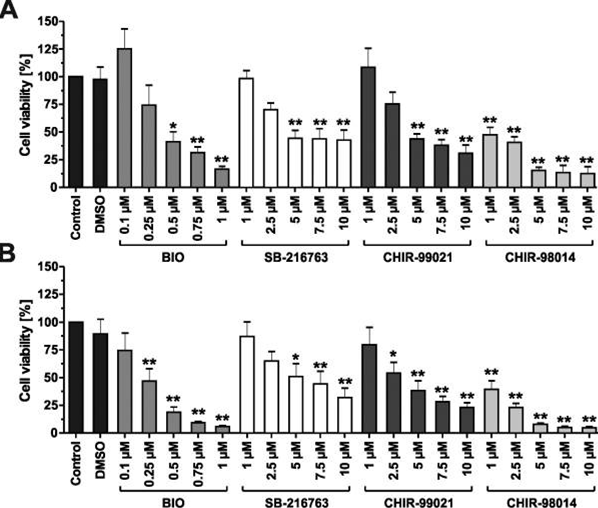
|
24779365 |
Technischer Support
Tel: +1-832-582-8158 Ext:3
Wenn Sie weitere Fragen haben, hinterlassen Sie bitte eine Nachricht.

Produkte sind nur für Forschungszwecke bestimmt. Nicht für den menschlichen Gebrauch. Wir verkaufen nicht an Patienten.
©Copyright 2013 Selleck Chemicals. Alle Rechte vorbehalten.