
nur für Forschungszwecke
TWS119 GSK-3 Inhibitor
Kat.-Nr.S1590
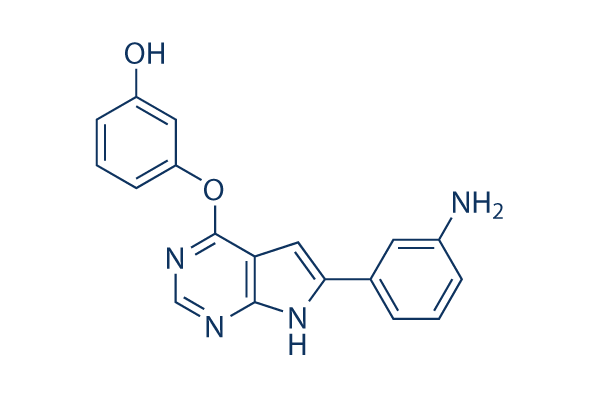
Chemische Struktur
Molekulargewicht: 318.33
Qualitätskontrolle
| Verwandte Ziele | PI3K Akt mTOR ATM/ATR DNA-PK AMPK PDPK1 PTEN PP2A PDK |
|---|---|
| Weitere GSK-3 Inhibitoren | CHIR-99021 (Laduviglusib) Laduviglusib (CHIR-99021) Hydrochloride SB216763 CHIR-98014 GSK-3 Inhibitor IX (BIO) LY2090314 Tideglusib SB415286 AR-A014418 IM-12 |
Zellkultur, Behandlung & Arbeitskonzentration
| Zelllinien | Assay-Typ | Konzentration | Inkubationszeit | Formulierung | Aktivitätsbeschreibung | PMID |
|---|---|---|---|---|---|---|
| RAW 264.7 | Cytotoxicity Assay | 0-10000ng/ml | 24 h | induces cell death in a dose dependent manner | 24330853 | |
| D3 | Function assay | Binding affinity to GSK-3 beta in mouse D3 cells, IC50=0.03μM. | 16408003 | |||
| D3 | Function assay | Inhibition of GSK-3 beta in mouse D3 cells, Kd=0.126μM. | 16408003 | |||
| D3 | Function assay | Inhibition of GSK-3 beta in mouse D3 cells assessed as induction of neuron specific marker neurofilament-M by immunofluorescence method, EC50=1μM. | 16408003 | |||
| D3 | Function assay | Inhibition of GSK-3 beta in mouse D3 cells assessed as induction of neuron specific marker microtubule-associated protein 2 by immunofluorescence method, EC50=1μM. | 16408003 | |||
| D3 | Function assay | Inhibition of GSK-3 beta in mouse D3 cells assessed as induction of neuron specific marker beta3-tubulin by immunofluorescence method, EC50=1μM. | 16408003 | |||
| DAOY | qHTS assay | qHTS of pediatric cancer cell lines to identify multiple opportunities for drug repurposing: Primary screen for DAOY cells | 29435139 | |||
| SJ-GBM2 | qHTS assay | qHTS of pediatric cancer cell lines to identify multiple opportunities for drug repurposing: Primary screen for SJ-GBM2 cells | 29435139 | |||
| A673 | qHTS assay | qHTS of pediatric cancer cell lines to identify multiple opportunities for drug repurposing: Primary screen for A673 cells | 29435139 | |||
| SK-N-MC | qHTS assay | qHTS of pediatric cancer cell lines to identify multiple opportunities for drug repurposing: Primary screen for SK-N-MC cells | 29435139 | |||
| NB-EBc1 | qHTS assay | qHTS of pediatric cancer cell lines to identify multiple opportunities for drug repurposing: Primary screen for NB-EBc1 cells | 29435139 | |||
| Saos-2 | qHTS assay | qHTS of pediatric cancer cell lines to identify multiple opportunities for drug repurposing: Primary screen for Saos-2 cells | 29435139 | |||
| SK-N-SH | qHTS assay | qHTS of pediatric cancer cell lines to identify multiple opportunities for drug repurposing: Primary screen for SK-N-SH cells | 29435139 | |||
| NB1643 | qHTS assay | qHTS of pediatric cancer cell lines to identify multiple opportunities for drug repurposing: Primary screen for NB1643 cells | 29435139 | |||
| LAN-5 | qHTS assay | qHTS of pediatric cancer cell lines to identify multiple opportunities for drug repurposing: Primary screen for LAN-5 cells | 29435139 | |||
| Rh18 | qHTS assay | qHTS of pediatric cancer cell lines to identify multiple opportunities for drug repurposing: Primary screen for Rh18 cells | 29435139 | |||
| RD | qHTS assay | qHTS of pediatric cancer cell lines to identify multiple opportunities for drug repurposing: Primary screen for RD cells | 29435139 | |||
| Rh41 | qHTS assay | qHTS of pediatric cancer cell lines to identify multiple opportunities for drug repurposing: Primary screen for Rh41 cells | 29435139 | |||
| Klicken Sie hier, um weitere experimentelle Daten zu Zelllinien anzuzeigen | ||||||
Chemische Informationen, Lagerung & Stabilität
| Molekulargewicht | 318.33 | Formel | C18H14N4O2 |
Lagerung (Ab dem Eingangsdatum) | |
|---|---|---|---|---|---|
| CAS-Nr. | 601514-19-6 | SDF herunterladen | Lagerung von Stammlösungen |
|
|
| Synonyme | N/A | Smiles | C1=CC(=CC(=C1)N)C2=CC3=C(N2)N=CN=C3OC4=CC=CC(=C4)O | ||
Löslichkeit
|
In vitro |
DMSO
: 64 mg/mL
(201.04 mM)
Water : Insoluble Ethanol : Insoluble |
Molaritätsrechner
|
In vivo |
|||||
In-vivo-Formulierungsrechner (Klare Lösung)
Schritt 1: Geben Sie die untenstehenden Informationen ein (Empfohlen: Ein zusätzliches Tier zur Berücksichtigung von Verlusten während des Experiments)
Schritt 2: Geben Sie die In-vivo-Formulierung ein (Dies ist nur der Rechner, keine Formulierung. Bitte kontaktieren Sie uns zuerst, wenn es im Abschnitt "Löslichkeit" keine In-vivo-Formulierung gibt.)
Berechnungsergebnisse:
Arbeitskonzentration: mg/ml;
Methode zur Herstellung der DMSO-Stammlösung: mg Wirkstoff vorgelöst in μL DMSO ( Konzentration der Stammlösung mg/mL, Bitte kontaktieren Sie uns zuerst, wenn die Konzentration die DMSO-Löslichkeit der Wirkstoffcharge überschreitet. )
Methode zur Herstellung der In-vivo-Formulierung: Nehmen Sie μL DMSO Stammlösung, dann hinzufügenμL PEG300, mischen und klären, dann hinzufügenμL Tween 80, mischen und klären, dann hinzufügen μL ddH2O, mischen und klären.
Methode zur Herstellung der In-vivo-Formulierung: Nehmen Sie μL DMSO Stammlösung, dann hinzufügen μL Maisöl, mischen und klären.
Hinweis: 1. Bitte stellen Sie sicher, dass die Flüssigkeit klar ist, bevor Sie das nächste Lösungsmittel hinzufügen.
2. Achten Sie darauf, das/die Lösungsmittel der Reihe nach hinzuzufügen. Sie müssen sicherstellen, dass die bei der vorherigen Zugabe erhaltene Lösung eine klare Lösung ist, bevor Sie mit der Zugabe des nächsten Lösungsmittels fortfahren. Physikalische Methoden wie Vortex, Ultraschall oder ein heißes Wasserbad können zur Unterstützung des Lösens verwendet werden.
Wirkmechanismus
| Targets/IC50/Ki |
GSK-3β
(Cell-free assay) 30 nM
|
|---|---|
| In vitro |
Die Behandlung einer Monolage von P19-Zellen mit 1 μM TWS119 führt dazu, dass sich 30–40 % der Zellen spezifisch in neuronale Linien differenzieren, basierend auf der Zählung von TuJ1-positiven Zellen mit korrekter neuronaler Morphologie (bis zu 60 % neuronale Differenzierung erfolgte durch das Standard-EB-Formationsprotokoll mit gleichzeitiger Behandlung mit dieser Verbindung). Diese Verbindung bindet fest an GSK-3β (K D = 126 nM), was durch Oberflächenplasmonenresonanz (SPR) quantifiziert wird und eine IC50 von 30 nM weiter demonstriert. Es wurde festgestellt, dass es die neuronale Differenzierung sowohl in murinen Embryonalkarzinom- als auch in ES-Zellen potent induziert. Die Behandlung von hepatischen Sternzellen (HSC) mit dieser Chemikalie führt zu einer reduzierten β-Catenin-Phosphorylierung, induziert die nukleäre Translokation von β-Catenin, erhöht die Glutaminsynthetaseproduktion, hemmt die Synthese von glattem Muskelaktin und Wnt5a, fördert aber die Expression von glialem fibrillärem saurem Protein, Wnt10b und dem gepaarten Homöodomänen-Transkriptionsfaktor 2c. Dieses Agens löst eine schnelle Akkumulation von β-Catenin aus (durchschnittlich 6,8-fache Zunahme durch Densitometrie), verstärkt die nukleäre Proteininteraktion mit Oligonukleotiden, die die DNA-Sequenzen enthalten, an die Tcf und Lef binden, und reguliert die Expression von Tcf7, Lef1 und anderen Wnt-Zielgenen, einschließlich Jun, Ezd7 (kodiert für Frizzled-7), Nlk (kodiert für Nemo-like Kinase), stark hoch. Es induziert eine dosisabhängige Abnahme des T-Zell-spezifischen Tötens und der IFN-γ-Freisetzung, verbunden mit der Erhaltung der Fähigkeit, IL-2 zu produzieren. Eine aktuelle Studie zeigt, dass die Wnt-Signalgebung in polyklonal aktivierten menschlichen T-Zellen durch die Behandlung mit dieser Verbindung induziert wird. Diese T-Zellen bewahren einen nativen CD45RA(+)CD62L(+)-Phänotyp im Vergleich zu kontroll-aktivierten T-Zellen, die zu einem CD45RO(+)CD62L(-)-Effektor-Phänotyp fortschreiten, und dies geschieht dosisabhängig von dieser Chemikalie. Die durch sie induzierte Wnt-Signalgebung reduziert die T-Zell-Expansion infolge einer Blockade der Zellteilung und beeinträchtigt die Akquisition der T-Zell-Effektorfunktion, gemessen an der Degranulation und IFN-γ-Produktion als Reaktion auf die T-Zell-Aktivierung. Die Blockade der T-Zell-Teilung kann auf eine reduzierte IL-2Rα-Expression in T-Zellen zurückgeführt werden, die mit diesem Agens behandelt wurden, was ihre Kapazität zur Nutzung von autokrinem IL-2 für die Expansion verringert.
|
| In vivo |
Eine Zellpopulation, die bei der Verabreichung von 30 mg/kg TWS119 niedrige CD44- und hohe CD62L-Spiegel auf der Zelloberfläche exprimierte.
|
Literatur |
|
Anwendungen
| Methoden | Biomarker | Bilder | PMID |
|---|---|---|---|
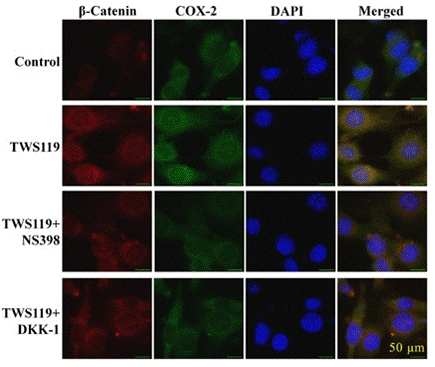
| Immunofluorescence | β-catenin / COX-2 |
|
30618773 |
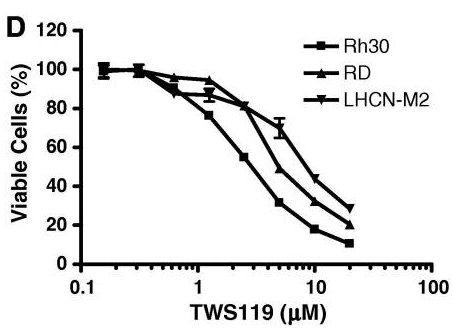
| Growth inhibition assay | Cell viability |
|
19995556 |
Technischer Support
Tel: +1-832-582-8158 Ext:3
Wenn Sie weitere Fragen haben, hinterlassen Sie bitte eine Nachricht.

Produkte sind nur für Forschungszwecke bestimmt. Nicht für den menschlichen Gebrauch. Wir verkaufen nicht an Patienten.
©Copyright 2013 Selleck Chemicals. Alle Rechte vorbehalten.