
nur für Forschungszwecke
IKK-16 IKK-Inhibitor
Kat.-Nr.S2882
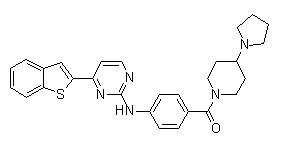
Chemische Struktur
Molekulargewicht: 483.63
Qualitätskontrolle
- In Nature Medicine für seine erstklassige Qualität zitiert
- COA
- NMR
- HPLC
- SDS
- Datenblatt
| Verwandte Ziele | NF-κB HDAC Antioxidant ROS Nrf2 AP-1 MALT NOD |
|---|---|
| Weitere IκB/IKK Inhibitoren | TBK1/IKKε-IN-5 Wedelolactone TPCA-1 BMS-345541 Bay 11-7085 IMD 0354 MRT67307 HCl SC-514 WS6 Mesalazine (5-ASA) |
Zellkultur, Behandlung & Arbeitskonzentration
| Zelllinien | Assay-Typ | Konzentration | Inkubationszeit | Formulierung | Aktivitätsbeschreibung | PMID |
|---|---|---|---|---|---|---|
| bovine retinal endothelial cells | Function assay | 30 mins | Inhibition of atypical PKCzeta in bovine retinal endothelial cells assessed as TNFalpha/VEGF-induced endothelial permeability preincubated for 30 mins followed by TNFalpha induction for 1 hr and VEGF induction for 30 mins measured every 30 mins for 4 hrs , EC50 = 0.002 μM. | 23566515 | ||
| HEK293 | Function assay | 3 hrs | Inhibition of atypical PKCzeta in HEK293 cells assessed as TNF-induced NFkappaB activation incubated for 3 hrs prior to TNF induction measured after 5 hrs by bright-glo luciferase reporter gene assay, EC50 = 0.003 μM. | 23566515 | ||
| HeLa | Function assay | Inhibitory activity against IKK complex isolated from HeLa cells, IC50 = 0.07 μM. | 16236504 | |||
| HUVEC | Function assay | Inhibition of TNF-alpha-stimulated expression of ICAM1 in HUVEC cells, IC50 = 0.3 μM. | 16236504 | |||
| HUVEC | Function assay | Inhibition of TNF-alpha-stimulated expression of VCAM1 in HUVEC cells, IC50 = 0.3 μM. | 16236504 | |||
| HUVEC | Function assay | Inhibition of TNF-alpha-stimulated expression of E-selectin in HUVEC cells, IC50 = 0.5 μM. | 16236504 | |||
| DAOY | qHTS assay | qHTS of pediatric cancer cell lines to identify multiple opportunities for drug repurposing: Primary screen for DAOY cells | 29435139 | |||
| SJ-GBM2 | qHTS assay | qHTS of pediatric cancer cell lines to identify multiple opportunities for drug repurposing: Primary screen for SJ-GBM2 cells | 29435139 | |||
| A673 | qHTS assay | qHTS of pediatric cancer cell lines to identify multiple opportunities for drug repurposing: Primary screen for A673 cells | 29435139 | |||
| SK-N-MC | qHTS assay | qHTS of pediatric cancer cell lines to identify multiple opportunities for drug repurposing: Primary screen for SK-N-MC cells | 29435139 | |||
| BT-37 | qHTS assay | qHTS of pediatric cancer cell lines to identify multiple opportunities for drug repurposing: Primary screen for BT-37 cells | 29435139 | |||
| NB-EBc1 | qHTS assay | qHTS of pediatric cancer cell lines to identify multiple opportunities for drug repurposing: Primary screen for NB-EBc1 cells | 29435139 | |||
| U-2 OS | qHTS assay | qHTS of pediatric cancer cell lines to identify multiple opportunities for drug repurposing: Primary screen for U-2 OS cells | 29435139 | |||
| Saos-2 | qHTS assay | qHTS of pediatric cancer cell lines to identify multiple opportunities for drug repurposing: Primary screen for Saos-2 cells | 29435139 | |||
| SK-N-SH | qHTS assay | qHTS of pediatric cancer cell lines to identify multiple opportunities for drug repurposing: Primary screen for SK-N-SH cells | 29435139 | |||
| NB1643 | qHTS assay | qHTS of pediatric cancer cell lines to identify multiple opportunities for drug repurposing: Primary screen for NB1643 cells | 29435139 | |||
| LAN-5 | qHTS assay | qHTS of pediatric cancer cell lines to identify multiple opportunities for drug repurposing: Primary screen for LAN-5 cells | 29435139 | |||
| BT-12 | qHTS assay | qHTS of pediatric cancer cell lines to identify multiple opportunities for drug repurposing: Primary screen for BT-12 cells | 29435139 | |||
| Rh18 | qHTS assay | qHTS of pediatric cancer cell lines to identify multiple opportunities for drug repurposing: Primary screen for Rh18 cells | 29435139 | |||
| OHS-50 | qHTS assay | qHTS of pediatric cancer cell lines to identify multiple opportunities for drug repurposing: Primary screen for OHS-50 cells | 29435139 | |||
| RD | qHTS assay | qHTS of pediatric cancer cell lines to identify multiple opportunities for drug repurposing: Primary screen for RD cells | 29435139 | |||
| MG 63 (6-TG R) | qHTS assay | qHTS of pediatric cancer cell lines to identify multiple opportunities for drug repurposing: Primary screen for MG 63 (6-TG R) cells | 29435139 | |||
| Rh30 | qHTS assay | qHTS of pediatric cancer cell lines to identify multiple opportunities for drug repurposing: Primary screen for Rh30 cells | 29435139 | |||
| Rh41 | qHTS assay | qHTS of pediatric cancer cell lines to identify multiple opportunities for drug repurposing: Primary screen for Rh41 cells | 29435139 | |||
| Klicken Sie hier, um weitere experimentelle Daten zu Zelllinien anzuzeigen | ||||||
Chemische Informationen, Lagerung & Stabilität
| Molekulargewicht | 483.63 | Formel | C28H29N5OS |
Lagerung (Ab dem Eingangsdatum) | |
|---|---|---|---|---|---|
| CAS-Nr. | 873225-46-8 | SDF herunterladen | Lagerung von Stammlösungen |
|
|
| Synonyme | IKK Inhibitor VII | Smiles | C1CCN(C1)C2CCN(CC2)C(=O)C3=CC=C(C=C3)NC4=NC=CC(=N4)C5=CC6=CC=CC=C6S5 | ||
Löslichkeit
|
In vitro |
DMSO
: 97 mg/mL
(200.56 mM)
Water : Insoluble Ethanol : Insoluble |
Molaritätsrechner
|
In vivo |
|||||
In-vivo-Formulierungsrechner (Klare Lösung)
Schritt 1: Geben Sie die untenstehenden Informationen ein (Empfohlen: Ein zusätzliches Tier zur Berücksichtigung von Verlusten während des Experiments)
Schritt 2: Geben Sie die In-vivo-Formulierung ein (Dies ist nur der Rechner, keine Formulierung. Bitte kontaktieren Sie uns zuerst, wenn es im Abschnitt "Löslichkeit" keine In-vivo-Formulierung gibt.)
Berechnungsergebnisse:
Arbeitskonzentration: mg/ml;
Methode zur Herstellung der DMSO-Stammlösung: mg Wirkstoff vorgelöst in μL DMSO ( Konzentration der Stammlösung mg/mL, Bitte kontaktieren Sie uns zuerst, wenn die Konzentration die DMSO-Löslichkeit der Wirkstoffcharge überschreitet. )
Methode zur Herstellung der In-vivo-Formulierung: Nehmen Sie μL DMSO Stammlösung, dann hinzufügenμL PEG300, mischen und klären, dann hinzufügenμL Tween 80, mischen und klären, dann hinzufügen μL ddH2O, mischen und klären.
Methode zur Herstellung der In-vivo-Formulierung: Nehmen Sie μL DMSO Stammlösung, dann hinzufügen μL Maisöl, mischen und klären.
Hinweis: 1. Bitte stellen Sie sicher, dass die Flüssigkeit klar ist, bevor Sie das nächste Lösungsmittel hinzufügen.
2. Achten Sie darauf, das/die Lösungsmittel der Reihe nach hinzuzufügen. Sie müssen sicherstellen, dass die bei der vorherigen Zugabe erhaltene Lösung eine klare Lösung ist, bevor Sie mit der Zugabe des nächsten Lösungsmittels fortfahren. Physikalische Methoden wie Vortex, Ultraschall oder ein heißes Wasserbad können zur Unterstützung des Lösens verwendet werden.
Wirkmechanismus
| Targets/IC50/Ki |
IKK2
(Cell-free assay) 40 nM
IKK complex
(Cell-free assay) 70 nM
IKK1
(Cell-free assay) 200 nM
|
|---|---|
| In vitro |
IKK-16 hemmt die TNFα-stimulierte Expression der Adhäsionsmoleküle E-selectin, ICAM-1 und VCAM-1 in HUVEC-Zellen. Obwohl diese Verbindung eine Aktivität bei der IFNγ-induzierten Expression von β2-Mikroglobulin oder HLA-DR zeigt, ist ihre Potenz in diesen Assays 4- bis 10-mal schwächer. |
| In vivo |
IKK-16 ist bei Ratten und Mäusen oral bioverfügbar und hemmt die LPS-induzierte TNF-α-Freisetzung in vivo und die Neutrophilenextravasation bei Thioglykolat-induzierter Peritonitis. |
Literatur |
Technischer Support
Tel: +1-832-582-8158 Ext:3
Wenn Sie weitere Fragen haben, hinterlassen Sie bitte eine Nachricht.

Produkte sind nur für Forschungszwecke bestimmt. Nicht für den menschlichen Gebrauch. Wir verkaufen nicht an Patienten.
©Copyright 2013 Selleck Chemicals. Alle Rechte vorbehalten.