
nur für Forschungszwecke
Lonidamine (AF 1890) Hexokinase Inhibitor
Kat.-Nr.: S2610
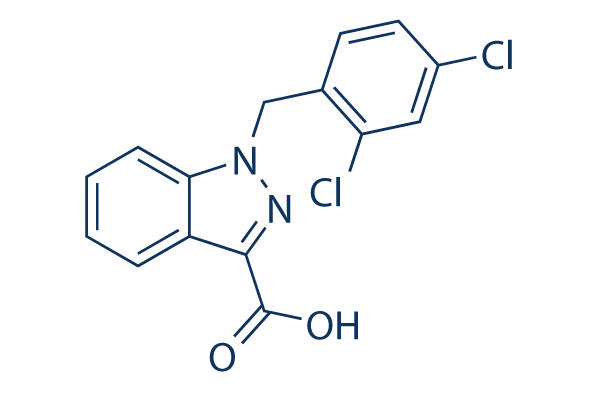
Chemische Struktur
Molekulargewicht: 321.16
Qualitätskontrolle (Quality Control)
Chemische Informationen, Lagerung & Stabilität (Chemical Information, Storage & Stability)
| Molekulargewicht | 321.16 | Formel | C15H10Cl2N2O2 |
Lagerung (Ab dem Eingangsdatum) | |
|---|---|---|---|---|---|
| CAS-Nr. | 50264-69-2 | SDF herunterladen | Lagerung von Stammlösungen |
|
|
| Synonyme | AF-1890, Diclondazolic Acid, DICA | Smiles | C1=CC=C2C(=C1)C(=NN2CC3=C(C=C(C=C3)Cl)Cl)C(=O)O | ||
Löslichkeit (Solubility)
|
In vitro |
DMSO
: 64 mg/mL
(199.27 mM)
Water : Insoluble Ethanol : Insoluble |
Molaritätsrechner
|
In vivo |
|||||
In-vivo-Formulierungsrechner (Klare Lösung)
Schritt 1: Geben Sie die untenstehenden Informationen ein (Empfohlen: Ein zusätzliches Tier zur Berücksichtigung von Verlusten während des Experiments)
Schritt 2: Geben Sie die In-vivo-Formulierung ein (Dies ist nur der Rechner, keine Formulierung. Bitte kontaktieren Sie uns zuerst, wenn es im Abschnitt "Löslichkeit" keine In-vivo-Formulierung gibt.)
Berechnungsergebnisse:
Arbeitskonzentration: mg/ml;
Methode zur Herstellung der DMSO-Stammlösung: mg Wirkstoff vorgelöst in μL DMSO ( Konzentration der Stammlösung mg/mL, Bitte kontaktieren Sie uns zuerst, wenn die Konzentration die DMSO-Löslichkeit der Wirkstoffcharge überschreitet. )
Methode zur Herstellung der In-vivo-Formulierung: Nehmen Sie μL DMSO Stammlösung, dann hinzufügenμL PEG300, mischen und klären, dann hinzufügenμL Tween 80, mischen und klären, dann hinzufügen μL ddH2O, mischen und klären.
Methode zur Herstellung der In-vivo-Formulierung: Nehmen Sie μL DMSO Stammlösung, dann hinzufügen μL Maisöl, mischen und klären.
Hinweis: 1. Bitte stellen Sie sicher, dass die Flüssigkeit klar ist, bevor Sie das nächste Lösungsmittel hinzufügen.
2. Achten Sie darauf, das/die Lösungsmittel der Reihe nach hinzuzufügen. Sie müssen sicherstellen, dass die bei der vorherigen Zugabe erhaltene Lösung eine klare Lösung ist, bevor Sie mit der Zugabe des nächsten Lösungsmittels fortfahren. Physikalische Methoden wie Vortex, Ultraschall oder ein heißes Wasserbad können zur Unterstützung des Lösens verwendet werden.
Wirkmechanismus (Mechanism of Action)
| Targets/IC50/Ki |
hexokinase
|
|---|---|
| In vitro |
Lonidamine reduces the oxygen consumption in both normal and neoplastic cells, while it increases the aerobic glycolysis of normal cells but inhibited that of tumor cells. This compound induces the permeabilization of ANT proteoliposomes in a cell-free system, yet has no effect on protein-free liposomes. It adds to synthetic planar lipid bilayers containing ANT, eliciting ANT channel activities with clearly distinct conductance levels. It provokes a disruption of the mitochondrial transmembrane potential which precedes signs of nuclear apoptosis and cytolysis. This chemical causes the dissipation of the mitochondrial inner transmembrane potential and the release of apoptogenic factors capable of inducing nuclear apoptosis in vitro. This compound (50 mg/mL) induces apoptosis in resistant cells (MCF-7 ADR(r) human breast cancer cell line, and LB9 glioblastoma multiform cell line), as demonstrated by sub-G1 peaks in DNA content histograms, condensation of nuclear chromatin, and internucleosomal DNA fragmentation. It has a stronger effect on glioblastoma cell proliferation and metabolism in vitro than did either agent used alone. |
| In vivo |
Lonidamine (160 mg/kg) in combination is significantly more effective in reducing glioblastoma tumor growth than either drug alone in mice, this tumor growth retardation is maintained as long as treatment is given. |
Literatur |
|
Klinische Studieninformationen (Clinical Trial Information)
(Daten von https://clinicaltrials.gov, aktualisiert am 2024-05-22)
| NCT-Nummer | Rekrutierung | Erkrankungen | Sponsor/Kooperationspartner | Startdatum | Phasen |
|---|---|---|---|---|---|
| NCT02758860 | Completed | Colonic Diverticula |
University of Roma La Sapienza |
2016-06 | -- |
| NCT00435448 | TERMINATED | Benign Prostatic Hyperplasia; Enlarged Prostate |
Threshold Pharmaceuticals |
2005-06 | PHASE3 |
| NCT00237536 | TERMINATED | Benign Prostatic Hyperplasia |
Threshold Pharmaceuticals |
2005-06 | PHASE2 |
| NCT00182078 | Completed | Posttraumatic Stress Disorder|Depression |
Massachusetts General Hospital |
2002-11 | Phase 4 |
Häufig gestellte Fragen (Frequently Asked Questions)
Frage 1:
Could you please test an in vivo formulation for this compound? Can it be administrated via i.p. injection?
Antwort:
The suggested IP formula of S2610 is 5%DMSO+30%PEG300+5%Tween-80+ddH2O.

Produkte sind nur für Forschungszwecke bestimmt. Nicht für den menschlichen Gebrauch. Wir verkaufen nicht an Patienten.
©Copyright 2013 Selleck Chemicals. Alle Rechte vorbehalten.