
nur für Forschungszwecke
ONC212 GPR Agonist
Kat.-Nr.S8673
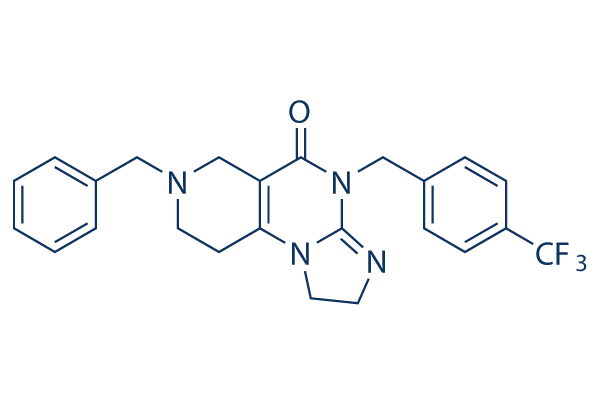
Chemische Struktur
Molekulargewicht: 440.46
Qualitätskontrolle
- In Nature Medicine für seine erstklassige Qualität zitiert
- COA
- NMR
- SDS
- Datenblatt
Chemische Informationen, Lagerung & Stabilität
| Molekulargewicht | 440.46 | Formel | C24H23F3N4O |
Lagerung (Ab dem Eingangsdatum) | |
|---|---|---|---|---|---|
| CAS-Nr. | 1807861-48-8 | SDF herunterladen | Lagerung von Stammlösungen |
|
|
| Synonyme | N/A | Smiles | C1CN(CC2=C1N3CCN=C3N(C2=O)CC4=CC=C(C=C4)C(F)(F)F)CC5=CC=CC=C5 | ||
Löslichkeit
|
In vitro |
DMSO
: 88 mg/mL
(199.79 mM)
Ethanol : 88 mg/mL Water : Insoluble |
Molaritätsrechner
|
In vivo |
|||||
In-vivo-Formulierungsrechner (Klare Lösung)
Schritt 1: Geben Sie die untenstehenden Informationen ein (Empfohlen: Ein zusätzliches Tier zur Berücksichtigung von Verlusten während des Experiments)
Schritt 2: Geben Sie die In-vivo-Formulierung ein (Dies ist nur der Rechner, keine Formulierung. Bitte kontaktieren Sie uns zuerst, wenn es im Abschnitt "Löslichkeit" keine In-vivo-Formulierung gibt.)
Berechnungsergebnisse:
Arbeitskonzentration: mg/ml;
Methode zur Herstellung der DMSO-Stammlösung: mg Wirkstoff vorgelöst in μL DMSO ( Konzentration der Stammlösung mg/mL, Bitte kontaktieren Sie uns zuerst, wenn die Konzentration die DMSO-Löslichkeit der Wirkstoffcharge überschreitet. )
Methode zur Herstellung der In-vivo-Formulierung: Nehmen Sie μL DMSO Stammlösung, dann hinzufügenμL PEG300, mischen und klären, dann hinzufügenμL Tween 80, mischen und klären, dann hinzufügen μL ddH2O, mischen und klären.
Methode zur Herstellung der In-vivo-Formulierung: Nehmen Sie μL DMSO Stammlösung, dann hinzufügen μL Maisöl, mischen und klären.
Hinweis: 1. Bitte stellen Sie sicher, dass die Flüssigkeit klar ist, bevor Sie das nächste Lösungsmittel hinzufügen.
2. Achten Sie darauf, das/die Lösungsmittel der Reihe nach hinzuzufügen. Sie müssen sicherstellen, dass die bei der vorherigen Zugabe erhaltene Lösung eine klare Lösung ist, bevor Sie mit der Zugabe des nächsten Lösungsmittels fortfahren. Physikalische Methoden wie Vortex, Ultraschall oder ein heißes Wasserbad können zur Unterstützung des Lösens verwendet werden.
Wirkmechanismus
| In vitro |
ONC212 zeigt eine antiproliferative Wirkung in einer großen Panel von Bauchspeicheldrüsenkrebs-Zelllinien, wobei diese Verbindung eine mindestens zehnfach erhöhte Potenz im Vergleich zu ONC201 aufweist. Es induziert Apoptose früher und bei niedrigeren Konzentrationen als ONC201 in sensitiven Bauchspeicheldrüsenkrebs-Zelllinien. Diese Verbindung übt potente und prominente apoptogene Wirkungen auf akute myeloische Leukämie (AML)- und Mantelzelllymphom (MCL)-Zelllinien aus (z. B. ED50-Werte von 141,0 nM in p53-Wildtyp-OCI-AML3-Zellen, 105,7 nM in MOLM13-Zellen und 265,2 nM in p53-null JeKo-1-Zelllinien). Die Zeitverlaufanalyse der Apoptose in OCI-AML3-Zellen zeigt, dass es mehr als 36 Stunden dauert, bis die Apoptose induziert wird. Diese Chemikalie induziert signifikant Sub-G1-apoptotische Zellen und/oder Zellzyklusarrest.
|
|---|---|
| In vivo |
ONC212 zeigt eine verbesserte Wirksamkeit in Melanom- und hepatozellulärem Karzinom-Xenograftmodellen. Diese Verbindung besitzt ein breites therapeutisches Fenster, ein akzeptables PK-Profil und ist oral gut verträglich in Mäusen ohne Anzeichen von Toxizität bei wirksamen Dosen sowohl bei Darm- als auch bei dreifach negativem Brustkrebs. Es zeigt eine schnelle Kinetik der Aktivität. Diese Chemikalie hat eine etwas kürzere Halbwertszeit als ONC201, mit einer Eliminierung aus dem Blut nach 12 Stunden, einer T1/2 von 4,3 Stunden und einer Cmax von 1,4 mg/mL. Es hat eine verlängerte pharmakodynamische Wirkung trotz systemischer Clearance. Die orale Verabreichung zeigt eine potente Antitumorwirksamkeit in einem humanen Melanom-Xenograft- und hepatozellulären Modell. ONC206 und ONC201 hemmen beide die Invasion und Migration von Tumorzellen, während diese Verbindung nur die Invasion hemmt.
|
Literatur |
|
Technischer Support
Tel: +1-832-582-8158 Ext:3
Wenn Sie weitere Fragen haben, hinterlassen Sie bitte eine Nachricht.

Produkte sind nur für Forschungszwecke bestimmt. Nicht für den menschlichen Gebrauch. Wir verkaufen nicht an Patienten.
©Copyright 2013 Selleck Chemicals. Alle Rechte vorbehalten.