
nur für Forschungszwecke
Rucaparib phosphate PARP Inhibitor
Kat.-Nr.S1098
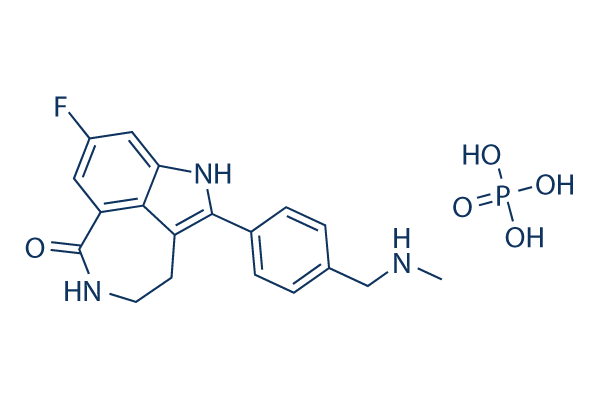
Chemische Struktur
Molekulargewicht: 421.36
Qualitätskontrolle
| Verwandte Ziele | HDAC ATM/ATR DNA-PK WRN DNA/RNA Synthesis Topoisomerase PPAR Sirtuin Casein Kinase eIF |
|---|---|
| Weitere PARP Inhibitoren | XAV-939 AZD5305 (Saruparib) Veliparib (ABT-888) PJ34 HCl AG-14361 Iniparib (BSI-201) G007-LK Pamiparib UPF 1069 A-966492 |
Zellkultur, Behandlung & Arbeitskonzentration
| Zelllinien | Assay-Typ | Konzentration | Inkubationszeit | Formulierung | Aktivitätsbeschreibung | PMID |
|---|---|---|---|---|---|---|
| BT-474 | Function Assay | 0.1/1/500/1000 nM | inhibits PARP activity at starting concerntration of 500 nM | 25128455 | ||
| BT474 | Growth Inhibition Assay | 500 nM | 10–15 d | reduces cell growth in the four lines and significantly | 25128455 | |
| SKBR3 | Growth Inhibition Assay | 500 nM | 10–15 d | reduces cell growth in the four lines and significantly | 25128455 | |
| AU565 | Growth Inhibition Assay | 500 nM | 10–15 d | reduces cell growth in the four lines and significantly | 25128455 | |
| EFM192A | Growth Inhibition Assay | 500 nM | 10–15 d | reduces cell growth in the four lines and significantly | 25128455 | |
| MDA-MB-231 | Function Assay | 10/20/40 μM | 24 h | increases p-AKT levels in a dose-dependent manner | 24420152 | |
| MDA-MB-231 | Cell Viability Assay | 0.1-40 μM | 24 h | IC50 = 17.77 μM | 24420152 | |
| MDA-MB-231 | Apoptosis Assay | 10/20/40 μM | 24 h | induces apoptosis dose dependently | 24420152 | |
| MDA-MB-231 | Growth Inhibition Assay | 10/20/40 μM | 24 h | blocks cell cycle progression in G2/M phase | 24420152 | |
| H460 | Growth Inhibition Assay | 400 nM | 24 h | increases cellular radiosensitivity | 24411611 | |
| A549 | Growth Inhibition Assay | 400 nM | 24 h | increases cellular radiosensitivity | 24411611 | |
| DT40 | Growth Inhibition Assay | IC50=21 nM | 24356813 | |||
| DU145 | Growth Inhibition Assay | IC50=18 nM | 24356813 | |||
| COLO704 | Growth Inhibition Assay | IC50=2.52 ± 0.67 μM | 23729402 | |||
| OVMANAb | Growth Inhibition Assay | IC50=2.58 ± 0.38 μM | 23729402 | |||
| OV177 | Growth Inhibition Assay | IC50=2.78 ± 0.71 μM | 23729402 | |||
| OAW28 | Growth Inhibition Assay | IC50=3.61 ± 0.28 μM | 23729402 | |||
| OVSAHO | Growth Inhibition Assay | IC50=3.64 ± 0.33 μM | 23729402 | |||
| OVKATE | Growth Inhibition Assay | IC50=3.64 ± 1.79 μM | 23729402 | |||
| OVCAR3 | Growth Inhibition Assay | IC50=3.74 ± 0.40 μM | 23729402 | |||
| PEO14 | Growth Inhibition Assay | IC50=3.84 ± 0.76 μM | 23729402 | |||
| A2780 | Growth Inhibition Assay | IC50=3.94 ± 0.25 μM | 23729402 | |||
| OVTOKO | Growth Inhibition Assay | IC50=4.14 ± 1.53 μM | 23729402 | |||
| KURAMOCHIb | Growth Inhibition Assay | IC50=4.34 ± 0.29 μM | 23729402 | |||
| TOV21G | Growth Inhibition Assay | IC50=5.07 ± 1.30 μM | 23729402 | |||
| OVISE | Growth Inhibition Assay | IC50=5.68 ± 0.23 μM | 23729402 | |||
| KK | Growth Inhibition Assay | IC50=6.15 ± 1.42 μM | 23729402 | |||
| RMUGS | Growth Inhibition Assay | IC50=7.03 ± 1.83 μM | 23729402 | |||
| PEO6 | Growth Inhibition Assay | IC50=7.06 ± 0.74 μM | 23729402 | |||
| OVCA429 | Growth Inhibition Assay | IC50=8.29 ± 1.64 μM | 23729402 | |||
| OV167 | Growth Inhibition Assay | IC50=8.33 ± 1.18 μM | 23729402 | |||
| RMG1 | Growth Inhibition Assay | IC50=9.32 ± 2.36 μM | 23729402 | |||
| OVCAR5 | Growth Inhibition Assay | IC50=9.50 ± 2.59 μM | 23729402 | |||
| EFO21 | Growth Inhibition Assay | IC50=9.92 ± 1.87 μM | 23729402 | |||
| ES2 | Growth Inhibition Assay | IC50=10.12 ± 1.23 μM | 23729402 | |||
| Tyk-nu | Growth Inhibition Assay | IC50=10.20 ± 1.12 μM | 23729402 | |||
| CAOV3 | Growth Inhibition Assay | IC50=10.37 ± 0.87 μM | 23729402 | |||
| OV207 | Growth Inhibition Assay | IC50=12.27 ± 0.32 μM | 23729402 | |||
| HEY | Growth Inhibition Assay | IC50=13.01 ± 0.75 μM | 23729402 | |||
| DOV13 | Growth Inhibition Assay | IC50>15 μM | 23729402 | |||
| EFO27 | Growth Inhibition Assay | IC50>15 μM | 23729402 | |||
| HEY C2 | Growth Inhibition Assay | IC50>15 μM | 23729402 | |||
| KOC-7cc | Growth Inhibition Assay | IC50>15 μM | 23729402 | |||
| MCASb | Growth Inhibition Assay | IC50>15 μM | 23729402 | |||
| OAW42 | Growth Inhibition Assay | IC50>15 μM | 23729402 | |||
| OV2008 | Growth Inhibition Assay | IC50>15 μM | 23729402 | |||
| OV90 | Growth Inhibition Assay | IC50>15 μM | 23729402 | |||
| OVCA420b | Growth Inhibition Assay | IC50>15 μM | 23729402 | |||
| OVCA432 | Growth Inhibition Assay | IC50>15 μM | 23729402 | |||
| PEA2 | Growth Inhibition Assay | IC50>15 μM | 23729402 | |||
| SKOV3 | Growth Inhibition Assay | IC50>15 μM | 23729402 | |||
| TOV112D | Growth Inhibition Assay | 0-3 μM | IC50>15 μM | 23729402 | ||
| C4-2 | Growth Inhibition Assay | 0-3 μM | 14 d | DMSO | decreases colony number dose dependently | 23565244 |
| PC3 | Growth Inhibition Assay | 0-3 μM | 14 d | DMSO | decreases colony number dose dependently | 23565244 |
| DU145 | Growth Inhibition Assay | 0-3 μM | 14 d | DMSO | decreases colony number dose dependently | 23565244 |
| VCaP | Growth Inhibition Assay | 0-3 μM | 14 d | DMSO | decreases colony number dose dependently | 23565244 |
| LNCaP | Growth Inhibition Assay | 0-3 μM | 14 d | DMSO | decreases colony number dose dependently | 23565244 |
| MDA-MB-468 | Cell Viability Assay | IC50=9.7 μM | 22678161 | |||
| MDA-MB-231 | Cell Viability Assay | IC50=13 μM | 22678161 | |||
| Cal-51 | Cell Viability Assay | IC50=8.6 μM | 22678161 | |||
| LoVo | Function assay | 30 mins | Inhibition of PARP in human LoVo cells assessed as inhibition of poly(ADP)-ribose polymerization for 30 mins by fluorescence assay, EC50 = 0.00469 μM. | 26652717 | ||
| MX1 | Cytotoxicity assay | Cytotoxicity against BRCA1-deficient human MX1 cells, EC50 = 0.0053 μM. | 26652717 | |||
| Rosetta2 (DE3) | Function assay | Inhibition of human N-terminal 6xhis-tagged ARTD6 (873 to 1161) expressed in Escherichia coli Rosetta2 (DE3) cells using NAD+ as substrate by fluorescence assay, IC50 = 0.014 μM. | 24900770 | |||
| Rosetta2 (DE3) | Function assay | Inhibition of human 6xhis-tagged ARTD5 (1030 to 1317) expressed in Escherichia coli Rosetta2 (DE3) cells using NAD+ as substrate by fluorescence assay, IC50 = 0.025 μM. | 24900770 | |||
| LoVo | Cytotoxicity assay | 0.4 uM | 5 days | Potentiation of temozolomide-induced cytotoxicity in human LoVo cells assessed as temozolomide GI50 at 0.4 uM after 5 days by Celltiter-Glo assay, GI50 = 0.144 μM. | 26652717 | |
| Capan1 | Cytotoxicity assay | Cytotoxicity against BRCA2-deficient human Capan1 cells, EC50 = 0.609 μM. | 26652717 | |||
| MDA-MB-436 | Anticancer assay | 96 hrs | Anticancer activity against human BRCA1-deficient MDA-MB-436 cells after 96 hrs by MTT assay, CC50 = 3 μM. | 26342868 | ||
| OVCAR3 | Antiproliferative assay | 24 hrs | Antiproliferative activity against human OVCAR3 cells after 24 hrs by MTT assay, IC50 = 3.31 μM. | 29456106 | ||
| MRC5 | Cytotoxicity assay | Cytotoxicity against human MRC5 cells, EC50 = 8.53 μM. | 26652717 | |||
| MCF7 | Anticancer assay | 96 hrs | Anticancer activity against human MCF7 cells after 96 hrs by MTT assay, CC50 = 19.47 μM. | 26342868 | ||
| A673 | qHTS assay | qHTS of pediatric cancer cell lines to identify multiple opportunities for drug repurposing: Primary screen for A673 cells | 29435139 | |||
| A673 | qHTS assay | qHTS of pediatric cancer cell lines to identify multiple opportunities for drug repurposing: Confirmatory screen for A673 cells) | 29435139 | |||
| Rh41 | qHTS assay | qHTS of pediatric cancer cell lines to identify multiple opportunities for drug repurposing: Confirmatory screen for Rh41 cells | 29435139 | |||
| SK-N-MC | qHTS assay | qHTS of pediatric cancer cell lines to identify multiple opportunities for drug repurposing: Confirmatory screen for SK-N-MC cells | 29435139 | |||
| TC32 | qHTS assay | qHTS of pediatric cancer cell lines to identify multiple opportunities for drug repurposing: Confirmatory screen for TC32 cells | 29435139 | |||
| Klicken Sie hier, um weitere experimentelle Daten zu Zelllinien anzuzeigen | ||||||
Chemische Informationen, Lagerung & Stabilität
| Molekulargewicht | 421.36 | Formel | C19H18FN3O.H3PO4 |
Lagerung (Ab dem Eingangsdatum) | |
|---|---|---|---|---|---|
| CAS-Nr. | 459868-92-9 | SDF herunterladen | Lagerung von Stammlösungen |
|
|
| Synonyme | AG-014699 phosphate, PF-01367338 phosphate | Smiles | CNCC1=CC=C(C=C1)C2=C3CCNC(=O)C4=C3C(=CC(=C4)F)N2.OP(=O)(O)O | ||
Löslichkeit
|
In vitro |
DMSO
: 85 mg/mL
(201.72 mM)
Water : 7 mg/mL Ethanol : Insoluble |
Molaritätsrechner
|
In vivo |
|||||
In-vivo-Formulierungsrechner (Klare Lösung)
Schritt 1: Geben Sie die untenstehenden Informationen ein (Empfohlen: Ein zusätzliches Tier zur Berücksichtigung von Verlusten während des Experiments)
Schritt 2: Geben Sie die In-vivo-Formulierung ein (Dies ist nur der Rechner, keine Formulierung. Bitte kontaktieren Sie uns zuerst, wenn es im Abschnitt "Löslichkeit" keine In-vivo-Formulierung gibt.)
Berechnungsergebnisse:
Arbeitskonzentration: mg/ml;
Methode zur Herstellung der DMSO-Stammlösung: mg Wirkstoff vorgelöst in μL DMSO ( Konzentration der Stammlösung mg/mL, Bitte kontaktieren Sie uns zuerst, wenn die Konzentration die DMSO-Löslichkeit der Wirkstoffcharge überschreitet. )
Methode zur Herstellung der In-vivo-Formulierung: Nehmen Sie μL DMSO Stammlösung, dann hinzufügenμL PEG300, mischen und klären, dann hinzufügenμL Tween 80, mischen und klären, dann hinzufügen μL ddH2O, mischen und klären.
Methode zur Herstellung der In-vivo-Formulierung: Nehmen Sie μL DMSO Stammlösung, dann hinzufügen μL Maisöl, mischen und klären.
Hinweis: 1. Bitte stellen Sie sicher, dass die Flüssigkeit klar ist, bevor Sie das nächste Lösungsmittel hinzufügen.
2. Achten Sie darauf, das/die Lösungsmittel der Reihe nach hinzuzufügen. Sie müssen sicherstellen, dass die bei der vorherigen Zugabe erhaltene Lösung eine klare Lösung ist, bevor Sie mit der Zugabe des nächsten Lösungsmittels fortfahren. Physikalische Methoden wie Vortex, Ultraschall oder ein heißes Wasserbad können zur Unterstützung des Lösens verwendet werden.
Wirkmechanismus
| Merkmale |
The first PARP inhibitor used in clinical trials combined with temozolomide.
|
|---|---|
| Targets/IC50/Ki |
PARP
(Cell-free assay) 1.4 nM(Ki)
|
| In vitro |
Rucaparib ist ein potenter Inhibitor der gereinigten humanen PARP-1 in voller Länge und zeigt eine höhere Hemmung der zellulären PARP in LoVo- und SW620-Zellen. Außerdem bindet Rucaparib nachweislich an acht weitere PARP-Domänen, darunter PARP2, 3, 4, 10, 15, 16, TNKS1 und TNKS2. Die Radiosensibilisierung durch Rucaparib beruht auf der nachgeschalteten Hemmung der NF-κB-Aktivierung und ist unabhängig von der SSB-Reparaturhemmung. Rucaparib könnte NF-κB angreifen, das durch DNA-Schäden aktiviert wird, und die bei klassischen NF-κB-Inhibitoren beobachtete Toxizität überwinden, ohne andere wichtige Entzündungsfunktionen zu beeinträchtigen. Rucaparib hemmt die PARP-1-Aktivität bei einer Konzentration von 1 μM in permeabilisierten D283Med-Zellen um 97,1 %.
|
| Kinase-Assay |
Ki-Bestimmung
|
|
Die Hemmung der humanen rekombinanten PARP-1 in voller Länge durch den Einbau von [32P]NAD+ wird gemessen. Das in säureunlösliches Material eingebaute [32P]ADP-Ribose wird mit einem PhosphorImager quantifiziert. Ki wird mittels nichtlinearer Regressionsanalyse berechnet.
|
|
| In vivo |
Rucaparib ist nicht toxisch, verstärkt aber signifikant die Temozolomid-induzierte TGD in DNA-Reparatur-kompetenten D384Med-Xenotransplantaten. Pharmakokinetische Studien zeigen auch, dass Rucaparib im Gehirngewebe nachgewiesen wird, was darauf hindeutet, dass Rucaparib Potenzial in der intrakraniellen Malignomtherapie hat. Rucaparib verstärkt signifikant die Zytotoxizität von Topotecan und Temozolomid in NB-1691-, SH-SY-5Y- und SKNBE(2c)-Zellen. Rucaparib verstärkt die Antitumoraktivität von Temozolomid und zeigt eine vollständige und anhaltende Tumorregression in NB1691- und SHSY5Y-Xenotransplantaten.
|
Literatur |
|
Anwendungen
| Methoden | Biomarker | Bilder | PMID |
|---|---|---|---|
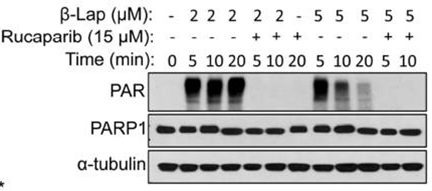
| Western blot | PAR BRCA1 |
|
27960087 |
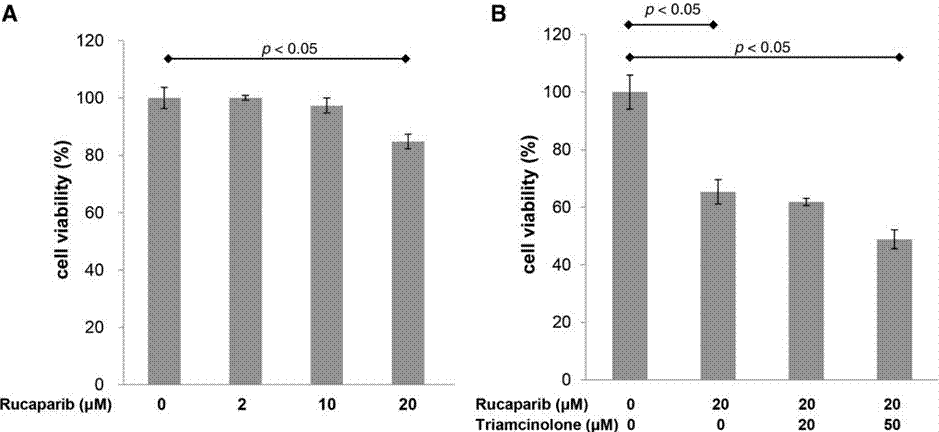
| Growth inhibition assay | Cell viability |
|
31119062 |
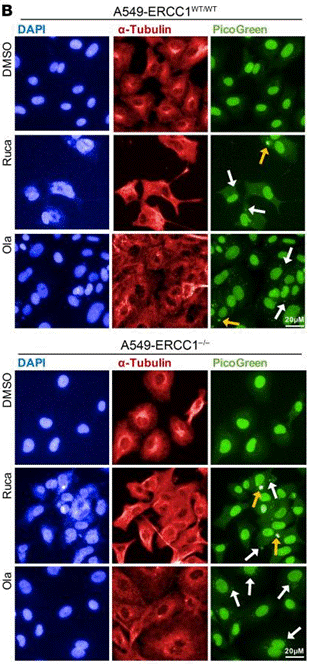
| Immunofluorescence | α-tubulin PAR γH2AX 53BP1 |
|
30589644 |
Klinische Studieninformationen
(Daten von https://clinicaltrials.gov, aktualisiert am 2024-05-22)
| NCT-Nummer | Rekrutierung | Erkrankungen | Sponsor/Kooperationspartner | Startdatum | Phasen |
|---|---|---|---|---|---|
| NCT04539327 | Completed | Epithelial Ovarian Cancer|Fallopian Tube Cancer|Primary Peritoneal Cancer |
Grupo Español de Investigación en Cáncer de Ovario|Clovis Oncology Inc. |
July 29 2020 | -- |
| NCT04209595 | Active not recruiting | Small Cell Lung Cancer|Extra-Pulmonary Small Cell Carcinomas |
National Cancer Institute (NCI)|National Institutes of Health Clinical Center (CC) |
April 8 2020 | Phase 1|Phase 2 |
| NCT04179396 | Completed | Metastatic Castration Resistant Prostate Cancer |
pharmaand GmbH |
December 5 2019 | Phase 1 |
| NCT03824704 | Terminated | Epithelial Ovarian Cancer|Fallopian Tube Cancer|Primary Peritoneal Carcinoma|High Grade Serous Carcinoma|Endometrioid Adenocarcinoma |
pharmaand GmbH|Bristol-Myers Squibb|Foundation Medicine |
August 23 2019 | Phase 2 |
| NCT03840200 | Completed | Breast Cancer|Prostate Cancer|Ovarian Cancer |
Hoffmann-La Roche |
June 12 2019 | Phase 1 |
Technischer Support
Tel: +1-832-582-8158 Ext:3
Wenn Sie weitere Fragen haben, hinterlassen Sie bitte eine Nachricht.

Produkte sind nur für Forschungszwecke bestimmt. Nicht für den menschlichen Gebrauch. Wir verkaufen nicht an Patienten.
©Copyright 2013 Selleck Chemicals. Alle Rechte vorbehalten.