
nur für Forschungszwecke
Mitoxantrone Dihydrochloride (NSC 301739) PKC/Topoisomerase II Inhibitor
Kat.-Nr.S2485
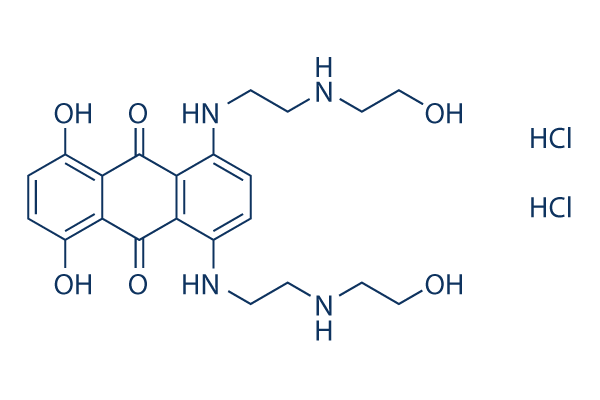
Chemische Struktur
Molekulargewicht: 517.4
Qualitätskontrolle
| Verwandte Ziele | HDAC PARP ATM/ATR DNA-PK WRN DNA/RNA Synthesis PPAR Sirtuin Casein Kinase eIF |
|---|---|
| Weitere Topoisomerase Inhibitoren | Camptothecin (CPT) Betulinic acid Beta-Lapachone (S)-10-Hydroxycamptothecin Amonafide Voreloxin (SNS-595) hydrochloride Ellagic acid Cu(II)-Elesclomol Hydroxy Camptothecine Rubitecan |
Zellkultur, Behandlung & Arbeitskonzentration
| Zelllinien | Assay-Typ | Konzentration | Inkubationszeit | Formulierung | Aktivitätsbeschreibung | PMID |
|---|---|---|---|---|---|---|
| L1210 cell | Cytotoxicity assay | 48 h | Cytotoxic potency required to inhibit L1210 cell growth by 50% after cell drug contact for 48 hrs, IC50=4e-05 μM | |||
| HL60 cells | Cytotoxicity assay | 48 h | Cytotoxicity against human HL60 cells after 48 hrs by MTT assay, GI50=0.33 μM | |||
| MDA435/LCC6 cells | Proliferation assay | Antiproliferative activity against MDA435/LCC6 cells by ELISA, IC50=0.35 nM | ||||
| A2780-cell | Growth inhibition assay | Concentration required to inhibit A2780-cell growth by 50%, IC50=0.55 nM | ||||
| G-361 cell | Growth inhibition assay | Cytotoxic potency required to inhibit G-361 cell growth by 50%, IC50=0.65 nM | ||||
| human HL60 cells | Proliferation assay | 72 h | Antiproliferative activity against human HL60 cells after 72 hrs by SRB assay, IC50=2.5 nM | |||
| human K562 cells | Cytotoxicity assay | 5 days | Cytotoxicity against human K562 cells after 5 days by XTT assay, IC50=2.6 nM | |||
| CH1 cell | Cytotoxicity assay | Cytotoxic potency required to inhibit CH1 cell growth by 50%, IC50=2.65 nM | ||||
| MES-SA cells | Proliferation assay | 72 h | Antiproliferative activity against MES-SA cells by MTT assay after 72 hrs, IC50=3 nM | |||
| A549 cells | Function assay | Activity against A549 cancer cell line, IC50=3.1 nM | ||||
| LoVo cells | Cytotoxicity assay | 144 h | Cytotoxicity against human LoVo cancer cell line was determined after 144 hr, IC50=3.3 nM | |||
| P388 cells | Proliferation assay | Antiproliferative activity against P388 cells by ELISA, IC50=4.3 nM | ||||
| human Daudi cells | Proliferation assay | 72 h | Antiproliferative activity against human Daudi cells after 72 hrs by MTT assay, IC50=5 nM | |||
| SKOV-3 cell | Cytotoxicity assay | Cytotoxic potency required to inhibit SKOV-3 cell growth 50%, IC50=5.3 nM | ||||
| OVCAR-3 cell | Function assay | Antitumor activity against human ovarian OVCAR-3 cell lines, IC50=5.8 nM | ||||
| human MES-SA cells | Proliferation assay | 72 h | Antiproliferative activity against human MES-SA cells after 72 hrs by MTT assay, IC50=6 nM | |||
| PC3 cancer cell | Cytotoxicity assay | 144 h | Cytotoxicity against human PC3 cancer cell line was determined after 144 hr, IC50=7 nM | |||
| MXF7 breast cell | Function assay | Antitumor activity against human mammary carcinoma sensitive MXF7 breast cell line, IC50=8.7 nM | ||||
| HT-29 cell | Cytotoxicity assay | 144 h | Cytotoxic potency required to inhibit HT-29 cell growth by 50% after cell drug contact for 144 hrs, IC5=0.01 μM | |||
| HEK293 cells | Cytotoxicity assay | 72 h | Cytotoxicity against HEK293 cells after 72 hrs by MTT assay, IC50=0.01 μM | |||
| MKN45 cells | Cytotoxicity assay | 144 h | Cytotoxicity against human MKN45 cancer cell line was determined after 144 hr, IC50=0.012 μM | |||
| MES-SA cells | Cytotoxicity assay | 72 h | Cytotoxicity against human MES-SA cells assessed as inhibition of cell proliferation after 72 hrs by MTT assay, IC50=0.012 μM | |||
| FM3 cells | Proliferation assay | 72 h | Antiproliferative activity against human FM3 cells after 72 hrs by MTT assay, IC50=0.013 μM | |||
| MCF-7 cells | Growth inhibition assay | Inhibitory activity against human tumor cell line MCF-7 breast adenocarcinoma, IC50=0.02 μM | ||||
| human small-cell lung cancer | Cytotoxicity assay | Cytotoxicity against human small-cell lung cancer (SCLC), IC50=0.02 μM | ||||
| human HCT116 cells | Cytotoxicity assay | 72 h | Cytotoxicity against human HCT116 cells assessed as inhibition of cell proliferation after 72 hrs by MTT assay, IC50=0.022 μM | |||
| human HCT116 cells | Proliferation assay | 72 h | Antiproliferative activity against human HCT116 cells after 72 hrs by MTT assay, IC50=0.025 μM | |||
| NCI-H460 cells | Cytotoxicity assay | 48 h | Cytotoxicity against human NCI-H460 cells after 48 hrs by resazurin dye assay, EC50=0.03 μM | |||
| CCRF-CEM cells | Cytotoxicity assay | 48 h | Cytotoxicity against human CCRF-CEM cells assessed as cell viability after 48 hrs by celltiter-blue assay, IC50=0.036 μM | |||
| HeLa cells | Proliferation assay | 72 h | Antiproliferative activity against human HeLa cells after 72 hrs by MTT assay, IC50=0.044 μM | |||
| NCI60 cells | Function assay | 48 h | Antitumor activity against human NCI60 cells after 48 hrs by SRB assay, GI50=47.86 nM | |||
| UACC375 cell | Function assay | Antitumor activity against human melanoma UACC375 cell line, IC50=0.048 μM | ||||
| HT1080 cell | Growth inhibition assay | Inhibitory activity against human tumor cell line HT1080, IC50=0.066 μM | ||||
| MES-SA/Dx5 cells | Proliferation assay | 72 h | Antiproliferative activity against human MES-SA/Dx5 cells after 72 hrs by MTT assay, IC50=0.073 μM | |||
| SF268 cells | Proliferation assay | 48 h | Antiproliferative activity against human SF268 cells after 48 hrs, EC50=0.32 μM | |||
| KB/HeLa cells | Proliferation assay | 48 h | Antiproliferative activity against human KB/HeLa cells after 48 hrs, EC50=0.36 μM | |||
| K562 cells | Growth inhibition assay | 72 h | Growth inhibition of human K562 cells after 72 hrs by MTS method, IC50=0.42 μM | |||
| MDA-MB-231 cells | Proliferation assay | 72 h | Antiproliferative activity against human MDA-MB-231 cells by WST-1 method after 72 hrs, IC50=0.96 μM | |||
| SF268 cells | Cytotoxicity assay | 48 h | Cytotoxicity against human SF268 cells after 48 hrs by SRB assay, GI50=0.97 μM | |||
| HCT116 cells | Cytotoxicity assay | Cytotoxicity against human HCT116 cells by MTT assay, IC50=3.96 μM | ||||
| U937 cells | Cytotoxicity assay | Cytotoxicity against human U937 cells by MTT assay, IC50=6.2 μM | ||||
| HepG2 cells | Proliferation assay | 48 h | Antiproliferative activity against human HepG2 cells after 48 hrs by MTT assay, IC50=11.05 μM | |||
| Klicken Sie hier, um weitere experimentelle Daten zu Zelllinien anzuzeigen | ||||||
Chemische Informationen, Lagerung & Stabilität
| Molekulargewicht | 517.4 | Formel | C22H29ClN4O6.2HCl |
Lagerung (Ab dem Eingangsdatum) | |
|---|---|---|---|---|---|
| CAS-Nr. | 70476-82-3 | SDF herunterladen | Lagerung von Stammlösungen |
|
|
| Synonyme | NSC-301739 2HCl, Mitozantrone 2HCl | Smiles | C1=CC(=C2C(=C1NCCNCCO)C(=O)C3=C(C=CC(=C3C2=O)O)O)NCCNCCO.Cl.Cl | ||
Löslichkeit
|
In vitro |
DMSO
: 104 mg/mL
(201.0 mM)
Water : 104 mg/mL Ethanol : Insoluble |
Molaritätsrechner
|
In vivo |
|||||
In-vivo-Formulierungsrechner (Klare Lösung)
Schritt 1: Geben Sie die untenstehenden Informationen ein (Empfohlen: Ein zusätzliches Tier zur Berücksichtigung von Verlusten während des Experiments)
Schritt 2: Geben Sie die In-vivo-Formulierung ein (Dies ist nur der Rechner, keine Formulierung. Bitte kontaktieren Sie uns zuerst, wenn es im Abschnitt "Löslichkeit" keine In-vivo-Formulierung gibt.)
Berechnungsergebnisse:
Arbeitskonzentration: mg/ml;
Methode zur Herstellung der DMSO-Stammlösung: mg Wirkstoff vorgelöst in μL DMSO ( Konzentration der Stammlösung mg/mL, Bitte kontaktieren Sie uns zuerst, wenn die Konzentration die DMSO-Löslichkeit der Wirkstoffcharge überschreitet. )
Methode zur Herstellung der In-vivo-Formulierung: Nehmen Sie μL DMSO Stammlösung, dann hinzufügenμL PEG300, mischen und klären, dann hinzufügenμL Tween 80, mischen und klären, dann hinzufügen μL ddH2O, mischen und klären.
Methode zur Herstellung der In-vivo-Formulierung: Nehmen Sie μL DMSO Stammlösung, dann hinzufügen μL Maisöl, mischen und klären.
Hinweis: 1. Bitte stellen Sie sicher, dass die Flüssigkeit klar ist, bevor Sie das nächste Lösungsmittel hinzufügen.
2. Achten Sie darauf, das/die Lösungsmittel der Reihe nach hinzuzufügen. Sie müssen sicherstellen, dass die bei der vorherigen Zugabe erhaltene Lösung eine klare Lösung ist, bevor Sie mit der Zugabe des nächsten Lösungsmittels fortfahren. Physikalische Methoden wie Vortex, Ultraschall oder ein heißes Wasserbad können zur Unterstützung des Lösens verwendet werden.
Wirkmechanismus
| Targets/IC50/Ki |
Topoisomerase II
PKC
(Cell-free assay) 8.5 μM
|
|---|---|
| In vitro |
Mitoxantrone induziert in allen untersuchten Patienten DNA-Fragmentierung und die proteolytische Spaltung der Poly(ADP-Ribose)-Polymerase (PARP), einen Marker für die Aktivierung von Caspasen, was zeigt, dass die zytotoxische Wirkung von Mitoxantrone auf der Induktion von Apoptose beruht. Mitoxantrone aktiviert NFkappaB und stimuliert den IkappaBalpha-Abbau in der promyelozytischen Leukämiezelllinie HL60, aber nicht in den Varianten, den HL60/MX2-Zellen, denen die Beta-Isoform der Topoisomerase II fehlt und die eine verkürzte Alpha-Isoform exprimieren, die zu einer veränderten subzellulären Verteilung führt. Mitoxantrone hemmt die Proliferation aktivierter PBMCs, B-Lymphozyten oder antigenspezifischer T-Zelllinien (TCLs), die auf Antigen-präsentierenden Zellen (APCs) stimuliert werden, dosisabhängig. Mitoxantrone induziert Apoptose von PBMCs, Monozyten und DCs bei niedrigen Konzentrationen, während höhere Dosen Zelllyse verursachen. |
| In vivo |
Mitoxantrone verringert vorübergehend die Wachstumsrate von HID-Xenografts bei Mäusen, beeinflusst jedoch nicht die von PAC120-Xenografts. Mitoxantrone führt zu einer Verschlimmerung der Herzläsionen sowie der Nephropathie und der intestinalen Toxizität bei spontan hypertensiven Ratten. Mitoxantrone und Eisen(III) bilden einen starken 2:1-Komplex, in dem Mitoxantrone als dreizähniger Ligand wirken kann. |
Literatur |
|
Anwendungen
| Methoden | Biomarker | Bilder | PMID |
|---|---|---|---|
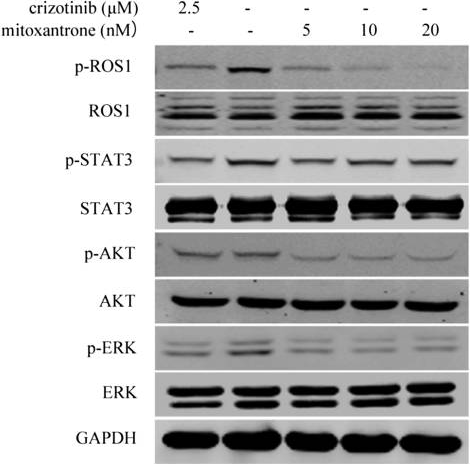
| Western blot | p-ROS1 / ROS1 / p-STAT3 / STAT3 / p-AKT / AKT / p-ERK / ERK |
|
30108778 |
| Growth inhibition assay | Cell number |

|
24349321 |
Klinische Studieninformationen
(Daten von https://clinicaltrials.gov, aktualisiert am 2024-05-22)
| NCT-Nummer | Rekrutierung | Erkrankungen | Sponsor/Kooperationspartner | Startdatum | Phasen |
|---|---|---|---|---|---|
| NCT06156761 | Not yet recruiting | Breast Cancer |
Cancer Institute and Hospital Chinese Academy of Medical Sciences|CSPC Ouyi Pharmaceutical Co. Ltd. |
November 28 2023 | Not Applicable |
| NCT05875428 | Recruiting | Diffuse Large B-Cell Lymphoma |
CSPC ZhongQi Pharmaceutical Technology Co. Ltd. |
July 10 2023 | Phase 2 |
| NCT05496894 | Withdrawn | Relapsing Multiple Sclerosis |
CSPC Zhongnuo Pharmaceutical (Shijiazhuang) Co. Ltd. |
August 2022 | Phase 2 |
Technischer Support
Tel: +1-832-582-8158 Ext:3
Wenn Sie weitere Fragen haben, hinterlassen Sie bitte eine Nachricht.

Produkte sind nur für Forschungszwecke bestimmt. Nicht für den menschlichen Gebrauch. Wir verkaufen nicht an Patienten.
©Copyright 2013 Selleck Chemicals. Alle Rechte vorbehalten.