
nur für Forschungszwecke
Apocynin NADPH-oxidase Inhibitor
Kat.-Nr.S2425
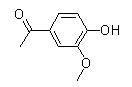
Chemische Struktur
Molekulargewicht: 166.17
Qualitätskontrolle
| Verwandte Ziele | PD-1/PD-L1 CXCR STING AhR Immunology & Inflammation related CD markers Interleukins Anti-infection Antioxidant COX |
|---|---|
| Weitere NADPH-oxidase Inhibitoren | Setanaxib (GKT137831) NAD+ (β-DPN) DPI (Diphenyleneiodonium chloride) 2-Acetylphenothiazine (ML171) GLX351322 GSK2795039 VAS2870 gp91ds-tat Isuzinaxib (APX-115 free base) |
Chemische Informationen, Lagerung & Stabilität
| Molekulargewicht | 166.17 | Formel | C9H10O3 |
Lagerung (Ab dem Eingangsdatum) | |
|---|---|---|---|---|---|
| CAS-Nr. | 498-02-2 | SDF herunterladen | Lagerung von Stammlösungen |
|
|
Löslichkeit
|
In vitro |
DMSO
: 33 mg/mL
(198.59 mM)
Ethanol : 33 mg/mL Water : Insoluble |
Molaritätsrechner
|
In vivo |
|||||
In-vivo-Formulierungsrechner (Klare Lösung)
Schritt 1: Geben Sie die untenstehenden Informationen ein (Empfohlen: Ein zusätzliches Tier zur Berücksichtigung von Verlusten während des Experiments)
Schritt 2: Geben Sie die In-vivo-Formulierung ein (Dies ist nur der Rechner, keine Formulierung. Bitte kontaktieren Sie uns zuerst, wenn es im Abschnitt "Löslichkeit" keine In-vivo-Formulierung gibt.)
Berechnungsergebnisse:
Arbeitskonzentration: mg/ml;
Methode zur Herstellung der DMSO-Stammlösung: mg Wirkstoff vorgelöst in μL DMSO ( Konzentration der Stammlösung mg/mL, Bitte kontaktieren Sie uns zuerst, wenn die Konzentration die DMSO-Löslichkeit der Wirkstoffcharge überschreitet. )
Methode zur Herstellung der In-vivo-Formulierung: Nehmen Sie μL DMSO Stammlösung, dann hinzufügenμL PEG300, mischen und klären, dann hinzufügenμL Tween 80, mischen und klären, dann hinzufügen μL ddH2O, mischen und klären.
Methode zur Herstellung der In-vivo-Formulierung: Nehmen Sie μL DMSO Stammlösung, dann hinzufügen μL Maisöl, mischen und klären.
Hinweis: 1. Bitte stellen Sie sicher, dass die Flüssigkeit klar ist, bevor Sie das nächste Lösungsmittel hinzufügen.
2. Achten Sie darauf, das/die Lösungsmittel der Reihe nach hinzuzufügen. Sie müssen sicherstellen, dass die bei der vorherigen Zugabe erhaltene Lösung eine klare Lösung ist, bevor Sie mit der Zugabe des nächsten Lösungsmittels fortfahren. Physikalische Methoden wie Vortex, Ultraschall oder ein heißes Wasserbad können zur Unterstützung des Lösens verwendet werden.
Wirkmechanismus
| Targets/IC50/Ki |
NADPH-oxidase
(Cell-free assay) 10 μM
|
|---|---|
| In vitro |
Apocynin ist ein natürlich vorkommendes Methoxy-substituiertes Catechol, das als Inhibitor der NADPH-Oxidase verwendet wird. Diese Verbindung verhindert die Serinphosphorylierung von p47phox und blockiert dessen Assoziation mit gp91phox, wodurch die Aktivierung der NADPH-Oxidase gedämpft wird. Es kann die Produktion von Superoxid (O(2)(-)) aus aktivierten Neutrophilen und Makrophagen verringern. Diese Chemikalie hemmt nach metabolischer Umwandlung die Assemblierung der NADPH-Oxidase, die für die Produktion reaktiver Sauerstoffspezies (ROS) verantwortlich ist.
|
| In vivo |
Apocynin besitzt entzündungshemmende Aktivität in einer Vielzahl von Zell- und Tiermodellen der Entzündung. Diese Verbindung dämpft die TNF-α- und IL-1β-Produktion sowie die iNOS-Expression in der Lunge von Carrageenan-behandelten Mäusen. Es zeigt vorteilhafte Wirkungen in einem Mausmodell der Rückenmarksverletzung. Diese Chemikalie reduziert (1) das Ausmaß der Rückenmarksschädigung, (2) die Neutrophileninfiltration, (3) die ICAM-1- und P-Selectin-Expression, (4) die PAR- und Nitrotyrosinbildung, (5) den IκB-α-Abbau, (6) die NF-κB-Aktivierung, (7) die Produktion proinflammatorischer Zytokine (TNF-α und IL-1β), (8) die Apoptose (TUNEL-Färbung, FAS-Ligandenexpression, Bax- und Bcl-2-Expression) und (9) die MAPK-Aktivierung (P-38 und phospho-JNK). LD50: Mäuse 9g/kg (i.g.).
|
Literatur |
|
Technischer Support
Tel: +1-832-582-8158 Ext:3
Wenn Sie weitere Fragen haben, hinterlassen Sie bitte eine Nachricht.

Produkte sind nur für Forschungszwecke bestimmt. Nicht für den menschlichen Gebrauch. Wir verkaufen nicht an Patienten.
©Copyright 2013 Selleck Chemicals. Alle Rechte vorbehalten.