
nur für Forschungszwecke
CAY10603 HDAC Inhibitor
Kat.-Nr.S7596
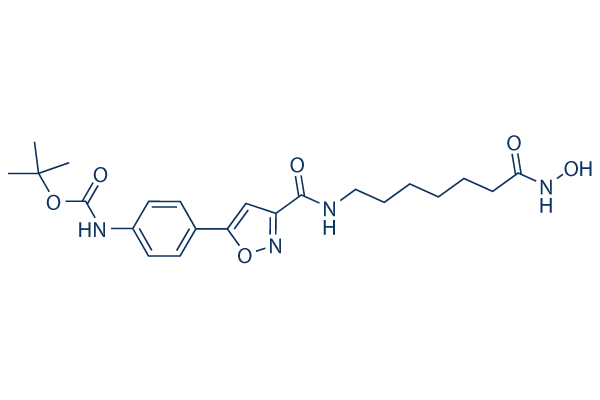
Chemische Struktur
Molekulargewicht: 446.5
Qualitätskontrolle
- In Nature Medicine für seine erstklassige Qualität zitiert
- COA
- NMR
- SDS
- Datenblatt
Zellkultur, Behandlung & Arbeitskonzentration
| Zelllinien | Assay-Typ | Konzentration | Inkubationszeit | Formulierung | Aktivitätsbeschreibung | PMID |
|---|---|---|---|---|---|---|
| human Panc04.03 cells | Proliferation assay | 72 h | Antiproliferative activity against human Panc04.03 cells after 72 hrs by MTT assay, IC50=0.1 μM | 18642892 | ||
| human MiaPaca2 cells | Proliferation assay | 72 h | Antiproliferative activity against human MiaPaca2 cells after 72 hrs by MTT assay, IC50=0.1 μM | 18642892 | ||
| human HupT3 cells | Proliferation assay | 72 h | Antiproliferative activity against human HupT3 cells after 72 hrs by MTT assay, IC50=0.3 μM | 18642892 | ||
| HPDE 6c7 cells | Cytotoxicity assay | 72 h | Cytotoxicity against HPDE 6c7 cells after 72 hrs by MTT assay, IC50=0.5 μM | 18642892 | ||
| human SU.86.86 cells | Proliferation assay | 72 h | Antiproliferative activity against human SU.86.86 cells after 72 hrs by MTT assay, IC50=0.6 μM | 18642892 | ||
| human BxPC3 cells | Proliferation assay | 72 h | Antiproliferative activity against human BxPC3 cells after 72 hrs by MTT assay, IC50=1 μM | 18642892 | ||
| HMEC | Cytotoxicity assay | 72 h | Cytotoxicity against HMEC after 72 hrs by MTT assay, IC50=1 μM | 18642892 | ||
| sf9 | Function assay | 5 to 10 mins | Inhibition of recombinant full length C-terminal His/FLAG tagged human HDAC1 (1 to 482 residues) expressed in baculovirus infected sf9 insect cells using p53 (379 to 382 residues) derived fluorogenic peptide RHKKAc as substrate preincubated for 5 to 10 mins, IC50=0.0032μM. | 31414801 | ||
| sf9 | Function assay | 5 to 10 mins | Inhibition of recombinant N-terminal GST-tagged human HDAC6 (1 to 1215 residues) expressed in baculovirus infected sf9 insect cells using p53 (379 to 382 residues) derived fluorogenic peptide RHKKAc as substrate preincubated for 5 to 10 mins, IC50=0.0138μM. | 31414801 | ||
| HeLa | Function assay | 2 hrs | Inhibition of dye-labeled tracer binding to HDAC10 (unknown origin) transfected in human HeLa cells measured after 2 hrs by nano-luciferase reporter gene-based BRET assay, IC50=0.79433μM. | 30964290 | ||
| TC32 | qHTS assay | qHTS of pediatric cancer cell lines to identify multiple opportunities for drug repurposing: Primary screen for TC32 cells | 29435139 | |||
| DAOY | qHTS assay | qHTS of pediatric cancer cell lines to identify multiple opportunities for drug repurposing: Primary screen for DAOY cells | 29435139 | |||
| SJ-GBM2 | qHTS assay | qHTS of pediatric cancer cell lines to identify multiple opportunities for drug repurposing: Primary screen for SJ-GBM2 cells | 29435139 | |||
| A673 | qHTS assay | qHTS of pediatric cancer cell lines to identify multiple opportunities for drug repurposing: Primary screen for A673 cells | 29435139 | |||
| SK-N-MC | qHTS assay | qHTS of pediatric cancer cell lines to identify multiple opportunities for drug repurposing: Primary screen for SK-N-MC cells | 29435139 | |||
| BT-37 | qHTS assay | qHTS of pediatric cancer cell lines to identify multiple opportunities for drug repurposing: Primary screen for BT-37 cells | 29435139 | |||
| NB-EBc1 | qHTS assay | qHTS of pediatric cancer cell lines to identify multiple opportunities for drug repurposing: Primary screen for NB-EBc1 cells | 29435139 | |||
| U-2 OS | qHTS assay | qHTS of pediatric cancer cell lines to identify multiple opportunities for drug repurposing: Primary screen for U-2 OS cells | 29435139 | |||
| Saos-2 | qHTS assay | qHTS of pediatric cancer cell lines to identify multiple opportunities for drug repurposing: Primary screen for Saos-2 cells | 29435139 | |||
| SK-N-SH | qHTS assay | qHTS of pediatric cancer cell lines to identify multiple opportunities for drug repurposing: Primary screen for SK-N-SH cells | 29435139 | |||
| NB1643 | qHTS assay | qHTS of pediatric cancer cell lines to identify multiple opportunities for drug repurposing: Primary screen for NB1643 cells | 29435139 | |||
| LAN-5 | qHTS assay | qHTS of pediatric cancer cell lines to identify multiple opportunities for drug repurposing: Primary screen for LAN-5 cells | 29435139 | |||
| BT-12 | qHTS assay | qHTS of pediatric cancer cell lines to identify multiple opportunities for drug repurposing: Primary screen for BT-12 cells | 29435139 | |||
| Rh18 | qHTS assay | qHTS of pediatric cancer cell lines to identify multiple opportunities for drug repurposing: Primary screen for Rh18 cells | 29435139 | |||
| OHS-50 | qHTS assay | qHTS of pediatric cancer cell lines to identify multiple opportunities for drug repurposing: Primary screen for OHS-50 cells | 29435139 | |||
| RD | qHTS assay | qHTS of pediatric cancer cell lines to identify multiple opportunities for drug repurposing: Primary screen for RD cells | 29435139 | |||
| Rh30 | qHTS assay | qHTS of pediatric cancer cell lines to identify multiple opportunities for drug repurposing: Primary screen for Rh30 cells | 29435139 | |||
| Rh41 | qHTS assay | qHTS of pediatric cancer cell lines to identify multiple opportunities for drug repurposing: Primary screen for Rh41 cells | 29435139 | |||
| NB1643 | qHTS assay | qHTS of pediatric cancer cell lines to identify multiple opportunities for drug repurposing: Confirmatory screen for NB1643 cells | 29435139 | |||
| A673 | qHTS assay | qHTS of pediatric cancer cell lines to identify multiple opportunities for drug repurposing: Confirmatory screen for A673 cells) | 29435139 | |||
| SK-N-MC | qHTS assay | qHTS of pediatric cancer cell lines to identify multiple opportunities for drug repurposing: Confirmatory screen for SK-N-MC cells | 29435139 | |||
| BT-12 | qHTS assay | qHTS of pediatric cancer cell lines to identify multiple opportunities for drug repurposing: Confirmatory screen for BT-12 cells | 29435139 | |||
| SJ-GBM2 | qHTS assay | qHTS of pediatric cancer cell lines to identify multiple opportunities for drug repurposing: Confirmatory screen for SJ-GBM2 cells | 29435139 | |||
| U-2 OS | qHTS assay | qHTS of pediatric cancer cell lines to identify multiple opportunities for drug repurposing: Confirmatory screen for U-2 OS cells | 29435139 | |||
| Rh41 | qHTS assay | qHTS of pediatric cancer cell lines to identify multiple opportunities for drug repurposing: Confirmatory screen for Rh41 cells | 29435139 | |||
| RD | qHTS assay | qHTS of pediatric cancer cell lines to identify multiple opportunities for drug repurposing: Confirmatory screen for RD cells | 29435139 | |||
| Rh18 | qHTS assay | qHTS of pediatric cancer cell lines to identify multiple opportunities for drug repurposing: Confirmatory screen for Rh18 cells | 29435139 | |||
| Rh30 | qHTS assay | qHTS of pediatric cancer cell lines to identify multiple opportunities for drug repurposing: Confirmatory screen for Rh30 cells | 29435139 | |||
| SK-N-SH | qHTS assay | qHTS of pediatric cancer cell lines to identify multiple opportunities for drug repurposing: Confirmatory screen for SK-N-SH cells | 29435139 | |||
| MV4-11 | Function assay | 1 hr | Binding affinity to HDAC6 in human MV4-11 cells assessed as increase in cellular protein stabilization at 1 uL preincubated for 1 hr followed by heating at 52 degree C for 3.5 mins by CETSA | 32212730 | ||
| Klicken Sie hier, um weitere experimentelle Daten zu Zelllinien anzuzeigen | ||||||
Chemische Informationen, Lagerung & Stabilität
| Molekulargewicht | 446.5 | Formel | C22H30N4O6 |
Lagerung (Ab dem Eingangsdatum) | |
|---|---|---|---|---|---|
| CAS-Nr. | 1045792-66-2 | SDF herunterladen | Lagerung von Stammlösungen |
|
|
| Synonyme | BML-281 | Smiles | CC(C)(C)OC(=O)NC1=CC=C(C=C1)C2=CC(=NO2)C(=O)NCCCCCCC(=O)NO | ||
Löslichkeit
|
In vitro |
DMSO
: 89 mg/mL
(199.32 mM)
Ethanol : 5 mg/mL Water : Insoluble |
Molaritätsrechner
|
In vivo |
|||||
In-vivo-Formulierungsrechner (Klare Lösung)
Schritt 1: Geben Sie die untenstehenden Informationen ein (Empfohlen: Ein zusätzliches Tier zur Berücksichtigung von Verlusten während des Experiments)
Schritt 2: Geben Sie die In-vivo-Formulierung ein (Dies ist nur der Rechner, keine Formulierung. Bitte kontaktieren Sie uns zuerst, wenn es im Abschnitt "Löslichkeit" keine In-vivo-Formulierung gibt.)
Berechnungsergebnisse:
Arbeitskonzentration: mg/ml;
Methode zur Herstellung der DMSO-Stammlösung: mg Wirkstoff vorgelöst in μL DMSO ( Konzentration der Stammlösung mg/mL, Bitte kontaktieren Sie uns zuerst, wenn die Konzentration die DMSO-Löslichkeit der Wirkstoffcharge überschreitet. )
Methode zur Herstellung der In-vivo-Formulierung: Nehmen Sie μL DMSO Stammlösung, dann hinzufügenμL PEG300, mischen und klären, dann hinzufügenμL Tween 80, mischen und klären, dann hinzufügen μL ddH2O, mischen und klären.
Methode zur Herstellung der In-vivo-Formulierung: Nehmen Sie μL DMSO Stammlösung, dann hinzufügen μL Maisöl, mischen und klären.
Hinweis: 1. Bitte stellen Sie sicher, dass die Flüssigkeit klar ist, bevor Sie das nächste Lösungsmittel hinzufügen.
2. Achten Sie darauf, das/die Lösungsmittel der Reihe nach hinzuzufügen. Sie müssen sicherstellen, dass die bei der vorherigen Zugabe erhaltene Lösung eine klare Lösung ist, bevor Sie mit der Zugabe des nächsten Lösungsmittels fortfahren. Physikalische Methoden wie Vortex, Ultraschall oder ein heißes Wasserbad können zur Unterstützung des Lösens verwendet werden.
Wirkmechanismus
| Targets/IC50/Ki |
HDAC6
(Cell-free assay) 2 pM
|
|---|---|
| In vitro |
CAY10603 zeigt über die Hemmung von HDAC6 eine potente antiproliferative Aktivität gegen Bauchspeicheldrüsenkrebszelllinien mit einer IC50 von <1 μM, die als neue molekulare Sonde zur Erforschung der HDAC-Biologie verwendet werden kann.
|
| Kinase-Assay |
HDAC-Inhibitions-Assays
|
|
Gereinigte HDACs werden 17 Stunden lang bei 25 °C in HDAC-Assay-Puffer, der 100 mM HEPES (pH 7,5), 25 mM KCl, 0,1 % BSA und 0,01 % Triton X-100 enthält, mit 1 mM Carboxyfluorescein (FAM)-markiertem acetyliertem Peptidsubstrat und der Testverbindung inkubiert. Die Reaktionen werden durch Zugabe von Puffer, der 0,078 % SDS enthält, für eine endgültige SDS-Konzentration von 0,05 % beendet. Substrat und Produkt werden elektrophoretisch unter Verwendung eines Caliper LabChip 3000-Systems mit blauer Laseranregung und grüner Fluoreszenzdetektion (CCD2) getrennt. Die Fluoreszenzintensität in den Substrat- und Produktpeaks wird mit der Well Analyzer-Software auf dem Caliper-System bestimmt. Die Reaktionen werden für jede Probe in Duplikaten durchgeführt. Die IC50-Werte werden automatisch mit dem IDBS XLFit Version 4.2.1 Plug-in für Microsoft Excel und dem XLFit 4-Parameter Logistikmodell berechnet: ((A+((B_A)/1+((C/x)D)))), wobei x die Verbindungskonzentration ist, A und B jeweils das geschätzte Minimum und Maximum der prozentualen Hemmung sind, C der Wendepunkt und D die Hill-Steigung der sigmoidalen Kurve ist. Die Standardfehler der IC50-Werte werden automatisch mit dem IDBS XLFit Version 4.2.1 Plug-in für Microsoft Excel und der Formel xf4_FitResultStdError berechnet.
|
Literatur |
Technischer Support
Tel: +1-832-582-8158 Ext:3
Wenn Sie weitere Fragen haben, hinterlassen Sie bitte eine Nachricht.
Häufig gestellte Fragen
Frage 1:
I want to use it and Tubastatin A via IP for mice. What can serve as the working solution instead of DMSO?
Antwort:
It can be dissolved in 5% DMSO+50% PEG 300+ddH2O at 9mg/ml as a clear solution. The dissolving protocol is the same as S8049.

Produkte sind nur für Forschungszwecke bestimmt. Nicht für den menschlichen Gebrauch. Wir verkaufen nicht an Patienten.
©Copyright 2013 Selleck Chemicals. Alle Rechte vorbehalten.