
nur für Forschungszwecke
FK866 (Daporinad) NAMPT-Inhibitor
Kat.-Nr.S2799
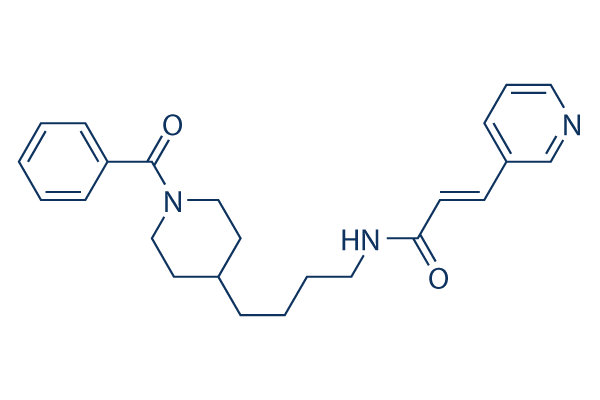
Chemische Struktur
Molekulargewicht: 391.51
Qualitätskontrolle
Produkte, die oft zusammen verwendet werden mit FK866 (Daporinad)
Zellkultur, Behandlung & Arbeitskonzentration
| Zelllinien | Assay-Typ | Konzentration | Inkubationszeit | Formulierung | Aktivitätsbeschreibung | PMID |
|---|---|---|---|---|---|---|
| SH-SY5Y | Cytotoxicity assay | Cytotoxicity against human SH-SY5Y cells assessed as reduction of total cellular NAD(P) level, IC50 = 0.0005 μM. | 19961183 | |||
| SH-SY5Y | Cytotoxicity assay | 48 hrs | Cytotoxicity against human SH-SY5Y cells assessed as cell viability after 48 hrs by MTT assay, IC50 = 0.0017 μM. | 19961183 | ||
| HT1080 | Cytotoxicity assay | 6 days | Cytotoxicity against human HT1080 cells after 6 days by SRB assay, IC50 = 0.16 μM. | 21330015 | ||
| A549 | Cytotoxicity assay | 6 days | Cytotoxicity against human A549 cells after 6 days by SRB assay, IC50 = 0.16 μM. | 21330015 | ||
| HCT116 | Cytotoxicity assay | 6 days | Cytotoxicity against human HCT116 cells after 6 days by SRB assay, IC50 = 0.16 μM. | 21330015 | ||
| SNU638 | Cytotoxicity assay | 6 days | Cytotoxicity against human SNU638 cells after 6 days by SRB assay, IC50 = 0.16 μM. | 21330015 | ||
| MCF7 | Antitumor assay | 10 uM | 6 days | Antitumor activity against human MCF7 cells at 10 uM after 6 days by SRB assay, IC50 = 0.68 μM. | 21330015 | |
| K562 | Cytotoxicity assay | 6 days | Cytotoxicity against human K562 cells after 6 days by SRB assay, IC50 = 20 μM. | 21330015 | ||
| A2780 | Cytotoxicity assay | 72 hrs | Cytotoxicity against human A2780 cells after 72 hrs by SRB assay, IC50 = 0.001 μM. | 23617784 | ||
| NYH | Cytotoxicity assay | 3 weeks | Cytotoxicity against human NYH cells after 3 weeks by clonogenic survival assay, LD50 = 0.0015 μM. | 23679915 | ||
| K562 | Cytotoxicity assay | 96 hrs | Cytotoxicity against human K562 cells after 96 hrs by MTT assay, IC50 = 0.0072 μM. | 23679915 | ||
| A2780 | Antiproliferative assay | 72 hrs | Antiproliferative activity against human A2780 cells assessed as growth inhibition after 72 hrs by SRB-based microplate reader analysis, IC50 = 0.001 μM. | 23859118 | ||
| NYH | Cytotoxicity assay | Cytotoxicity against human NYH cells by clonogenic assay, IC50 = 0.0015 μM. | 24164086 | |||
| A2780 | Cytotoxicity assay | 72 hrs | Cytotoxicity against human A2780 cells assessed as growth inhibition after 72 hrs by WST-1 assay, IC50 = 0.0016 μM. | 24164086 | ||
| HepG2 | Function assay | 1 hr | Inhibition of NAMPT in human HepG2 cells using [14C]-nicotinamide/PRPP as substrate assessed as formation of [14C]-nicotinamide mononucleotide after 1 hr by liquid scintillation counting analysis, IC50 = 0.0022 μM. | 24164086 | ||
| PC3 | Cytotoxicity assay | Cytotoxicity against human PC3 cells by clonogenic assay, IC50 = 0.0038 μM. | 24164086 | |||
| A2780 | Cytotoxicity assay | Cytotoxicity against human A2780 cells by clonogenic assay, IC50 = 0.0057 μM. | 24164086 | |||
| A431 | Cytotoxicity assay | Cytotoxicity against human A431 cells by clonogenic assay, IC50 = 0.0061 μM. | 24164086 | |||
| MCF-7 | Cytotoxicity assay | 72 hrs | Cytotoxicity against human MCF-7 cells assessed as growth inhibition after 72 hrs by WST-1 assay, IC50 = 0.0074 μM. | 24164086 | ||
| MCF7 | Cytotoxicity assay | Cytotoxicity against human MCF7 cells by clonogenic assay, IC50 = 0.0084 μM. | 24164086 | |||
| HCT116 | Cytotoxicity assay | 72 hrs | Cytotoxicity against human HCT116 cells assessed as growth inhibition after 72 hrs by WST-1 assay, IC50 = 0.0109 μM. | 24164086 | ||
| SKOV3 | Cytotoxicity assay | Cytotoxicity against human SKOV3 cells by clonogenic assay, IC50 = 0.211 μM. | 24164086 | |||
| HCT116 | Cytotoxicity assay | 72 hrs | Cytotoxicity against APO866-resistant human HCT116 cells assessed as growth inhibition after 72 hrs by WST-1 assay, IC50 = 0.946 μM. | 24164086 | ||
| A2780 | Antiproliferative assay | 72 hrs | Antiproliferative activity against human A2780 cells after 72 hrs by sulforhodamine B assay, IC50 = 0.001 μM. | 24405419 | ||
| A2780 | Function assay | 72 hrs | Inhibition of NAMPT in human A2780 cells assessed as decrease in cell viability after 72 hrs by SRB assay, IC50 = 0.001 μM. | 27541271 | ||
| DE3 | Function assay | 15 mins | Inhibition of human full length C-terminal His6-tagged NAMPT expressed in Escherichia coli Rosetta (DE3) cells using nicotinamide as substrate incubated for 15 mins prior to substrate addition measured after 30 mins in presence of PRPP, IC50 = 0.003 μM. | 27541271 | ||
| SH-SY5Y | Cytotoxicity assay | 56 hrs | Cytotoxicity against human SH-SY5Y cells assessed as reduction in cell viability after 56 hrs by MTT assay, EC50 = 0.0034 μM. | 28165742 | ||
| A2780 | Cytotoxicity assay | Cytotoxicity against human A2780 cells assessed as reduction in cell viability, IC50 = 0.0042 μM. | 28165742 | |||
| PC3 | Antiproliferative assay | 5 days | Antiproliferative activity against human PC3 cells assessed as reduction in cell viability incubated for 5 days by Cell-titer Glo reagent based assay, IC50 = 0.0057 μM. | 28610984 | ||
| HepG2 | Cytotoxicity assay | 72 hrs | Cytotoxicity in human HepG2 cells assessed as reduction in cell viability after 72 hrs by MTT assay, IC50 = 0.89 μM. | 28885834 | ||
| MDA-MB-231 | Cytotoxicity assay | 72 hrs | Cytotoxicity in human MDA-MB-231 cells assessed as reduction in cell viability after 72 hrs by MTT assay, IC50 = 1.3 μM. | 28885834 | ||
| HCT116 | Cytotoxicity assay | 72 hrs | Cytotoxicity in human HCT116 cells assessed as reduction in cell viability after 72 hrs by MTT assay, IC50 = 1.6 μM. | 28885834 | ||
| HepG2 | Cytotoxicity assay | 72 hrs | Cytotoxicity against human HepG2 cells assessed as inhibition of cell growth after 72 hrs by MTT assay, IC50 = 0.89 μM. | 29348808 | ||
| HCT116 | Cytotoxicity assay | 72 hrs | Cytotoxicity against human HCT116 cells assessed as inhibition of cell growth after 72 hrs by MTT assay, IC50 = 1.6 μM. | 29348808 | ||
| A549 | Cytotoxicity assay | 72 hrs | Cytotoxicity against human A549 cells assessed as inhibition of cell growth after 72 hrs by MTT assay, IC50 = 3.7 μM. | 29348808 | ||
| SH-SY5Y | Autophagy assay | 40 hrs | Induction of autophagy in human SH-SY5Y cells assessed as LC3/phosphotidylethanolamine coupling after 40 hrs by Western blot analysis | 19961183 | ||
| MCF7 | Antitumor assay | 6 days | Antitumor activity against human MCF7 cells after 6 days by SRB assay | 21330015 | ||
| MDCK | Function assay | 10 uM | Apparent permeability across apical to basolateral side in dog MDCK cells at 10 uM by LC-MS/MS analysis | 23859118 | ||
| DU145 | Cytotoxicity assay | Cytotoxicity against human DU145 cells by clonogenic assay | 24164086 | |||
| MCF7 | Cytotoxicity assay | 96 hrs | Cytotoxicity against human MCF7 cells after 96 hrs by clonogenic assay | 24164086 | ||
| HCT116 | Function assay | Resistance factor, ratio of IC50 for APO866-resistant human HCT116 cells to IC50 for human HCT116 cells | 24164086 | |||
| A2780 | Antiproliferative assay | 72 hrs | Antiproliferative activity against human A2780 cells after 72 hrs by sulforhodamine B assay in presence of nicotinamide mononucleotide | 24405419 | ||
| Sf9 | Function assay | 30 mins | Inhibition of recombinant full length human C-terminal His/flag-tagged HDAC1 expressed in baculovirus infected Sf9 insect cells after 30 mins by fluorescence assay | 29348808 | ||
| Klicken Sie hier, um weitere experimentelle Daten zu Zelllinien anzuzeigen | ||||||
Chemische Informationen, Lagerung & Stabilität
| Molekulargewicht | 391.51 | Formel | C24H29N3O2 |
Lagerung (Ab dem Eingangsdatum) | |
|---|---|---|---|---|---|
| CAS-Nr. | 658084-64-1 | SDF herunterladen | Lagerung von Stammlösungen |
|
|
| Synonyme | APO866 | Smiles | C1CN(CCC1CCCCNC(=O)C=CC2=CN=CC=C2)C(=O)C3=CC=CC=C3 | ||
Löslichkeit
|
In vitro |
DMSO
: 78 mg/mL
(199.22 mM)
Ethanol : 78 mg/mL Water : Insoluble |
Molaritätsrechner
|
In vivo |
|||||
In-vivo-Formulierungsrechner (Klare Lösung)
Schritt 1: Geben Sie die untenstehenden Informationen ein (Empfohlen: Ein zusätzliches Tier zur Berücksichtigung von Verlusten während des Experiments)
Schritt 2: Geben Sie die In-vivo-Formulierung ein (Dies ist nur der Rechner, keine Formulierung. Bitte kontaktieren Sie uns zuerst, wenn es im Abschnitt "Löslichkeit" keine In-vivo-Formulierung gibt.)
Berechnungsergebnisse:
Arbeitskonzentration: mg/ml;
Methode zur Herstellung der DMSO-Stammlösung: mg Wirkstoff vorgelöst in μL DMSO ( Konzentration der Stammlösung mg/mL, Bitte kontaktieren Sie uns zuerst, wenn die Konzentration die DMSO-Löslichkeit der Wirkstoffcharge überschreitet. )
Methode zur Herstellung der In-vivo-Formulierung: Nehmen Sie μL DMSO Stammlösung, dann hinzufügenμL PEG300, mischen und klären, dann hinzufügenμL Tween 80, mischen und klären, dann hinzufügen μL ddH2O, mischen und klären.
Methode zur Herstellung der In-vivo-Formulierung: Nehmen Sie μL DMSO Stammlösung, dann hinzufügen μL Maisöl, mischen und klären.
Hinweis: 1. Bitte stellen Sie sicher, dass die Flüssigkeit klar ist, bevor Sie das nächste Lösungsmittel hinzufügen.
2. Achten Sie darauf, das/die Lösungsmittel der Reihe nach hinzuzufügen. Sie müssen sicherstellen, dass die bei der vorherigen Zugabe erhaltene Lösung eine klare Lösung ist, bevor Sie mit der Zugabe des nächsten Lösungsmittels fortfahren. Physikalische Methoden wie Vortex, Ultraschall oder ein heißes Wasserbad können zur Unterstützung des Lösens verwendet werden.
Wirkmechanismus
| Targets/IC50/Ki |
NMPRTase
(Cell-free assay) 0.4 nM(Ki)
|
|---|---|
| In vitro |
FK866 (Daporinad) induziert bei niedrigen Konzentrationen von 0,09-27 nM eine dosisabhängige Zytotoxizität in 41 hämatologischen malignen Zellen, einschließlich akuter myeloischer Leukämie [AML], akuter lymphoblastischer Leukämie [ALL], Mantelzelllymphom [MCL], chronischer lymphatischer Leukämie [CLL] und T-Zell-Lymphom. Bei Konzentrationen von 0-10 nM induziert diese Verbindung den Zelltod, ein Effekt, der unabhängig von der Caspase-Aktivierung, aber mit der Depolarisation der mitochondrialen Membran verbunden ist. Es induziert auch dosisabhängig die Verringerung der intrazellulären NAD- und ATP-Gehalte und den Zelltod in verschiedenen hämatologischen Krebszellen bei Konzentrationen von 0-10 nM. Bei einer Konzentration von 10 nM hemmt es die PBEF-induzierte Sekretion von MMP-3, CCL2 und CXCL8 in HFFF2-Zellen.
|
| In vivo |
FK866 (Daporinad), intraperitoneal in einer Dosis von 20 mg/kg zweimal täglich über 4 Tage verabreicht und wöchentlich über 3 Wochen wiederholt, verhindert und unterdrückt das Tumorwachstum in C.B.-17 SCID-Maus-Xenotransplantatmodellen für menschliche AML, lymphoblastisches Lymphom und Leukämie. Bei einer Dosis von 0,12 mg/kg/Stunde verhindert diese Verbindung Gelenkzerstörung und Leukozyteninfiltration durch Hemmung von PBEF bei Mäusen mit CIA.
|
Literatur |
|
Anwendungen
| Methoden | Biomarker | Bilder | PMID |
|---|---|---|---|
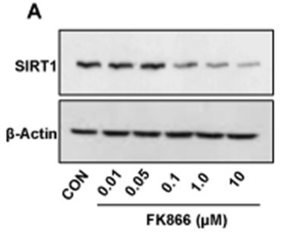
| Western blot | SIRT1 p-AMPK / AMPK / p-EIF2A / EIF2A / p-4EBP1 / 4EBP1 AKT / pAKT(Ser-473) / mTOR / p-mTOR(Ser-2448) |
|
29905535 |
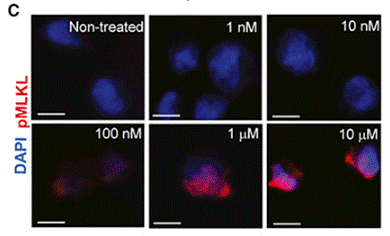
| Immunofluorescence | pMLKL phGSK3β ph-β-catenin |
|
29996103 |
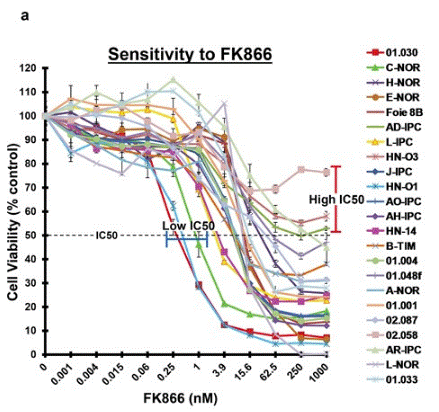
| Growth inhibition assay | Cell viability |
|
27462772 |
Klinische Studieninformationen
(Daten von https://clinicaltrials.gov, aktualisiert am 2024-05-22)
| NCT-Nummer | Rekrutierung | Erkrankungen | Sponsor/Kooperationspartner | Startdatum | Phasen |
|---|---|---|---|---|---|
| NCT00435084 | Completed | B-cell Chronic Lymphocytic Leukemia |
Valerio Therapeutics |
February 2007 | Phase 1|Phase 2 |
Technischer Support
Tel: +1-832-582-8158 Ext:3
Wenn Sie weitere Fragen haben, hinterlassen Sie bitte eine Nachricht.
Häufig gestellte Fragen
Frage 1:
We are considering the use of it for in vivo injections. Any suggestions for the formula?
Antwort:
The recommended vehicle for in vivo study of this compound is 45% Propylene glycol (dissolve first) +5% Tween 80+ddH2O. It can be dissolved in Propylene glycol first and then diluted with water containing Tween 80. The solution is clear and suitable for injection.

Produkte sind nur für Forschungszwecke bestimmt. Nicht für den menschlichen Gebrauch. Wir verkaufen nicht an Patienten.
©Copyright 2013 Selleck Chemicals. Alle Rechte vorbehalten.