
nur für Forschungszwecke
IPI-145 (Duvelisib) PI3K δ/γ Inhibitor
Kat.-Nr.S7028
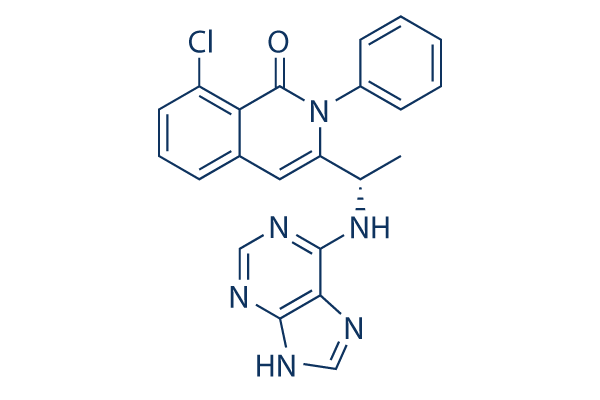
Chemische Struktur
Molekulargewicht: 416.86
Qualitätskontrolle
| Verwandte Ziele | EGFR VEGFR JAK PDGFR FGFR Src HIF FLT FLT3 HER2 |
|---|---|
| Weitere PI3K Inhibitoren | GDC-0077 (Inavolisib) SAR405 Quercetin (Sophoretin) LY294002 XL147 analogue Tersolisib (STX-478) Buparlisib (BKM120) 740 Y-P (PDGFR 740Y-P) GO-203 TFA Eganelisib (IPI-549) |
Zellkultur, Behandlung & Arbeitskonzentration
| Zelllinien | Assay-Typ | Konzentration | Inkubationszeit | Formulierung | Aktivitätsbeschreibung | PMID |
|---|---|---|---|---|---|---|
| Jurkat | Proliferation assay | 3 days | Antiproliferative activity against human Jurkat cells after 3 days by CellTiter-Glo assay, IC50=1.9 Μm | 27774127 | ||
| MOLT4 | Proliferation assay | 3 days | Antiproliferative activity against human MOLT4 cells after 3 days by CellTiter-Glo assay, IC50=2.3 μM | 27774127 | ||
| MV4-11 | Proliferation assay | 3 days | Antiproliferative activity against human MV4-11 cells after 3 days by CellTiter-Glo assay, IC50=4.4 μM | 27774127 | ||
| MOLM14 | Proliferation assay | 3 days | Antiproliferative activity against human MOLM14 cells after 3 days by CellTiter-Glo assay, IC50=1.2 μM | 27774127 | ||
| Loucy | Proliferation assay | 3 days | Antiproliferative activity against human Loucy cells after 3 days by CellTiter-Glo assay, IC50=0.98 μM | 27774127 | ||
| JURKAT | Function assay | 0.1, 1.0, and 9.0 μM | IPI145 was able to inhibit Akt and S6 phosphorylation and modestly affected growth in JURKAT | 30970263 | ||
| MOLT3 | Function assay | 0.1, 1.0, and 9.0 μM | IPI145 was able to inhibit Akt and S6 phosphorylation but barely affected the growth of MOLT3 T-ALL | 30970263 | ||
| Raji32 | Function assay | 1 μM | effectively impaired the phosphorylation of Akt | 30584254 | ||
| Ramos460 | Function assay | 1 μM | effectively impaired the phosphorylation of Akt | 30584254 | ||
| HBL-1 | Growth inhibition assay | GI50=5.3 μM | 30067771 | |||
| OCI-Ly3 | Growth inhibition assay | GI50=3.7 μM | 30067771 | |||
| TMD-8 | Growth inhibition assay | GI50=0.0005 μM | 30067771 | |||
| U-2932 | Growth inhibition assay | GI50=1.8 μM | 30067771 | |||
| Farage | Growth inhibition assay | GI50=0.04 μM | 30067771 | |||
| SU-DHL-10 | Growth inhibition assay | GI50=2.4 μM | 30067771 | |||
| SU-DHL-4 | Growth inhibition assay | GI50=0.2 μM | 30067771 | |||
| Karpas-422 | Growth inhibition assay | GI50=0.1 μM | 30067771 | |||
| DOHH-2 | Growth inhibition assay | GI50=0.05 μM | 30067771 | |||
| WSU-NHL | Growth inhibition assay | GI50=0.008 μM | 30067771 | |||
| Jeko-1 | Growth inhibition assay | GI50=1.3 μM | 30067771 | |||
| Mino | Growth inhibition assay | GI50=3.4 μM | 30067771 | |||
| NCI-H929 | Growth inhibition assay | GI50=1 μM | 30067771 | |||
| HH | Growth inhibition assay | GI50=0.01 μM | 30067771 | |||
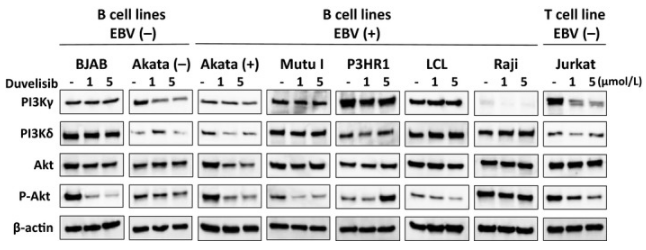
| BJAB | Cell viability assay | 0.1, 1, 5 μM | 48 and 72 h | inhibited cell growth | 29522278 | |
| LCL | Cell viability assay | 0.1, 1, 5 μM | 48 and 72 h | inhibited cell growth | 29522278 | |
| insect cells | Function assay | 5 mins | Inhibition of recombinant human C-terminal His6-tagged p110gamma expressed in insect cells using phosphatidylinositol as substrate in presence of gamma-32P-ATP after 5 mins by thin layer chromatographic method, IC50 = 0.1 μM. | ChEMBL | ||
| Sf21 | Function assay | 5 mins | Inhibition of N-terminal His6-tagged recombinant full-length human p110delta/untagged recombinant full length p85alpha expressed in baculovirus infected Sf21 cells using phosphatidylinositol as substrate in presence of gamma-32P-ATP after 5 mins by thin l, IC50 = 0.1 μM. | ChEMBL | ||
| splenic B | Antiproliferative assay | 30 mins | Antiproliferative activity against Balb/c mouse splenic B cells preincubated for 30 mins followed by LPS or F(ab')2 donkey anti-mouse IgM and recombinant mouse IL4 stimulation measured after 72 hrs by Alamar Blue reduction assay, EC50 = 0.1 μM. | ChEMBL | ||
| Sf21 | Function assay | 5 mins | Inhibition of N-terminal His6-tagged recombinant full-length human p110beta/untagged recombinant full length p85alpha expressed in baculovirus infected Sf21 cells using phosphatidylinositol as substrate in presence of gamma-32P-ATP after 5 mins by thin la, IC50 = 1 μM. | ChEMBL | ||
| Sf21 | Function assay | 5 mins | Inhibition of N-terminal His6-tagged recombinant full-length human p110alpha/untagged recombinant full length human p85alpha expressed in baculovirus infected Sf21 cells using phosphatidylinositol as substrate in presence of gamma-32P-ATP after 5 mins by , IC50 = 10 μM. | ChEMBL | ||
| Klicken Sie hier, um weitere experimentelle Daten zu Zelllinien anzuzeigen | ||||||
Chemische Informationen, Lagerung & Stabilität
| Molekulargewicht | 416.86 | Formel | C22H17ClN6O |
Lagerung (Ab dem Eingangsdatum) | |
|---|---|---|---|---|---|
| CAS-Nr. | 1201438-56-3 | SDF herunterladen | Lagerung von Stammlösungen |
|
|
| Synonyme | INK1197 | Smiles | CC(C1=CC2=C(C(=CC=C2)Cl)C(=O)N1C3=CC=CC=C3)NC4=NC=NC5=C4NC=N5 | ||
Löslichkeit
|
In vitro |
DMSO
: 83 mg/mL
(199.1 mM)
Water : Insoluble Ethanol : Insoluble |
Molaritätsrechner
|
In vivo |
|||||
In-vivo-Formulierungsrechner (Klare Lösung)
Schritt 1: Geben Sie die untenstehenden Informationen ein (Empfohlen: Ein zusätzliches Tier zur Berücksichtigung von Verlusten während des Experiments)
Schritt 2: Geben Sie die In-vivo-Formulierung ein (Dies ist nur der Rechner, keine Formulierung. Bitte kontaktieren Sie uns zuerst, wenn es im Abschnitt "Löslichkeit" keine In-vivo-Formulierung gibt.)
Berechnungsergebnisse:
Arbeitskonzentration: mg/ml;
Methode zur Herstellung der DMSO-Stammlösung: mg Wirkstoff vorgelöst in μL DMSO ( Konzentration der Stammlösung mg/mL, Bitte kontaktieren Sie uns zuerst, wenn die Konzentration die DMSO-Löslichkeit der Wirkstoffcharge überschreitet. )
Methode zur Herstellung der In-vivo-Formulierung: Nehmen Sie μL DMSO Stammlösung, dann hinzufügenμL PEG300, mischen und klären, dann hinzufügenμL Tween 80, mischen und klären, dann hinzufügen μL ddH2O, mischen und klären.
Methode zur Herstellung der In-vivo-Formulierung: Nehmen Sie μL DMSO Stammlösung, dann hinzufügen μL Maisöl, mischen und klären.
Hinweis: 1. Bitte stellen Sie sicher, dass die Flüssigkeit klar ist, bevor Sie das nächste Lösungsmittel hinzufügen.
2. Achten Sie darauf, das/die Lösungsmittel der Reihe nach hinzuzufügen. Sie müssen sicherstellen, dass die bei der vorherigen Zugabe erhaltene Lösung eine klare Lösung ist, bevor Sie mit der Zugabe des nächsten Lösungsmittels fortfahren. Physikalische Methoden wie Vortex, Ultraschall oder ein heißes Wasserbad können zur Unterstützung des Lösens verwendet werden.
Wirkmechanismus
| Targets/IC50/Ki |
PI3Kδ
(Cell-free assay) 23 pM(Ki)
PI3Kβ
(Cell-free assay) 1564 pM(Ki)
PI3Kγ
(Cell-free assay) 243 pM(Ki)
|
|---|---|
| In vitro |
Duvelisib (IPI-145) unterdrückt die Proliferation von murinen/humanen B-Zellen mit einer EC50 von 0,5 nM/0,5 nM und hemmt auch die Proliferation von humanen T-Zellen mit einer EC50 von 9,5 nM. |
| In vivo |
Duvelisib (IPI-145) (10 mg/kg, p.o.) zeigt eine gute Pharmakokinetik mit Cmax und AUC von 390 ng/mL und 137 ng•h/mL bei Mäusen und Ratten. Es ist im murinen DTH-Modell mit ~50 % Ohrschwellung aktiv und zeigt eine dosisabhängige Wirkung im Ratten-Kollagen-induzierten Arthritis (CIA)-Modell. Diese Verbindung verhindert Entzündungen und schützt Gelenkknochen und Knorpel im Ratten-CIA-Modell. Es (10 mg/kg, QD) zeigt auch Aktivität im Ratten-Adjuvans-induzierten Polyarthritis-Modell. |
Literatur |
|
Anwendungen
| Methoden | Biomarker | Bilder | PMID |
|---|---|---|---|
| Western blot | PI3Kγ / PI3Kδ p-AKT / AKT / p-MAPK / MAPK |
|
29522278 |
Klinische Studieninformationen
(Daten von https://clinicaltrials.gov, aktualisiert am 2024-05-22)
| NCT-Nummer | Rekrutierung | Erkrankungen | Sponsor/Kooperationspartner | Startdatum | Phasen |
|---|---|---|---|---|---|
| NCT02307461 | Completed | Healthy |
SecuraBio |
November 2014 | Phase 1 |
| NCT02095587 | Completed | Hepatic Impairment |
SecuraBio |
March 2014 | Phase 1 |
| NCT01947777 | Completed | Healthy |
SecuraBio |
October 2013 | Phase 1 |
| NCT01925911 | Completed | Healthy |
SecuraBio |
August 2013 | Phase 1 |
| NCT01836861 | Completed | Healthy |
SecuraBio |
March 2013 | Phase 1 |
| NCT01549106 | Completed | Healthy Volunteers |
SecuraBio |
August 2011 | Phase 1 |
Technischer Support
Tel: +1-832-582-8158 Ext:3
Wenn Sie weitere Fragen haben, hinterlassen Sie bitte eine Nachricht.
Häufig gestellte Fragen
Frage 1:
Whether it is a mixture of two chiral forms, and if not, which form is this compound?
Antwort:
Its S form is S7028.

Produkte sind nur für Forschungszwecke bestimmt. Nicht für den menschlichen Gebrauch. Wir verkaufen nicht an Patienten.
©Copyright 2013 Selleck Chemicals. Alle Rechte vorbehalten.