
nur für Forschungszwecke
Metformin Hydrochloride Antihyperglykämisches Mittel
Kat.-Nr.: S1950
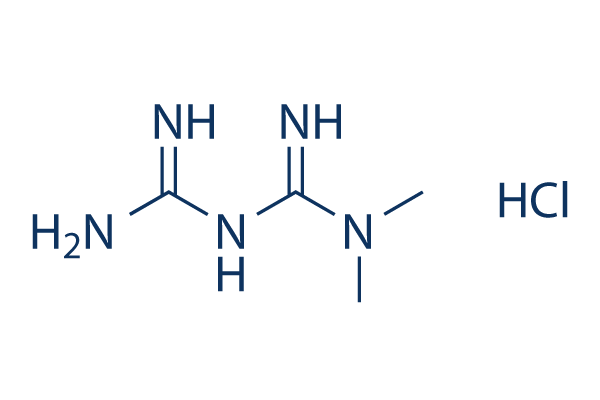
Chemische Struktur
Molekulargewicht: 165.62
Qualitätskontrolle (Quality Control)
Produkte, die oft zusammen verwendet werden mit Metformin Hydrochloride
| Verwandte Ziele | Dehydrogenase HSP Transferase P450 (e.g. CYP17) PDE phosphatase PPAR Vitamin Mitochondrial Metabolism Casein Kinase |
|---|---|
| Weitere Carbohydrate Metabolism Inhibitoren | 2-DG (2-Deoxy-D-glucose) Bromopyruvic acid (3-BP) Dorzagliatin LY2608204 Voglibose 1-Deoxynojirimycin 4',7-Dimethoxy-5-Hydroxyflavone FBPase-1 inhibitor-1 AZD1656 Nodakenetin |
Zellkultur, Behandlung & Arbeitskonzentration
(Cell Culture, Treatment & Working Concentration)
| Zelllinien | Assay-Typ | Konzentration | Inkubationszeit | Formulierung | Aktivitätsbeschreibung | PMID |
|---|---|---|---|---|---|---|
| human HepG2 cells | Function assay | 1 mM | 24 h | Activation of AMPK in human HepG2 cells assessed as reduction of gluconeogenesis at 1 mM after 24 hrs by enzymatic colorimetric assay | 26471090 | |
| mouse 3T3L1 cells | Function assay | 1 mM | Induction of AMPK phosphorylation in mouse 3T3L1 cells at 1 mM by Western blot analysis | 25216379 | ||
| human HepG2 cells | Function assay | 1 mM | 24 h | Reduction of glucose consumption in insulin-resistant human HepG2 cells at 1 mM after 24 hrs by glucose oxidase method in presence of 22.2 mM of glucose | 23025244 | |
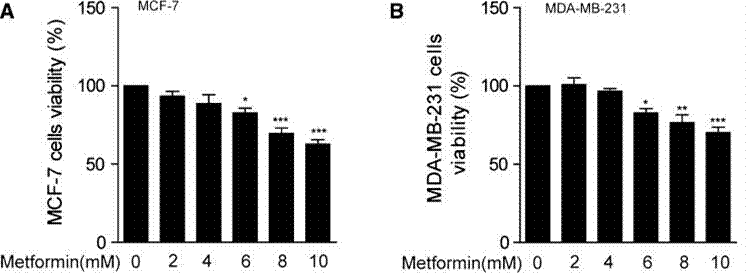
| human MDA-MB-231 cells | Function assay | 1 to 20 mM | 24 h | Antiproliferative activity against human MDA-MB-231 cells at 1 to 20 mM after 24 hrs by MTT assay. | 22459208 | |
| human HepG2 cells | Function assay | 24 h | Increase in glucose consumption in insulin-resistant human HepG2 cells after 24 hrs, EC50=0.27 μM. | 21856048 | ||
| Hs575T | Function assay | 20 mM | 24 hrs | Inhibition of mTOR phosphorylation in triple-negative human Hs575T cells at 20 mM after 24 hrs by immunoblot analysis | 23490148 | |
| Hs578T | Antiinvasive assay | 20 mM | 17 hrs | Antiinvasive activity against triple-negative human Hs578T cells at 20 mM after 17 hrs by light microscopic analysis | 23490148 | |
| Hs575T | Function assay | 20 mM | 24 hrs | Activation of AMPK in triple-negative human Hs575T cells at 20 mM after 24 hrs by immunoblot analysis | 23490148 | |
| L6 | Function assay | 2 mM | 4 hrs | Increase in glucose uptake in rat L6 cells at 2 mM treated for 4 hrs post 30 mins AMPK inhibitor compound C treatment | 29128163 | |
| HepG2 | Function assay | 1 mM | 24 hrs | Induction of glucose consumption in human HepG2 cells at 1 mM incubated for 24 hrs | 28651984 | |
| Klicken Sie hier, um weitere experimentelle Daten zu Zelllinien anzuzeigen | ||||||
Chemische Informationen, Lagerung & Stabilität (Chemical Information, Storage & Stability)
| Molekulargewicht | 165.62 | Formel | C4H11N5.HCl |
Lagerung (Ab dem Eingangsdatum) | |
|---|---|---|---|---|---|
| CAS-Nr. | 1115-70-4 | SDF herunterladen | Lagerung von Stammlösungen |
|
|
| Synonyme | 1,1-Dimethylbiguanide HCl | Smiles | CN(C)C(=N)N=C(N)N.Cl | ||
Löslichkeit (Solubility)
|
In vitro |
Water : 33 mg/mL Ethanol : Insoluble |
Molaritätsrechner
|
In vivo |
|||||
In-vivo-Formulierungsrechner (Klare Lösung)
Schritt 1: Geben Sie die untenstehenden Informationen ein (Empfohlen: Ein zusätzliches Tier zur Berücksichtigung von Verlusten während des Experiments)
Schritt 2: Geben Sie die In-vivo-Formulierung ein (Dies ist nur der Rechner, keine Formulierung. Bitte kontaktieren Sie uns zuerst, wenn es im Abschnitt "Löslichkeit" keine In-vivo-Formulierung gibt.)
Berechnungsergebnisse:
Arbeitskonzentration: mg/ml;
Methode zur Herstellung der DMSO-Stammlösung: mg Wirkstoff vorgelöst in μL DMSO ( Konzentration der Stammlösung mg/mL, Bitte kontaktieren Sie uns zuerst, wenn die Konzentration die DMSO-Löslichkeit der Wirkstoffcharge überschreitet. )
Methode zur Herstellung der In-vivo-Formulierung: Nehmen Sie μL DMSO Stammlösung, dann hinzufügenμL PEG300, mischen und klären, dann hinzufügenμL Tween 80, mischen und klären, dann hinzufügen μL ddH2O, mischen und klären.
Methode zur Herstellung der In-vivo-Formulierung: Nehmen Sie μL DMSO Stammlösung, dann hinzufügen μL Maisöl, mischen und klären.
Hinweis: 1. Bitte stellen Sie sicher, dass die Flüssigkeit klar ist, bevor Sie das nächste Lösungsmittel hinzufügen.
2. Achten Sie darauf, das/die Lösungsmittel der Reihe nach hinzuzufügen. Sie müssen sicherstellen, dass die bei der vorherigen Zugabe erhaltene Lösung eine klare Lösung ist, bevor Sie mit der Zugabe des nächsten Lösungsmittels fortfahren. Physikalische Methoden wie Vortex, Ultraschall oder ein heißes Wasserbad können zur Unterstützung des Lösens verwendet werden.
Wirkmechanismus (Mechanism of Action)
| Targets/IC50/Ki |
AMPK
(Hepatocytes) |
|---|---|
| In vitro |
Metformin (500 μM) activates AMPK in hepatocytes, as a result, acetyl-CoA carboxylase (ACC) activity is reduced, fatty acid oxidation is induced, and expression of lipogenic enzymes is suppressed. Metformin (2 mM) activates muscle AMPK and promotes glucose uptake. Metformin (500 μM) or AICAR strongly suppresses SREBP-1 mRNA expression in rat hepatocytes. Metformin ameliorates hyperglycemia without stimulating insulin secretion, promoting weight gain, or causing hypoglycemia. Metformin has beneficial effects on circulating lipids linked to increased cardiovascular risk. Metformin decreases hepatic glucose production and increases skeletal myocyte glucose uptake. Metformin requires LKB1 in the liver to lower blood glucose levels. Metformin (2 mM) leads to a significant increase in the activity of both α1- and α2-containing complexes in muscle cells. Metformin (2 mM) also increases threonine 172 phosphorylation in muscle cells. |
| In vivo |
Metformin (100 mg/ml, po) treatment produces significant decreases in hepatic expression of mRNAs for SREBP-1, FAS, and S14 in SD rats that are consistent with effects documented in cells. Metformin also decreases hepatic lipids in obese mice. Metformin (250 mg/kg, i.p.) increases AMPK phosphorylation in livers of wild-type mice. Metformin (250 mg/kg, i.p.) treatment reduces blood glucose by more than 50% in the wild-type mice on a high-fat diet. Metformin (250 mg/kg, i.p.) treatment also loweres blood glucose in the ob/ob mice by 40%. |
Literatur |
|
Anwendungen (Applications)
| Methoden | Biomarker | Bilder | PMID |
|---|---|---|---|
| Western blot | pSTAT3 (Ser727) / STAT3 / Jak2 / Cdk5 / pNFκB / Bcl-2 / Bcl-XL / c-Myc pACC / ACC / pS6 / S6 TTP / p-STAT3 / STAT3 / c-Myc p-AMPK / AMPK / p-mTOR / mTOR / p-S6K / S6K |

|
28114390 |
| Immunofluorescence | beta-catenin / AMPK CD86 / CD206 PAR LKB1 |

|
30854043 |
| Growth inhibition assay | Cell viability |
|
26956973 |
Klinische Studieninformationen (Clinical Trial Information)
(Daten von https://clinicaltrials.gov, aktualisiert am 2024-05-22)
| NCT-Nummer | Rekrutierung | Erkrankungen | Sponsor/Kooperationspartner | Startdatum | Phasen |
|---|---|---|---|---|---|
| NCT05910554 | Not yet recruiting | Sarcoidosis Pulmonary |
University of Maryland Baltimore |
2024-05-01 | Phase 2 |
| NCT06120881 | Recruiting | Type 2 Diabetes |
University of California San Francisco|National Institute of Diabetes and Digestive and Kidney Diseases (NIDDK) |
2024-04-01 | Early Phase 1 |
| NCT06147050 | Not yet recruiting | Long COVID |
Purpose Life Sciences |
2024-04 | Phase 3 |
| NCT06296836 | Not yet recruiting | Diabetes Mellitus Type 2 |
University of Illinois at Chicago|Emily Hanners|Dulal Bhaumik|Avisek Datta|Peggy Choye|Hailey Soni|Annesti Elmasri|Julie Jun|Colin Goodman |
2024-04-01 | Phase 4 |

Produkte sind nur für Forschungszwecke bestimmt. Nicht für den menschlichen Gebrauch. Wir verkaufen nicht an Patienten.
©Copyright 2013 Selleck Chemicals. Alle Rechte vorbehalten.