
nur für Forschungszwecke
Volasertib (BI6727) PLK1-Inhibitor
Kat.-Nr.S2235
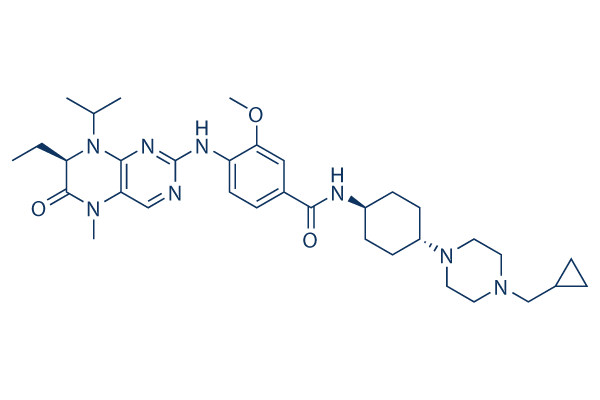
Chemische Struktur
Molekulargewicht: 618.81
Qualitätskontrolle
| Verwandte Ziele | CDK HSP PD-1/PD-L1 ROCK Wee1 DNA/RNA Synthesis Microtubule Associated Ras KRas Aurora Kinase |
|---|---|
| Weitere PLK Inhibitoren | BI 2536 Rigosertib (ON-01910) GSK461364 Onvansertib (NMS-1286937, NMS-P937) CFI-400945 HMN-214 Ro3280 SBE 13 HCl MLN0905 Centrinone (LCR-263) |
Zellkultur, Behandlung & Arbeitskonzentration
| Zelllinien | Assay-Typ | Konzentration | Inkubationszeit | Formulierung | Aktivitätsbeschreibung | PMID |
|---|---|---|---|---|---|---|
| KASUMI-1 | Growth Inhibition Assay | 72 h | IC50=170±51 nM | 25576074 | ||
| KG-1 | Growth Inhibition Assay | 72 h | IC50=150±67 nM | 25576074 | ||
| MOLM-13 | Growth Inhibition Assay | 72 h | IC50=57±44 nM | 25576074 | ||
| MV-4-11 | Growth Inhibition Assay | 72 h | IC50=16±6 nM | 25576074 | ||
| NOMO-1 | Growth Inhibition Assay | 72 h | IC50=145±7 nM | 25576074 | ||
| OCI-AML3 | Growth Inhibition Assay | 72 h | IC50=90±51 nM | 25576074 | ||
| SKM-1 | Growth Inhibition Assay | 72 h | IC50=95±52 nM | 25576074 | ||
| THP-1 | Growth Inhibition Assay | 72 h | IC50=56±39 nM | 25576074 | ||
| MCF7/LTED | Growth Inhibition Assay | 2.5-40 nM | 5 d | inhibits cell growth in a dose-dependent manner | 25480943 | |
| HCC1428/LTED | Growth Inhibition Assay | 2.5-40 nM | 5 d | inhibits cell growth in a dose-dependent manner | 25480943 | |
| A431 | Growth Inhibition Assay | 0-30 nM | 1-4 d | inhibits cell growth in both dose- and time-dependent manner | 23891096 | |
| FaDu | Growth Inhibition Assay | 0-1000 nM | 1-4 d | inhibits cell growth in both dose- and time-dependent manner | 23891096 | |
| SF188 | Growth Inhibition Assay | 50-150 nM | 72 h | DMSO | inhibits cell proliferation | 23887645 |
| T98G | Growth Inhibition Assay | 50-150 nM | 72 h | DMSO | inhibits cell proliferation | 23887645 |
| DU145 | Growth Inhibition Assay | 10/50/250 nM | 24 h | IC50<10 nM | 23884428 | |
| LNCaP | Growth Inhibition Assay | 10/50/250 nM | 24 h | IC50<10 nM | 23884428 | |
| PC3 | Growth Inhibition Assay | 10/50/250 nM | 24 h | IC50∼600 nM | 23884428 | |
| RT4 | Growth Inhibition Assay | 48 h | IC50=111.27 nM | 23792639 | ||
| 5637 | Growth Inhibition Assay | 48 h | IC50=1165.14 nM | 23792639 | ||
| T24 | Growth Inhibition Assay | 48 h | IC50=204.91 nM | 23792639 | ||
| KMCH-1 | Apoptosis Assay | 200 nM | 24 h | induces apoptosis | 23703673 | |
| Mz-ChA-1 | Apoptosis Assay | 200 nM | 24 h | induces apoptosis | 23703673 | |
| HUCCT-1 | Apoptosis Assay | 200 nM | 24 h | induces apoptosis | 23703673 | |
| HCT 116 | Growth Inhibition Assay | EC50 = 23 nM | 19383823 | |||
| NCI-H460 | Growth Inhibition Assay | EC50 = 21 nM | 19383823 | |||
| BRO | Growth Inhibition Assay | EC50 = 11 nM | 19383823 | |||
| GRANTA-519 | Growth Inhibition Assay | EC50 = 15 nM | 19383823 | |||
| HL-60 | Growth Inhibition Assay | EC50 = 32 nM | 19383823 | |||
| THP-1 | Growth Inhibition Assay | EC50 = 36 nM | 19383823 | |||
| Raji | Growth Inhibition Assay | EC50 = 37 nM | 19383823 | |||
| TC32 | qHTS assay | qHTS of pediatric cancer cell lines to identify multiple opportunities for drug repurposing: Primary screen for TC32 cells | 29435139 | |||
| U-2 OS | qHTS assay | qHTS of pediatric cancer cell lines to identify multiple opportunities for drug repurposing: Primary screen for U-2 OS cells | 29435139 | |||
| A673 | qHTS assay | qHTS of pediatric cancer cell lines to identify multiple opportunities for drug repurposing: Primary screen for A673 cells | 29435139 | |||
| DAOY | qHTS assay | qHTS of pediatric cancer cell lines to identify multiple opportunities for drug repurposing: Primary screen for DAOY cells | 29435139 | |||
| Saos-2 | qHTS assay | qHTS of pediatric cancer cell lines to identify multiple opportunities for drug repurposing: Primary screen for Saos-2 cells | 29435139 | |||
| BT-37 | qHTS assay | qHTS of pediatric cancer cell lines to identify multiple opportunities for drug repurposing: Primary screen for BT-37 cells | 29435139 | |||
| RD | qHTS assay | qHTS of pediatric cancer cell lines to identify multiple opportunities for drug repurposing: Primary screen for RD cells | 29435139 | |||
| SK-N-SH | qHTS assay | qHTS of pediatric cancer cell lines to identify multiple opportunities for drug repurposing: Primary screen for SK-N-SH cells | 29435139 | |||
| BT-12 | qHTS assay | qHTS of pediatric cancer cell lines to identify multiple opportunities for drug repurposing: Primary screen for BT-12 cells | 29435139 | |||
| MG 63 (6-TG R) | qHTS assay | qHTS of pediatric cancer cell lines to identify multiple opportunities for drug repurposing: Primary screen for MG 63 (6-TG R) cells | 29435139 | |||
| NB1643 | qHTS assay | qHTS of pediatric cancer cell lines to identify multiple opportunities for drug repurposing: Primary screen for NB1643 cells | 29435139 | |||
| OHS-50 | qHTS assay | qHTS of pediatric cancer cell lines to identify multiple opportunities for drug repurposing: Primary screen for OHS-50 cells | 29435139 | |||
| Rh41 | qHTS assay | qHTS of pediatric cancer cell lines to identify multiple opportunities for drug repurposing: Primary screen for Rh41 cells | 29435139 | |||
| Rh30 | qHTS assay | qHTS of pediatric cancer cell lines to identify multiple opportunities for drug repurposing: Primary screen for Rh30 cells | 29435139 | |||
| SJ-GBM2 | qHTS assay | qHTS of pediatric cancer cell lines to identify multiple opportunities for drug repurposing: Primary screen for SJ-GBM2 cells | 29435139 | |||
| SK-N-MC | qHTS assay | qHTS of pediatric cancer cell lines to identify multiple opportunities for drug repurposing: Primary screen for SK-N-MC cells | 29435139 | |||
| NB-EBc1 | qHTS assay | qHTS of pediatric cancer cell lines to identify multiple opportunities for drug repurposing: Primary screen for NB-EBc1 cells | 29435139 | |||
| LAN-5 | qHTS assay | qHTS of pediatric cancer cell lines to identify multiple opportunities for drug repurposing: Primary screen for LAN-5 cells | 29435139 | |||
| Rh18 | qHTS assay | qHTS of pediatric cancer cell lines to identify multiple opportunities for drug repurposing: Primary screen for Rh18 cells | 29435139 | |||
| SKBR3 | Cytotoxicity assay | 24 hrs | Cytotoxicity against human SKBR3 cells after 24 hrs by MTT assay | 29288948 | ||
| MDA-MB-231 | Cytotoxicity assay | 24 hrs | Cytotoxicity against human MDA-MB-231 cells after 24 hrs by MTT assay | 29288948 | ||
| MDA-MB-468 | Cytotoxicity assay | 24 hrs | Cytotoxicity against human MDA-MB-468 cells after 24 hrs by MTT assay | 29288948 | ||
| BT474 | Cytotoxicity assay | 24 hrs | Cytotoxicity against human BT474 cells after 24 hrs by MTT assay | 29288948 | ||
| ZR-75-1 | Cytotoxicity assay | 24 hrs | Cytotoxicity against human ZR-75-1 cells after 24 hrs by MTT assay | 29288948 | ||
| Klicken Sie hier, um weitere experimentelle Daten zu Zelllinien anzuzeigen | ||||||
Chemische Informationen, Lagerung & Stabilität
| Molekulargewicht | 618.81 | Formel | C34H50N8O3 |
Lagerung (Ab dem Eingangsdatum) | |
|---|---|---|---|---|---|
| CAS-Nr. | 755038-65-4 | SDF herunterladen | Lagerung von Stammlösungen |
|
|
| Synonyme | BI 6727 | Smiles | CCC1C(=O)N(C2=CN=C(N=C2N1C(C)C)NC3=C(C=C(C=C3)C(=O)NC4CCC(CC4)N5CCN(CC5)CC6CC6)OC)C | ||
Löslichkeit
|
In vitro |
DMSO
: 35 mg/mL
(56.56 mM)
Water : Insoluble Ethanol : Insoluble |
Molaritätsrechner
|
In vivo |
|||||
In-vivo-Formulierungsrechner (Klare Lösung)
Schritt 1: Geben Sie die untenstehenden Informationen ein (Empfohlen: Ein zusätzliches Tier zur Berücksichtigung von Verlusten während des Experiments)
Schritt 2: Geben Sie die In-vivo-Formulierung ein (Dies ist nur der Rechner, keine Formulierung. Bitte kontaktieren Sie uns zuerst, wenn es im Abschnitt "Löslichkeit" keine In-vivo-Formulierung gibt.)
Berechnungsergebnisse:
Arbeitskonzentration: mg/ml;
Methode zur Herstellung der DMSO-Stammlösung: mg Wirkstoff vorgelöst in μL DMSO ( Konzentration der Stammlösung mg/mL, Bitte kontaktieren Sie uns zuerst, wenn die Konzentration die DMSO-Löslichkeit der Wirkstoffcharge überschreitet. )
Methode zur Herstellung der In-vivo-Formulierung: Nehmen Sie μL DMSO Stammlösung, dann hinzufügenμL PEG300, mischen und klären, dann hinzufügenμL Tween 80, mischen und klären, dann hinzufügen μL ddH2O, mischen und klären.
Methode zur Herstellung der In-vivo-Formulierung: Nehmen Sie μL DMSO Stammlösung, dann hinzufügen μL Maisöl, mischen und klären.
Hinweis: 1. Bitte stellen Sie sicher, dass die Flüssigkeit klar ist, bevor Sie das nächste Lösungsmittel hinzufügen.
2. Achten Sie darauf, das/die Lösungsmittel der Reihe nach hinzuzufügen. Sie müssen sicherstellen, dass die bei der vorherigen Zugabe erhaltene Lösung eine klare Lösung ist, bevor Sie mit der Zugabe des nächsten Lösungsmittels fortfahren. Physikalische Methoden wie Vortex, Ultraschall oder ein heißes Wasserbad können zur Unterstützung des Lösens verwendet werden.
Wirkmechanismus
| Merkmale |
A high volume of distribution, indicating good tissue penetration, and a long terminal half-life.
|
|---|---|
| Targets/IC50/Ki |
PLK1
(Cell-free assay) 0.87 nM
|
| In vitro |
Ähnlich wie BI2536 ist BI6727 ein ATP-kompetitiver Kinasehemmer aus der Klasse der Dihydropteridinon-Verbindungen. Neben Plk1 hemmt diese Verbindung auch potent zwei eng verwandte Kinasen, Plk2 und Plk3, mit IC50-Werten von 5 nM bzw. 56 nM. Diese Chemikalie zeigt in Konzentrationen bis zu 10 μM keine hemmende Aktivität gegen ein Panel von >50 anderen Kinasen. Sie hemmt die Proliferation mehrerer Zelllinien, die von verschiedenen Krebsgeweben abgeleitet sind, darunter HCT116, NCI-H460, BRO, GRANTA-519, HL-60, THP-1 und Raji-Zellen mit EC50-Werten von 23 nM, 21 nM, 11 nM, 15 nM, 32 nM, 36 nM bzw. 37 nM. Die Behandlung mit dieser Verbindung (100 nM) in NCI-H460-Zellen induziert eine Akkumulation von Mitosezellen mit monopolaren Spindeln und positiver Färbung für Histon H3 Phosphoserin 10, was bestätigt, dass die Zellen früh in der M-Phase arretiert werden, gefolgt von der Induktion der Apoptose. Niedrige nanomolare Konzentrationen dieses Inhibitors zeigen eine potente hemmende Aktivität gegen Neuroblastom (NB) Tumor-initiierende Zellen (NB TIC) mit einer EC50 von 21 nM, während nur mikromolare Konzentrationen davon zytotoxisch für normale pädiatrische neurale Stammzellen sind. Es induziert einen Wachstumsstopp von Daoy- und ONS-76-Medulloblastomzellen ähnlich wie BI 2536. |
| Kinase-Assay |
In-vitro-Kinase-Assays
|
|
Rekombinantes humanes Plk1 (Reste 1-603) wird als NH2-terminales, GST-markiertes Fusionsprotein unter Verwendung eines Baculovirus-Expressionssystems exprimiert und mittels Affinitätschromatographie unter Verwendung von Glutathion-Agarose gereinigt. Enzymaktivitätsassays für Plk1 werden in Gegenwart seriell verdünnter dieser Verbindung unter Verwendung von 20 ng rekombinanter Kinase und 10 μg Kasein aus Kuhmilch als Substrat durchgeführt. Kinase-Reaktionen werden in einem Endvolumen von 60 μL für 45 Minuten bei 30 °C [15 mM MgCl2, 25 mM MOPS (pH 7.0), 1 mM DTT, 1% DMSO, 7.5 μM ATP, 0.3 μCi γ-32P-ATP] durchgeführt. Die Reaktionen werden durch Zugabe von 125 μL eiskalter 5%iger TCA beendet. Nach Übertragung der Präzipitate auf MultiScreen-Mischester-Cellulosefilterplatten werden die Platten mit 1%iger TCA gewaschen und radiometrisch quantifiziert. Dosis-Wirkungs-Kurven werden zur Berechnung des IC50-Wertes verwendet.
|
|
| In vivo |
Die Verabreichung von BI6727 hemmt signifikant das Wachstum mehrerer menschlicher Karzinom-Xenotransplantate, darunter HCT116, NCI-H460 und Taxan-resistentes CXB1-Kolonkarzinom, begleitet von einem Anstieg des Mitoseindex sowie einem Anstieg der Apoptose. In In-vivo-Studien zeigt diese Verbindung ein besseres Toxizitäts- und pharmakokinetisches Profil im Vergleich zu BI2536. |
Literatur |
|
Anwendungen
| Methoden | Biomarker | Bilder | PMID |
|---|---|---|---|
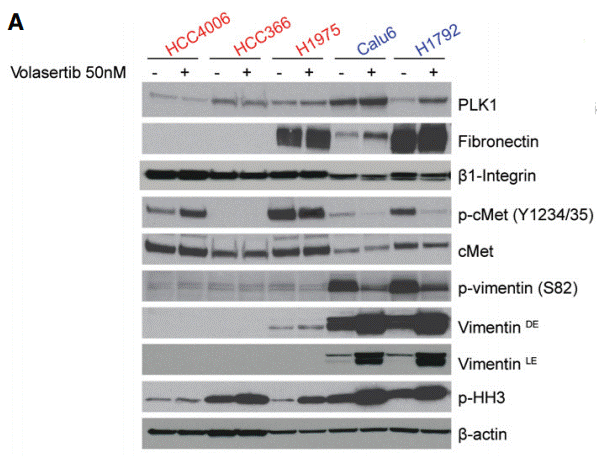
| Western blot | Fibronectin / β-integrin / p-vimentin / Vimentin / p-HH3 p-c-Met / c-Met / p-FAK / FAK / p-Src / Src PARP / c-myc p-AKT / AKT / p-MAPK / MAPK p-PLK1 / PLK1 |
|
31040125 |
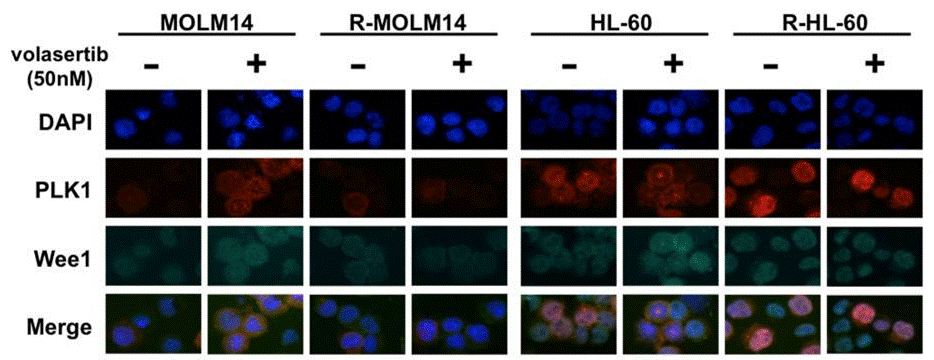
| Immunofluorescence | PLK1 / Wee1 |
|
29108241 |
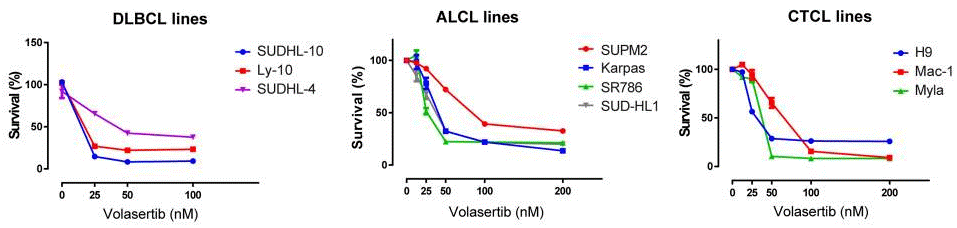
| Growth inhibition assay | Cell viability |
|
29383095 |
Klinische Studieninformationen
(Daten von https://clinicaltrials.gov, aktualisiert am 2024-05-22)
| NCT-Nummer | Rekrutierung | Erkrankungen | Sponsor/Kooperationspartner | Startdatum | Phasen |
|---|---|---|---|---|---|
| NCT02722135 | Withdrawn | Leukemia Myeloid Acute |
Boehringer Ingelheim |
November 2016 | Phase 1 |
| NCT02721875 | Terminated | Myelodysplastic Syndromes |
Boehringer Ingelheim |
April 28 2016 | Phase 1 |
| NCT02201329 | Completed | Myelodysplastic Syndromes|Leukemia Myelomonocytic Chronic |
Boehringer Ingelheim |
August 2014 | Phase 1 |
| NCT01971476 | Completed | Leukemia|Neoplasms |
Boehringer Ingelheim |
October 22 2013 | Phase 1 |
| NCT01772563 | Completed | Neoplasms |
Boehringer Ingelheim |
February 4 2013 | Phase 1 |
| NCT01662505 | Completed | Leukemia Myeloid Acute |
Boehringer Ingelheim |
August 2012 | Phase 1 |
Technischer Support
Tel: +1-832-582-8158 Ext:3
Wenn Sie weitere Fragen haben, hinterlassen Sie bitte eine Nachricht.
Häufig gestellte Fragen
Frage 1:
I wonder how to reconstitute it for in vivo studies?
Antwort:
It can be dissolved in 4% DMSO+Corn oil at 2mg/ml for i.p. injection in mice. For oral administration, this compound can be formulated in hydrochloric acid (0.1 N), and diluted with 0.9% NaCl, or suspended in 0.5% Natrosol 250 hydroxyethyl-cellulose as indicated in the publications. We also suggest the vehicle 30% PEG400/0.5% Tween80/5% propylene glycol for a suspension which we tested in house.

Produkte sind nur für Forschungszwecke bestimmt. Nicht für den menschlichen Gebrauch. Wir verkaufen nicht an Patienten.
©Copyright 2013 Selleck Chemicals. Alle Rechte vorbehalten.