
nur für Forschungszwecke
WYE-125132 (WYE-132) mTOR Inhibitor
Kat.-Nr.S2661
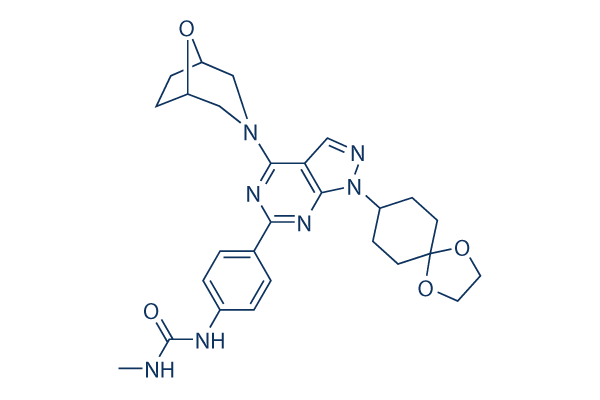
Chemische Struktur
Molekulargewicht: 519.6
Qualitätskontrolle
- In Nature Medicine für seine erstklassige Qualität zitiert
- COA
- NMR
- HPLC
- SDS
- Datenblatt
| Verwandte Ziele | PI3K Akt GSK-3 ATM/ATR DNA-PK AMPK PDPK1 PTEN PP2A PDK |
|---|---|
| Weitere mTOR Inhibitoren | Torin 1 Torin 2 AZD8055 Ridaforolimus (Deforolimus, MK-8669) Sapanisertib (MLN0128, INK-128) Torkinib (PP242) MHY1485 Vistusertib (AZD2014) KU-0063794 OSI-027 |
Zellkultur, Behandlung & Arbeitskonzentration
| Zelllinien | Assay-Typ | Konzentration | Inkubationszeit | Formulierung | Aktivitätsbeschreibung | PMID |
|---|---|---|---|---|---|---|
| LNCAP cells | Cytotoxicity assay | Cytotoxicity against human LNCAP cells, IC50=0.002 μM | ||||
| Klicken Sie hier, um weitere experimentelle Daten zu Zelllinien anzuzeigen | ||||||
Chemische Informationen, Lagerung & Stabilität
| Molekulargewicht | 519.6 | Formel | C27H33N7O4 |
Lagerung (Ab dem Eingangsdatum) | |
|---|---|---|---|---|---|
| CAS-Nr. | 1144068-46-1 | SDF herunterladen | Lagerung von Stammlösungen |
|
|
| Synonyme | N/A | Smiles | CNC(=O)NC1=CC=C(C=C1)C2=NC3=C(C=NN3C4CCC5(CC4)OCCO5)C(=N2)N6CC7CCC(C6)O7 | ||
Löslichkeit
|
In vitro |
DMSO
: 104 mg/mL
(200.15 mM)
Water : Insoluble Ethanol : Insoluble |
Molaritätsrechner
|
In vivo |
|||||
In-vivo-Formulierungsrechner (Klare Lösung)
Schritt 1: Geben Sie die untenstehenden Informationen ein (Empfohlen: Ein zusätzliches Tier zur Berücksichtigung von Verlusten während des Experiments)
Schritt 2: Geben Sie die In-vivo-Formulierung ein (Dies ist nur der Rechner, keine Formulierung. Bitte kontaktieren Sie uns zuerst, wenn es im Abschnitt "Löslichkeit" keine In-vivo-Formulierung gibt.)
Berechnungsergebnisse:
Arbeitskonzentration: mg/ml;
Methode zur Herstellung der DMSO-Stammlösung: mg Wirkstoff vorgelöst in μL DMSO ( Konzentration der Stammlösung mg/mL, Bitte kontaktieren Sie uns zuerst, wenn die Konzentration die DMSO-Löslichkeit der Wirkstoffcharge überschreitet. )
Methode zur Herstellung der In-vivo-Formulierung: Nehmen Sie μL DMSO Stammlösung, dann hinzufügenμL PEG300, mischen und klären, dann hinzufügenμL Tween 80, mischen und klären, dann hinzufügen μL ddH2O, mischen und klären.
Methode zur Herstellung der In-vivo-Formulierung: Nehmen Sie μL DMSO Stammlösung, dann hinzufügen μL Maisöl, mischen und klären.
Hinweis: 1. Bitte stellen Sie sicher, dass die Flüssigkeit klar ist, bevor Sie das nächste Lösungsmittel hinzufügen.
2. Achten Sie darauf, das/die Lösungsmittel der Reihe nach hinzuzufügen. Sie müssen sicherstellen, dass die bei der vorherigen Zugabe erhaltene Lösung eine klare Lösung ist, bevor Sie mit der Zugabe des nächsten Lösungsmittels fortfahren. Physikalische Methoden wie Vortex, Ultraschall oder ein heißes Wasserbad können zur Unterstützung des Lösens verwendet werden.
Wirkmechanismus
| Merkmale |
A highly potent, ATP-competitive, and specific mTOR kinase inhibitor.
|
|---|---|
| Targets/IC50/Ki |
mTOR
(Cell-free assay) 0.19 nM
|
| In vitro |
WYE-125132 (WYE-132) hemmt rekombinante mTOR-Kinase potent und ATP-kompetitiv mit einer IC50 von 0,19 nM und zeigt auch eine hohe Selektivität gegenüber verschiedenen PI3Ks und einem Panel von 230 Proteinkinasen. In vitro zeigt es eine signifikante antiproliferative Aktivität gegen ein Panel von Tumorzelllinien mit IC50-Werten von 2 nM (LNCap) bis 380 nM (HTC116). Außerdem bewirkt diese Verbindung auch eine Zellzyklusprogression, die Induktion von Apoptose und die Hemmung der Proteinsynthese und Zellgröße. Es führt zu einer signifikanten Reduktion der Synthese von prä-tRNALeu um 72 %, 80 % und 53 % in aktiv proliferierenden Zellen von MG63, MDA361 bzw. HEK293 durch Hemmung von mTORC1. Darüber hinaus wird festgestellt, dass WYE-125132 auch die Dephosphorylierung von Maf1 (negativer Regulator der Pol III-Transkription) und dessen Akkumulation im Zellkern induziert.
|
| Kinase-Assay |
Kinase-Assays
|
|
mTOR-Enzymassays mittels Dissociations-Enhanced Lanthanide Fluorescent Immunoassay (DELFIA), ATP-Matrix-Assays und mTOR-Immunkomplex-Kinase-Assays werden wie folgt für WYE-125132 (WYE-132) durchgeführt. Das endogene TOR aus LNCap-Zelllysat wird durch Anti-FRAP/TOR (N-19) immunpräzipitiert. Zelllysat (1,0 mg) wird mit 4 μg Antikörper, gekoppelt an Protein-G/A-Agarose, in 1 ml Lysebuffer gemischt. Die Immunkomplexe werden nacheinander mit Lysebuffer, Lysebuffer plus 500 mM KCl und Kinasebuffer-Waschlösung gewaschen. Die Immunkomplexe werden 30 Minuten lang bei 30 °C in einem Endvolumen von 50 μl, das 10 mM Hepes (pH 7,4), 50 mM NaCl, 50 mM β-Glycerophosphat und 0,5 μM Microcystin LR, 1 mM DTT, 10 mM MnCl2, 100 μM ATP, 1 μg His6-S6K oder 1 μg His6-4EBP1 enthält, einer Kinase-Reaktion unterzogen. Kinase-Reaktionen (Immunkomplex und gereinigte Enzyme) werden durch NuPAGE LDS-Probenpuffer beendet und in einem 4-12% NuPAGE Bis-Tris-Gel für Western Blotting mit Anti-P(T389)-p70S6K und Anti-P(T46)-4EBP1, Anti-FRAP/TOR (N-19), Anti-FLAG M2 und Anti-His6 (Klon His-1) aufgetrennt. Im radioaktiven Assay werden 10 μCi [γ-32P]ATP (3000 Ci/mmol) und 100 μM kaltes ATP verwendet. 32P-markierte Produkte werden durch SDS-PAGE aufgetrennt und einem Autoradiogramm auf Kodak-Röntgenfilmen unterzogen.
|
|
| In vivo |
WYE-125132 (WYE-132) (5 mg/kg p.o.) erzeugt eine signifikante Antitumoraktivität und verursacht eine dosisabhängige Verzögerung des Tumorwachstums im PI3K/mTOR- und HER2-hyperaktiven MDA361-Tumormodell. Darüber hinaus zeigt es auch eine potente Antitumorwirksamkeit in den PTEN-null-Gliom-U87MG-, nicht-kleinzelligem Lungenkrebs-H1975- und A549-Modellen.
|
Literatur |
|
Technischer Support
Tel: +1-832-582-8158 Ext:3
Wenn Sie weitere Fragen haben, hinterlassen Sie bitte eine Nachricht.
Häufig gestellte Fragen
Frage 1:
Whether the vehicle “30% PEG400+0.5% Tween80+5% Propylene glycol” you recommended for it is a clear solution or not? What’s the suggested formula for i.p. injection?
Antwort:
The formula on our website “30% PEG400+0.5% Tween80+5% Propylene glycol” is not a clear solution and can be used for p.o. administration. For i.p. solution, there are two methods to prepare it: 1)2% DMSO+30% PEG 300+ddH2O, 2.5mg/ml, stable for 1h at RT; 2)2% DMSO+30% PEG 300+ 2% Tween80 +ddH2O, 2.5mg/ml, stable for 2h at RT.

Produkte sind nur für Forschungszwecke bestimmt. Nicht für den menschlichen Gebrauch. Wir verkaufen nicht an Patienten.
©Copyright 2013 Selleck Chemicals. Alle Rechte vorbehalten.