
nur für Forschungszwecke
TW-37 Bcl-2 Inhibitor
Kat.-Nr.S1121
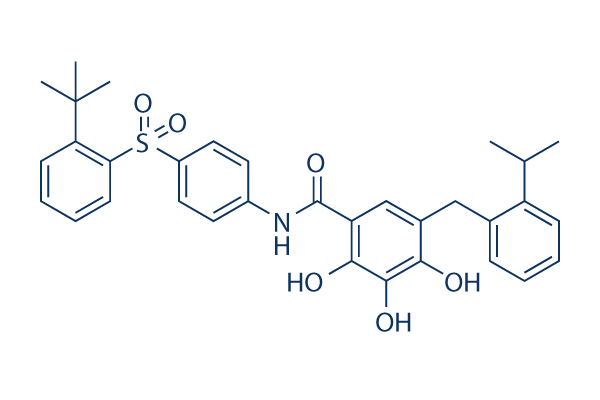
Chemische Struktur
Molekulargewicht: 573.7
Qualitätskontrolle
| Verwandte Ziele | Caspase PD-1/PD-L1 Ferroptosis p53 Apoptosis related Synthetic Lethality STAT TNF-alpha Ras KRas |
|---|---|
| Weitere Bcl-2 Inhibitoren | Navitoclax (ABT-263) S63845 ABT-737 Obatoclax Mesylate (GX15-070) A-1331852 A-1210477 A-1155463 Dihydrochloride AZD5991 UMI-77 (R)-(-)-Gossypol (AT-101) acetic acid |
Zellkultur, Behandlung & Arbeitskonzentration
| Zelllinien | Assay-Typ | Konzentration | Inkubationszeit | Formulierung | Aktivitätsbeschreibung | PMID |
|---|---|---|---|---|---|---|
| human JAR cell | Growth inhibition assay | Inhibition of human JAR cell growth in a cell viability assay, IC50=2.6 nM | ||||
| human Ca9-22 cell | Growth inhibition assay | Inhibition of human Ca9-22 cell growth in a cell viability assay, IC50=3.82 nM | ||||
| human CHL-1 cell | Growth inhibition assay | Inhibition of human CHL-1 cell growth in a cell viability assay, IC50=11.9 nM | ||||
| human A549 cell | Growth inhibition assay | Inhibition of human A549 cell growth in a cell viability assay, IC50=14.09 nM | ||||
| human RKO cell | Growth inhibition assay | Inhibition of human RKO cell growth in a cell viability assay, IC50=15.17 nM | ||||
| human GCIY cell | Growth inhibition assay | Inhibition of human GCIY cell growth in a cell viability assay, IC50=20.83 nM | ||||
| human BHT-101 cell | Growth inhibition assay | Inhibition of human BHT-101 cell growth in a cell viability assay, IC50=21.83 nM | ||||
| human Hs-578-T cell | Growth inhibition assay | Inhibition of human Hs-578-T cell growth in a cell viability assay, IC50=23.59 nM | ||||
| human SK-UT-1 cell | Growth inhibition assay | Inhibition of human SK-UT-1 cell growth in a cell viability assay, IC50=28.68 nM | ||||
| human NB7 cell | Growth inhibition assay | Inhibition of human NB7 cell growth in a cell viability assay, IC50=29.28 nM | ||||
| human YKG-1 cell | Growth inhibition assay | Inhibition of human YKG-1 cell growth in a cell viability assay, IC50=29.76 nM | ||||
| human HuH-7 cell | Growth inhibition assay | Inhibition of human HuH-7 cell growth in a cell viability assay, IC50=32.82 nM | ||||
| human SAS cell | Growth inhibition assay | Inhibition of human SAS cell growth in a cell viability assay, IC50=33.18 nM | ||||
| human UACC-62 cell | Growth inhibition assay | Inhibition of human UACC-62 cell growth in a cell viability assay, IC50=34.35 nM | ||||
| human AGS cell | Growth inhibition assay | Inhibition of human AGS cell growth in a cell viability assay, IC50=37.53 nM | ||||
| human SK-MEL-30 cell | Growth inhibition assay | Inhibition of human SK-MEL-30 cell growth in a cell viability assay, IC50=37.97 nM | ||||
| human A427 cell | Growth inhibition assay | Inhibition of human A427 cell growth in a cell viability assay, IC50=44.69 nM | ||||
| human DU-145 cell | Growth inhibition assay | Inhibition of human DU-145 cell growth in a cell viability assay, IC50=52.13 nM | ||||
| human HCT-116 cell | Growth inhibition assay | Inhibition of human HCT-116 cell growth in a cell viability assay, IC50=52.66 nM | ||||
| human A673 cell | Growth inhibition assay | Inhibition of human A673 cell growth in a cell viability assay, IC50=53.85 nM | ||||
| human SF126 cell | Growth inhibition assay | Inhibition of human SF126 cell growth in a cell viability assay, IC50=57.07 nM | ||||
| human SW872 cell | Growth inhibition assay | Inhibition of human SW872 cell growth in a cell viability assay, IC50=58.9 nM | ||||
| human NCI-H1581 cell | Growth inhibition assay | Inhibition of human NCI-H1581 cell growth in a cell viability assay, IC50=67.64 nM | ||||
| human SK-MEL-5 cell | Growth inhibition assay | Inhibition of human SK-MEL-5 cell growth in a cell viability assay, IC50=69.25 nM | ||||
| human CP50-MEL-B cell | Growth inhibition assay | Inhibition of human CP50-MEL-B cell growth in a cell viability assay, IC50=69.59 nM | ||||
| human YH-13 cell | Growth inhibition assay | Inhibition of human YH-13 cell growth in a cell viability assay, IC50=70.59 nM | ||||
| human LXF-289 cell | Growth inhibition assay | Inhibition of human LXF-289 cell growth in a cell viability assay, IC50=72.85 nM | ||||
| human MC-IXC cell | Growth inhibition assay | Inhibition of human MC-IXC cell growth in a cell viability assay, IC50=75.33 nM | ||||
| human NB14 cell | Growth inhibition assay | Inhibition of human NB14 cell growth in a cell viability assay, IC50=76.45 nM | ||||
| human HEC-1 cell | Growth inhibition assay | Inhibition of human HEC-1 cell growth in a cell viability assay, IC50=81.37 nM | ||||
| human U-87-MG cell | Growth inhibition assay | Inhibition of human U-87-MG cell growth in a cell viability assay, IC50=82.24 nM | ||||
| human HOS cell | Growth inhibition assay | Inhibition of human HOS cell growth in a cell viability assay, IC50=84.71 nM | ||||
| human HUTU-80 cell | Growth inhibition assay | Inhibition of human HUTU-80 cell growth in a cell viability assay, IC50=87.01 nM | ||||
| human A375 cell | Growth inhibition assay | Inhibition of human A375 cell growth in a cell viability assay, IC50=88.83 nM | ||||
| human A204 cell | Growth inhibition assay | Inhibition of human A204 cell growth in a cell viability assay, IC50=97.84 nM | ||||
| human GB-1 cell | Growth inhibition assay | Inhibition of human GB-1 cell growth in a cell viability assay, IC50=98.69 nM | ||||
| human MDA-MB-231 cell | Growth inhibition assay | Inhibition of human MDA-MB-231 cell growth in a cell viability assay, IC50=0.10807 μM | ||||
| human SW982 cell | Growth inhibition assay | Inhibition of human SW982 cell growth in a cell viability assay, IC50=0.1107 μM | ||||
| human SW756 cell | Growth inhibition assay | Inhibition of human SW756 cell growth in a cell viability assay, IC50=0.11236 μM | ||||
| human MG-63 cell | Growth inhibition assay | Inhibition of human MG-63 cell growth in a cell viability assay, IC50=0.11248 μM | ||||
| human Daoy cell | Growth inhibition assay | Inhibition of human Daoy cell growth in a cell viability assay, IC50=0.14073 μM | ||||
| human MDA-MB-453 cell | Growth inhibition assay | Inhibition of human MDA-MB-453 cell growth in a cell viability assay, IC50=0.15188 μM | ||||
| human HT-144 cell | Growth inhibition assay | Inhibition of human HT-144 cell growth in a cell viability assay, IC50=0.15201 μM | ||||
| human LoVo cell | Growth inhibition assay | Inhibition of human LoVo cell growth in a cell viability assay, IC50=0.16093 μM | ||||
| human NY cell | Growth inhibition assay | Inhibition of human NY cell growth in a cell viability assay, IC50=0.17762 μM | ||||
| human SW1783 cell | Growth inhibition assay | Inhibition of human SW1783 cell growth in a cell viability assay, IC50=0.21301 μM | ||||
| human A2780 cell | Growth inhibition assay | Inhibition of human A2780 cell growth in a cell viability assay, IC50=0.21846 μM | ||||
| human MDA-MB-361 cell | Growth inhibition assay | Inhibition of human MDA-MB-361 cell growth in a cell viability assay, IC50=0.2264 μM | ||||
| human RPMI-2650 cell | Growth inhibition assay | Inhibition of human RPMI-2650 cell growth in a cell viability assay, IC50=0.23831 μM | ||||
| Klicken Sie hier, um weitere experimentelle Daten zu Zelllinien anzuzeigen | ||||||
Chemische Informationen, Lagerung & Stabilität
| Molekulargewicht | 573.7 | Formel | C33H35NO6S |
Lagerung (Ab dem Eingangsdatum) | |
|---|---|---|---|---|---|
| CAS-Nr. | 877877-35-5 | SDF herunterladen | Lagerung von Stammlösungen |
|
|
| Synonyme | N/A | Smiles | CC(C)C1=CC=CC=C1CC2=CC(=C(C(=C2O)O)O)C(=O)NC3=CC=C(C=C3)S(=O)(=O)C4=CC=CC=C4C(C)(C)C | ||
Löslichkeit
|
In vitro |
DMSO
: 115 mg/mL
(200.45 mM)
Ethanol : 4 mg/mL Water : Insoluble |
Molaritätsrechner
|
In vivo |
|||||
In-vivo-Formulierungsrechner (Klare Lösung)
Schritt 1: Geben Sie die untenstehenden Informationen ein (Empfohlen: Ein zusätzliches Tier zur Berücksichtigung von Verlusten während des Experiments)
Schritt 2: Geben Sie die In-vivo-Formulierung ein (Dies ist nur der Rechner, keine Formulierung. Bitte kontaktieren Sie uns zuerst, wenn es im Abschnitt "Löslichkeit" keine In-vivo-Formulierung gibt.)
Berechnungsergebnisse:
Arbeitskonzentration: mg/ml;
Methode zur Herstellung der DMSO-Stammlösung: mg Wirkstoff vorgelöst in μL DMSO ( Konzentration der Stammlösung mg/mL, Bitte kontaktieren Sie uns zuerst, wenn die Konzentration die DMSO-Löslichkeit der Wirkstoffcharge überschreitet. )
Methode zur Herstellung der In-vivo-Formulierung: Nehmen Sie μL DMSO Stammlösung, dann hinzufügenμL PEG300, mischen und klären, dann hinzufügenμL Tween 80, mischen und klären, dann hinzufügen μL ddH2O, mischen und klären.
Methode zur Herstellung der In-vivo-Formulierung: Nehmen Sie μL DMSO Stammlösung, dann hinzufügen μL Maisöl, mischen und klären.
Hinweis: 1. Bitte stellen Sie sicher, dass die Flüssigkeit klar ist, bevor Sie das nächste Lösungsmittel hinzufügen.
2. Achten Sie darauf, das/die Lösungsmittel der Reihe nach hinzuzufügen. Sie müssen sicherstellen, dass die bei der vorherigen Zugabe erhaltene Lösung eine klare Lösung ist, bevor Sie mit der Zugabe des nächsten Lösungsmittels fortfahren. Physikalische Methoden wie Vortex, Ultraschall oder ein heißes Wasserbad können zur Unterstützung des Lösens verwendet werden.
Wirkmechanismus
| Targets/IC50/Ki |
Mcl-1
(Cell-free assay) 0.26 μM(Ki)
Bcl-2
(Cell-free assay) 0.29 μM(Ki)
Bcl-xL
(Cell-free assay) 1.11 μM(Ki)
|
|---|---|
| In vitro |
TW-37 zielt auf die BH3-Bindungsfurche in Bcl-2 ab, an die proapoptotische Bcl-2-Proteine binden, und zeigt eine höhere Affinität und Selektivität für Bcl-2 und Mcl-1 gegenüber Bcl-xL mit Ki-Werten von 0,29 μM, 0,26 μM bzw. 1,11 μM. In vitro zeigt diese Verbindung eine signifikante antiproliferative und pro-apoptotische Wirkung in einer de novo chemoresistenten WSU-DLCL2 Lymphomzelllinie und primären Zellen, die von einem Lymphompatienten stammen, ohne Auswirkungen auf normale periphere Blutlymphozyten. Es zeigt die hemmende Wirkung sowohl auf das Zellwachstum als auch auf den Zelltod in Endothelzellen mit einem IC50 von ca. 1,8 μM ohne Wirkung auf Fibroblasten, die dem gleichen Konzentrationsbereich wie die Endothelzellen ausgesetzt waren. Darüber hinaus zeigt diese Chemikalie auch antiproliferative Effekte in MCF-7, LNCaP und SLK Tumorzelllinien mit dem gleichen oder einem niedrigeren Konzentrationsbereich als die, die zur Hemmung des Endothelzellwachstums erforderlich sind. |
| Kinase-Assay |
Fluoreszenzpolarisationsbasierter Bindungsassay für rekombinantes Bcl-2-, Bcl-XL- und Mcl-1-Protein
|
|
Für diesen Assay werden das 21-Reste BH3-Peptid QEDIIRNIARHLAQVGDSMDR, abgeleitet von Bid, markiert mit FAM-Bid, und rekombinante Proteine, abgeleitet von menschlichem Bcl-2, Bcl-X L und Mcl-1, verwendet. Es wird bestimmt, dass FAM-Bid einen Ki von 11 nM zu Bcl-2-Protein, 25 nM zu Bcl-XL-Protein und 5,7 nM zu Mcl-1-Protein hat. Der kompetitive Bindungsassay für Bcl-XL ist derselbe wie der für Bcl-2 mit folgenden Ausnahmen: 30 nM Bcl-XL-Protein und 2,5 nM FAM-Bid-Peptid im folgenden Assaypuffer [50 mM Tris-Bis (pH 7.4) und 0.01% bovines Gamma-Globulin].
|
|
| In vivo |
TW-37 zeigt eine maximal tolerierte Dosis (MTD) von 40 mg/kg für drei i.v. Injektionen bei SCID-Mäusen (Severe Combined Immunodeficient), wenn es allein verabreicht wird, und verstärkt die tumorhemmende Wirkung des CHOP-Regimes. Diese Verbindung, i.v. verabreicht, erzeugt den antiangiogenen Effekt, indem sie die Dichte funktioneller menschlicher Mikrogefäße im SCID-Mausmodell der menschlichen Angiogenese verringert. Die Kombination dieser Chemikalie und MEK-Inhibitoren blockiert synergistisch das Melanomzellwachstum bei Mäusen durch eine signifikante Reduktion des Tumorvolumens und der Tumormasse. |
Literatur |
|
Technischer Support
Tel: +1-832-582-8158 Ext:3
Wenn Sie weitere Fragen haben, hinterlassen Sie bitte eine Nachricht.

Produkte sind nur für Forschungszwecke bestimmt. Nicht für den menschlichen Gebrauch. Wir verkaufen nicht an Patienten.
©Copyright 2013 Selleck Chemicals. Alle Rechte vorbehalten.