
nur für Forschungszwecke
ABT-199 (Venetoclax) Bcl-2 Inhibitor
Kat.-Nr.S8048
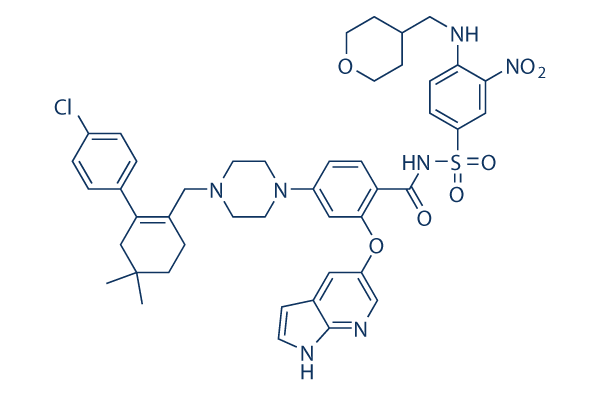
Chemische Struktur
Molekulargewicht: 868.44
Qualitätskontrolle
Produkte, die oft zusammen verwendet werden mit ABT-199 (Venetoclax)
| Verwandte Ziele | Caspase PD-1/PD-L1 Ferroptosis p53 Apoptosis related Synthetic Lethality STAT TNF-alpha Ras KRas |
|---|---|
| Weitere Bcl-2 Inhibitoren | ABT-737 Obatoclax Mesylate (GX15-070) A-1331852 TW-37 A-1155463 Dihydrochloride AZD5991 UMI-77 (R)-(-)-Gossypol (AT-101) acetic acid A-1155463 Sabutoclax |
Zellkultur, Behandlung & Arbeitskonzentration
| Zelllinien | Assay-Typ | Konzentration | Inkubationszeit | Formulierung | Aktivitätsbeschreibung | PMID |
|---|---|---|---|---|---|---|
| CS-THL1 | Growth Inhibition Assay | 20 nM | 72 h | DMSO | Inhibits cell growth assessed by cell viability | 25916698 |
| CS-THL1 | Apoptotic Assay | 25 nM | DMSO | Induces apoptosis | 25916698 | |
| DoGKiT | Apoptotic Assay | 50 nM | DMSO | Induces apoptosis | 25916698 | |
| RS4-11 | Growth Inhibition Assay | 72 h | IC50=0.0402 μM | 25649768 | ||
| NALM-6 | Growth Inhibition Assay | 72 h | IC50>3 μM | 25649768 | ||
| SU-DHL-6 | Growth Inhibition Assay | 0.8 μM | Inhibits cell growth assessed by cell viability | 25590803 | ||
| OCI-Ly19 | Growth Inhibition Assay | 1 μM | Inhibits cell growth assessed by cell viability | 25590803 | ||
| SU-DHL-6 | Function Assay | 0.75 μM | 18 h | Increases pro-survival protein MCL-1 expression | 25590803 | |
| KCL22 | Function Assay | 2 μM | 48 h | DMSO | Increases DNA fragamentation | 25333252 |
| LOUCY | Growth Inhibition Assay | 10 μM | 48 h | DMSO | IC50=0.0139 μM | 25301704 |
| ALL-SIL | Growth Inhibition Assay | 10 μM | 48 h | DMSO | IC50=0.1803 μM | 25301704 |
| CUTLL1 | Growth Inhibition Assay | 10 μM | 48 h | DMSO | IC50=0.3823 μM | 25301704 |
| KOPTK1 | Growth Inhibition Assay | 10 μM | 48 h | DMSO | IC50=0.6432 μM | 25301704 |
| DND-41 | Growth Inhibition Assay | 10 μM | 48 h | DMSO | IC50=1.9695 μM | 25301704 |
| PF-382 | Growth Inhibition Assay | 10 μM | 48 h | DMSO | IC50=2.1824 μM | 25301704 |
| KARPAS-45 | Growth Inhibition Assay | 10 μM | 48 h | DMSO | IC50=3.2225 μM | 25301704 |
| PEER | Growth Inhibition Assay | 10 μM | 48 h | DMSO | IC50=4.6403 μM | 25301704 |
| CX-1 | Growth Inhibition Assay | 100 μM | 72 h | IC50=6.7 μM | 25208882 | |
| LS147T | Growth Inhibition Assay | 100 μM | 72 h | IC50=29.5 μM | 25208882 | |
| HL-60 | Growth Inhibition Assay | 48 h | IC50<1 μM | 24346116 | ||
| MOLM-13 | Growth Inhibition Assay | 48 h | IC50<1 μM | 24346116 | ||
| OCI-AML2 | Growth Inhibition Assay | 48 h | IC50<1 μM | 24346116 | ||
| Kasumi-1 | Growth Inhibition Assay | 48 h | IC50<1 μM | 24346116 | ||
| KG-1 | Growth Inhibition Assay | 48 h | IC50<1 μM | 24346116 | ||
| THP-1 | Growth Inhibition Assay | 48 h | IC50<1 μM | 24346116 | ||
| MOLM-14 | Growth Inhibition Assay | 48 h | IC50<1 μM | 24346116 | ||
| MOLM-13 | Apoptotic Assay | 50 nM | 24 h | Apoptosis induction | 24346116 | |
| HSB | Growth Inhibition Assay | 10 μM | 48 h | DMSO | IC50=4.448 μM | 24342948 |
| MOLT4 | Growth Inhibition Assay | 10 μM | 48 h | DMSO | IC50=4.154 μM | 24342948 |
| SKW-3/KE-37 | Growth Inhibition Assay | 10 μM | 48 h | DMSO | IC50=0.712 μM | 24342948 |
| SUPT-11 | Growth Inhibition Assay | 10 μM | 48 h | DMSO | IC50=4.473 μM | 24342948 |
| JURKAT | Growth Inhibition Assay | 10 μM | 48 h | DMSO | IC50=4.893 μM | 24342948 |
| CCRF-CEM | Growth Inhibition Assay | 10 μM | 48 h | DMSO | IC50=1.360 μM | 24342948 |
| LOUCY | Apoptotic Assay | 2 μM | 48 h | DMSO | Apoptosis induction | 24342948 |
| RS4:11 | Cytotoxicity assay | 29407973 | ||||
| RS4:11 | MTS assay | 72 h | 30278333 | |||
| RS4:11 | MTS assay | 28926247 | ||||
| Toledo | MTS assay | 72 h | 30278333 | |||
| NCI60 | SRB assay | 48 h | 27994761 | |||
| RS4:11 | MTT assay | 24 h | 29453135 | |||
| melanoma | SRB assay | 48 h | 27994761 | |||
| leukemia | SRB assay | 48 h | 27994761 | |||
| renal cancer | SRB assay | 48 h | 27994761 | |||
| non-small cell lung cancer | SRB assay | 48 h | 27994761 | |||
| breast cancer | SRB assay | 48 h | 27994761 | |||
| colon cancer | SRB assay | 48 h | 27994761 | |||
| ovarian cancer | SRB assay | 48 h | 27994761 | |||
| CNS cancer | SRB assay | 48 h | 27994761 | |||
| prostate cancer | SRB assay | 48 h | 27994761 | |||
| Remb1 | MTT assay | 24 h | 29453135 | |||
| Klicken Sie hier, um weitere experimentelle Daten zu Zelllinien anzuzeigen | ||||||
Chemische Informationen, Lagerung & Stabilität
| Molekulargewicht | 868.44 | Formel | C45H50ClN7O7S |
Lagerung (Ab dem Eingangsdatum) | |
|---|---|---|---|---|---|
| CAS-Nr. | 1257044-40-8 | SDF herunterladen | Lagerung von Stammlösungen |
|
|
| Synonyme | GDC-0199 | Smiles | CC1(CCC(=C(C1)C2=CC=C(C=C2)Cl)CN3CCN(CC3)C4=CC(=C(C=C4)C(=O)NS(=O)(=O)C5=CC(=C(C=C5)NCC6CCOCC6)[N+](=O)[O-])OC7=CN=C8C(=C7)C=CN8)C | ||
Löslichkeit
|
In vitro |
DMSO
: 100 mg/mL
(115.14 mM)
Water : Insoluble Ethanol : Insoluble |
Molaritätsrechner
|
In vivo |
|||||
In-vivo-Formulierungsrechner (Klare Lösung)
Schritt 1: Geben Sie die untenstehenden Informationen ein (Empfohlen: Ein zusätzliches Tier zur Berücksichtigung von Verlusten während des Experiments)
Schritt 2: Geben Sie die In-vivo-Formulierung ein (Dies ist nur der Rechner, keine Formulierung. Bitte kontaktieren Sie uns zuerst, wenn es im Abschnitt "Löslichkeit" keine In-vivo-Formulierung gibt.)
Berechnungsergebnisse:
Arbeitskonzentration: mg/ml;
Methode zur Herstellung der DMSO-Stammlösung: mg Wirkstoff vorgelöst in μL DMSO ( Konzentration der Stammlösung mg/mL, Bitte kontaktieren Sie uns zuerst, wenn die Konzentration die DMSO-Löslichkeit der Wirkstoffcharge überschreitet. )
Methode zur Herstellung der In-vivo-Formulierung: Nehmen Sie μL DMSO Stammlösung, dann hinzufügenμL PEG300, mischen und klären, dann hinzufügenμL Tween 80, mischen und klären, dann hinzufügen μL ddH2O, mischen und klären.
Methode zur Herstellung der In-vivo-Formulierung: Nehmen Sie μL DMSO Stammlösung, dann hinzufügen μL Maisöl, mischen und klären.
Hinweis: 1. Bitte stellen Sie sicher, dass die Flüssigkeit klar ist, bevor Sie das nächste Lösungsmittel hinzufügen.
2. Achten Sie darauf, das/die Lösungsmittel der Reihe nach hinzuzufügen. Sie müssen sicherstellen, dass die bei der vorherigen Zugabe erhaltene Lösung eine klare Lösung ist, bevor Sie mit der Zugabe des nächsten Lösungsmittels fortfahren. Physikalische Methoden wie Vortex, Ultraschall oder ein heißes Wasserbad können zur Unterstützung des Lösens verwendet werden.
Wirkmechanismus
| Merkmale |
Re-engineered version of ABT-263 (Navitoclax).
|
|---|---|
| Targets/IC50/Ki |
Bcl-2
(Cell-free assay) <0.01 nM(Ki)
|
| In vitro |
Venetoclax (ABT-199) zeigt eine geringere Empfindlichkeit gegenüber Bcl-xL, Mcl-1 und Bcl-w mit Ki von 48 nM, > 444 nM bzw. 245 nM. Es hemmt potent FL5.12-Bcl-2-Zellen, RS4;11-Zellen mit EC50 von 4 nM und 8 nM, während es eine geringe Aktivität gegen FL5.12-Bcl-xL-Zellen mit EC50 von 261 nM zeigt. Diese Verbindung induziert eine schnelle Apoptose in RS4;11-Zellen mit Cytochrom c-Freisetzung, Caspase-Aktivierung, der Externalisierung von Phosphatidylserin und der Akkumulation von Sub-G0/G1-DNA. Quantitative Immunoblot-Analysen zeigen, dass die Empfindlichkeit stark mit der Expression von Bcl-2 korreliert, einschließlich NHL-, DLBCL-, MCL-, AML- und ALL-Zelllinien. Es induziert auch Apoptose in CLL mit einem durchschnittlichen EC50 von 3,0 nM.
|
| Kinase-Assay |
Bindungsaffinitätsassays
|
|
Bindungsaffinitäten (Ki oder IC50) von Venetoclax (ABT-199) gegen verschiedene Isoformen der Bcl-2-Familie werden mit kompetitiven Fluoreszenzpolarisationstests bestimmt. Die folgenden Peptidprobe/Protein-Paare werden verwendet: f-bad (1 nM) und Bcl-xL (6 nM), f-Bax (1 nM) und Bcl-2 (10 nM), f-Bax (1 nM) und Bcl-w (40 nM), f-Noxa (2 nM) und Mcl-1 (40 nM) sowie f-Bax (1 nM) und Bcl-2-A1 (15 nM). Seine Bindungsaffinitäten für Bcl-xL werden auch mittels eines zeitaufgelösten Fluoreszenzresonanzenergietransfer-Assays bestimmt. In diesem Assay wird Bcl-xL (1 nM, His-markiert) mit 200 nM f-Bak, 1 nM Tb-markiertem Anti-His-Antikörper und der Verbindung bei Raumtemperatur für 30 min gemischt. Die Fluoreszenz wird auf einem Envision-Plattenlesegerät unter Verwendung eines 340/35 nm Anregungsfilters und 520/525 (f-Bak) und 495/510 nm (Tb-markierter Anti-His-Antikörper) Emissionsfilters gemessen.
|
|
| In vivo |
Venetoclax (ABT-199) bewirkt eine maximale Tumorwachstumshemmung von 95 % und eine Tumorwachstumsverzögerung von 152 % in RS4;11-Xenotransplantaten. Es hemmt auch das Xenotransplantatwachstum (DoHH2, Granta-519) als Einzelwirkstoff oder in Kombination mit SDX-105 und anderen Wirkstoffen.
|
Literatur |
Anwendungen
| Methoden | Biomarker | Bilder | PMID |
|---|---|---|---|
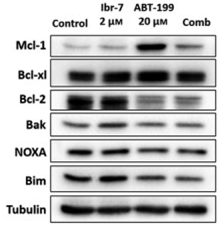
| Western blot | Mcl-1 / Bcl-xl / Bcl-2 / Bak / NOXA / Bim PARP / Cleaved PARP / Caspase 3 / Cleaved caspase3 / p-S6(Ser236/236) |
|
30663221 |
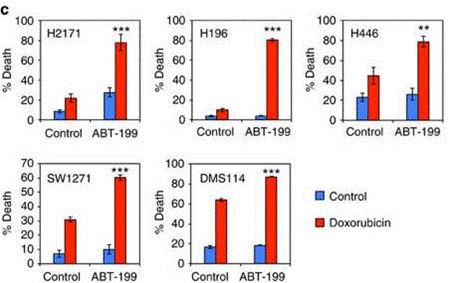
| Growth inhibition assay | Cell death Cell viability |
|
28714472 |
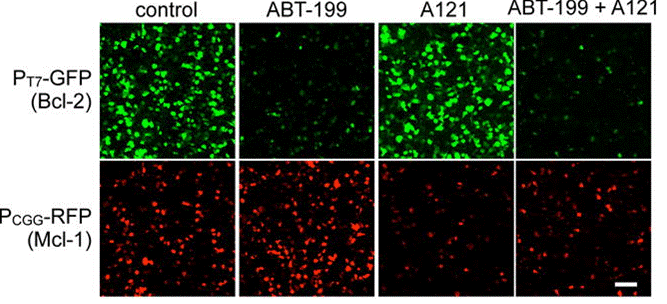
| Immunofluorescence | Bcl-2 / Mcl-1 |
|
28767232 |
Klinische Studieninformationen
(Daten von https://clinicaltrials.gov, aktualisiert am 2024-05-22)
| NCT-Nummer | Rekrutierung | Erkrankungen | Sponsor/Kooperationspartner | Startdatum | Phasen |
|---|---|---|---|---|---|
| NCT06382168 | Not yet recruiting | Leukemia Myeloid Acute |
Delta-Fly Pharma Inc. |
May 31 2024 | Phase 1|Phase 2 |
| NCT06263387 | Not yet recruiting | AML Adult |
French Innovative Leukemia Organisation|Acute Leukemia French Association |
April 29 2024 | -- |
Technischer Support
Tel: +1-832-582-8158 Ext:3
Wenn Sie weitere Fragen haben, hinterlassen Sie bitte eine Nachricht.
Häufig gestellte Fragen
Frage 1:
Could you please offer some advice on the half-life of it ?
Antwort:
According to the reference (https://www.ncbi.nlm.nih.gov/pubmed/24212376), its half-life in dogs is 12.9 hr.

Produkte sind nur für Forschungszwecke bestimmt. Nicht für den menschlichen Gebrauch. Wir verkaufen nicht an Patienten.
©Copyright 2013 Selleck Chemicals. Alle Rechte vorbehalten.