
nur für Forschungszwecke
Avagacestat (BMS-708163) Secretase Inhibitor
Kat.-Nr.S1262
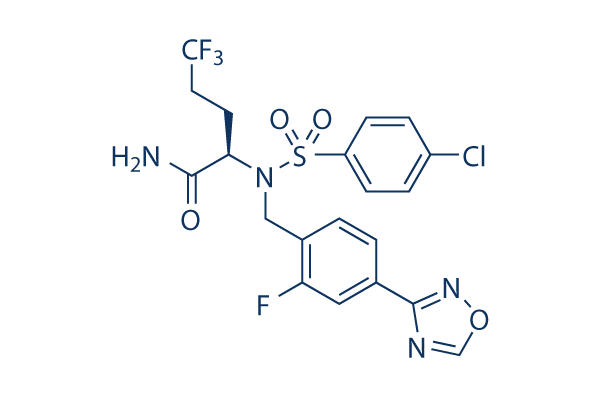
Chemische Struktur
Molekulargewicht: 520.88
Qualitätskontrolle
| Verwandte Ziele | HDAC Caspase Proteasome MMP HCV Protease Cysteine Protease DPP Tyrosinase HIV Protease Serine Protease |
|---|---|
| Weitere Secretase Inhibitoren | DAPT RO4929097 (RG-4733) LY411575 Nirogacestat (PF-03084014) Dibenzazepine (YO-01027) Semagacestat (LY450139) MK-0752 MDL-28170 L-685,458 NGP 555 |
Zellkultur, Behandlung & Arbeitskonzentration
| Zelllinien | Assay-Typ | Konzentration | Inkubationszeit | Formulierung | Aktivitätsbeschreibung | PMID |
|---|---|---|---|---|---|---|
| human IMR32 cell | Function assay | 2 h | Inhibition of gamma-secretase in human IMR32 cell membrane using APP as substrate after 2 hrs by ELISA, IC50=0.13 nM | |||
| human H4 cells | Function assay | Inhibition of gamma secretase-mediated amyloid beta42 production in human H4 cells expressing human APP swedish mutant, IC50=0.225 μM | ||||
| HEK293 cells | Function assay | Inhibition of gamma-secretase in HEK293 cells after overnight incubation by Western blotting analysis, IC50=1.2 nM | ||||
| CHO cells | Function assay | Inhibition of gamma-secretase in CHO cells assessed expressing APPSw assessed as inhibition of amyloid beta(1 to x) secretion after overnight incubation by ELISA, ED50=1.2 nM | ||||
| human IMR32 cell | Function assay | 2 h | Inhibition of gamma-secretase in human IMR32 cell membrane using Notch as substrate after 2 hrs by ELISA, IC50=1.5 nM | |||
| human 786-0 cell | Growth inhibition assay | Inhibition of human 786-0 cell growth in a cell viability assay, IC50=0.32173 μM | ||||
| human NCI-H810 cell | Growth inhibition assay | Inhibition of human NCI-H810 cell growth in a cell viability assay, IC50=0.42598 μM | ||||
| human IGR-1 cell | Growth inhibition assay | Inhibition of human IGR-1 cell growth in a cell viability assay, IC50=1.04778 μM | ||||
| human SK-MEL-3 cell | Growth inhibition assay | Inhibition of human SK-MEL-3 cell growth in a cell viability assay, IC50=1.49922 μM | ||||
| human HT-1080 cell | Growth inhibition assay | Inhibition of human HT-1080 cell growth in a cell viability assay, IC50=2.48764 μM | ||||
| human NCI-H23 cell | Growth inhibition assay | Inhibition of human NCI-H23 cell growth in a cell viability assay, IC50=3.9322 μM | ||||
| human Calu-6 cell | Growth inhibition assay | Inhibition of human Calu-6 cell growth in a cell viability assay, IC50=4.96014 μM | ||||
| human CAPAN-1 cell | Growth inhibition assay | Inhibition of human CAPAN-1 cell growth in a cell viability assay, IC50=5.17886 μM | ||||
| human COLO-668 cell | Growth inhibition assay | Inhibition of human COLO-668 cell growth in a cell viability assay, IC50=5.40221 μM | ||||
| human TE-6 cell | Growth inhibition assay | Inhibition of human TE-6 cell growth in a cell viability assay, IC50=6.19082 μM | ||||
| human LCLC-97TM1 cell | Growth inhibition assay | Inhibition of human LCLC-97TM1 cell growth in a cell viability assay, IC50=10.0886 μM | ||||
| human CAS-1 cell | Growth inhibition assay | Inhibition of human CAS-1 cell growth in a cell viability assay, IC50=13.671 μM | ||||
| human RPMI-2650 cell | Growth inhibition assay | Inhibition of human RPMI-2650 cell growth in a cell viability assay, IC50=13.8124 μM | ||||
| human MDA-MB-157 cell | Growth inhibition assay | Inhibition of human MDA-MB-157 cell growth in a cell viability assay, IC50=14.2431 μM | ||||
| human KINGS-1 cell | Growth inhibition assay | Inhibition of human KINGS-1 cell growth in a cell viability assay, IC50=14.3762 μM | ||||
| human BB49-HNC cell | Growth inhibition assay | Inhibition of human BB49-HNC cell growth in a cell viability assay, IC50=14.4138 μM | ||||
| human SK-UT-1 cell | Growth inhibition assay | Inhibition of human SK-UT-1 cell growth in a cell viability assay, IC50=14.6882 μM | ||||
| human EW-11 cell | Growth inhibition assay | Inhibition of human EW-11 cell growth in a cell viability assay, IC50=14.8832 μM | ||||
| human D-502MG cell | Growth inhibition assay | Inhibition of human D-502MG cell growth in a cell viability assay, IC50=14.9034 μM | ||||
| human MMAC-SF cell | Growth inhibition assay | Inhibition of human MMAC-SF cell growth in a cell viability assay, IC50=15.0833 μM | ||||
| human NCI-H1648 cell | Growth inhibition assay | Inhibition of human NCI-H1648 cell growth in a cell viability assay, IC50=15.778 μM | ||||
| human NCI-H292 cell | Growth inhibition assay | Inhibition of human NCI-H292 cell growth in a cell viability assay, IC50=15.8806 μM | ||||
| human NMC-G1 cell | Growth inhibition assay | Inhibition of human NMC-G1 cell growth in a cell viability assay, IC50=16.6293 μM | ||||
| human SAS cell | Growth inhibition assay | Inhibition of human SAS cell growth in a cell viability assay, IC50=17.7812 μM | ||||
| human HCT-116 cell | Growth inhibition assay | Inhibition of human HCT-116 cell growth in a cell viability assay, IC50=18.7965 μM | ||||
| human SBC-5 cell | Growth inhibition assay | Inhibition of human SBC-5 cell growth in a cell viability assay, IC50=19.03 μM | ||||
| Klicken Sie hier, um weitere experimentelle Daten zu Zelllinien anzuzeigen | ||||||
Chemische Informationen, Lagerung & Stabilität
| Molekulargewicht | 520.88 | Formel | C20H17ClF4N4O4S |
Lagerung (Ab dem Eingangsdatum) | |
|---|---|---|---|---|---|
| CAS-Nr. | 1146699-66-2 | SDF herunterladen | Lagerung von Stammlösungen |
|
|
| Synonyme | N/A | Smiles | C1=CC(=CC=C1S(=O)(=O)N(CC2=C(C=C(C=C2)C3=NOC=N3)F)C(CCC(F)(F)F)C(=O)N)Cl | ||
Löslichkeit
|
In vitro |
DMSO
: 104 mg/mL
(199.66 mM)
Water : Insoluble Ethanol : Insoluble |
Molaritätsrechner
|
In vivo |
|||||
In-vivo-Formulierungsrechner (Klare Lösung)
Schritt 1: Geben Sie die untenstehenden Informationen ein (Empfohlen: Ein zusätzliches Tier zur Berücksichtigung von Verlusten während des Experiments)
Schritt 2: Geben Sie die In-vivo-Formulierung ein (Dies ist nur der Rechner, keine Formulierung. Bitte kontaktieren Sie uns zuerst, wenn es im Abschnitt "Löslichkeit" keine In-vivo-Formulierung gibt.)
Berechnungsergebnisse:
Arbeitskonzentration: mg/ml;
Methode zur Herstellung der DMSO-Stammlösung: mg Wirkstoff vorgelöst in μL DMSO ( Konzentration der Stammlösung mg/mL, Bitte kontaktieren Sie uns zuerst, wenn die Konzentration die DMSO-Löslichkeit der Wirkstoffcharge überschreitet. )
Methode zur Herstellung der In-vivo-Formulierung: Nehmen Sie μL DMSO Stammlösung, dann hinzufügenμL PEG300, mischen und klären, dann hinzufügenμL Tween 80, mischen und klären, dann hinzufügen μL ddH2O, mischen und klären.
Methode zur Herstellung der In-vivo-Formulierung: Nehmen Sie μL DMSO Stammlösung, dann hinzufügen μL Maisöl, mischen und klären.
Hinweis: 1. Bitte stellen Sie sicher, dass die Flüssigkeit klar ist, bevor Sie das nächste Lösungsmittel hinzufügen.
2. Achten Sie darauf, das/die Lösungsmittel der Reihe nach hinzuzufügen. Sie müssen sicherstellen, dass die bei der vorherigen Zugabe erhaltene Lösung eine klare Lösung ist, bevor Sie mit der Zugabe des nächsten Lösungsmittels fortfahren. Physikalische Methoden wie Vortex, Ultraschall oder ein heißes Wasserbad können zur Unterstützung des Lösens verwendet werden.
Wirkmechanismus
| Merkmale |
Appears to be more “notch sparing” than semagacestat (LY450139).
|
|---|---|
| Targets/IC50/Ki |
Aβ42
(in H4-8Sw cells) 0.27 nM
Aβ40
(in H4-8Sw cells) 0.3 nM
|
| In vitro |
Avagacestat (BMS-708163) zeigt eine schwächere Selektivität für die Hemmung der Notch-Prozessierung mit einem 193-fachen IC50-Wert.
|
| In vivo |
Avagacestat (BMS-708163) reduziert die Aβ40-Spiegel im Gehirn, Plasma und Liquor von Ratten und Hunden nach oraler Verabreichung über längere Zeiträume signifikant. Es hat keine dosislimitierenden Effekte bei Hunden (3 mg/kg über 6 Monate), mit einem hohen Gehirn-zu-Plasma-Verhältnis (2,4).
|
Literatur |
Klinische Studieninformationen
(Daten von https://clinicaltrials.gov, aktualisiert am 2024-05-22)
| NCT-Nummer | Rekrutierung | Erkrankungen | Sponsor/Kooperationspartner | Startdatum | Phasen |
|---|---|---|---|---|---|
| NCT01002079 | Completed | Alzheimer Disease |
Bristol-Myers Squibb|PRA Health Sciences |
August 2010 | Phase 1 |
| NCT01057030 | Completed | Alzheimer Disease |
Bristol-Myers Squibb |
March 2010 | Phase 1 |
| NCT01042314 | Completed | Alzheimer Disease |
Bristol-Myers Squibb |
January 2010 | Phase 1 |
| NCT01039194 | Completed | Alzheimer Disease |
Bristol-Myers Squibb |
January 2010 | Phase 1 |
| NCT00979316 | Completed | Alzheimer Disease |
Bristol-Myers Squibb |
September 2009 | Phase 1 |
| NCT00890890 | Terminated | Alzheimer''s Disease |
Bristol-Myers Squibb |
May 2009 | Phase 2 |
Technischer Support
Tel: +1-832-582-8158 Ext:3
Wenn Sie weitere Fragen haben, hinterlassen Sie bitte eine Nachricht.

Produkte sind nur für Forschungszwecke bestimmt. Nicht für den menschlichen Gebrauch. Wir verkaufen nicht an Patienten.
©Copyright 2013 Selleck Chemicals. Alle Rechte vorbehalten.