
nur für Forschungszwecke
Dibenzazepine (YO-01027) γ-Sekretase-Inhibitor
Kat.-Nr.S2711
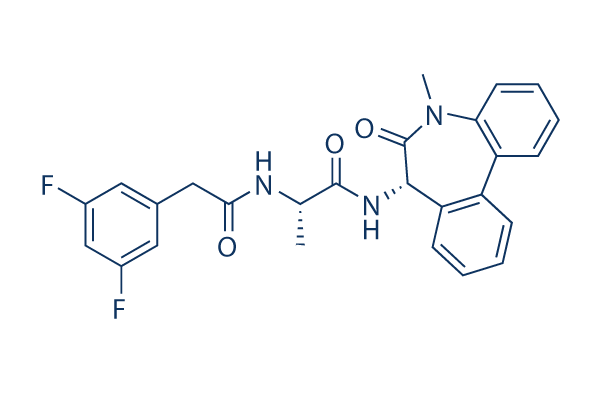
Chemische Struktur
Molekulargewicht: 463.48
Qualitätskontrolle
| Verwandte Ziele | HDAC Caspase Proteasome MMP HCV Protease Cysteine Protease DPP Tyrosinase HIV Protease Serine Protease |
|---|---|
| Weitere Secretase Inhibitoren | DAPT RO4929097 (RG-4733) LY411575 Nirogacestat (PF-03084014) Avagacestat (BMS-708163) Semagacestat (LY450139) MK-0752 MDL-28170 L-685,458 NGP 555 |
Zellkultur, Behandlung & Arbeitskonzentration
| Zelllinien | Assay-Typ | Konzentration | Inkubationszeit | Formulierung | Aktivitätsbeschreibung | PMID |
|---|---|---|---|---|---|---|
| SupT1 | Function assay | 16 hrs | Inhibition of gamma secretase in human SupT1 cells assessed as reduction in amyloid beta 40 after 16 hrs by chemiluminescence assay, IC50=0.0026μM | 27045975 | ||
| SupT1 | Function assay | 16 hrs | Inhibition of gamma secretase mediated Notch signaling in human SupT1 cells after 16 hrs by chemiluminescence assay, IC50=0.0029μM | 27045975 | ||
| DAOY | qHTS assay | qHTS of pediatric cancer cell lines to identify multiple opportunities for drug repurposing: Primary screen for DAOY cells | 29435139 | |||
| A673 | qHTS assay | qHTS of pediatric cancer cell lines to identify multiple opportunities for drug repurposing: Primary screen for A673 cells | 29435139 | |||
| SK-N-MC | qHTS assay | qHTS of pediatric cancer cell lines to identify multiple opportunities for drug repurposing: Primary screen for SK-N-MC cells | 29435139 | |||
| SK-N-SH | qHTS assay | qHTS of pediatric cancer cell lines to identify multiple opportunities for drug repurposing: Primary screen for SK-N-SH cells | 29435139 | |||
| NB1643 | qHTS assay | qHTS of pediatric cancer cell lines to identify multiple opportunities for drug repurposing: Primary screen for NB1643 cells | 29435139 | |||
| RD | qHTS assay | qHTS of pediatric cancer cell lines to identify multiple opportunities for drug repurposing: Primary screen for RD cells | 29435139 | |||
| MG 63 (6-TG R) | qHTS assay | qHTS of pediatric cancer cell lines to identify multiple opportunities for drug repurposing: Primary screen for MG 63 (6-TG R) cells | 29435139 | |||
| Rh41 | qHTS assay | qHTS of pediatric cancer cell lines to identify multiple opportunities for drug repurposing: Primary screen for Rh41 cells | 29435139 | |||
| Klicken Sie hier, um weitere experimentelle Daten zu Zelllinien anzuzeigen | ||||||
Chemische Informationen, Lagerung & Stabilität
| Molekulargewicht | 463.48 | Formel | C26H23F2N3O3 |
Lagerung (Ab dem Eingangsdatum) | |
|---|---|---|---|---|---|
| CAS-Nr. | 209984-56-5 | SDF herunterladen | Lagerung von Stammlösungen |
|
|
| Synonyme | YO-01027 | Smiles | CC(C(=O)NC1C2=CC=CC=C2C3=CC=CC=C3N(C1=O)C)NC(=O)CC4=CC(=CC(=C4)F)F | ||
Löslichkeit
|
In vitro |
DMSO
: 92 mg/mL
(198.49 mM)
Water : Insoluble Ethanol : Insoluble |
Molaritätsrechner
|
In vivo |
|||||
In-vivo-Formulierungsrechner (Klare Lösung)
Schritt 1: Geben Sie die untenstehenden Informationen ein (Empfohlen: Ein zusätzliches Tier zur Berücksichtigung von Verlusten während des Experiments)
Schritt 2: Geben Sie die In-vivo-Formulierung ein (Dies ist nur der Rechner, keine Formulierung. Bitte kontaktieren Sie uns zuerst, wenn es im Abschnitt "Löslichkeit" keine In-vivo-Formulierung gibt.)
Berechnungsergebnisse:
Arbeitskonzentration: mg/ml;
Methode zur Herstellung der DMSO-Stammlösung: mg Wirkstoff vorgelöst in μL DMSO ( Konzentration der Stammlösung mg/mL, Bitte kontaktieren Sie uns zuerst, wenn die Konzentration die DMSO-Löslichkeit der Wirkstoffcharge überschreitet. )
Methode zur Herstellung der In-vivo-Formulierung: Nehmen Sie μL DMSO Stammlösung, dann hinzufügenμL PEG300, mischen und klären, dann hinzufügenμL Tween 80, mischen und klären, dann hinzufügen μL ddH2O, mischen und klären.
Methode zur Herstellung der In-vivo-Formulierung: Nehmen Sie μL DMSO Stammlösung, dann hinzufügen μL Maisöl, mischen und klären.
Hinweis: 1. Bitte stellen Sie sicher, dass die Flüssigkeit klar ist, bevor Sie das nächste Lösungsmittel hinzufügen.
2. Achten Sie darauf, das/die Lösungsmittel der Reihe nach hinzuzufügen. Sie müssen sicherstellen, dass die bei der vorherigen Zugabe erhaltene Lösung eine klare Lösung ist, bevor Sie mit der Zugabe des nächsten Lösungsmittels fortfahren. Physikalische Methoden wie Vortex, Ultraschall oder ein heißes Wasserbad können zur Unterstützung des Lösens verwendet werden.
Wirkmechanismus
| Targets/IC50/Ki |
γ secretase
(Cell-free assay) 2.6 nM
Notch
(Cell-free assay) 2.9 nM
|
|---|---|
| In vitro |
YO-01027 interagiert direkt mit dem γ-secretase-Komplex und zielt auf das N-terminale Presenilin-Fragment ab. Steigende Konzentrationen von YO-01027, die APPL- oder Notch-exprimierenden Zellen verabreicht werden, führen zu einer progressiven Akkumulation von APPL CTF-Fragmenten und einer Abnahme der NICD-Produktion auf streng dosisabhängige Weise. 10 μM YO-01027 reduziert die Anzahl und Aktivität von Brustkrebs-Stammzellen (BCSC). Eine aktuelle Untersuchung zeigt, dass YO-01027 die Biosynthese des Muzinproteins MUC16 in undifferenzierten Zellen sowohl in präkonfluenten als auch in konfluenten Stadien durch Notch-Hemmung, aber nicht in postmitotischen geschichteten Zellen, konzentrationsabhängig beeinträchtigt.
|
| Kinase-Assay |
Pharmakologische Hemmung der γ-secretase-Aktivität
|
|
Für YO-01027 werden Pilotexperimente mit verschiedenen Arzneimittelkonzentrationen im Bereich von 0,1 nM bis 250 nM durchgeführt, um den effektiven linearen Bereich und die maximale Hemmdosis für YO-01027 zu bestimmen. YO-01027 wird in den erforderlichen Konzentrationen dem S2-Zellmedium bei Induktion der Notch- oder APPL-Expression 6 Stunden vor der Proteinentnahme zugesetzt. Für jede Probe wird YO-01027 auch in der entsprechenden Konzentration in den Lysepuffer zur Proteinextraktion und Immunoblot-Analyse eingeschlossen.
|
|
| In vivo |
YO-01027, das am Tag der Zellinjektion und alle 3 folgenden Tage als 1 mg/mL i.p.-Injektion verabreicht wird, verringert signifikant MCF7-, aber nicht MDA-MB-231-Tumoren und erhöht die Latenz im Vergleich zu Kontrollmäusen (18-28 Tage). Die mit YO-01027 behandelten MCF7-Tumoren, die sich bildeten, hatten deutlich reduzierte Tumorvolumina. Die Behandlung von C57BL/6-Mäusen mit YO-01027 hemmt die Proliferation von Epithelzellen und induziert die Becherzellendifferenzierung in intestinalen Adenomen dosisabhängig.
|
Literatur |
|
Technischer Support
Tel: +1-832-582-8158 Ext:3
Wenn Sie weitere Fragen haben, hinterlassen Sie bitte eine Nachricht.
Häufig gestellte Fragen
Frage 1:
How to dissolve it for in vivo applications?
Antwort:
For S2711, we suggest to use 0.5% hydroxyethyl cellulose in vivo study for it.

Produkte sind nur für Forschungszwecke bestimmt. Nicht für den menschlichen Gebrauch. Wir verkaufen nicht an Patienten.
©Copyright 2013 Selleck Chemicals. Alle Rechte vorbehalten.