
nur für Forschungszwecke
Carbamazepine Sodium Channel Inhibitor
Kat.-Nr.: S1693
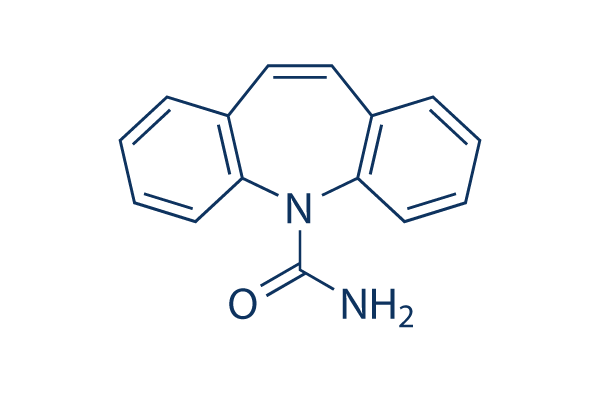
Chemische Struktur
Molekulargewicht: 236.27
Qualitätskontrolle (Quality Control)
| Verwandte Ziele | CFTR CRM1 CD markers AChR Calcium Channel Potassium Channel GABA Receptor TRP Channel ATPase GluR |
|---|---|
| Weitere Sodium Channel Inhibitoren | Camostat Mesilate A-803467 cariporide Tolperisone HCl Vinpocetine Veratramine Bulleyaconi cine A GS967 Ambroxol HCl Benzocaine |
Chemische Informationen, Lagerung & Stabilität (Chemical Information, Storage & Stability)
| Molekulargewicht | 236.27 | Formel | C15H12N2O |
Lagerung (Ab dem Eingangsdatum) | |
|---|---|---|---|---|---|
| CAS-Nr. | 298-46-4 | SDF herunterladen | Lagerung von Stammlösungen |
|
|
| Synonyme | NSC 169864 | Smiles | C1=CC=C2C(=C1)C=CC3=CC=CC=C3N2C(=O)N | ||
Löslichkeit (Solubility)
|
In vitro |
DMSO
: 47 mg/mL
(198.92 mM)
Ethanol : 47 mg/mL Water : Insoluble |
Molaritätsrechner
|
In vivo |
|||||
In-vivo-Formulierungsrechner (Klare Lösung)
Schritt 1: Geben Sie die untenstehenden Informationen ein (Empfohlen: Ein zusätzliches Tier zur Berücksichtigung von Verlusten während des Experiments)
Schritt 2: Geben Sie die In-vivo-Formulierung ein (Dies ist nur der Rechner, keine Formulierung. Bitte kontaktieren Sie uns zuerst, wenn es im Abschnitt "Löslichkeit" keine In-vivo-Formulierung gibt.)
Berechnungsergebnisse:
Arbeitskonzentration: mg/ml;
Methode zur Herstellung der DMSO-Stammlösung: mg Wirkstoff vorgelöst in μL DMSO ( Konzentration der Stammlösung mg/mL, Bitte kontaktieren Sie uns zuerst, wenn die Konzentration die DMSO-Löslichkeit der Wirkstoffcharge überschreitet. )
Methode zur Herstellung der In-vivo-Formulierung: Nehmen Sie μL DMSO Stammlösung, dann hinzufügenμL PEG300, mischen und klären, dann hinzufügenμL Tween 80, mischen und klären, dann hinzufügen μL ddH2O, mischen und klären.
Methode zur Herstellung der In-vivo-Formulierung: Nehmen Sie μL DMSO Stammlösung, dann hinzufügen μL Maisöl, mischen und klären.
Hinweis: 1. Bitte stellen Sie sicher, dass die Flüssigkeit klar ist, bevor Sie das nächste Lösungsmittel hinzufügen.
2. Achten Sie darauf, das/die Lösungsmittel der Reihe nach hinzuzufügen. Sie müssen sicherstellen, dass die bei der vorherigen Zugabe erhaltene Lösung eine klare Lösung ist, bevor Sie mit der Zugabe des nächsten Lösungsmittels fortfahren. Physikalische Methoden wie Vortex, Ultraschall oder ein heißes Wasserbad können zur Unterstützung des Lösens verwendet werden.
Wirkmechanismus (Mechanism of Action)
| Merkmale |
Frequently prescribed first-line drug for the treatment of partial and generalized tonic-clonic epileptic seizures.
|
|---|---|
| Targets/IC50/Ki |
Sodium channel
131 μM
|
| In vitro |
Carbamazepine inhibits the binding of [3H]batrachotoxinin A 20-α-benzoate (BTX-B) to a receptor site of voltage-sensitive sodium channel with IC50 of 131 μM, to decrease the activation of sodium channel ion flux in rat brain synaptosomes. This compound reduces receptor affinity due to an increased rate of ligand dissociation from the receptor-ligand complex, without altering maximal binding capacity from the scatchard analysis of BTX-B binding to synaptosome, suggesting an indirect allosteric mechanism for anticonvulsant inhibition of BTX-B binding. It does not alter basal 125I-labeled scorpion toxin binding to synaptosomes in the absence of batrachotoxin, but when batrachotoxin (1.25 μM) added, this chemical inhibits the batrachotoxin-dependent increase in scorpion toxin binding in a concentration-dependent manner with IC50 of 260 μM mediated at the alkaloid toxin binding site, none of which affects [3H]saxitoxin binding.
|
| In vivo |
Carbamazepine at 25 mg/kg significantly increases extracellular levels of striatal and hippocampal dopamine (DA), 3,4-dihydroxyphenylalanine (DOPA), 3,4-dihydroxyphenylacetic acid (DOPAC) and homovanillic acid (HVA) in a dose dependent manner, while this compound at 50 mg/kg significantly decreases total levels of striatal DA and DOPA as well as hippocampal HVA, but has no effect on total levels of striatal DOPAC and HVA nor on hippocampal DA, DOPA and DOPAC. Intraperitoneal administration of this chemical (~100 mg/kg)to rats produces significant increases in the cerebral cortical concentrations of neuroactive steroids and neuroactive steroids in plasma in a dose and time dependent maner with DHEA formed as a result of side chain cleavage of pregnenolone not affected.
|
Literatur |
|
Klinische Studieninformationen (Clinical Trial Information)
(Daten von https://clinicaltrials.gov, aktualisiert am 2026-06-29)
| NCT-Nummer | Rekrutierung | Erkrankungen | Sponsor/Kooperationspartner | Startdatum | Phasen |
|---|---|---|---|---|---|
| NCT07673549 | NOT_YET_RECRUITING | Idiopathic Trigeminal Neuralgia |
Beijing Tiantan Hospital |
2026-08-31 | |
| NCT03307863 | SUSPENDED | Contraception; Drug Interactions |
University of Sao Paulo |
2017-11-01 | PHASE4 |
| NCT07750730 | NOT_YET_RECRUITING | Trigeminal Neuralgia (TN) |
Beijing Hospital of Traditional Chinese Medicine |
2026-08-31 | |
| NCT07369622 | NOT_YET_RECRUITING | Gout Initiating Urate-loweringUrate-lowering Therapy; Gout Arthritis; Gout and Hyperuricemia |
Haiphong University of Medicine and Pharmacy |
2026-01-20 | PHASE4 |
| NCT07395024 | ACTIVE_NOT_RECRUITING | Healthy Volunteer |
Astellas Pharma Global Development, Inc. |
2026-02-03 | PHASE1 |
| NCT07781631 | NOT_YET_RECRUITING | Healthy |
Boehringer Ingelheim |
2026-09-10 | PHASE1 |

Produkte sind nur für Forschungszwecke bestimmt. Nicht für den menschlichen Gebrauch. Wir verkaufen nicht an Patienten.
©Copyright 2013 Selleck Chemicals. Alle Rechte vorbehalten.