
nur für Forschungszwecke
Flavopiridol (Alvocidib, HMR-1275) CDK Inhibitor
Kat.-Nr.S1230
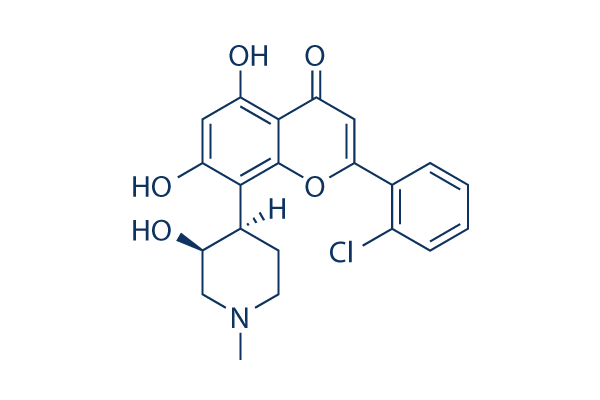
Chemische Struktur
Molekulargewicht: 401.84
Qualitätskontrolle
Zellkultur, Behandlung & Arbeitskonzentration
| Zelllinien | Assay-Typ | Konzentration | Inkubationszeit | Formulierung | Aktivitätsbeschreibung | PMID |
|---|---|---|---|---|---|---|
| MCF-7 tumor cell | Proliferation assay | Inhibition of MCF-7 tumor cell proliferation | 10843211 | |||
| PC3 cell | Function assay | Inhibition of PC3 cell clonogenic assay, IC50=10 μM | 11063609 | |||
| HCT116 cell | Function assay | Inhibition of HCT116 cell clonogenic assay, IC50=13 μM | 11063609 | |||
| A2780 cell | Function assay | Inhibition of A2780 cell clonogenic assay, IC50=15 μM | 11063609 | |||
| Mia PaCa-2 cell | Function assay | Inhibition of Mia PaCa-2 cell clonogenic assay, IC50=36 μM | 11063609 | |||
| LNCaP human prostate carcinoma cell | Proliferation assay | Inhibition of LNCaP human prostate carcinoma cell proliferation | 12190313 | |||
| HCT116/VP35 human colon carcinoma cell | Proliferation assay | Inhibition of HCT116/VP35 human colon carcinoma cell proliferation, IC50=17 nM | 12190313 | |||
| HCT116 human colon carcinoma cell | Proliferation assay | Inhibition of HCT116 human colon carcinoma cell proliferation, IC50=18 nM | 12190313 | |||
| HCT116/VM46 human colon carcinoma cell | Proliferation assay | Inhibition of HCT116/VM46 human colon carcinoma cell proliferation, IC50=21 nM | 12190313 | |||
| A2780/DDP-R human ovarian carcinoma cell | Proliferation assay | Inhibition of A2780/DDP-R human ovarian carcinoma cell proliferation, IC50=38 nM | 12190313 | |||
| ABAE human fibroblast cell | Proliferation assay | Inhibition of ABAE human fibroblast cell proliferation, IC50=45 nM | 12190313 | |||
| HL60 human leukemia cell | Proliferation assay | Inhibition of HL60 human leukemia cell proliferation, IC50=46 nM | 12190313 | |||
| Hs 27 human fibroblast cell | Proliferation assay | Inhibition of Hs 27 human fibroblast cell proliferation, IC50=51 nM | 12190313 | |||
| CCRF-CEM human leukemia cell | Proliferation assay | Inhibition of CCRF-CEM human leukemia cell proliferation, IC50=52 nM | 12190313 | |||
| OVCAR-3 human ovarian carcinoma cell | Proliferation assay | Inhibition of OVCAR-3 human ovarian carcinoma cell proliferation, IC50=54 nM | 12190313 | |||
| A2780/DDP-S human ovarian carcinoma cell | Proliferation assay | Inhibition of A2780/DDP-S human ovarian carcinoma cell proliferation, IC50=56 nM | 12190313 | |||
| A2780/TAX-S human ovarian carcinoma cell | Proliferation assay | Inhibition of A2780/TAX-S human ovarian carcinoma cell proliferation, IC50=65 nM | 12190313 | |||
| LS174T human colon carcinoma cell | Proliferation assay | Inhibition of LS174T human colon carcinoma cell proliferation, IC50=65 nM | 12190313 | |||
| MCF-7 human breast carcinoma cell | Proliferation assay | Inhibition of MCF-7 human breast carcinoma cell proliferation, IC50=66 nM | 12190313 | |||
| PC3 human prostate carcinoma cell | Proliferation assay | Inhibition of PC3 human prostate carcinoma cell proliferation, IC50=66 nM | 12190313 | |||
| MLF mouse lung fibroblast cell | Proliferation assay | Inhibition of MLF mouse lung fibroblast cell proliferation, IC50=72 nM | 12190313 | |||
| LX-1 human lung carcinoma | Proliferation assay | Inhibition of LX-1 human lung carcinoma proliferation, IC50=75 nM | 12190313 | |||
| A431 human squamous cell | Proliferation assay | Inhibition of A431 human squamous cell carcinoma cell proliferation, IC50=75 nM | 12190313 | |||
| SKBR-3 human breast carcinoma cell | Proliferation assay | Inhibition of SKBR-3 human breast carcinoma cell proliferation, IC50=77 nM | 12190313 | |||
| A2780/TAX-R human ovarian carcinoma cell | Proliferation assay | Inhibition of A2780/TAX-R human ovarian carcinoma cell proliferation, IC50=78 nM | 12190313 | |||
| M109 mouse lung carcinoma cell | Proliferation assay | Inhibition of M109 mouse lung carcinoma cell proliferation, IC50=80 nM | 12190313 | |||
| CACO-2 human colon carcinoma cell | Proliferation assay | Inhibition of CACO-2 human colon carcinoma cell proliferation, IC50=86 nM | 12190313 | |||
| A549 human lung carcinoma cell | Proliferation assay | Inhibition of A549 human lung carcinoma cell proliferation, IC50=96 nM | 12190313 | |||
| MIP human colon carcinoma cell | Function assay | Inhibition of MIP human colon carcinoma cell line, IC50=0.12 μM | 12190313 | |||
| K562 human leukemia cell | Proliferation assay | Inhibition of K562 human leukemia cell proliferation, IC50=0.13 μM | 12190313 | |||
| human A2780 cell line | Proliferation assay | 72 h | Antiproliferative effect against human A2780 cell line was determined in a whole cell 72 hr cytotoxicity assay, IC50=71 nM | 15027863 | ||
| human ovarian (A2780) cancer cell | Cytotoxic assay | Cytotoxic effect on human ovarian (A2780) cancer cell line, IC50=71 nM | 15125971 | |||
| ID8 cells | Proliferation assay | Antiproliferative activity against ID8 cells, IC50=7 nM | 17123821 | |||
| MCF7 cells | Proliferation assay | Antiproliferative activity against MCF7 cells, IC50=26 nM | 17123821 | |||
| Sf9 cells | Function assay | Inhibition of recombinant cyclin A/CDK2 expressed in Sf9 cells, IC50=12 nM | 17904366 | |||
| human A2780 cells | Function assay | Inhibition of cdk-mediated NPM phosphorylation at thr199 in human A2780 cells | 18469809 | |||
| human A2780 cells | Function assay | 24 h | Inhibition of cdk-mediated Rb phosphorylation at thr821 in human A2780 cells after 24 hrs | 18469809 | ||
| human NCI60 cells | Proliferation assay | 72 h | Antiproliferative activity against human NCI60 cells after 72 hrs by sulforhodamine B assay, GI50=74.7 nM | 21080703 | ||
| human NCI60 cells | Proliferation assay | 72 h | Antiproliferative activity against human NCI60 cells assessed as lethal effect after 72 hrs by sulforhodamine B assay, LC50=0.904 μM | 21080703 | ||
| human A2780 cells | Cytotoxic assay | 24 h | Cytotoxicity against human A2780 cells after 24 hrs by MTT assay, GI50=23 nM | 23301767 | ||
| human MRC5 cells | Cytotoxic assay | 72 h | Cytotoxicity against human MRC5 cells after 72 hrs by MTT assay, GI50=28 nM | 23301767 | ||
| human A2780 cells | Cytotoxic assay | 72 h | Cytotoxicity against human A2780 cells after 72 hrs by MTT assay, GI50=29 nM | 23301767 | ||
| human A2780 cells | Cytotoxic assay | 48 h | Cytotoxicity against human A2780 cells after 48 hrs by MTT assay, GI50=31 nM | 23301767 | ||
| human MRC5 cells | Cytotoxic assay | 48 h | Cytotoxicity against human MRC5 cells after 48 hrs by MTT assay, GI50=39 nM | 23301767 | ||
| human MRC5 cells | Cytotoxic assay | 24 h | Cytotoxicity against human MRC5 cells after 24 hrs by MTT assay, GI50=49 nM | 23301767 | ||
| human HMEC1 cells | Cytotoxic assay | 24 h | Cytotoxicity against human HMEC1 cells after 24 hrs by MTT assay, GI50=61 nM | 23301767 | ||
| human HMEC1 cells | Cytotoxic assay | 48 h | Cytotoxicity against human HMEC1 cells after 48 hrs by MTT assay, GI50=62 nM | 23301767 | ||
| human HMEC1 cells | Cytotoxic assay | 72 h | Cytotoxicity against human HMEC1 cells after 72 hrs by MTT assay, GI50=66 nM | 23301767 | ||
| A2780 | Function assay | 330 nM | 24 hr | Percentage A2780 cells in sb-G1 after 24 hr r at 330 nM (IC50), Cell cycle = 0.001 μM. | 12190313 | |
| A2780 | Apoptosis assay | 330 nM | 24 hr | Apoptotic A2780 cells after 24 hr r at 330 nM (IC50), Cell cycle = 0.001 μM. | 12190313 | |
| A2780 | Function assay | 2980 nM | 24 hr | Percentage A2780 cells in sub-G1 after 24 hr r at 2980 nM (IC90), Cell cycle = 0.002 μM. | 12190313 | |
| A2780 | Apoptosis assay | 2980 nM | 24 hr | Apoptotic A2780 cells after 24 hr r at 2980 nM (IC90), Cell cycle = 0.009 μM. | 12190313 | |
| A2780 | Function assay | 2980 nM | 24 hr | Percentage A2780 cells in S-phase after 24 hr r at 2980 nM (IC90), Cell cycle = 0.012 μM. | 12190313 | |
| A2780 | Function assay | 330 nM | 24 hr | Percentage A2780 cells in S-phase after 24 hr r at 330 nM (IC50), Cell cycle = 0.016 μM. | 12190313 | |
| A2780 | Function assay | 330 nM | 24 hr | Percentage A2780 cells in G2/M after 24 hr r at 330 nM (IC50), Cell cycle = 0.023 μM. | 12190313 | |
| A2780 | Function assay | 2980 nM | 24 hr | Percentage A2780 cells in G2/M after 24 hr r at 2980 nM (IC90), Cell cycle = 0.025 μM. | 12190313 | |
| A2780 | Function assay | 330 nM | 24 hr | Percentage A2780 cells in G1 after 24 hr r at 330 nM (IC50), Cell cycle = 0.06 μM. | 12190313 | |
| A2780 | Function assay | 2980 nM | 24 hr | Percentage A2780 cells in G1 after 24 hr r at 2980 nM (IC90), Cell cycle = 0.061 μM. | 12190313 | |
| A2780 | Function assay | 24 hrs | Inhibition of cdk-mediated Rb phosphorylation at ser807/811 in human A2780 cells after 24 hrs | 18469809 | ||
| A2780 | Function assay | 24 hrs | Inhibition of cdk9-mediated RNA pol2 CTD phosphorylation at ser2 in human A2780 cells after 24 hrs | 18469809 | ||
| A2780 | Function assay | 24 hrs | Inhibition of cdk7-mediated RNA pol2 CTD phosphorylation at ser5 in human A2780 cells after 24 hrs | 18469809 | ||
| A2780 | Apoptosis assay | 24 hrs | Induction of apoptosis in human A2780 cells assessed as appearance of Mcl1 protein level after 24 hrs | 18469809 | ||
| DR-U2OS-GFP | Function assay | 0.1 uM | 56 hrs | Reduction of homologous recombination in human DR-U2OS-GFP cells expressing I-SceI nuclease assessed as reduction of RAD51 level at 0.1 uM after 56 hrs by immunoblotting | 21417417 | |
| A2780 | Function assay | 24 hrs | Inhibition of CDK9 in human A2780 cells assessed as reduction of RNAPII CTD phosphorylation at Ser2 at GI50 concentration after 24 hrs by Western blotting analysis | 23301767 | ||
| A2780 | Cell cycle assay | 24 hrs | Cell cycle arrest in human A2780 cells assessed as accumulation at G2/M phase at less than GI50 after 24 hrs by flow cytometric analysis | 23301767 | ||
| A2780 | Function assay | 24 hrs | Inhibition of CDK9 in human A2780 cells assessed as downregulation of MCL1 at GI50 to 5XGI50 concentration after 24 hrs by Western blotting analysis | 23301767 | ||
| A2780 | Apoptosis assay | 24 hrs | Induction of apoptosis in human A2780 cells assessed as induction of PARP cleavage at GI50 to 5XGI50 concentration after 24 hrs by Western blotting analysis | 23301767 | ||
| A2780 | Function assay | 24 hrs | Inhibition of CDK9 in human A2780 cells assessed as downregulation of HDM2 at GI50 to 5XGI50 concentration after 24 hrs by Western blotting analysis | 23301767 | ||
| MT4 | Antiproliferative assay | Antiviral activity against Human immunodeficiency virus 1 NL 4-3 infected in MT4 cells measured on day 4 post infection by p24 assay, EC50 = 0.015 μM. | 25914804 | |||
| MT4 | Cytotoxicity assay | Cytotoxicity against human MT4 cells, IC50 = 0.067 μM. | 25914804 | |||
| Sf9 | Function assay | 15 mins | Inhibition of CDK2/cyclin E1 (unknown origin) expressed in Sf9 insect cells using UlightCFFKNIVTPRTPPPSQGK-amide substrate after 15 mins by autoradiography, IC50 = 0.13 μM. | 25914804 | ||
| A549 | Antiproliferative assay | 3 days | Antiproliferative activity against human A549 cells after 3 days by SRB method, GI50 = 0.14 μM. | 25914804 | ||
| DU145 | Antiproliferative assay | 3 days | Antiproliferative activity against human DU145 cells after 3 days by SRB method, GI50 = 0.15 μM. | 25914804 | ||
| KB | Antiproliferative assay | 3 days | Antiproliferative activity against human KB cells after 3 days by SRB method, GI50 = 0.16 μM. | 25914804 | ||
| KBVIN | Antiproliferative assay | 3 days | Antiproliferative activity against human KBVIN cells after 3 days by SRB method, GI50 = 0.18 μM. | 25914804 | ||
| HCT116 | Antiproliferative assay | 72 hrs | Antiproliferative activity against human HCT116 cells after 72 hrs by Celltiter-Glo reagent based assay in presence of 10% fetal bovine serum, EC50 = 0.034 μM. | 26985305 | ||
| HCT116 | Antiproliferative assay | 72 hrs | Antiproliferative activity against human HCT116 cells after 72 hrs by Celltiter-Glo reagent based assay in presence of 0.625% fetal bovine serum, EC50 = 0.059 μM. | 26985305 | ||
| Sf9 | Function assay | 10 mins | Inhibition of human His6-tagged CDK9/cyclin T1 expressed in baculovirus infected sf9 cells using GST-CTD as substrate after 10 mins in presence of [gamma-32P]ATP by SDS-PAGE analysis, IC50 = 0.0025 μM. | 27171036 | ||
| Sf21 | Function assay | Inhibition of recombinant human full length C-terminal His6-tagged CDK9/cyclin T1 expressed in baculovirus infected Sf21 insect cells using PDKtide as substrate, IC50 = 0.011 μM. | 27171036 | |||
| HeLa | Cytotoxicity assay | 72 hrs | Cytotoxicity against human HeLa cells assessed as decrease in cell viability after 72 hrs by MTT assay, CC50 = 0.12 μM. | 27171036 | ||
| sf21 | Function assay | Inhibition of full length human N-terminal His6-tagged CDK6/N-terminal GST-tagged cyclin D3 expressed in sf21 cells using histone H1 substrate, IC50 = 0.395 μM. | 27171036 | |||
| Sf21 | Function assay | Inhibition of recombinant human full length C-terminal His6-tagged CDK7/cyclin H/N-terminal GST-tagged MAT1 expressed in baculovirus infected Sf21 insect cells using cdk7 substrate peptide, IC50 = 0.514 μM. | 27171036 | |||
| HepG2 | Antiproliferative assay | 72 hrs | Antiproliferative activity against human HepG2 cells after 72 hrs by CelTiter-Glo assay, EC50 = 0.1464 μM. | 29407975 | ||
| KOPN8 | Antiproliferative assay | 72 hrs | Antiproliferative activity against human KOPN8 cells after 72 hrs by CelTiter-Glo assay, EC50 = 0.1926 μM. | 29407975 | ||
| SEM | Antiproliferative assay | 72 hrs | Antiproliferative activity against human SEM cells after 72 hrs by CelTiter-Glo assay, EC50 = 0.2043 μM. | 29407975 | ||
| UOCB1 | Antiproliferative assay | 72 hrs | Antiproliferative activity against human UOCB1 cells after 72 hrs by CelTiter-Glo assay, EC50 = 0.2084 μM. | 29407975 | ||
| KOPN8 | Apoptosis assay | 0.5 uM | 3 to 24 hrs | Induction of apoptosis in human KOPN8 cells assessed as upregulation of cleaved PARP level at 0.5 uM after 3 to 24 hrs by Western blot analysis | 29407975 | |
| KOPN8 | Apoptosis assay | 0.5 uM | 1 hr | Induction of apoptosis in human KOPN8 cells assessed as upregulation of cleaved PARP level at 0.5 uM pre-treated with NAC for 1 hr and measured after 3 to 24 hrs by Western blot analysis | 29407975 | |
| Klicken Sie hier, um weitere experimentelle Daten zu Zelllinien anzuzeigen | ||||||
Chemische Informationen, Lagerung & Stabilität
| Molekulargewicht | 401.84 | Formel | C21H20ClNO5 |
Lagerung (Ab dem Eingangsdatum) | |
|---|---|---|---|---|---|
| CAS-Nr. | 146426-40-6 | SDF herunterladen | Lagerung von Stammlösungen |
|
|
| Synonyme | NSC 649890, HMR-1275, L86-8275 | Smiles | CN1CCC(C(C1)O)C2=C(C=C(C3=C2OC(=CC3=O)C4=CC=CC=C4Cl)O)O | ||
Löslichkeit
|
In vitro |
DMSO
: 80 mg/mL
(199.08 mM)
Water : Insoluble Ethanol : Insoluble |
Molaritätsrechner
|
In vivo |
|||||
In-vivo-Formulierungsrechner (Klare Lösung)
Schritt 1: Geben Sie die untenstehenden Informationen ein (Empfohlen: Ein zusätzliches Tier zur Berücksichtigung von Verlusten während des Experiments)
Schritt 2: Geben Sie die In-vivo-Formulierung ein (Dies ist nur der Rechner, keine Formulierung. Bitte kontaktieren Sie uns zuerst, wenn es im Abschnitt "Löslichkeit" keine In-vivo-Formulierung gibt.)
Berechnungsergebnisse:
Arbeitskonzentration: mg/ml;
Methode zur Herstellung der DMSO-Stammlösung: mg Wirkstoff vorgelöst in μL DMSO ( Konzentration der Stammlösung mg/mL, Bitte kontaktieren Sie uns zuerst, wenn die Konzentration die DMSO-Löslichkeit der Wirkstoffcharge überschreitet. )
Methode zur Herstellung der In-vivo-Formulierung: Nehmen Sie μL DMSO Stammlösung, dann hinzufügenμL PEG300, mischen und klären, dann hinzufügenμL Tween 80, mischen und klären, dann hinzufügen μL ddH2O, mischen und klären.
Methode zur Herstellung der In-vivo-Formulierung: Nehmen Sie μL DMSO Stammlösung, dann hinzufügen μL Maisöl, mischen und klären.
Hinweis: 1. Bitte stellen Sie sicher, dass die Flüssigkeit klar ist, bevor Sie das nächste Lösungsmittel hinzufügen.
2. Achten Sie darauf, das/die Lösungsmittel der Reihe nach hinzuzufügen. Sie müssen sicherstellen, dass die bei der vorherigen Zugabe erhaltene Lösung eine klare Lösung ist, bevor Sie mit der Zugabe des nächsten Lösungsmittels fortfahren. Physikalische Methoden wie Vortex, Ultraschall oder ein heißes Wasserbad können zur Unterstützung des Lösens verwendet werden.
Wirkmechanismus
| Merkmale |
First CDK inhibitor to be used in human clinical trials.
|
|---|---|
| Targets/IC50/Ki |
CDK9
(Cell-free assay) 20 nM
CDK1
(Cell-free assay) 30 nM
CDK4
(Cell-free assay) 20-40 nM
CDK2
(Cell-free assay) 40 nM
CDK6
(Cell-free assay) 60 nM
CDK7
(Cell-free assay) 875 nM
|
| In vitro |
Flavopiridol (Alvocidib) zeigt weniger Aktivität gegen nicht verwandte Kinasen wie MAP, PAK, PKC und EGFR mit einer IC50 von >14 μM. Es hemmt signifikant das Koloniewachstum von HCT116-, A2780-, PC3- und Mia PaCa-2-Zellen mit einer IC50 von 13 nM, 15 nM, 10 nM bzw. 36 nM. Diese Verbindung hemmt auch potent die Aktivität der Glykogensynthasekinase-3 (GSK-3) mit einer IC50 von 280 nM. Im Vergleich zu anderen CDKs hemmt es die Aktivität von CDK7 weniger potent mit einer IC50 von 875 nM. Bei 0,5 μM hemmt es sowohl pSer807/811 Rb als auch pThr199 NPM, während milde Veränderungen bei pThr821 Rb beobachtet werden. Es verringert auch den gesamten RNA-Polymerase-II-Spiegel sowie die Phosphorylierung der RNA-Polymerase II an den CTD-Wiederholungen bei Ser2 Ser5. Als Breitband-CDK-Inhibitor kann es den Cell Cycle in G1 oder G2 hemmen. Bei 0,3 μM induziert es einen G1-Arrest in MCF-7- oder MDA-MB-468-Zellen durch Hemmung der CDK4- oder CDK2-Kinaseaktivität. Es zeigt eine potente Zytotoxizität gegen eine Vielzahl von Tumorzelllinien mit IC50-Werten von 16 nM für LNCAP bis 130 nM für K562.
|
| Kinase-Assay |
CDK-Kinase-Assay
|
|
Für den CDK1/Cyclin B1-Kinase-Assay bestehen die Kinase-Reaktionen aus 100 ng des im Baculovirus exprimierten GST-CDK1/Cyclin B1 (human)-Komplexes, 1 μg Histon HI, 0,2 μCi [γ-33P]ATP, 25 μM ATP in 50 μL Kinase-Puffer (50 mM Tris, pH 8,0, 10 mM MgCl2, 1 mM EGTA, 0,5 mM DTT). Für den CDK2/Cyclin E-Kinase-Assay bestehen die Kinase-Reaktionen aus 5 ng des im Baculovirus exprimierten GST-CDK2/Cyclin E (human)-Komplexes, 0,5 μg GST-RB-Fusionsprotein (Aminosäuren 776-928 des Retinoblastom-Proteins), 0,2 μCi [γ-33P]ATP, 25 μM ATP in 50 μL Kinase-Puffer (50 mM Hepes, pH 8,0, 10 mM MgCl2, 1 mM EGTA, 2 mM DTT). Für den CDK4/Cyclin D1-Kinase-Assay bestehen die Kinase-Reaktionen aus 150 ng des im Baculovirus exprimierten GST-CDK4/Cyclin D1 (human), 280 ng Stag-Cyclin D1, 0,5 μg GST-RB-Fusionsprotein (Aminosäuren 776-928 des Retinoblastom-Proteins), 0,2 μCi [γ-33P]ATP, 25 μM ATP in 50 μL Kinase-Puffer (50 mM Hepes, pH 8,0, 10 mM MgCl2, 1 mM EGTA, 2 mM DTT). Die Reaktionen werden 45 Minuten für CDK1 und CDK2 oder 1 Stunde für CDK4 bei 30 °C inkubiert und durch Zugabe von kalter Trichloressigsäure (TCA) bis zu einer Endkonzentration von 15 % gestoppt. TCA-Präzipitate werden auf GF/C-Unifilterplatten mit einem Filtermate Universal Harvester gesammelt und die Filter mit einem TopCount 96-Well Flüssigkeitsszintillationszähler quantifiziert. Flavopiridol (Alvocidib) wird in 10 mM in Dimethylformamid (DMF) gelöst und in sechs Konzentrationen, jeweils dreifach, evaluiert. Die Endkonzentration von DMF im Assay beträgt 2 %. Die IC50-Werte werden durch nichtlineare Regressionsanalyse abgeleitet und haben einen Variabilitätskoeffizienten von 16 %. Zur Bestimmung seiner Aktivität auf CDK6 wird ein Filterbindungsassay etabliert. Die folgenden Komponenten werden in der Reaktionsmischung kombiniert: 2 μL CDK6 (0,7 mg/μL), 5 μL Histon H1 (6 mg/mL), 14 μL Kinase-Puffer (60 mM β-Glycerophosphat, 30 mM p-Nitrophenylphosphat, 25 mM MOPS (pH 7,0), 5 mM EGTA, 15 mM MgCl2, 1 mM DTT, 0,1 mM Na-Vanadat), 3 μL zunehmender Konzentrationen dieser in 50 % DMSO verdünnten Verbindung und 6 μL 33P-ATP (1 mCi/mL) in nichtradioaktivem ATP bei 90 μM Konzentration (Endkonzentration: 15 μM). Der Assay wird durch Zugabe von 33P-ATP initiiert. Die Reaktion wird 20 Minuten bei 30 °C inkubiert. Ein 25 μL Aliquot des Überstands wird dann auf Whatman P81 Phosphocellulose-Papier aufgetragen. Die Filter werden 5 Mal mit 1 %iger Phosphorsäurelösung gewaschen. Feuchte Filter werden in Gegenwart von 1 mL Szintillationsflüssigkeit gezählt. Die Cdk9-Aktivität wird unter Verwendung von 50 nM rekombinantem Cdk9/Cyclin T in 50 mM HEPES pH 7,5, 10 mM MgCl2, 1 mM DTT, 3 μM Na3VO4, 150 μM RNA-Polymerase CDT-Peptid und 80 μM ATP gemessen. Der Cdk7-Assay wird im selben Puffer unter Verwendung von 37 nM gereinigter Kinase in Gegenwart von 200 μM ATP und 10 μM Myelin-Bindungsprotein als Substrat durchgeführt. Die Wirksamkeit gegenüber CDK9 und CDK7 wird entweder mittels eines starken Anionenaustauscher-(Dowex 1-X8 Harz, Formiat-Form)-basierten Assays oder eines Szintillationsproximity-Assays bestimmt. Die IC50-Werte werden aus den Dosis-Wirkungs-Kurven berechnet.
|
|
| In vivo |
Die Verabreichung von S1230 mit 7,5 mg/kg über 7 Tage zeigt eine leichte Antitumoraktivität gegen P388-Mausleukämie, was zu einem %T/C-Wert von 110 führt, und ist aktiv gegen das subkutan in Nacktmäuse implantierte humane A2780-Ovarialkarzinom, wobei ein 1,5 log cell kill (LCK) erzeugt wird. Die S1230-Behandlung mit 1-2,5 mg/kg über 10 Tage unterdrückt signifikant die kollageninduzierte Arthritis bei Mäusen dosisabhängig, indem sie die synoviale Hyperplasie und Gelenkzerstörung hemmt, während die Serumkonzentrationen von Anti-Kollagen Typ II (CII) Antikörpern und proliferative Reaktionen auf CII aufrechterhalten bleiben. In p21-intakten Hct116-Xenotransplantaten in Nacktmäusen hemmt die Verabreichung von CPT-11 (100 mg/kg) gefolgt von S1230 (3 mg/kg) 7 und 16 Stunden später die Tumorregression signifikant um 86 % bzw. 82 %, was eine >2-fache Hemmung im Vergleich zu CPT-11 allein um 40 % zeigt. Die Kombination führt zu einer kompletten Ansprechrate (CR) von ~30 %, im Gegensatz zu CPT-11 allein, wo keine CR gefunden wird.
|
Literatur |
|
Anwendungen
| Methoden | Biomarker | Bilder | PMID |
|---|---|---|---|
| Western blot | Cleaved caspase-8 / Cleaved caspase-9 / Cleaved caspase-3 p-RNAPII / p-eIF4E / Mnk1 p-ERK / ERK / p-p38 / p-4EBP1 / 4EBP1 / p-S6 CDK2 / CDK4 / Cyclin A / p21 / p27 / Rb |
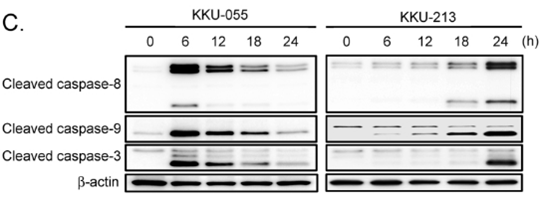
|
31193061 |
| Growth inhibition assay | Cell viability |
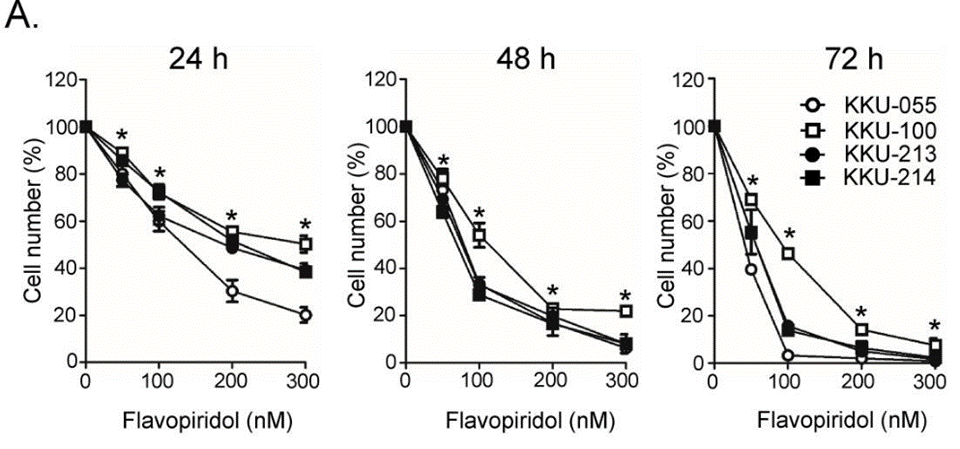
|
31193061 |
Klinische Studieninformationen
(Daten von https://clinicaltrials.gov, aktualisiert am 2024-05-22)
| NCT-Nummer | Rekrutierung | Erkrankungen | Sponsor/Kooperationspartner | Startdatum | Phasen |
|---|---|---|---|---|---|
| NCT03441555 | Completed | Acute Myeloid Leukemia (AML) |
AbbVie|Sumitomo Pharma America Inc. |
May 30 2018 | Phase 1 |
| NCT03298984 | Completed | Acute Myeloid Leukemia |
Sumitomo Pharma America Inc. |
September 25 2017 | Phase 1 |
Technischer Support
Tel: +1-832-582-8158 Ext:3
Wenn Sie weitere Fragen haben, hinterlassen Sie bitte eine Nachricht.

Produkte sind nur für Forschungszwecke bestimmt. Nicht für den menschlichen Gebrauch. Wir verkaufen nicht an Patienten.
©Copyright 2013 Selleck Chemicals. Alle Rechte vorbehalten.