
nur für Forschungszwecke
ON123300 CDK Inhibitor
Kat.-Nr.S8161
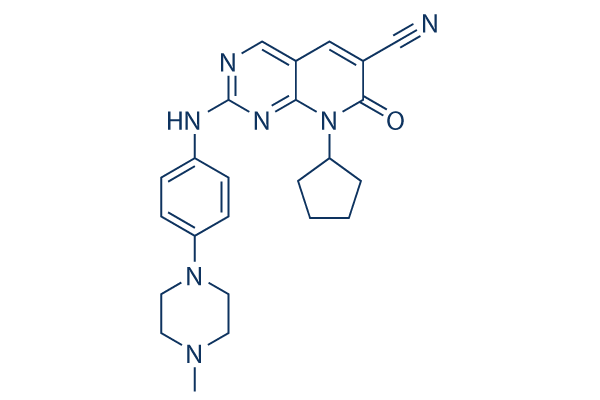
Chemische Struktur
Molekulargewicht: 429.52
Qualitätskontrolle
Chemische Informationen, Lagerung & Stabilität
| Molekulargewicht | 429.52 | Formel | C24H27N7O |
Lagerung (Ab dem Eingangsdatum) | |
|---|---|---|---|---|---|
| CAS-Nr. | 1357470-29-1 | SDF herunterladen | Lagerung von Stammlösungen |
|
|
| Synonyme | N/A | Smiles | CN1CCN(CC1)C2=CC=C(C=C2)NC3=NC=C4C=C(C(=O)N(C4=N3)C5CCCC5)C#N | ||
Löslichkeit
|
In vitro |
DMSO
: 29 mg/mL
(67.51 mM)
Water : Insoluble Ethanol : Insoluble |
Molaritätsrechner
|
In vivo |
|||||
In-vivo-Formulierungsrechner (Klare Lösung)
Schritt 1: Geben Sie die untenstehenden Informationen ein (Empfohlen: Ein zusätzliches Tier zur Berücksichtigung von Verlusten während des Experiments)
Schritt 2: Geben Sie die In-vivo-Formulierung ein (Dies ist nur der Rechner, keine Formulierung. Bitte kontaktieren Sie uns zuerst, wenn es im Abschnitt "Löslichkeit" keine In-vivo-Formulierung gibt.)
Berechnungsergebnisse:
Arbeitskonzentration: mg/ml;
Methode zur Herstellung der DMSO-Stammlösung: mg Wirkstoff vorgelöst in μL DMSO ( Konzentration der Stammlösung mg/mL, Bitte kontaktieren Sie uns zuerst, wenn die Konzentration die DMSO-Löslichkeit der Wirkstoffcharge überschreitet. )
Methode zur Herstellung der In-vivo-Formulierung: Nehmen Sie μL DMSO Stammlösung, dann hinzufügenμL PEG300, mischen und klären, dann hinzufügenμL Tween 80, mischen und klären, dann hinzufügen μL ddH2O, mischen und klären.
Methode zur Herstellung der In-vivo-Formulierung: Nehmen Sie μL DMSO Stammlösung, dann hinzufügen μL Maisöl, mischen und klären.
Hinweis: 1. Bitte stellen Sie sicher, dass die Flüssigkeit klar ist, bevor Sie das nächste Lösungsmittel hinzufügen.
2. Achten Sie darauf, das/die Lösungsmittel der Reihe nach hinzuzufügen. Sie müssen sicherstellen, dass die bei der vorherigen Zugabe erhaltene Lösung eine klare Lösung ist, bevor Sie mit der Zugabe des nächsten Lösungsmittels fortfahren. Physikalische Methoden wie Vortex, Ultraschall oder ein heißes Wasserbad können zur Unterstützung des Lösens verwendet werden.
Wirkmechanismus
| Targets/IC50/Ki |
CDK4/CyclinD1
(Cell-free assay) 3.87 nM
ARK5
(Cell-free assay) 4.95 nM
RET
(Cell-free assay) 9.2 nM
CDK6/CyclinD1
(Cell-free assay) 9.82 nM
Fyn
(Cell-free assay) 11 nM
PDGFRβ
(Cell-free assay) 26 nM
FGFR1
(Cell-free assay) 26 nM
PI3Kδ
(Cell-free assay) 144 nM
FGFR1
(Cell-free assay) 260 nM
|
|---|---|
| In vitro |
ON123300 hemmt die Proliferation von U87-Gliomzellen mit einem IC50 von 3,4 ± 0,1 μmol/L und reduziert die Phosphorylierung von Akt, induziert jedoch unerwartet auch die Erk-Aktivierung, beides dosis- und zeitabhängig, was anschließend auf die Aufhebung der Akt-vermittelten C-Raf-S259-Inaktivierung und die Aktivierung einer p70S6K-initiierten PI3K-negativen Rückkopplungsschleife zurückgeführt wird. Diese Verbindung hemmt auch CDK4/6 und PI3K-δ und zeigt eine potente Aktivität gegen Mantelzelllymphome (MCLs). Es ist ein potenter Inhibitor von CDK4 mit einem IC50 von 3,8 nM, mit geringer Hemmwirkung gegen CDKs 1, 2, 5 und 8. MCL-Zelllinien, die mit dieser Chemikalie behandelt wurden, akkumulieren in der G1-Phase bei niedrigeren Konzentrationen (0,1-1,0 μM); bei höheren Konzentrationen der Verbindung durchlaufen ein großer Teil der Zellen die S- und G2/M-Phasen des Zellzyklus und akkumulieren schließlich in der Sub-G1-Phase, was auf eine Induktion der Apoptose hindeutet. Es hemmt auch die Phosphorylierung von pRb und p130 dosisabhängig. Diese Behandlung führt zur Hemmung der FOXO1-Phosphorylierung, einem Ziel von mTOR. |
| In vivo |
In einem präklinischen Hirntumormodell (U87MG) zeigt ON123300 eine hohe Akkumulation im Gehirn und im Hirntumor. Konsistent mit den In-vitro-Studien verursacht diese Verbindung als Einzelwirkstoff eine dosisabhängige Unterdrückung der Phosphorylierung von Akt sowie eine Aktivierung von Erk in Hirntumoren. Es ist stark (99,4 %) an Plasmaproteine in Mäusen gebunden und dringt schnell ins Gehirn ein. Es hat eine effiziente BBB-Penetration und akkumuliert im normalen Gehirn. Die pharmakokinetischen Profile der Plasmakonzentration dieser Chemikalie sind multiexponentiell und nehmen insgesamt ziemlich schnell ab, mit terminalen Eliminationshalbwertzeiten von 1,5 Stunden. Maus-Xenograft-Assays zeigen eine starke Hemmung des MCL-Tumorwachstums bei mit dieser Verbindung behandelten Tieren. Sicherheitsstudien an Mäusen deuten darauf hin, dass es oral bioverfügbar und bei oraler oder intraperitonealer Verabreichung minimal toxisch ist. |
Literatur |
|
Klinische Studieninformationen
(Daten von https://clinicaltrials.gov, aktualisiert am 2024-05-22)
| NCT-Nummer | Rekrutierung | Erkrankungen | Sponsor/Kooperationspartner | Startdatum | Phasen |
|---|---|---|---|---|---|
| NCT06351644 | Not yet recruiting | Relapsed and/or Refractory Multiple Myeloma |
Adriana Rossi|Icahn School of Medicine at Mount Sinai |
June 3 2024 | Phase 1|Phase 2 |
| NCT04739293 | Recruiting | Solid Tumors Adult |
Traws Pharma Inc. |
May 13 2021 | Phase 1 |
Technischer Support
Tel: +1-832-582-8158 Ext:3
Wenn Sie weitere Fragen haben, hinterlassen Sie bitte eine Nachricht.

Produkte sind nur für Forschungszwecke bestimmt. Nicht für den menschlichen Gebrauch. Wir verkaufen nicht an Patienten.
©Copyright 2013 Selleck Chemicals. Alle Rechte vorbehalten.