
nur für Forschungszwecke
Samuraciclib (ICEC0942) hydrochloride CDK Inhibitor
Kat.-Nr.: S8722
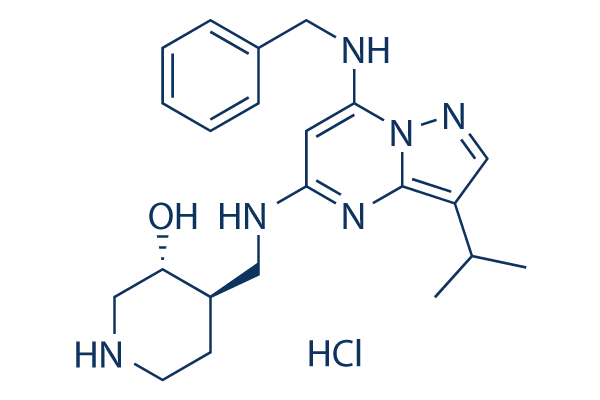
Chemische Struktur
Molekulargewicht: 430.97
Qualitätskontrolle (Quality Control)
- In Nature Medicine für seine erstklassige Qualität zitiert
- COA
- HPLC
- SDS
- Datenblatt
Chemische Informationen, Lagerung & Stabilität (Chemical Information, Storage & Stability)
| Molekulargewicht | 430.97 | Formel | C22H31ClN6O |
Lagerung (Ab dem Eingangsdatum) | 3 years -20°C powder |
|---|---|---|---|---|---|
| CAS-Nr. | 1805789-54-1 | -- | Lagerung von Stammlösungen |
|
|
| Synonyme | CT7001 hydrochloride | Smiles | CC(C)C1=C2N=C(C=C(N2N=C1)NCC3=CC=CC=C3)NCC4CCNCC4O.Cl | ||
Löslichkeit (Solubility)
|
In vitro |
DMSO
: 86 mg/mL
(199.54 mM)
Water : 86 mg/mL Ethanol : 15 mg/mL |
Molaritätsrechner
|
In vivo |
|||||
In-vivo-Formulierungsrechner (Klare Lösung)
Schritt 1: Geben Sie die untenstehenden Informationen ein (Empfohlen: Ein zusätzliches Tier zur Berücksichtigung von Verlusten während des Experiments)
Schritt 2: Geben Sie die In-vivo-Formulierung ein (Dies ist nur der Rechner, keine Formulierung. Bitte kontaktieren Sie uns zuerst, wenn es im Abschnitt "Löslichkeit" keine In-vivo-Formulierung gibt.)
Berechnungsergebnisse:
Arbeitskonzentration: mg/ml;
Methode zur Herstellung der DMSO-Stammlösung: mg Wirkstoff vorgelöst in μL DMSO ( Konzentration der Stammlösung mg/mL, Bitte kontaktieren Sie uns zuerst, wenn die Konzentration die DMSO-Löslichkeit der Wirkstoffcharge überschreitet. )
Methode zur Herstellung der In-vivo-Formulierung: Nehmen Sie μL DMSO Stammlösung, dann hinzufügenμL PEG300, mischen und klären, dann hinzufügenμL Tween 80, mischen und klären, dann hinzufügen μL ddH2O, mischen und klären.
Methode zur Herstellung der In-vivo-Formulierung: Nehmen Sie μL DMSO Stammlösung, dann hinzufügen μL Maisöl, mischen und klären.
Hinweis: 1. Bitte stellen Sie sicher, dass die Flüssigkeit klar ist, bevor Sie das nächste Lösungsmittel hinzufügen.
2. Achten Sie darauf, das/die Lösungsmittel der Reihe nach hinzuzufügen. Sie müssen sicherstellen, dass die bei der vorherigen Zugabe erhaltene Lösung eine klare Lösung ist, bevor Sie mit der Zugabe des nächsten Lösungsmittels fortfahren. Physikalische Methoden wie Vortex, Ultraschall oder ein heißes Wasserbad können zur Unterstützung des Lösens verwendet werden.
Wirkmechanismus (Mechanism of Action)
| Targets/IC50/Ki |
CDK7
(Cell-free assay) 40 nM
CDK2
(Cell-free assay) 620 nM
CDK9
(Cell-free assay) 1.2 μM
CDK1
(Cell-free assay) 1.8 μM
|
|---|---|
| In vitro |
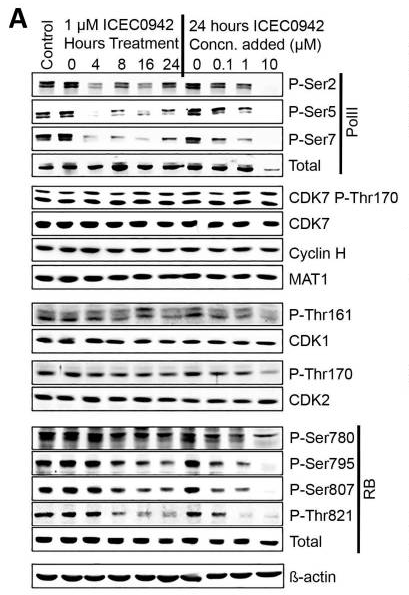
A wide range of cancer types are sensitive to CDK7 inhibition by ICEC0942 with GI50 values ranging between 0.2-0.3 µM. ICEC0942 inhibits PolII, CDK1, CDK2 and RB (retinoblastoma) phosphorylation in the MCF7 breast cancer cell line in a time and dose-sependent manner. ICEC0942 inhibits phosphorylation of CDK7 substrates and promotes cell cycle arrest and apoptosis. |
| In vivo |
In xenografts of both breast and colorectal cancers, ICEC0942 has substantial anti-tumor effects. For pharmacokinetics, CD1 male mice are treated intravenously (IV), subcutaneously (SC) or by oral gavage (PO) with 10 mg/kg ICEC0942. In plasma, ICEC0942 levels decline in a bi-phasic manner, indicating rapid distribution into tissues. Following IV administration of ICEC0942 at 10 mg/kg in male CD1 mice Cl(plasma) is calculated at 78 ml.min/kg. Blood/plasma ratio (Bl/Pl) is 1.81. ICEC0942 has a half-life of 1.9 hrs, a moderate half-life in this species. Only a small proportion (13.5%) of ICEC0942 is metabolized after 2 and 4 hour following a single PO administration (100 mg/kg). Comparing exposure (AUCt) after single PO and IV administration at 10 mg/kg, oral bioavailability (F%) is calculated at 30%. Median Tmax for PO administration is 2 hours and is unaffected by increasing dose. Over this dose range, Cmax is linearly associated with dose, as is the total exposure over time (AUCt). In tumor-bearing mice, there is appreciable accumulation of ICEC0942 in tumors 6-hours post administration. ICEC0942 levels in tumors lag behind plasma levels. |
Literatur |
Anwendungen (Applications)
| Methoden | Biomarker | Bilder | PMID |
|---|---|---|---|
| Western blot | p-Ser2 PolII / p-Ser5 PolII / p-Ser7 PolII / p-CDK7 / CDK7 / p-RB |
|
29545334 |
Klinische Studieninformationen (Clinical Trial Information)
(Daten von https://clinicaltrials.gov, aktualisiert am 2026-09-03)
| NCT-Nummer | Rekrutierung | Erkrankungen | Sponsor/Kooperationspartner | Startdatum | Phasen |
|---|---|---|---|---|---|
| NCT04802759 | RECRUITING | Inoperable, Locally Advanced or Metastatic, ER-positive Breast Cancer |
Hoffmann-La Roche |
2021-06-22 | PHASE1; PHASE2 |
| NCT07665684 | NOT_YET_RECRUITING | Pancreas Ductal Adenocarcinoma; Pancreas Cancer, Metastatic; Pancreatic Adenocarcinoma Metastatic; Adenosquamous Carcinoma of the Pancreas; Mucinous Adenocarcinoma |
University Health Network, Toronto |
2026-07 | PHASE1; PHASE2 |
| NCT07645651 | RECRUITING | Resectable Pancreatic Ductal Adenocarcinoma; Borderline Resectable Pancreatic Ductal Adenocarcinoma; Locally Advanced Pancreatic Ductal Adenocarcinoma |
University of Washington |
2026-09-15 | PHASE1 |
| NCT06125522 | ACTIVE_NOT_RECRUITING | Breast Cancer |
Pfizer |
2024-01-10 | PHASE1; PHASE2 |
| NCT05963997 | COMPLETED | Metastatic Breast Cancer; Locally Advanced Breast Cancer; Breast Cancer |
Carrick Therapeutics Limited |
2023-10-09 | PHASE1; PHASE2 |
| NCT05963984 | COMPLETED | Metastatic Breast Cancer; Locally Advanced Breast Cancer; Breast Cancer |
Carrick Therapeutics Limited |
2023-11-16 | PHASE2 |

Produkte sind nur für Forschungszwecke bestimmt. Nicht für den menschlichen Gebrauch. Wir verkaufen nicht an Patienten.
©Copyright 2013 Selleck Chemicals. Alle Rechte vorbehalten.