
nur für Forschungszwecke
Myricetin MEK Inhibitor
Kat.-Nr.: S2326
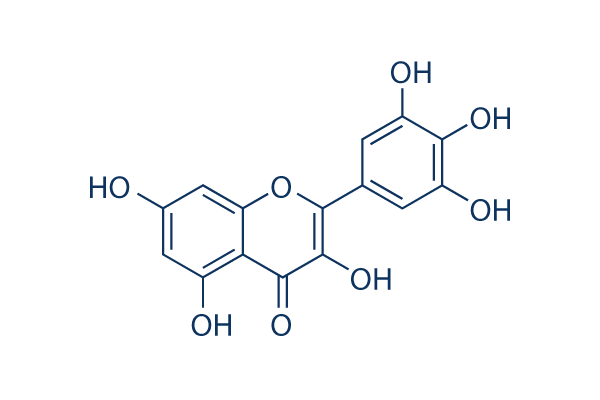
Chemische Struktur
Molekulargewicht: 318.24
Qualitätskontrolle (Quality Control)
| Verwandte Ziele | ERK p38 MAPK Raf JNK Ras KRas S6 Kinase MAP4K TAK1 Mixed Lineage Kinase |
|---|---|
| Weitere MEK Inhibitoren | PD0325901 (Mirdametinib) U0126-EtOH PD 98059 CI-1040 (PD184352) (E/Z)-BIX02189 Pimasertib (AS-703026) Refametinib (RDEA119) TAK-733 AZD8330 GDC-0623 |
Zellkultur, Behandlung & Arbeitskonzentration
(Cell Culture, Treatment & Working Concentration)
| Zelllinien | Assay-Typ | Konzentration | Inkubationszeit | Formulierung | Aktivitätsbeschreibung | PMID |
|---|---|---|---|---|---|---|
| HT-29 cells | Function assay | Desensitization of GPR35 receptor in human HT-29 cells assessed as inhibition of zaprinast-induced dynamic mass redistribution after 10 mins, IC50=2.12 μM | ||||
| HeLa cells | Function assay | Inhibition of MRP1 transfected in human HeLa cells assessed as inhibition of [3H]LTC4 transport by rapid filtration assay, Ki=2.4 μM | ||||
| HCT116 cells | Growth inhibition assay | 48 h | Growth inhibition of human HCT116 cells overexpressing PI3Kalpha H1047R mutant after 48 hrs by MTT assay, IC50=4.1 μM | |||
| human 22Rv1 cells | Proliferation assay | 144 h | Antiproliferative activity against human 22Rv1 cells incubated up to 144 hrs by Coulter particle count and size analyzer, IC50=13.1 μM | |||
| human SKBR3 cells | Function assay | 24 h | Displacement of GM-cy3B from Hsp90 in human SKBR3 cells after 24 hrs by fluorescence polarization assay, IC50=13.5 μM | |||
| human U2OS cells | Function assay | 5 h | Agonist activity at GPR35 receptor in human U2OS cells coexpressing Gal4-VP16-TEV assessed as beta arrestin translocation after 5 hrs by beta lactamase reporter gene assay, EC50=14.7 μM | |||
| human H9 cells | Function assay | 3 days | Antiviral activity against HIV1 3B infected in human H9 cells assessed as inhibition of viral replication after 3 days by p24 antigen capture assay, EC50=35 μM | |||
| NCI-60 human tumor cell line | Cytotoxicity assay | In vitro cytotoxic potency against NCI-60 human tumor cell line, GI50=36 μM | ||||
| human HL60 cells | Proliferation assay | 30 μM | 48 h | Antiproliferative activity against human HL60 cells at 30 uM after 48 hrs by MTS assay | ||
| mouse L929 cells | Function assay | 2 h | Inhibition of recombinant human TNF-alpha-induced cytotoxicity of mouse L929 cells assessed as survivality treated with drug after 2 hrs of TNFalpha treatment | |||
| Klicken Sie hier, um weitere experimentelle Daten zu Zelllinien anzuzeigen | ||||||
Chemische Informationen, Lagerung & Stabilität (Chemical Information, Storage & Stability)
| Molekulargewicht | 318.24 | Formel | C15H10O8 |
Lagerung (Ab dem Eingangsdatum) | |
|---|---|---|---|---|---|
| CAS-Nr. | 529-44-2 | SDF herunterladen | Lagerung von Stammlösungen |
|
|
Löslichkeit (Solubility)
|
In vitro |
DMSO
: 63 mg/mL
(197.96 mM)
Ethanol : 20 mg/mL Water : Insoluble |
Molaritätsrechner
|
In vivo |
|||||
In-vivo-Formulierungsrechner (Klare Lösung)
Schritt 1: Geben Sie die untenstehenden Informationen ein (Empfohlen: Ein zusätzliches Tier zur Berücksichtigung von Verlusten während des Experiments)
Schritt 2: Geben Sie die In-vivo-Formulierung ein (Dies ist nur der Rechner, keine Formulierung. Bitte kontaktieren Sie uns zuerst, wenn es im Abschnitt "Löslichkeit" keine In-vivo-Formulierung gibt.)
Berechnungsergebnisse:
Arbeitskonzentration: mg/ml;
Methode zur Herstellung der DMSO-Stammlösung: mg Wirkstoff vorgelöst in μL DMSO ( Konzentration der Stammlösung mg/mL, Bitte kontaktieren Sie uns zuerst, wenn die Konzentration die DMSO-Löslichkeit der Wirkstoffcharge überschreitet. )
Methode zur Herstellung der In-vivo-Formulierung: Nehmen Sie μL DMSO Stammlösung, dann hinzufügenμL PEG300, mischen und klären, dann hinzufügenμL Tween 80, mischen und klären, dann hinzufügen μL ddH2O, mischen und klären.
Methode zur Herstellung der In-vivo-Formulierung: Nehmen Sie μL DMSO Stammlösung, dann hinzufügen μL Maisöl, mischen und klären.
Hinweis: 1. Bitte stellen Sie sicher, dass die Flüssigkeit klar ist, bevor Sie das nächste Lösungsmittel hinzufügen.
2. Achten Sie darauf, das/die Lösungsmittel der Reihe nach hinzuzufügen. Sie müssen sicherstellen, dass die bei der vorherigen Zugabe erhaltene Lösung eine klare Lösung ist, bevor Sie mit der Zugabe des nächsten Lösungsmittels fortfahren. Physikalische Methoden wie Vortex, Ultraschall oder ein heißes Wasserbad können zur Unterstützung des Lösens verwendet werden.
Wirkmechanismus (Mechanism of Action)
| Targets/IC50/Ki |
MEK1
PI3Kγ
0.17 μM(Kd)
|
|---|---|
| In vitro |
Myricetin(Cannabiscetin) is a flavonoid found in many grapes, berries, fruits, vegetables, herbs, as well as other plants, which has antioxidant and anti tumor properties. This compound has antioxidant properties. In vitro research suggests that this compound in high concentrations can modify LDL cholesterol such that uptake by white blood cells is increased. Studies shows that high consumption of this compound reduces the risk of prostate cancer and pancreatic cancer.
|
Literatur |
|
Klinische Studieninformationen (Clinical Trial Information)
(Daten von https://clinicaltrials.gov, aktualisiert am 2024-08-12)
| NCT-Nummer | Rekrutierung | Erkrankungen | Sponsor/Kooperationspartner | Startdatum | Phasen |
|---|---|---|---|---|---|
| NCT06548503 | COMPLETED | Oxidative Stress; Alcohol Drinking |
University of Padova |
2023-11-01 |

Produkte sind nur für Forschungszwecke bestimmt. Nicht für den menschlichen Gebrauch. Wir verkaufen nicht an Patienten.
©Copyright 2013 Selleck Chemicals. Alle Rechte vorbehalten.