
nur für Forschungszwecke
PD 98059 MEK Inhibitor
Kat.-Nr.S1177
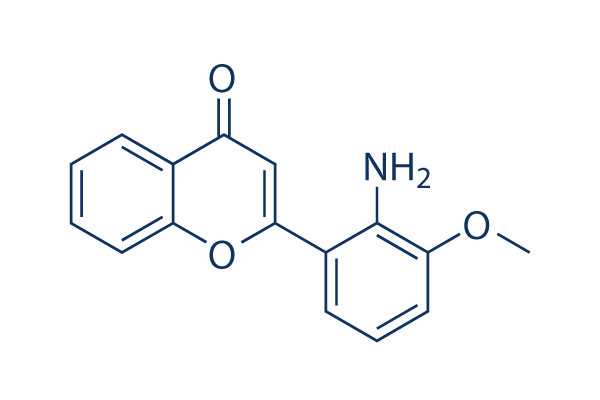
Chemische Struktur
Molekulargewicht: 267.28
Qualitätskontrolle
| Verwandte Ziele | ERK p38 MAPK Raf JNK Ras KRas S6 Kinase MAP4K TAK1 Mixed Lineage Kinase |
|---|---|
| Weitere MEK Inhibitoren | PD0325901 (Mirdametinib) U0126-EtOH PD184352 (CI-1040) BIX 02189 Pimasertib (AS-703026) Refametinib (RDEA119) TAK-733 AZD8330 SL-327 BIX 02188 |
Zellkultur, Behandlung & Arbeitskonzentration
| Zelllinien | Assay-Typ | Konzentration | Inkubationszeit | Formulierung | Aktivitätsbeschreibung | PMID |
|---|---|---|---|---|---|---|
| TE4 | Function Assay | 50 μM | 48 h | DMSO | upregulates the expression of HLA class I | 24244023 |
| MKN7 | Function Assay | 50 μM | 48 h | DMSO | increases expression of HLA-A02 or HLA-A24 molecules | 24244023 |
| OE19 | Function Assay | 50 μM | 48 h | DMSO | increases expression of HLA-A02 or HLA-A24 molecules | 24244023 |
| NCI-N87 | Function Assay | 50 μM | 48 h | DMSO | increases expression of HLA-A02 or HLA-A24 molecules | 24244023 |
| KATOIII | Function Assay | 50 μM | 48 h | DMSO | increases expression of HLA-A02 or HLA-A24 molecules | 24244023 |
| NUGC3 | Function Assay | 50 μM | 48 h | DMSO | increases expression of HLA-A02 or HLA-A24 molecules | 24244023 |
| NUGC2 | Function Assay | 50 μM | 48 h | DMSO | increases expression of HLA-A02 or HLA-A24 molecules | 24244023 |
| SGC-7901 | Apoptosis Assay | 20 μM | 24 h | inhibits CP-mediated apoptosis | 24241351 | |
| MG-63 | Function Assay | 20 μM | 0.5 h | blocks the CH-induced phosphorylated ELK1 protein expression | 24239640 | |
| ARPE-19 | Function Assay | 20 μM | 0.5 h | inhibits Apelin-induced phosphorylation of Erk and Akt | 24227918 | |
| CRL-2302 | Function Assay | 20 μM | 0.5 h | inhibits Apelin-induced phosphorylation of Erk and Akt | 24227918 | |
| MCF-7 | Apoptosis Assay | 20 μM | 1 h | increases caspase-9 enzyme activity | 24216289 | |
| MCF-7 | Function Assay | 20 μM | 1 h | abolishes expression of phosphorylated ERK co-treatment with conjugate | 24216289 | |
| 7402 | Apoptosis Assay | 30 μM | 5 d | decreases cell proliferation | 24211253 | |
| HT-29 | Function Assay | 20 μM | 48 h | reduces the BNIP3 expression pre-treated with 5-aza-dC | 24211581 | |
| DLD-1 | Function Assay | 20 μM | 48 h | reduces the BNIP3 expression pre-treated with 5-aza-dC | 24211581 | |
| 7721 | Apoptosis Assay | 30 μM | 5 d | decreases cell proliferation | 24211253 | |
| SGC7901 | Apoptosis Assay | 50 μM | 24/48/72 h | DMSO | induces apoptosis combined with JAK2 shRNA | 24178240 |
| SMMC7721 | Function Assay | 25/50 μM | 24 h | suppresses the expression of p-Akt or p-ERK1/2 | 24168056 | |
| MCF-7 | Growth Inhibition Assay | 10 μM | 48h | DMSO | reverses BNF-induced cell cycle arrest | 24163404 |
| Caco-2 | Function Assay | 50 μM | 48h | DMSO | enhances the mRNA levels of SCNN1A,FXYD3, LCT, LOX, HIF3A, ZG16, PDE6A and LGALS16 genes co-treated with Dex | 24161695 |
| HAECs | Function Assay | 10 μM | 1 h | attenuates TNF-α-stimulated ICAM-1 and VCAM-1 expression | 24134657 | |
| Ca9-22 | Function Assay | 3 μM | 1 h | abolishes the ability of HbR to induce IL-8 production | 24126532 | |
| Ca9-22 | Function Assay | 3 μM | 1/2 h | reduces HbR-induced ATF-2 phosphorylation | 24126532 | |
| AGS | Function Assay | 10 μM | 0.5 h | inhibits the upregulation of the IL-8 gene | 24106166 | |
| Caco-2 | Apoptosis Assay | 10 μM | 24 h | decreases cell apoptosis induced by 5-FU | 24095863 | |
| A549 | Function Assay | 50 μM | 2 h | blocks ERK phosphorylation mediated by 1,2-NQ | 24067727 | |
| HPMC | Function Assay | 10 μM | 48 h | reverses the changes in cell morphology induced by HGPDS | 24042838 | |
| HCT-8 | Apoptosis Assay | 10 μM | 24 h | decreases cell apoptosis induced by 5-FU | 24095863 | |
| HPMC | Apoptosis Assay | 10 μM | 24 h | reverses decrease in cell viability induced by HGPDS | 24042838 | |
| MGC803 | Apoptosis Assay | 20 μM | 1 h | inhibits apoptosis induced by IFN-α and 5′-DFUR | 24027750 | |
| SGC7901 | Apoptosis Assay | 20 μM | 1 h | inhibits apoptosis induced by IFN-α and 5′-DFUR | 24027750 | |
| G292 | Apoptosis Assay | 30 μM | 2 h | restores capsaicin-induced cell death | 24012930 | |
| COLO205 | Apoptosis Assay | 10/20/40 μM | 24 h | induces DNA ladder formation | 24019108 | |
| BxPC-3 | Function Assay | 10 μM | 6 h | increase miR-143 expression | 23973710 | |
| HPAF-II | Function Assay | 10 μM | 6 h | increase miR-143 expression | 23973710 | |
| HepG2 | Function Assay | 40 μM | 6/12 h | inhibits the increase of p-ERK1 and p-c-Jun protein expression by PL | 23942851 | |
| HL-60 | Apoptosis Assay | 50 μM | 1 h | rescues BA145 mediated apoptosis | 23948751 | |
| LNCaP | Function Assay | 10 μM | 1 h | decreases the EGF upregulated p-YB-1 | 23838318 | |
| HUVECs | Function Assay | 25 μM | 1 h | increase NF-κB p65 nuclear translocation | 23901008 | |
| HL60 | Function Assay | 20 μM | 72 h | DMSO | inhibits -induced CD11b expression | 23825585 |
| NB4 | Function Assay | 10 μM | 72 h | DMSO | inhibits -induced CD11b expression | 23825585 |
| EPOR/CR3 | Function Assay | 50 μM | 3 h | reduces EPO and/or IL-3-induced the tyrosine phosphorylation | 23820731 | |
| HUASMCs | Function Assay | 10 μM | 24 h | inhibits Ang II-induced ERK1/2 phosphorylation level | 23816468 | |
| HUASMCs | Function Assay | 10 μM | 24 h | diminishes Ang II-caused SOCS3 mRNA and protein expression | 23816468 | |
| SGC7901 | Function Assay | 10 μM | 24 h | inhibits the expression of phosphorylated ERK1/2 | 23792588 | |
| MKN45 | Growth Inhibition Assay | 10 μM | 24/48/72 h | inhibits cell growth co-treated with DAPT | 23792588 | |
| SGC7901 | Growth Inhibition Assay | 10 μM | 24/48/72 h | inhibits cell growth co-treated with DAPT | 23792588 | |
| MKN45 | Function Assay | 10 μM | 24 h | inhibits the expression of phosphorylated ERK1/2 | 23792588 | |
| SGC7901 | Apoptosis Assay | 10 μM | 24 h | increases the DAPT-induced cell apoptosis | 23792588 | |
| MKN45 | Apoptosis Assay | 10 μM | 24 h | increases the DAPT-induced cell apoptosis | 23792588 | |
| BxPC-3 cells | Growth Inhibition Assay | 20 μM | 0.5 h | inhibits VEGF-A-regulated HUVEC growth and tube formation induced by PAR-2 AP | 23764046 | |
| NB4 | Apoptosis Assay | 10/20/60 μM | 1.5 h | DMSO | decreases cell viability co-treated | 23735541 |
| HepG2 | Function Assay | 20 μM | 24 h | inhibits the HO-1 protein expression co-treated | 23707609 | |
| HUVECs | Apoptosis Assay | 2/4 μM | 24/48 h | induces cell death | 23707520 | |
| KG-1 | Apoptosis Assay | 20 μM | 12 h | enhances cell apoptosis induced by S1 | 23706691 | |
| AML 1# | Apoptosis Assay | 20 μM | 12 h | enhances cell apoptosis induced by S1 | 23706691 | |
| A2780 | Function Assay | 20 μM | 1 h | blocks DTCD-induced DR5 expression | 23696862 | |
| KYSE30 | Function Assay | 50 μM | 48 h | DMSO | upregulates the expression of HLA class I | 24244023 |
| TE5 | Function Assay | 50 μM | 48 h | DMSO | upregulates the expression of HLA class I | 24244023 |
| TE1 | Function Assay | 50 μM | 48 h | DMSO | upregulates the expression of HLA class I | 24244023 |
| TE3 | Function Assay | 50 μM | 48 h | DMSO | upregulates the expression of HLA class I | 24244023 |
| KYSE30 | Function Assay | 20/50/100 μM | 48 h | DMSO | inhibits p-Erk and wortmannin downregulated p-Akt in a dose-dependent manner | 24244023 |
| TE1 | Function Assay | 20/50/100 μM | 48 h | DMSO | inhibits p-Erk and wortmannin downregulated p-Akt in a dose-dependent manner | 24244023 |
| TE4 | Function Assay | 20/50/100 μM | 48 h | DMSO | inhibits p-Erk and wortmannin downregulated p-Akt in a dose-dependent manner | 24244023 |
| HT29 | Function Assay | 10 μM | 2 h | inhibits of JAK2, ERK1/2 and STAT3 phosphorylation | 24265293 | |
| HepG2 | Apoptosis Assay | 20 μM | 24 h | inhibits ERK1/2 phosphorylation and enhances VB1-induced apoptosis | 24247909 | |
| HepG2 | Function Assay | 20 μM | 2 h | enhances VB1-induced FOXO3a transcriptional activity | 24247909 | |
| MC-3 | Apoptosis Assay | 10 μM | 24 h | potentiated MESC-induced apoptosis in cells | 24270523 | |
| Raji | Function Assay | 10 μM | 1 h | blocks hsBAFF induced Erk1/2 phosphorylation | 24269630 | |
| Raji | Growth Inhibition Assay | 10 μM | 1 h | inhibits the basal or hsBAFF-stimulated cell proliferation and viability | 24269630 | |
| A549 | Function Assay | 30 μM | 0.5 h | DMSO | inhibits thrombin-induced C/EBPβ Thr235 phosphorylation | 24277696 |
| HCSMCs | Growth Inhibition Assay | 10 μM | 24 h | blocks FABP4-induced HCASMC proliferation | 24312381 | |
| PANC-1 | Function Assay | 20 μM | 48 h | inhibits the expression of Δ6D in response to the PPARδ agonist | 24294133 | |
| A549 | Function Assay | 30 μM | 0.5 h | DMSO | inhibits the thrombin-induced IL-8/CXCL8-Luc activity | 24277696 |
| SW480 | Function Assay | 10 μM | 20 h | DMSO | suppresses the CRT activity | 24324366 |
| HEK 293 | Function Assay | 10 μM | 5 h | DMSO | inhibits Wnt-induced β-catenin/TCF4 activity and nuclear β-catenin accumulation | 24324366 |
| HEK 293 | Function Assay | 10 μM | 5 h | DMSO | suppresses the CRT activity | 24324366 |
| HL-60 | Function Assay | 10/20 μM | 1 h | inhibits the N. chinensisextract induced differentiation into granulocytes | 24357020 | |
| HL-60 | Function Assay | 2 µM | 16 h | DMSO | inhibits the association of pS621 Raf-1 and NFATc3, and the RA-induced phosphorylation of nuclear NFATc3 | 24330068 |
| HeLa | Function Assay | 50 μM | 0.5 h | blocks TRX-1 nuclear migration and TXNIP down-regulation | 24376827 | |
| HUVECs | Function Assay | 10 μM | 1 h | inhibits the HDL reduced COX-2 expression and PGI-2 release | 24385109 | |
| MCF-7 | Function Assay | 10 μM | 10/30 min | reduces the UTP-dependent ERK phosphorylation | 24390819 | |
| HGC-27 | Apoptosis Assay | 1 µM | 1 h | suppresses RAD001 plus MK-2206-induced cell viability loss | 24416349 | |
| PC3 | Apoptosis Assay | 50 μM | 0.5 h | inhibits MHY-449-induced apoptosis | 24424889 | |
| HPAEpiCs | Function Assay | 30 μM | 1 h | inhibits TNF-α stimulated p42/p44 MAPK phosphorylation | 24441870 | |
| BeWo | Function Assay | 10 μM | 2 h | inhibits ERK1/2 | 24433846 | |
| A498 | Apoptosis Assay | 50 μM | 24 h | potentiates the pro-apoptotic effects of NC | 24508476 | |
| NHBE | Function Assay | 2/20 μM | 2 h | attenuates IL-33 stimulated CXCL8/IL-8 secretion | 24479526 | |
| A375 | Cell Invasion Assay | 10–20 µM | 24 h | reduces melanoma cell invasion | 24466036 | |
| HBMEC | Function Assay | 10 μM | 1 h | blocks VEGF-induced EphA2 expression | 24458982 | |
| HCT-15 | Function Assay | 1 h | attenuates PGE2-induced phosphorylation of Erk | 25431425 | ||
| HCT-15 | Apoptosis Assay | 1 h | abolishes the protective effects of PGE2 against curcumin-induced apoptosis | 25431425 | ||
| 786-O | Apoptosis Assay | 50 μM | 24 h | potentiates the pro-apoptotic effects of NC | 24508476 | |
| HepG2 | Growth Inhibition Assay | 20 μM | 24 h | suppresses TGF-β1-induced cell proliferation and invasion | 25560488 | |
| SW480 | Function Assay | 20 μM | 1 h | reduces the expression of ATF3 protein | 25447816 | |
| MDA-MB-231 | Function Assay | 25 μM | 2-3 h | decreases p-ERK1/2 and S100A4 expression | 25555875 | |
| HepG2 | Function Assay | 10 μM | 5 h | blocks phosphorylated MAPKs induced by exogenous TGF-β1 | 25560488 | |
| MCF-7 | Function Assay | 10 μM | 1 h | inhibits IL-18-enhanced cell migration | 25727011 | |
| H1355 | Function Assay | 25 μM | 1 h | blunts the B[a]P-induced increase in phospho-Chk1 and phospho-ERK expression | 25769181 | |
| PC12 | Function assay | Inhibition of nerve growth factor-mediated MAP kinase activity in human PC12 cells, IC50 = 2 μM. | 18077363 | |||
| HT-29 | Antiproliferative assay | 5 days | Antiproliferative activity against human HT-29 cells after 5 days by WST1 assay, IC50 = 4 μM. | 25078316 | ||
| IEC6 | Function assay | 5 mins | Inhibition of MEK1/2 in rat IEC6 cells assessed as reduction in ERK1/2 loop phosphorylation dosed 30 mins before to stimulation with 10% serum for 5 mins by immunoblotting method, IC50 = 4.2 μM. | 25078316 | ||
| NG 108-15 | Function assay | Concentration required to abolish MAPK activity in mouse neuroblastoma and rat glioma hybrid NG 108-15 cells, Activity = 10 μM. | 15537354 | |||
| PC12 | Function assay | 10 uM | 5 hrs | Activation of Nrf2/ARE in rat PC12 cells assessed as HO-1 protein induction at 10 uM after 5 hrs pretreated with JNK inhibitor SP600125 for 1 hr before compound addition by Western blot analysis | 21345685 | |
| PC12 | Function assay | 10 uM | 5 hrs | Activation of Nrf2/ARE in rat PC12 cells assessed as HO-1 protein induction at 10 uM after 5 hrs pretreated with MEK2 inhibitor U0126 for 1 hr before compound addition by Western blot analysis | 21345685 | |
| PC12 | Function assay | 10 uM | 5 hrs | Activation of Nrf2/ARE in rat PC12 cells assessed as HO-1 protein induction at 10 uM after 5 hrs pretreated with MEK1 inhibitor PD98059 for 1 hr before compound addition by Western blot analysis | 21345685 | |
| HeLa | Function assay | 20 uM | 3 hrs | Inhibition of ERK1/2 phosphorylation in human HeLa cells at 20 uM after 3 hrs by Western blotting analysis | 23570615 | |
| RD | qHTS assay | qHTS of pediatric cancer cell lines to identify multiple opportunities for drug repurposing: Primary screen for RD cells | 29435139 | |||
| NB1643 | qHTS assay | qHTS of pediatric cancer cell lines to identify multiple opportunities for drug repurposing: Primary screen for NB1643 cells | 29435139 | |||
| RD | qHTS assay | qHTS of pediatric cancer cell lines to identify multiple opportunities for drug repurposing: Confirmatory screen for RD cells | 29435139 | |||
| SK-N-MC | qHTS assay | qHTS of pediatric cancer cell lines to identify multiple opportunities for drug repurposing: Primary screen for SK-N-MC cells | 29435139 | |||
| TC32 | qHTS assay | qHTS of pediatric cancer cell lines to identify multiple opportunities for drug repurposing: Confirmatory screen for TC32 cells | 29435139 | |||
| MDA-MB-231 | Function assay | 50 uM | Downregulation of MMP2 in human MDA-MB-231 cells at 50 uM by Western blot analysis | 22926226 | ||
| MDA-MB-231 | Function assay | 50 uM | Downregulation of MMP9 in human MDA-MB-231 cells at 50 uM by Western blot analysis | 22926226 | ||
| Klicken Sie hier, um weitere experimentelle Daten zu Zelllinien anzuzeigen | ||||||
Chemische Informationen, Lagerung & Stabilität
| Molekulargewicht | 267.28 | Formel | C16H13NO3 |
Lagerung (Ab dem Eingangsdatum) | |
|---|---|---|---|---|---|
| CAS-Nr. | 167869-21-8 | SDF herunterladen | Lagerung von Stammlösungen |
|
|
| Synonyme | N/A | Smiles | COC1=CC=CC(=C1N)C2=CC(=O)C3=CC=CC=C3O2 | ||
Löslichkeit
|
In vitro |
DMSO
: 46 mg/mL
(172.1 mM)
Water : Insoluble Ethanol : Insoluble |
Molaritätsrechner
|
In vivo |
|||||
In-vivo-Formulierungsrechner (Klare Lösung)
Schritt 1: Geben Sie die untenstehenden Informationen ein (Empfohlen: Ein zusätzliches Tier zur Berücksichtigung von Verlusten während des Experiments)
Schritt 2: Geben Sie die In-vivo-Formulierung ein (Dies ist nur der Rechner, keine Formulierung. Bitte kontaktieren Sie uns zuerst, wenn es im Abschnitt "Löslichkeit" keine In-vivo-Formulierung gibt.)
Berechnungsergebnisse:
Arbeitskonzentration: mg/ml;
Methode zur Herstellung der DMSO-Stammlösung: mg Wirkstoff vorgelöst in μL DMSO ( Konzentration der Stammlösung mg/mL, Bitte kontaktieren Sie uns zuerst, wenn die Konzentration die DMSO-Löslichkeit der Wirkstoffcharge überschreitet. )
Methode zur Herstellung der In-vivo-Formulierung: Nehmen Sie μL DMSO Stammlösung, dann hinzufügenμL PEG300, mischen und klären, dann hinzufügenμL Tween 80, mischen und klären, dann hinzufügen μL ddH2O, mischen und klären.
Methode zur Herstellung der In-vivo-Formulierung: Nehmen Sie μL DMSO Stammlösung, dann hinzufügen μL Maisöl, mischen und klären.
Hinweis: 1. Bitte stellen Sie sicher, dass die Flüssigkeit klar ist, bevor Sie das nächste Lösungsmittel hinzufügen.
2. Achten Sie darauf, das/die Lösungsmittel der Reihe nach hinzuzufügen. Sie müssen sicherstellen, dass die bei der vorherigen Zugabe erhaltene Lösung eine klare Lösung ist, bevor Sie mit der Zugabe des nächsten Lösungsmittels fortfahren. Physikalische Methoden wie Vortex, Ultraschall oder ein heißes Wasserbad können zur Unterstützung des Lösens verwendet werden.
Wirkmechanismus
| Merkmale |
Does not inhibit c-Raf phosphorylated MEK1.
|
|---|---|
| Targets/IC50/Ki |
AhR
(Cell-free assay) 1 μM
MEK1
(Cell-free assay) 2 μM
|
| In vitro |
PD98059 hemmt entweder das basale MEK1 oder ein teilweise aktiviertes MEK, das durch die Mutation von Serin an den Resten 218 und 222 zu Glutamat (MEK-2E) produziert wird, mit einer IC50 von 2 μM. Diese Verbindung hemmt die MAPK-Homologe JNK und P38 nicht. Es ist hochselektiv gegen MEK, da es eine Reihe anderer Kinaseaktivit en nicht hemmt, einschlie lich Raf-Kinase, cAMP-abh gige Kinase, Proteinkinase C, v-Src, Epidermaler Wachstumsfaktor (EGF)-Rezeptorkinase, Insulinrezeptorkinase, PDGF-Rezeptorkinase und Phosphatidylinositol-3-Kinase. Dieser Inhibitor hemmt die PDGF-stimulierte Aktivierung von MAPK und den Thymidineinbau in 3T3-Zellen mit einer IC50 von ~10 μM bzw. ~7 μM. Er verhindert wirksam die Aktivierung von MEK1 durch Raf oder MEK-Kinase mit einer IC50 von 4 μM und hemmt schwach die Aktivierung von MEK2 durch Raf mit einer IC50 von 50 μM. Diese Chemikalie hemmt nicht die Aktivierung der MEK-Homologe MKK4 und RK-Kinase, die an Stress- und Interleukin-1-stimulierten Kinasekaskaden in KB- und PC12-Zellen beteiligt sind, und die Aktivierung der p70 S6-Kinase durch Insulin oder Epidermal Growth Factor in Swiss 3T3-Zellen. Es blockiert vollst dig die durch Nerve Growth Factor (NGF) induzierte Differenzierung von PC12-Zellen, ohne die Zellviabilit t zu ver dern. Diese Verbindung hemmt die Proliferation von RAW264.7-Zellen in der RANKL-haltigen Kultur dosisabh gig, was zu einer offensichtlichen Abnahme der TRAP-positiven Zellen f hrt. |
| Kinase-Assay |
In vitro MEK-hemmende Aktivität
|
|
Der Einbau von 32P in Myelin-Basismaterial (MBP) wird in Gegenwart von Glutathion-S-Transferase (GST)-Fusionsproteinen, die die 44-kDa-MAPK (GST-MAPK) oder die 45-kDa-MEK (GST-MEK1) enthalten, untersucht. Die Assays werden in 50 μL 50 mM Tris, pH 7,4/10 mM MgCl2/2 mM EGTA/10 μM [γ-32P]ATP, enthaltend 10 μg GST-MEK1, 0,5 μg GST-MAPK und 40 μg MBP, durchgef
hrt. Nach Inkubation bei 30
C f
r 15 Minuten werden die Reaktionen durch Zugabe von Laemmli SDS-Probenpuffer gestoppt. Phosphoryliertes MBP wird mittels SDS/10% PAGE aufgetrennt.
|
|
| In vivo |
Die Behandlung von M usen 30 Minuten vor einer fokalen zerebralen Isch mie mit PD98059 sch tzt vor Sch den, was zu einer Verringerung des Infarktvolumens f hrt. Die Vorbehandlung mit dieser Verbindung 30 Minuten zuvor und anschlie end zusammen mit st dlichen Cerulein-Injektionen f r 3 Stunden verbessert die Cerulein-induzierte akute Pankreatitis signifikant auf der Grundlage des Pankreas-Feuchtgewichts und der Histologie. Die Verabreichung dieser Chemikalie (10 mg/kg) an M use 1 Stunde nach Carrageenan f hrt zu einer Reduzierung aller gemessenen Entz dungsparameter. |
Literatur |
|
Anwendungen
| Methoden | Biomarker | Bilder | PMID |
|---|---|---|---|
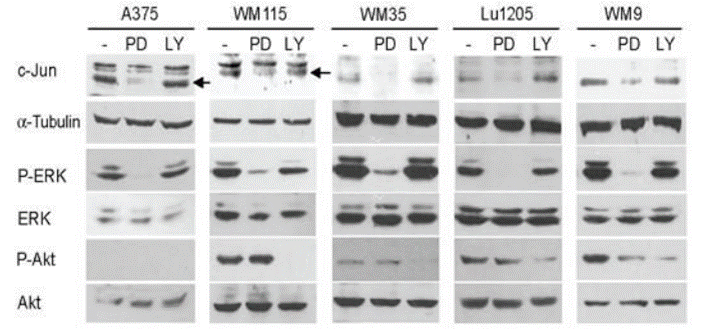
| Western blot | c-Jun / α-tubulin / p-ERK / ERK / p-AKT / AKT p-JNK / JNK / Cyclin D1 p-HER2 / HER2 MMP9 / XIAP / VEGF |
|
17482134 |
Technischer Support
Tel: +1-832-582-8158 Ext:3
Wenn Sie weitere Fragen haben, hinterlassen Sie bitte eine Nachricht.
Häufig gestellte Fragen
Frage 1:
How to formulate this inhibitor for i.p. injection?
Antwort:
You can prepare the stock of this compound by the vehicle 30% PEG400/0.5% Tween80/5% Propylene glycol, 0.5% CMC.

Produkte sind nur für Forschungszwecke bestimmt. Nicht für den menschlichen Gebrauch. Wir verkaufen nicht an Patienten.
©Copyright 2013 Selleck Chemicals. Alle Rechte vorbehalten.