
nur für Forschungszwecke
WZ4002 EGFR Inhibitor
Kat.-Nr.S1173
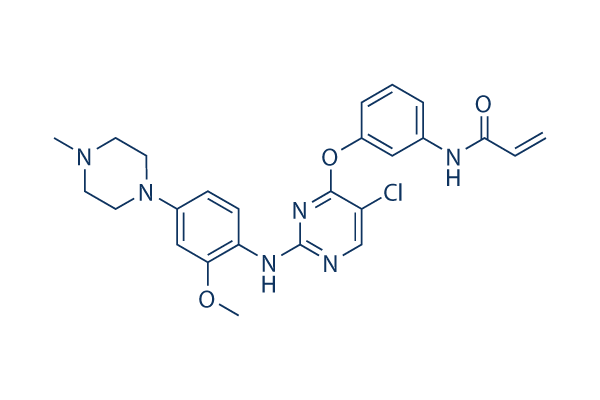
Chemische Struktur
Molekulargewicht: 494.18
Qualitätskontrolle
| Verwandte Ziele | VEGFR PDGFR FGFR c-Met Src MEK CSF-1R FLT3 HER2 c-Kit |
|---|---|
| Weitere EGFR Inhibitoren | Lazertinib (YH25448) Icotinib Hydrochloride Sunvozertinib AG-490 AG-1478 Canertinib (CI-1033) Rociletinib (CO-1686) Poziotinib (NOV120101, HM781-36B) Genistein Allitinib tosylate |
Zellkultur, Behandlung & Arbeitskonzentration
| Zelllinien | Assay-Typ | Konzentration | Inkubationszeit | Formulierung | Aktivitätsbeschreibung | PMID |
|---|---|---|---|---|---|---|
| Sf9 cells | Function assay | 60 mins | Inhibition of EGFR L858R mutant (unknown origin) expressed in Sf9 cells pre-incubated for 60 mins before substrate and ATP addition by homogeneous time-resolved FRET assay, IC50=1 nM | |||
| mouse BA/F3 cells | Proliferation assay | Antiproliferative activity against mouse BA/F3 cells transfected with EGFR E746_A750_del/T790M mutant, EC50=2 nM | ||||
| human HCC827 cells | Proliferation assay | 72 h | Antiproliferative activity against human HCC827 cells harboring EGFR del E746-A750 mutant after 72 hrs by MTS assay, IC50=7 nM | |||
| human PC9 cells | Proliferation assay | Antiproliferative activity against growth-resistant human PC9 cells expressing EGFR E746_A750/T790M mutant, EC50=14 nM | ||||
| NCI-H1975 cells | Function assay | 2 h | Inhibition of EGFR L858R/T970M double mutant phosphorylation in human NCI-H1975 cells after 2 hrs by fluorescence assay, IC50=0.023 μM | |||
| human 16HBE cells | Proliferation assay | 72 h | Antiproliferative activity against human 16HBE cells expressing wild type EGFR after 72 hrs by MTT assay, IC50=0.811 μM | |||
| human A431 cells | Cytotoxicity assay | 72 h | Cytotoxicity against human A431 cells overexpressing wild type EGFR assessed as growth inhibition after 72 hrs by MTT assay, IC50=1.108 μM | |||
| human LoVo cells | Function assay | 2 h | Inhibition of wild type EGFR phosphorylation in human LoVo cells after 2 hrs by fluorescence assay, IC50=1.18 μM | |||
| human 16HBE14o- cells | Cytotoxicity assay | 72 h | Cytotoxicity against human 16HBE14o- cells harboring wild type EGFR assessed as growth inhibition after 72 hrs by MTT assay, IC50=1.355 μM | |||
| human BEAS2B cells | Cytotoxicity assay | 72 h | Cytotoxicity against human BEAS2B cells harboring wild type EGFR assessed as growth inhibition after 72 hrs by MTT assay, IC50=1.811 μM | |||
| human A549 cells | Proliferation assay | 72 h | Antiproliferative activity against k-RAS dependent human A549 cells overexpressing WT EGFR after 72 hrs by MTT assay, IC50=2.102 μM | |||
| human HL7702 cells | Proliferation assay | 72 h | Antiproliferative activity against human HL7702 cells expressing wilt type EGFR after 72 hrs by MTS assay, IC50=2.73 μM | |||
| Klicken Sie hier, um weitere experimentelle Daten zu Zelllinien anzuzeigen | ||||||
Chemische Informationen, Lagerung & Stabilität
| Molekulargewicht | 494.18 | Formel | C25H27ClN6O3 |
Lagerung (Ab dem Eingangsdatum) | |
|---|---|---|---|---|---|
| CAS-Nr. | 1213269-23-8 | SDF herunterladen | Lagerung von Stammlösungen |
|
|
| Synonyme | N/A | Smiles | CN1CCN(CC1)C2=CC(=C(C=C2)NC3=NC=C(C(=N3)OC4=CC=CC(=C4)NC(=O)C=C)Cl)OC | ||
Löslichkeit
|
In vitro |
DMSO
: 13 mg/mL
(26.3 mM)
Water : Insoluble Ethanol : Insoluble |
Molaritätsrechner
|
In vivo |
|||||
In-vivo-Formulierungsrechner (Klare Lösung)
Schritt 1: Geben Sie die untenstehenden Informationen ein (Empfohlen: Ein zusätzliches Tier zur Berücksichtigung von Verlusten während des Experiments)
Schritt 2: Geben Sie die In-vivo-Formulierung ein (Dies ist nur der Rechner, keine Formulierung. Bitte kontaktieren Sie uns zuerst, wenn es im Abschnitt "Löslichkeit" keine In-vivo-Formulierung gibt.)
Berechnungsergebnisse:
Arbeitskonzentration: mg/ml;
Methode zur Herstellung der DMSO-Stammlösung: mg Wirkstoff vorgelöst in μL DMSO ( Konzentration der Stammlösung mg/mL, Bitte kontaktieren Sie uns zuerst, wenn die Konzentration die DMSO-Löslichkeit der Wirkstoffcharge überschreitet. )
Methode zur Herstellung der In-vivo-Formulierung: Nehmen Sie μL DMSO Stammlösung, dann hinzufügenμL PEG300, mischen und klären, dann hinzufügenμL Tween 80, mischen und klären, dann hinzufügen μL ddH2O, mischen und klären.
Methode zur Herstellung der In-vivo-Formulierung: Nehmen Sie μL DMSO Stammlösung, dann hinzufügen μL Maisöl, mischen und klären.
Hinweis: 1. Bitte stellen Sie sicher, dass die Flüssigkeit klar ist, bevor Sie das nächste Lösungsmittel hinzufügen.
2. Achten Sie darauf, das/die Lösungsmittel der Reihe nach hinzuzufügen. Sie müssen sicherstellen, dass die bei der vorherigen Zugabe erhaltene Lösung eine klare Lösung ist, bevor Sie mit der Zugabe des nächsten Lösungsmittels fortfahren. Physikalische Methoden wie Vortex, Ultraschall oder ein heißes Wasserbad können zur Unterstützung des Lösens verwendet werden.
Wirkmechanismus
| Targets/IC50/Ki |
EGFR (L858R)
(BaF3 cells) 2 nM
EGFR (L858R/T790M)
(BaF3 cells) 8 nM
|
|---|---|
| In vitro |
WZ4002 hemmt andere EGFR-Genotypen E746_A750 und E746_A750/T790M mit IC50-Werten von 2 und 6 nM. Darüber hinaus unterdrückt diese Verbindung Wildtyp-ERBB2 mit einer IC50 von 32 nM. Es hemmt die Phosphorylierung von EGFR, AKT und ERK1/2 in NSCLC-Zelllinien und verhindert die EGFR-Phosphorylierung in NIH-3T3-Zellen, die verschiedene EGFR T790M-Mutantenallele exprimieren. Für diese Chemikalie werden Kinasen, die eine Hemmung von mehr als 95 % im Vergleich zur DMSO-Kontrolle bei 10 μM aufwiesen, zur Messung ihrer Dissoziationskonstanten ausgewählt. Dieser Inhibitor, der eine ortho-Methoxygruppe am C2-Anilin-Substituenten besitzt, ist selektiver für EGFR im Vergleich zu WZ3146. Er ist 100-fach weniger wirksam bei der Hemmung der Phosphorylierung von WT EGFR im Vergleich zu den Chinazolin-Inhibitoren. Ähnlich verhindert diese Verbindung die EGFR-Kinaseaktivität des rekombinanten L858R/T790M-Proteins potenter als die von WT EGFR, während bei HKI-272 und Gefitinib das Gegenteil beobachtet wird. Darüber hinaus wird das phosphorylierte EGFR von Src TKI-resistenten H1975-Zellen sowie HCC827-Zellen durch den EGFR TKI der dritten Generation, WZ4002, vollständig unterdrückt.
|
| Kinase-Assay |
EGFR-Kinase-Assays
|
|
In-vitro-Inhibitor-Enzymkinetik-Assays unter Verwendung von rekombinantem EGFR L858R/T790M und WT-Protein werden unter Verwendung des ATP/NADH-gekoppelten Assay-Systems in einem 96-Well-Format durchgeführt. WZ4002 wird hinzugefügt, um seine hemmenden Wirkungen zu bestimmen.
|
|
| In vivo |
In einer 2-wöchigen Wirksamkeitsstudie führt die Behandlung mit WZ4002 zu signifikanten Tumorregressionen im Vergleich zum Vehikel allein in beiden T790M-haltigen Mausmodellen. Die Behandlung mit einer niedrigen Dosis dieser Verbindung und einer hohen Dosis dieser Verbindung führt zu mittleren Abnahmen der Tracer-Aufnahme von 26 % bzw. 36 %.
|
Literatur |
|
Technischer Support
Tel: +1-832-582-8158 Ext:3
Wenn Sie weitere Fragen haben, hinterlassen Sie bitte eine Nachricht.

Produkte sind nur für Forschungszwecke bestimmt. Nicht für den menschlichen Gebrauch. Wir verkaufen nicht an Patienten.
©Copyright 2013 Selleck Chemicals. Alle Rechte vorbehalten.