
nur für Forschungszwecke
AG-1478 EGFR Inhibitor
Kat.-Nr.S2728
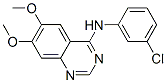
Chemische Struktur
Molekulargewicht: 315.75
Qualitätskontrolle
- In Nature Medicine für seine erstklassige Qualität zitiert
- COA
- NMR
- HPLC
- SDS
- Datenblatt
| Verwandte Ziele | VEGFR PDGFR FGFR c-Met Src MEK CSF-1R FLT3 HER2 c-Kit |
|---|---|
| Weitere EGFR Inhibitoren | Lazertinib (YH25448) Icotinib Hydrochloride Sunvozertinib AG-490 Canertinib (CI-1033) WZ4002 Rociletinib (CO-1686) Poziotinib (NOV120101, HM781-36B) Genistein Allitinib tosylate |
Zellkultur, Behandlung & Arbeitskonzentration
| Zelllinien | Assay-Typ | Konzentration | Inkubationszeit | Formulierung | Aktivitätsbeschreibung | PMID |
|---|---|---|---|---|---|---|
| U87MG | Growth inhibitory assay | ~100 μM | DMSO | IC50=34.6 μM | 8752145 | |
| U87MG.ΔEGFR | Growth inhibitory assay | ~100 μM | DMSO | IC50=8.7 μM | 8752145 | |
| U87MG.wtEGFR. | Growth inhibitory assay | ~100 μM | DMSO | IC50=48.4 μM | 8752145 | |
| U87MG | Kinase assay | ~100 μM | DMSO | inhibits EGFR tyrosine kinase activity | 8752145 | |
| U87MG.ΔEGFR | Kinase assay | ~100 μM | DMSO | inhibits EGFR tyrosine kinase activity | 8752145 | |
| U87MG.wtEGFR. | Kinase assay | ~100 μM | DMSO | inhibits EGFR tyrosine kinase activity | 8752145 | |
| HPV 16-immortalized human keratinocytes | Growth inhibitory assay | ~50 μM | DMSO | inhibits cell growth | 9288782 | |
| HPV 16-immortalized human keratinocytes | Function assay | ~50 μM | DMSO | induces arrest in the Cell Cycle | 9288782 | |
| HPV 16-immortalized human keratinocytes | Apoptosis assay | ~50 μM | DMSO | induces apoptosis. | 9288782 | |
| A431 | Kinase assay | ~10 μM | DMSO | inhibits the basal and TGF-α-stimulated tyrosine phosphorylation of the EGFR | 10702262 | |
| MDA-468 | Kinase assay | ~10 μM | DMSO | inhibits the basal and TGF-α-stimulated tyrosine phosphorylation of the EGFR | 10702262 | |
| A431 | Function assay | ~10 μM | DMSO | induces cell cycle arrest | 10702262 | |
| MDA-MB-231 | Kinase assay | ~5 μM | DMSO | inhibits EGF stimulated phosphorylation of FKHR | 11030146 | |
| CNE2 | Growth inhibitory assay | 100 μM | DMSO | inhibits cell proliferation by 98.4% | 11410322 | |
| CNE2 | Kinase assay | ~100 μM | DMSO | inhibits EGFR tyrosine phosphorylation | 11410322 | |
| CNE2 | Function assay | ~100 μM | DMSO | Inhibits MAPK and AKT activation | 11410322 | |
| CNE2 | Function assay | ~50 μM | DMSO | affects cell cycle distribution | 11410322 | |
| HSC-2 | Kinase assay | 8 μM | DMSO | inhibits phosphorylation of EGFR and Akt | 17689285 | |
| HSC-2 | Apoptosis assay | 8 μM | DMSO | inhibits Fas-mediated apoptosis | 17689285 | |
| HEp-2 | Growth inhibitory assay | ~10 μM | DMSO | enhances oridonin-induced growth-inhibitory | 20202741 | |
| SubG1 | Apoptosis assay | ~10 μM | DMSO | enhances oridonin-induced apoptosis | 20202741 | |
| HEp-2 | Function assay | ~10 μM | DMSO | enhances Oridonin-induced Bax activation, Bcl-2 degradation and SIRT1 inactivation | 20202741 | |
| H508 | Growth inhibitory assay | ~1 μM | DMSO | mitigates CPF-mediated H508 cell growth | 26514924 | |
| A431 | Antiproliferative assay | Tested for antiproliferative activity against human A431 cells, IC50=20μM | 15109642 | |||
| HeLa | Function assay | 30 mins | Inhibition of EGFR autophosphorylation in human HeLa cells preincubated for 30 mins prior to EGF stimulation by Western blotting | 21718029 | ||
| BT-37 | qHTS assay | qHTS of pediatric cancer cell lines to identify multiple opportunities for drug repurposing: Primary screen for BT-37 cells | 29435139 | |||
| SK-N-SH | qHTS assay | qHTS of pediatric cancer cell lines to identify multiple opportunities for drug repurposing: Primary screen for SK-N-SH cells | 29435139 | |||
| NB1643 | qHTS assay | qHTS of pediatric cancer cell lines to identify multiple opportunities for drug repurposing: Primary screen for NB1643 cells | 29435139 | |||
| OHS-50 | qHTS assay | qHTS of pediatric cancer cell lines to identify multiple opportunities for drug repurposing: Primary screen for OHS-50 cells | 29435139 | |||
| HEK293 | Function assay | 1 hr | Inhibition of human full length PKMYT1 expressed in HEK293 cells using EFS (247 to 259 residues) as substrate after 1 hr by fluorescence polarization immunoasay, Ki=1.87μM | 29941193 | ||
| HEK293 | Function assay | 1 hr | Inhibition of human full length PKMYT1 expressed in HEK293 cells using EFS (247 to 259 residues) as substrate after 1 hr by fluorescence polarization immunoasay, IC50=19.6μM | 29941193 | ||
| Klicken Sie hier, um weitere experimentelle Daten zu Zelllinien anzuzeigen | ||||||
Chemische Informationen, Lagerung & Stabilität
| Molekulargewicht | 315.75 | Formel | C16H14ClN3O2 |
Lagerung (Ab dem Eingangsdatum) | |
|---|---|---|---|---|---|
| CAS-Nr. | 153436-53-4,175178-82-2 | SDF herunterladen | Lagerung von Stammlösungen |
|
|
| Synonyme | Tyrphostin AG-1478, NSC 693255 | Smiles | COC1=C(C=C2C(=C1)C(=NC=N2)NC3=CC(=CC=C3)Cl)OC | ||
Löslichkeit
|
In vitro |
DMSO
: 25 mg/mL
(79.17 mM)
Ethanol : 13 mg/mL Water : Insoluble |
Molaritätsrechner
|
In vivo |
|||||
In-vivo-Formulierungsrechner (Klare Lösung)
Schritt 1: Geben Sie die untenstehenden Informationen ein (Empfohlen: Ein zusätzliches Tier zur Berücksichtigung von Verlusten während des Experiments)
Schritt 2: Geben Sie die In-vivo-Formulierung ein (Dies ist nur der Rechner, keine Formulierung. Bitte kontaktieren Sie uns zuerst, wenn es im Abschnitt "Löslichkeit" keine In-vivo-Formulierung gibt.)
Berechnungsergebnisse:
Arbeitskonzentration: mg/ml;
Methode zur Herstellung der DMSO-Stammlösung: mg Wirkstoff vorgelöst in μL DMSO ( Konzentration der Stammlösung mg/mL, Bitte kontaktieren Sie uns zuerst, wenn die Konzentration die DMSO-Löslichkeit der Wirkstoffcharge überschreitet. )
Methode zur Herstellung der In-vivo-Formulierung: Nehmen Sie μL DMSO Stammlösung, dann hinzufügenμL PEG300, mischen und klären, dann hinzufügenμL Tween 80, mischen und klären, dann hinzufügen μL ddH2O, mischen und klären.
Methode zur Herstellung der In-vivo-Formulierung: Nehmen Sie μL DMSO Stammlösung, dann hinzufügen μL Maisöl, mischen und klären.
Hinweis: 1. Bitte stellen Sie sicher, dass die Flüssigkeit klar ist, bevor Sie das nächste Lösungsmittel hinzufügen.
2. Achten Sie darauf, das/die Lösungsmittel der Reihe nach hinzuzufügen. Sie müssen sicherstellen, dass die bei der vorherigen Zugabe erhaltene Lösung eine klare Lösung ist, bevor Sie mit der Zugabe des nächsten Lösungsmittels fortfahren. Physikalische Methoden wie Vortex, Ultraschall oder ein heißes Wasserbad können zur Unterstützung des Lösens verwendet werden.
Wirkmechanismus
| Targets/IC50/Ki |
EGFR
(Cell-free assay) 3 nM
|
|---|---|
| In vitro |
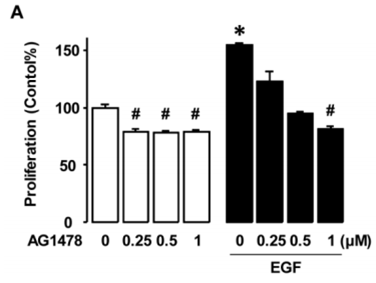
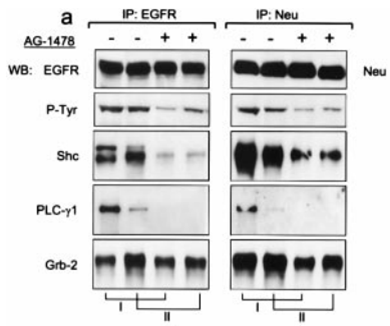
AG-1478 ist hochselektiv gegenüber ErbB2 und PDGFR mit einer IC50 von >100 μM. Diese Verbindung hemmt bevorzugt U87MG-Zellen, die trunkierte EGFR exprimieren, mit einer IC50 von 8,7 μM, verglichen mit Zellen, die endogenes wt EGFR exprimieren oder exogenes wt EGFR überexprimieren, mit einer IC50 von 34,6 μM bzw. 48,4 μM, und hemmt die DNA-Synthese mit einer IC50 von 4,6 μM, 19,67 μM bzw. 35,2 μM. Diese Chemikalie hemmt auch bevorzugt die Protein Tyrosine Kinase-Aktivität und Autophosphorylierung des ΔEGFR im Vergleich zu endogenem oder überexprimiertem exogenem wt EGFR. Es (0,25 μM) unterdrückt die durch Ang II, einen Ca2+-Ionophor sowie EGF, aber nicht durch einen Phorbolester oder platelet-derived growth factor-BB in den VSMC induzierte MAPK-Aktivierung. Diese Verbindung hemmt die EGF-induzierte Mitogenese der BaF/ERX- und LIM1215-Zellen mit einer IC50 von 0,07 μM bzw. 0,2 μM. Es ist in der Lage, die Funktion von ATP-binding cassette (ABC)-Transportern wie ABCB1 und ABCG2 zu hemmen, mit einem ausgeprägteren Effekt auf ABCG2. |
| In vivo |
Die Verabreichung von AG-1478 blockiert die Phosphorylierung des EGFR an der Tumorstelle und hemmt das Wachstum von A431-Xenografts, die WT EGFR überexprimieren, und Gliom-Xenografts, die de2-7 EGFR exprimieren. Selbst subtherapeutische Dosen dieser Verbindung verbessern die Wirksamkeit zytotoxischer Medikamente erheblich, wobei die Kombination dieser Chemikalie eine synergistische Antitumoraktivität gegen menschliche Gliom-Xenografts zeigt. Die Kombination dieser Verbindung und eines Anti-EGFR-Antikörpers (mAb 806) zeigt eine additive und in einigen Fällen synergistische Antitumoraktivität gegen Tumor-Xenografts, die den EGFR überexprimieren. Die Kombination dieser Verbindung (0,4 mg) mit einer Einzeldosis von 25 μCi 90Y-CHX-A''-DTPA-hu3S193 führt zu einer signifikanten Steigerung der Wirksamkeit im Vergleich zu jedem Wirkstoff allein. |
Literatur |
|
Anwendungen
| Methoden | Biomarker | Bilder | PMID |
|---|---|---|---|
| Growth inhibition assay | Cell viability |
|
25258648 |
| Western blot | Shc / PLC-γ1 EGFR / Neu / p-Tyr |
|
10931950 |
Technischer Support
Tel: +1-832-582-8158 Ext:3
Wenn Sie weitere Fragen haben, hinterlassen Sie bitte eine Nachricht.

Produkte sind nur für Forschungszwecke bestimmt. Nicht für den menschlichen Gebrauch. Wir verkaufen nicht an Patienten.
©Copyright 2013 Selleck Chemicals. Alle Rechte vorbehalten.