
nur für Forschungszwecke
Abemaciclib (LY2835219) CDK4/6-Inhibitor
Kat.-Nr.S5716
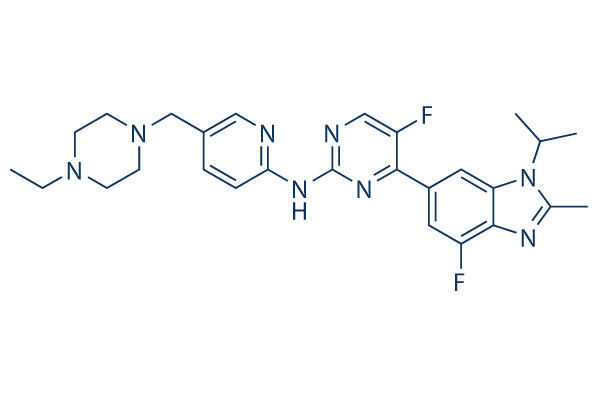
Chemische Struktur
Molekulargewicht: 506.59
Qualitätskontrolle
Zellkultur, Behandlung & Arbeitskonzentration
| Zelllinien | Assay-Typ | Konzentration | Inkubationszeit | Formulierung | Aktivitätsbeschreibung | PMID |
|---|---|---|---|---|---|---|
| COLO205 cells | Function assay | 24 h | Inhibition of CDK4/6 in human COLO205 cells assessed as inhibition of Rb phosphorylation after 24 hrs by propidium iodide staining-based laser-scanning fluorescence microplate cytometric analysis, IC50=0.12 μM | 26115571 | ||
| SK-ES-1 | Proliferation assay | 96 hours | antiproliferative effects with an absolute EC50 value below 1 μmol/L | 30131386 | ||
| Cado-ES-1 | Proliferation assay | 96 hours | antiproliferative effects with an absolute EC50 value below 1 μmol/L | 30131386 | ||
| ES-7 | Proliferation assay | 96 hours | antiproliferative effects with an absolute EC50 value below 1 μmol/L | 30131386 | ||
| TC-71 | Proliferation assay | 96 hours | antiproliferative effects with an absolute EC50 value below 1 μmol/L | 30131386 | ||
| A673 | Proliferation assay | 96 hours | antiproliferative effects with an absolute EC50 value below 1 μmol/L | 30131386 | ||
| RD-ES | Proliferation assay | 96 hours | antiproliferative effects with an absolute EC50 value below 1 μmol/L | 30131386 | ||
| ES-1 | Proliferation assay | 96 hours | antiproliferative effects with an absolute EC50 value below 1 μmol/L | 30131386 | ||
| ES-3 | Proliferation assay | 96 hours | antiproliferative effects with an absolute EC50 value below 1 μmol/L | 30131386 | ||
| CHLA-258 | Proliferation assay | 96 hours | antiproliferative effects with an absolute EC50 value below 1 μmol/L | 30131386 | ||
| MHH-ES-1 | Proliferation assay | 96 hours | antiproliferative effects with an absolute EC50 value below 1 μmol/L | 30131386 | ||
| ES-8 | Proliferation assay | 96 hours | antiproliferative effects with an absolute EC50 value below 1 μmol/L | 30131386 | ||
| EW8 | Proliferation assay | 96 hours | antiproliferative effects with an absolute EC50 value below 1 μmol/L | 30131386 | ||
| ES-6 | Proliferation assay | 96 hours | antiproliferative effects with an absolute EC50 value below 1 μmol/L | 30131386 | ||
| ES-2 | Proliferation assay | 96 hours | antiproliferative effects with an absolute EC50 value below 1 μmol/L | 30131386 | ||
| SMS-CTR | Proliferation assay | 96 hours | antiproliferative effects with an absolute EC50 value below 1 μmol/L | 30131386 | ||
| ES-4 | Proliferation assay | 96 hours | antiproliferative effects with an absolute EC50 value below 1 μmol/L | 30131386 | ||
| CT26 | Cell viability assay | 96 hours | IC50=2.7 μM | 29539425 | ||
| insect cells | Function assay | 50 mins | Competitive inhibition of human CDK4/cyclin D1 expressed in insect cells assessed as phosphorylation of CTRF after 50 mins by Michaelis-Menten plot analysis in presence of ATP, Ki = 0.0006 μM. | 26115571 | ||
| insect cells | Function assay | 50 mins | Inhibition of human CDK4/cyclin D1 expressed in insect cells assessed as phosphorylation of CTRF after 50 mins by microplate scintillation counter, IC50 = 0.002 μM. | 26115571 | ||
| COLO205 | Function assay | 24 hrs | Inhibition of CDK4/6 in human COLO205 cells assessed as maximum cell cycle arrest at G1 phase after 24 hrs by propidium iodide staining-based flow cytometric analysis, INH = 6.7 μM. | 26115571 | ||
| Sf9 | Function assay | Inhibition of CDK1/Cyclin B (unknown origin) expressed in baculoviral infected insect Sf9 cells using histone H1 as substrate in presence of [gamma-33P]ATP, IC50 = 0.371 μM. | 26741853 | |||
| Sf9 | Function assay | 90 mins | Inhibition of recombinant human N-terminal GST-tagged CDK4 (4 to 303 residues)/cyclin D1 (4 to 295 residues) expressed in sf9 cells using C-terminal retinoblastoma fragment as substrate after 90 mins by [gamma-33P]ATP based microbeta scintillation countin, Ki = 0.002 μM. | 27171036 | ||
| Sf9 | Function assay | 90 mins | Inhibition of recombinant full length human N-terminal GST-tagged CDK6 (1 to 326 residues)/cyclin D1 (4 to 295 residues) expressed in sf9 cells using C-terminal retinoblastoma fragment as substrate after 90 mins by [gamma-33P]ATP based microbeta scintilla, Ki = 0.01 μM. | 27171036 | ||
| Sf21 | Function assay | Inhibition of recombinant human full length C-terminal His6-tagged CDK7/cyclin H/N-terminal GST-tagged MAT1 expressed in baculovirus infected Sf21 insect cells using cdk7 substrate peptide, Ki = 3.91 μM. | 27171036 | |||
| COLO205 | Antiproliferative assay | 96 hrs | Antiproliferative activity against human COLO205 cells after 96 hrs by CCK-8 assay, IC50 = 0.46 μM. | 29074254 | ||
| U87MG | Antiproliferative assay | 72 hrs | Antiproliferative activity against human U87MG cells after 72 hrs by DAPI staining based assay, IC50 = 0.0481 μM. | 29247857 | ||
| Sf9 | Function assay | Inhibition of recombinant human N-terminal GST-tagged CDK4 (S4 to E303 residues)/Cyclin D1 (Q4 to I295 residues) expressed in sf9 cells using Rb protein (773 to 928 residues) as substrate in presence of [33P]-ATP by scintillation counting method, IC50 = 0.002 μM. | 29429832 | |||
| Sf9 | Function assay | 90 mins | Inhibition of recombinant human full length CDK6 expressed in baculovirus infected Sf9 insect cells using histone H1 substrate after 90 mins by ADP-Glo assay, IC50 = 0.0078 μM. | 29429832 | ||
| Sf9 | Function assay | Inhibition of recombinant human N-terminal GST-tagged CDK4 (M1 to A326 residues)/Cyclin D1 (Q4 to I295 residues) expressed in sf9 cells using Rb protein (773 to 928 residues) as substrate in presence of [33P]-ATP by scintillation counting method, IC50 = 0.01 μM. | 29429832 | |||
| Sf9 | Function assay | 90 mins | Inhibition of recombinant human full length CDK1/Cyclin D3 expressed in baculovirus infected Sf9 insect cells using histone H1 substrate after 90 mins by ADP-Glo assay, IC50 = 0.056 μM. | 29429832 | ||
| MDA-MB-231 | Antiproliferative assay | 72 hrs | Antiproliferative activity against human MDA-MB-231 cells after 72 hrs by DAPI staining based assay, IC50 = 0.191 μM. | 29429832 | ||
| COLO205 | Antiproliferative assay | 96 hrs | Antiproliferative activity against human COLO205 cells after 96 hrs by CCK8 assay, IC50 = 0.217 μM. | 29459274 | ||
| MDA-MB-468 | Antiproliferative assay | 96 hrs | Antiproliferative activity against human MDA-MB-468 cells after 96 hrs by CCK8 assay, IC50 = 4.808 μM. | 29459274 | ||
| COLO205 | Function assay | 0.1 to 10 uM | 24 hrs | Inhibition of CDK4 in human COLO205 cells assessed as reduction in total Rb protein level at 0.1 to 10 uM after 24 hrs by immunoblotting method | 29459274 | |
| COLO205 | Cell cycle arrest assay | up to 10 uM | 24 hrs | Cell cycle arrest in human COLO205 cells assessed as accumulation at G2/M phase up to 10 uM after 24 hrs by propidium iodide staining based FACS analysis | 29459274 | |
| Klicken Sie hier, um weitere experimentelle Daten zu Zelllinien anzuzeigen | ||||||
Chemische Informationen, Lagerung & Stabilität
| Molekulargewicht | 506.59 | Formel | C27H32F2N8 |
Lagerung (Ab dem Eingangsdatum) | 3 years -20°C powder |
|---|---|---|---|---|---|
| CAS-Nr. | 1231929-97-7 | -- | Lagerung von Stammlösungen |
|
|
| Synonyme | LY2835219 | Smiles | CCN1CCN(CC1)CC2=CN=C(C=C2)NC3=NC=C(C(=N3)C4=CC5=C(C(=C4)F)N=C(N5C(C)C)C)F | ||
Löslichkeit
|
In vitro |
Ethanol : 8 mg/mL
DMSO
: 6 mg/mL
(11.84 mM)
Water : Insoluble |
Molaritätsrechner
|
In vivo |
|||||
In-vivo-Formulierungsrechner (Klare Lösung)
Schritt 1: Geben Sie die untenstehenden Informationen ein (Empfohlen: Ein zusätzliches Tier zur Berücksichtigung von Verlusten während des Experiments)
Schritt 2: Geben Sie die In-vivo-Formulierung ein (Dies ist nur der Rechner, keine Formulierung. Bitte kontaktieren Sie uns zuerst, wenn es im Abschnitt "Löslichkeit" keine In-vivo-Formulierung gibt.)
Berechnungsergebnisse:
Arbeitskonzentration: mg/ml;
Methode zur Herstellung der DMSO-Stammlösung: mg Wirkstoff vorgelöst in μL DMSO ( Konzentration der Stammlösung mg/mL, Bitte kontaktieren Sie uns zuerst, wenn die Konzentration die DMSO-Löslichkeit der Wirkstoffcharge überschreitet. )
Methode zur Herstellung der In-vivo-Formulierung: Nehmen Sie μL DMSO Stammlösung, dann hinzufügenμL PEG300, mischen und klären, dann hinzufügenμL Tween 80, mischen und klären, dann hinzufügen μL ddH2O, mischen und klären.
Methode zur Herstellung der In-vivo-Formulierung: Nehmen Sie μL DMSO Stammlösung, dann hinzufügen μL Maisöl, mischen und klären.
Hinweis: 1. Bitte stellen Sie sicher, dass die Flüssigkeit klar ist, bevor Sie das nächste Lösungsmittel hinzufügen.
2. Achten Sie darauf, das/die Lösungsmittel der Reihe nach hinzuzufügen. Sie müssen sicherstellen, dass die bei der vorherigen Zugabe erhaltene Lösung eine klare Lösung ist, bevor Sie mit der Zugabe des nächsten Lösungsmittels fortfahren. Physikalische Methoden wie Vortex, Ultraschall oder ein heißes Wasserbad können zur Unterstützung des Lösens verwendet werden.
Wirkmechanismus
| Targets/IC50/Ki |
CDK4
(Cell-free assay) 2 nM
CDK6
(Cell-free assay) 10 nM
|
|---|---|
| In vitro |
Abemaciclib hemmt hochselektiv die Komplexe CDK4/Cyclin D1 (IC50 = 2 nmol/L) und CDK6/Cyclin D1 (IC50 = 10 nmol/L), ohne Aktivität gegen andere CDK/Cyclin-Komplexe oder Cell Cycle-bezogene Kinasen im Nanomolbereich, außer der Hemmung von CDK9 bei einer mindestens fünfmal höheren IC50. Neben der Cell Cycle-abhängigen Aktivität ist Abemaciclib in der Lage, die Antitumorimmunität zu stärken, indem es die Präsentation von Tumorantigenen potenziert und gleichzeitig die Proliferation von regulatorischen T-Zellen (Treg) selektiv unterdrückt. In Übereinstimmung mit seiner Aktivität gegen CDK4 und CDK6 hemmt Abemaciclib die RB-Phosphorylierung und führt zu einem G1-Arrest in RB-profizienten Zelllinien. In vitro führte die Behandlung mit Abemaciclib zu einer erhöhten Aktivierung menschlicher T-Zellen und einer hochregulierten Expression von Antigenpräsentationsgenen in MCF-7-Brustkrebszellen.
|
| In vivo |
In einem Kolorektalkrebs-Xenograftmodell, das zur Entwicklung eines integrierten pharmakokinetischen/pharmakodynamischen Modells verwendet wurde, kann Abemaciclib oral nach einem kontinuierlichen Zeitplan dosiert werden, um eine anhaltende Target-Hemmung zu erzielen, und zeigt nicht nur eine dauerhafte Cell Cycle-Hemmung, sondern auch eine Antitumoraktivität als Einzelwirkstoff. Eine Tumorwachstumshemmung wird in mehreren anderen menschlichen Krebs-Xenograftmodellen beobachtet, einschließlich derer, die von nicht-kleinzelligem Lungenkrebs (NSCLC), Melanom, Glioblastom und Mantelzelllymphom abgeleitet sind. Abemaciclib verteilt sich über die Blut-Hirn-Schranke und verlängert das Überleben in einem intrakraniellen Glioblastom-Xenograftmodell. Beim Menschen zeigt die Pharmakokinetik von Abemaciclib eine langsame Absorptionsphase mit einer medianen Zeit von der oralen Dosis bis zur maximalen Plasmakonzentration (tmax) von 4 bis 6 Stunden. Es wird extensiv abgebaut und verteilt. Die mittlere terminale Eliminationshalbwertszeit (t1/2) lag zwischen 17,4 und 38,1 Stunden ohne offensichtliche dosisabhängige Veränderung der Clearance.
|
Literatur |
|
Anwendungen
| Methoden | Biomarker | Bilder | PMID |
|---|---|---|---|
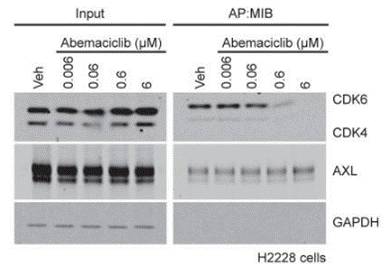
| Western blot | CDK6 / CDK4 / AXL GSK3β / CAMKII pan β-catenin p-Rb / Rb / p-EGFR / EGFR / p-HER2 / HER2 / p-HER3 / HER3 / p-P70S6K / P70S6K / p-S6RP / S6RP / Cyclin D1 |
|
29133594 |
Klinische Studieninformationen
(Daten von https://clinicaltrials.gov, aktualisiert am 2024-05-22)
| NCT-Nummer | Rekrutierung | Erkrankungen | Sponsor/Kooperationspartner | Startdatum | Phasen |
|---|---|---|---|---|---|
| NCT06139107 | Recruiting | Breast Cancer |
Mridula George MD|Rutgers The State University of New Jersey |
June 21 2024 | Phase 1 |
| NCT06259929 | Not yet recruiting | Breast Cancer |
Fondazione Oncotech |
April 1 2024 | Phase 2 |
Technischer Support
Tel: +1-832-582-8158 Ext:3
Wenn Sie weitere Fragen haben, hinterlassen Sie bitte eine Nachricht.

Produkte sind nur für Forschungszwecke bestimmt. Nicht für den menschlichen Gebrauch. Wir verkaufen nicht an Patienten.
©Copyright 2013 Selleck Chemicals. Alle Rechte vorbehalten.