
nur für Forschungszwecke
AGK2 SIRT2 Inhibitor
Kat.-Nr.S7577
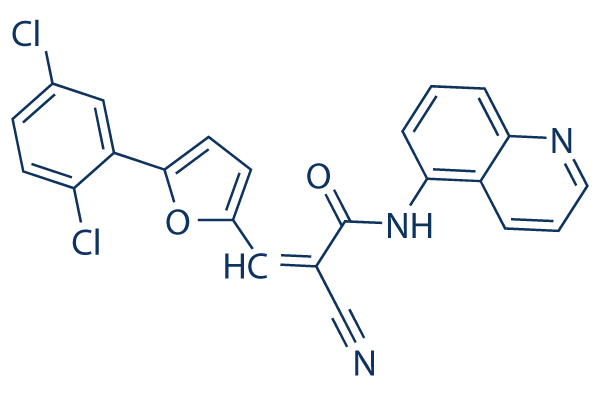
Chemische Struktur
Molekulargewicht: 434.27
Qualitätskontrolle
| Verwandte Ziele | Akt Wnt/beta-catenin PKC HSP ROCK Microtubule Associated Integrin Bcr-Abl Actin FAK |
|---|---|
| Weitere Sirtuin Inhibitoren | SRT1720 HCl Selisistat (EX-527) Sirtinol Fisetin 3-TYP SRT2104 (GSK2245840) OSS_128167 SirReal2 Thiomyristoyl NRD167 |
Zellkultur, Behandlung & Arbeitskonzentration
| Zelllinien | Assay-Typ | Konzentration | Inkubationszeit | Formulierung | Aktivitätsbeschreibung | PMID |
|---|---|---|---|---|---|---|
| HeLa | Function assay | Inhibition of over-expressed SIRT2 immunoprecipitated from HeLa cells transfected with SIRT2-myc expression construct | 17588900 | |||
| H4 | Function assay | 24 hrs | Inhibition of SIRT2 in H4 cells co-transfected with alphaSyn and synphilin1 assessed as enlarged alphaSyn inclusions after 24 hrs | 17588900 | ||
| rat embryo midbrain | Function assay | Protection of dopaminergic cell death in rat embryo midbrain transduced with lentivirus encoding alphaSyn-A53T mutant assessed as tyrosine hydroxylase positive cells | 17588900 | |||
| HCT116 | Function assay | 10 uM | 8 hrs | Inhibition of SIRT2 in human HCT116 cells assessed as increase in acetylated alpha-tubulin at 10 uM after 8 hrs by Western blot analysis | 22642300 | |
| Escherichia coli cells | Function assay | Inhibition of human recombinant SIRT2 expressed in Escherichia coli cells using acetylated Lys side chain amino acids 379-382 (Arg-His-Lys-Lys(Ac)) p53 conjugated with aminomethylcoumarin as substrate by fluorescence assay, IC50=5.5μM | 22931526 | |||
| 30PT | Cytotoxicity assay | 72 hrs | Cytotoxicity against human 30PT cells after 72 hrs by Cell-titer GLo assay, CC50=9.6μM | 22931526 | ||
| 30P | Cytotoxicity assay | 72 hrs | Cytotoxicity against human 30P cells after 72 hrs by Cell-titer GLo assay, CC50=12.5μM | 22931526 | ||
| Escherichia coli cells | Function assay | Inhibition of human recombinant SIRT1 expressed in Escherichia coli cells using acetylated Lys side chain amino acids 379-382 (Arg-His-Lys-Lys(Ac)) p53 conjugated with aminomethylcoumarin as substrate by fluorescence assay, IC50=38μM | 22931526 | |||
| 30PT | Cytotoxicity assay | 72 hrs | Cytotoxicity against human 30PT cells after 72 hrs by celltiter-glo luminescent assay, CC50=9.6μM | 23189967 | ||
| 30P | Cytotoxicity assay | 72 hrs | Cytotoxicity against human 30P cells after 72 hrs by celltiter-glo luminescent assay, CC50=12.5μM | 23189967 | ||
| Escherichia coli BL21 (DE3) | Function assay | Inhibition of full length human SIRT2 expressed in Escherichia coli BL21 (DE3) cells using fluorogenic 7-amino-4-methylcoumarin (AMC)-labeled peptide by fluorescence assay, IC50=1.56μM | 25275824 | |||
| SH-SY5Y | Neuroprotective assay | 1 to 10 uM | 30 mins | Neuroprotective activity against oligomeric alpha-synuclein-induced cytotoxicity in human SH-SY5Y cells assessed as increase in cell growth at 1 to 10 uM preincubated for 30 mins followed by alpha-synuclein addition measured after 72 hrs by MTT assay | 26982234 | |
| MCF7 | Function assay | 10 to 50 uM | 24 hrs | Inhibition of SIRT2 in human MCF7 cells assessed as increase in alpha-tubulin K40 acetylation level at 10 to 50 uM after 24 hrs in presence of TSA by Western blot analysis | 28135086 | |
| U373 | Antiproliferative assay | 72 hrs | Antiproliferative activity against human U373 cells after 72 hrs by MTT assay, IC50=47.6μM | 28475330 | ||
| Hs683 | Cell cycle assay | 24 to 48 hrs | Cell cycle arrest in human Hs683 cells assessed as accumulation at sub-G1 phase at IC50 for MTT assay after 24 to 48 hrs by propidium iodide staining-based flow cytometry | 28475330 | ||
| U373 | Cell cycle assay | 24 to 48 hrs | Cell cycle arrest in human U373 cells assessed as accumulation at sub-G1 phase at IC50 for MTT assay after 24 to 48 hrs by propidium iodide staining-based flow cytometry | 28475330 | ||
| Hs683 | Cell cycle assay | 24 to 48 hrs | Cell cycle arrest in human Hs683 cells assessed as accumulation at G2/M phase at IC50 after 24 to 48 hrs by propidium iodide staining-based flow cytometry | 28475330 | ||
| U373 | Cell cycle assay | 24 to 48 hrs | Cell cycle arrest in human U373 cells assessed as accumulation at G2/M phase at IC50 after 24 to 48 hrs by propidium iodide staining-based flow cytometry | 28475330 | ||
| Klicken Sie hier, um weitere experimentelle Daten zu Zelllinien anzuzeigen | ||||||
Chemische Informationen, Lagerung & Stabilität
| Molekulargewicht | 434.27 | Formel | C23H13Cl2N3O2 |
Lagerung (Ab dem Eingangsdatum) | |
|---|---|---|---|---|---|
| CAS-Nr. | 304896-28-4 | SDF herunterladen | Lagerung von Stammlösungen |
|
|
| Synonyme | N/A | Smiles | C1=CC2=C(C=CC=N2)C(=C1)NC(=O)C(=CC3=CC=C(O3)C4=C(C=CC(=C4)Cl)Cl)C#N | ||
Löslichkeit
|
In vitro |
DMSO
: 10 mg/mL
(23.02 mM)
Mit 50°C Wasserbad erwärmt;
Ultraschallbehandelt;
Water : Insoluble Ethanol : Insoluble |
Molaritätsrechner
|
In vivo |
|||||
In-vivo-Formulierungsrechner (Klare Lösung)
Schritt 1: Geben Sie die untenstehenden Informationen ein (Empfohlen: Ein zusätzliches Tier zur Berücksichtigung von Verlusten während des Experiments)
Schritt 2: Geben Sie die In-vivo-Formulierung ein (Dies ist nur der Rechner, keine Formulierung. Bitte kontaktieren Sie uns zuerst, wenn es im Abschnitt "Löslichkeit" keine In-vivo-Formulierung gibt.)
Berechnungsergebnisse:
Arbeitskonzentration: mg/ml;
Methode zur Herstellung der DMSO-Stammlösung: mg Wirkstoff vorgelöst in μL DMSO ( Konzentration der Stammlösung mg/mL, Bitte kontaktieren Sie uns zuerst, wenn die Konzentration die DMSO-Löslichkeit der Wirkstoffcharge überschreitet. )
Methode zur Herstellung der In-vivo-Formulierung: Nehmen Sie μL DMSO Stammlösung, dann hinzufügenμL PEG300, mischen und klären, dann hinzufügenμL Tween 80, mischen und klären, dann hinzufügen μL ddH2O, mischen und klären.
Methode zur Herstellung der In-vivo-Formulierung: Nehmen Sie μL DMSO Stammlösung, dann hinzufügen μL Maisöl, mischen und klären.
Hinweis: 1. Bitte stellen Sie sicher, dass die Flüssigkeit klar ist, bevor Sie das nächste Lösungsmittel hinzufügen.
2. Achten Sie darauf, das/die Lösungsmittel der Reihe nach hinzuzufügen. Sie müssen sicherstellen, dass die bei der vorherigen Zugabe erhaltene Lösung eine klare Lösung ist, bevor Sie mit der Zugabe des nächsten Lösungsmittels fortfahren. Physikalische Methoden wie Vortex, Ultraschall oder ein heißes Wasserbad können zur Unterstützung des Lösens verwendet werden.
Wirkmechanismus
| Targets/IC50/Ki |
SIRT2
(Cell-free assay) 3.5 μM
|
|---|---|
| In vitro |
In SIRT2-myc-exprimierenden HeLa-Zellen hemmt AGK2 effektiv die Aktivität von SIRT2 und erhöht das acetylierte Tubulin. Diese Verbindung schützt dopaminerge Neuronen vor α-Syn-induzierter Toxizität in primären Mittelhirnkulturen. Sie induziert sowohl Nekrose als auch Caspase-3-abhängige Apoptose in C6-Gliomzellen. SIRT2 verringert auch die Lebensfähigkeit Merlin-mutanter Maus-Schwann-Zellen (MSCs), ohne die Lebensfähigkeit von Wildtyp-MSCs wesentlich zu reduzieren.
|
| In vivo |
Im Drosophila-Modell der Parkinson-Krankheit rettet AGK2 die α-Syn-vermittelte Toxizität und modifiziert die Aggregation.
|
Literatur |
|
Technischer Support
Tel: +1-832-582-8158 Ext:3
Wenn Sie weitere Fragen haben, hinterlassen Sie bitte eine Nachricht.

Produkte sind nur für Forschungszwecke bestimmt. Nicht für den menschlichen Gebrauch. Wir verkaufen nicht an Patienten.
©Copyright 2013 Selleck Chemicals. Alle Rechte vorbehalten.