
nur für Forschungszwecke
ARS-853 KRas Inhibitor
Kat.-Nr.: S8156
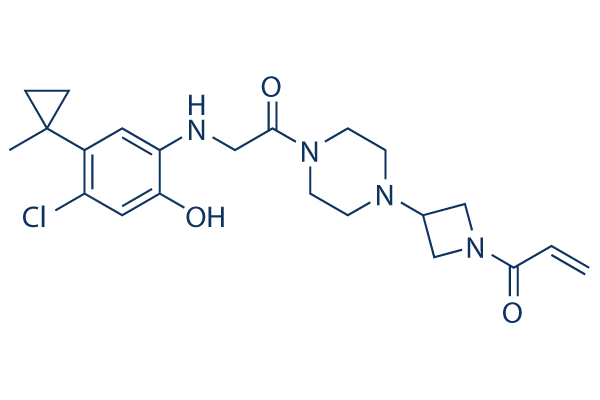
Chemische Struktur
Molekulargewicht: 432.94
Qualitätskontrolle (Quality Control)
| Verwandte Ziele | CDK HSP PD-1/PD-L1 ROCK Wee1 DNA/RNA Synthesis Microtubule Associated Ras Aurora Kinase Casein Kinase |
|---|---|
| Weitere KRas Inhibitoren | RMC-7977 Daraxonrasib (RMC-6236) MRTX1133 Zoldonrasib (RMC-9805) BI-2852 Adagrasib (MRTX849) HRS-4642 ARS-1620 BI-3406 K-Ras(G12C) inhibitor 12 |
Chemische Informationen, Lagerung & Stabilität (Chemical Information, Storage & Stability)
| Molekulargewicht | 432.94 | Formel | C22H29ClN4O3 |
Lagerung (Ab dem Eingangsdatum) | |
|---|---|---|---|---|---|
| CAS-Nr. | 1629268-00-3 | SDF herunterladen | Lagerung von Stammlösungen |
|
|
| Synonyme | N/A | Smiles | CC1(CC1)C2=CC(=C(C=C2Cl)O)NCC(=O)N3CCN(CC3)C4CN(C4)C(=O)C=C | ||
Löslichkeit (Solubility)
|
In vitro |
DMSO
: 86 mg/mL
(198.64 mM)
Ethanol : 7 mg/mL Water : Insoluble |
Molaritätsrechner
|
In vivo |
|||||
In-vivo-Formulierungsrechner (Klare Lösung)
Schritt 1: Geben Sie die untenstehenden Informationen ein (Empfohlen: Ein zusätzliches Tier zur Berücksichtigung von Verlusten während des Experiments)
Schritt 2: Geben Sie die In-vivo-Formulierung ein (Dies ist nur der Rechner, keine Formulierung. Bitte kontaktieren Sie uns zuerst, wenn es im Abschnitt "Löslichkeit" keine In-vivo-Formulierung gibt.)
Berechnungsergebnisse:
Arbeitskonzentration: mg/ml;
Methode zur Herstellung der DMSO-Stammlösung: mg Wirkstoff vorgelöst in μL DMSO ( Konzentration der Stammlösung mg/mL, Bitte kontaktieren Sie uns zuerst, wenn die Konzentration die DMSO-Löslichkeit der Wirkstoffcharge überschreitet. )
Methode zur Herstellung der In-vivo-Formulierung: Nehmen Sie μL DMSO Stammlösung, dann hinzufügenμL PEG300, mischen und klären, dann hinzufügenμL Tween 80, mischen und klären, dann hinzufügen μL ddH2O, mischen und klären.
Methode zur Herstellung der In-vivo-Formulierung: Nehmen Sie μL DMSO Stammlösung, dann hinzufügen μL Maisöl, mischen und klären.
Hinweis: 1. Bitte stellen Sie sicher, dass die Flüssigkeit klar ist, bevor Sie das nächste Lösungsmittel hinzufügen.
2. Achten Sie darauf, das/die Lösungsmittel der Reihe nach hinzuzufügen. Sie müssen sicherstellen, dass die bei der vorherigen Zugabe erhaltene Lösung eine klare Lösung ist, bevor Sie mit der Zugabe des nächsten Lösungsmittels fortfahren. Physikalische Methoden wie Vortex, Ultraschall oder ein heißes Wasserbad können zur Unterstützung des Lösens verwendet werden.
Wirkmechanismus (Mechanism of Action)
| Targets/IC50/Ki |
K-Ras(G12C)
(in H358 cells) 2.5 μM
|
|---|---|
| In vitro |
ARS-853 treatment of KRASG12C cells led to a dose-dependent and nearly complete inhibition of CRAF-RBD (RBD)-mediated pulldown of KRAS from lysates, with an IC50 of approximately 1 μmol/L. Treatment of H358 cells by this compound resulted in a significant loss of KRAS–CRAF interactions. Consistent with an inactive state of KRASG12C once bound to this chemical, downstream signaling through both MAPK (including pMEK, pERK, and pRSK) and PI3K signaling (pAKT) pathways was inhibited by it in H358 and other KRASG12C cell lines. The inhibition of RAF-RBD pulldown and KRAS downstream signaling was sustained over a period of 72 hours, accompanied by G1 cell-cycle arrest, loss of Cyclin D1 and Rb expression, and an increase in the cell-cycle inhibitor p27 KIP1. In addition, hallmarks of apoptosis, including cleaved PARP and increases in sub-diploid DNA, were observed in H358 cells following treatment with this compound. No effects on RAF-RBD binding or downstream signaling were observed in A549 cells (KRASG12S), and the inhibitory effects of it in H358 cells could be rescued by ectopic expression of KRASG12V. KRASG12C is the most potent covalent target of this chemical across more than 2,700 cellular proteins and consistently find that it exerts no effects on cellular signaling or growth in non-KRASG12C cells at concentrations up to 10-fold higher than its KRASG12C potency. It reacts only with the inactive (GDP-bound), but the not the active (GTP-bound), state of KRAS. This compound reduced KRAS-GTP levels and ERK phosphorylation in human embryonic kidney 293 (HEK293) or H358 cells engineered to express KRASG12C but not in those expressing KRASG12C/A59G. It traps KRASG12C in a GDP-bound conformation by lowering its affinity for nucleotide exchange factors.
|
Literatur |
|

Produkte sind nur für Forschungszwecke bestimmt. Nicht für den menschlichen Gebrauch. Wir verkaufen nicht an Patienten.
©Copyright 2013 Selleck Chemicals. Alle Rechte vorbehalten.