
nur für Forschungszwecke
Onalespib (AT13387) HSP90 Inhibitor
Kat.-Nr.S1163
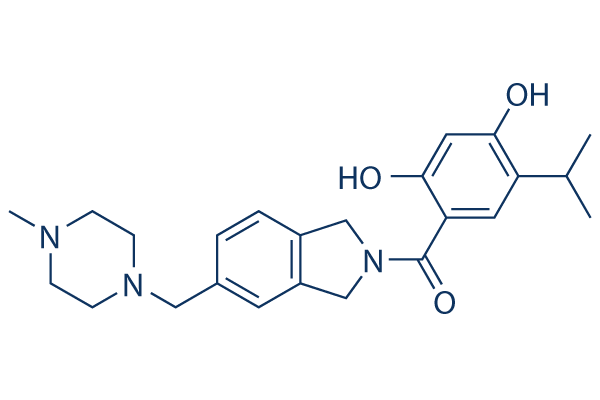
Chemische Struktur
Molekulargewicht: 409.52
Qualitätskontrolle
Zellkultur, Behandlung & Arbeitskonzentration
| Zelllinien | Assay-Typ | Konzentration | Inkubationszeit | Formulierung | Aktivitätsbeschreibung | PMID |
|---|---|---|---|---|---|---|
| human HCT116 cells | Cytotoxic assay | Cytotoxicity against human HCT116 cells by Alamar blue assay, IC50=0.048 μM | 20662534 | |||
| human HCT116 cells | Function assay | 10 nM | 18 h | Induction of apoptosis in human HCT116 cells assessed as upregulation of Hsp70 level at 10 nM after 18 hrs by immunoblotting | 20662534 | |
| human HCT116 cells | Function assay | 30 nM | 18 h | Induction of apoptosis in human HCT116 cells assessed as reduction of CDK4 level at 30 nM after 18 hrs by immunoblotting | 20662534 | |
| human HCT116 cells | Function assay | 30 nM | 18 h | Induction of apoptosis in human HCT116 cells assessed as reduction of Raf-1 level at 30 nM after 18 hrs by immunoblotting | 20662534 | |
| human HCT116 cells | Proliferation assay | 48 h | Antiproliferative activity against human HCT116 cells after 48 hrs by MTT assay, IC50=0.08 μM | 24763261 | ||
| human SKBR3 cells | Proliferation assay | 48 h | Antiproliferative activity against human SKBR3 cells after 48 hrs by MTT assay, IC50=0.14 μM | 24763261 | ||
| human MCF7 cells | Proliferation assay | 48 h | Antiproliferative activity against human MCF7 cells after 48 hrs by MTT assay, IC50=0.28 μM | 24763261 | ||
| human A231 cells | Proliferation assay | 48 h | Antiproliferative activity against human A231 cells after 48 hrs by MTT assay, IC50=1.01 μM | 24763261 | ||
| GIST430 | Cytotoxicity assay | 7 days | Cytotoxicity against imatinib-resistant human GIST430 cells assessed as decrease in cell viability after 7 days by alamar blue assay, IC50=0.034μM. | 26844689 | ||
| GIST48 | Cytotoxicity assay | 7 days | Cytotoxicity against imatinib-resistant human GIST48 cells assessed as decrease in cell viability after 7 days by alamar blue assay, IC50=0.055μM. | 26844689 | ||
| MCF7 | Antiproliferative assay | 72 hrs | Antiproliferative activity against human MCF7 cells incubated for 72 hrs by MTT assay, IC50=0.032μM. | 29028527 | ||
| SKBR3 | Antiproliferative assay | 72 hrs | Antiproliferative activity against human SKBR3 cells incubated for 72 hrs by MTT assay, IC50=0.045μM. | 29028527 | ||
| TC32 | qHTS assay | qHTS of pediatric cancer cell lines to identify multiple opportunities for drug repurposing: Primary screen for TC32 cells | 29435139 | |||
| DAOY | qHTS assay | qHTS of pediatric cancer cell lines to identify multiple opportunities for drug repurposing: Primary screen for DAOY cells | 29435139 | |||
| SJ-GBM2 | qHTS assay | qHTS of pediatric cancer cell lines to identify multiple opportunities for drug repurposing: Primary screen for SJ-GBM2 cells | 29435139 | |||
| A673 | qHTS assay | qHTS of pediatric cancer cell lines to identify multiple opportunities for drug repurposing: Primary screen for A673 cells | 29435139 | |||
| SK-N-MC | qHTS assay | qHTS of pediatric cancer cell lines to identify multiple opportunities for drug repurposing: Primary screen for SK-N-MC cells | 29435139 | |||
| NB-EBc1 | qHTS assay | qHTS of pediatric cancer cell lines to identify multiple opportunities for drug repurposing: Primary screen for NB-EBc1 cells | 29435139 | |||
| Saos-2 | qHTS assay | qHTS of pediatric cancer cell lines to identify multiple opportunities for drug repurposing: Primary screen for Saos-2 cells | 29435139 | |||
| SK-N-SH | qHTS assay | qHTS of pediatric cancer cell lines to identify multiple opportunities for drug repurposing: Primary screen for SK-N-SH cells | 29435139 | |||
| NB1643 | qHTS assay | qHTS of pediatric cancer cell lines to identify multiple opportunities for drug repurposing: Primary screen for NB1643 cells | 29435139 | |||
| LAN-5 | qHTS assay | qHTS of pediatric cancer cell lines to identify multiple opportunities for drug repurposing: Primary screen for LAN-5 cells | 29435139 | |||
| Rh18 | qHTS assay | qHTS of pediatric cancer cell lines to identify multiple opportunities for drug repurposing: Primary screen for Rh18 cells | 29435139 | |||
| OHS-50 | qHTS assay | qHTS of pediatric cancer cell lines to identify multiple opportunities for drug repurposing: Primary screen for OHS-50 cells | 29435139 | |||
| RD | qHTS assay | qHTS of pediatric cancer cell lines to identify multiple opportunities for drug repurposing: Primary screen for RD cells | 29435139 | |||
| NB1643 | qHTS assay | qHTS of pediatric cancer cell lines to identify multiple opportunities for drug repurposing: Confirmatory screen for NB1643 cells | 29435139 | |||
| A673 | qHTS assay | qHTS of pediatric cancer cell lines to identify multiple opportunities for drug repurposing: Confirmatory screen for A673 cells) | 29435139 | |||
| SK-N-MC | qHTS assay | qHTS of pediatric cancer cell lines to identify multiple opportunities for drug repurposing: Confirmatory screen for SK-N-MC cells | 29435139 | |||
| BT-12 | qHTS assay | qHTS of pediatric cancer cell lines to identify multiple opportunities for drug repurposing: Confirmatory screen for BT-12 cells | 29435139 | |||
| LAN-5 | qHTS assay | qHTS of pediatric cancer cell lines to identify multiple opportunities for drug repurposing: Confirmatory screen for LAN-5 cells | 29435139 | |||
| BT-37 | qHTS assay | qHTS of pediatric cancer cell lines to identify multiple opportunities for drug repurposing: Confirmatory screen for BT-37 cells | 29435139 | |||
| TC32 | qHTS assay | qHTS of pediatric cancer cell lines to identify multiple opportunities for drug repurposing: Confirmatory screen for TC32 cells | 29435139 | |||
| U-2 OS | qHTS assay | qHTS of pediatric cancer cell lines to identify multiple opportunities for drug repurposing: Confirmatory screen for U-2 OS cells | 29435139 | |||
| Rh41 | qHTS assay | qHTS of pediatric cancer cell lines to identify multiple opportunities for drug repurposing: Confirmatory screen for Rh41 cells | 29435139 | |||
| RD | qHTS assay | qHTS of pediatric cancer cell lines to identify multiple opportunities for drug repurposing: Confirmatory screen for RD cells | 29435139 | |||
| Rh18 | qHTS assay | qHTS of pediatric cancer cell lines to identify multiple opportunities for drug repurposing: Confirmatory screen for Rh18 cells | 29435139 | |||
| Rh30 | qHTS assay | qHTS of pediatric cancer cell lines to identify multiple opportunities for drug repurposing: Confirmatory screen for Rh30 cells | 29435139 | |||
| SK-N-SH | qHTS assay | qHTS of pediatric cancer cell lines to identify multiple opportunities for drug repurposing: Confirmatory screen for SK-N-SH cells | 29435139 | |||
| NCI-H3122 | Antiproliferative assay | 72 hrs | Antiproliferative activity against human NCI-H3122 cells after 72 hrs by SRB assay, IC50=0.052μM. | 29698859 | ||
| PANC1 | Function assay | 1 uM | 36 hrs | Inhibition of HSP90alpha in human PANC1 cells assessed as up-regulation of Hsp70 at 1 uM after 36 hrs by Western blot analysis | 30351001 | |
| PANC1 | Function assay | 1 uM | 36 hrs | Inhibition of HSP90alpha in human PANC1 cells assessed as akt degradation at 1 uM after 36 hrs by Western blot analysis | 30351001 | |
| MCF7 | Antiproliferative assay | 72 hrs | Antiproliferative activity against human MCF7 cells after 72 hrs by MTT assay, IC50=0.29μM. | 30784881 | ||
| NCI-H1299 | Antiproliferative assay | 72 hrs | Antiproliferative activity against human NCI-H1299 cells after 72 hrs by MTT assay, IC50=0.37μM. | 30784881 | ||
| A549 | Antiproliferative assay | 72 hrs | Antiproliferative activity against human A549 cells after 72 hrs by MTT assay, IC50=0.44μM. | 30784881 | ||
| Vero E6 | Function assay | 48 hrs | IC50 for antiviral activity against SARS-CoV-2 in the Vero E6 cell line at 48 h by immunofluorescence-based assay (detecting the viral NP protein in the nucleus of the Vero E6 cells), IC50=0.15488μM. | 32353859 | ||
| Klicken Sie hier, um weitere experimentelle Daten zu Zelllinien anzuzeigen | ||||||
Chemische Informationen, Lagerung & Stabilität
| Molekulargewicht | 409.52 | Formel | C24H31N3O3 |
Lagerung (Ab dem Eingangsdatum) | |
|---|---|---|---|---|---|
| CAS-Nr. | 912999-49-6 | SDF herunterladen | Lagerung von Stammlösungen |
|
|
| Synonyme | N/A | Smiles | CC(C)C1=CC(=C(C=C1O)O)C(=O)N2CC3=C(C2)C=C(C=C3)CN4CCN(CC4)C | ||
Löslichkeit
|
In vitro |
DMSO
: 25 mg/mL
(61.04 mM)
Water : Insoluble Ethanol : Insoluble |
Molaritätsrechner
|
In vivo |
|||||
In-vivo-Formulierungsrechner (Klare Lösung)
Schritt 1: Geben Sie die untenstehenden Informationen ein (Empfohlen: Ein zusätzliches Tier zur Berücksichtigung von Verlusten während des Experiments)
Schritt 2: Geben Sie die In-vivo-Formulierung ein (Dies ist nur der Rechner, keine Formulierung. Bitte kontaktieren Sie uns zuerst, wenn es im Abschnitt "Löslichkeit" keine In-vivo-Formulierung gibt.)
Berechnungsergebnisse:
Arbeitskonzentration: mg/ml;
Methode zur Herstellung der DMSO-Stammlösung: mg Wirkstoff vorgelöst in μL DMSO ( Konzentration der Stammlösung mg/mL, Bitte kontaktieren Sie uns zuerst, wenn die Konzentration die DMSO-Löslichkeit der Wirkstoffcharge überschreitet. )
Methode zur Herstellung der In-vivo-Formulierung: Nehmen Sie μL DMSO Stammlösung, dann hinzufügenμL PEG300, mischen und klären, dann hinzufügenμL Tween 80, mischen und klären, dann hinzufügen μL ddH2O, mischen und klären.
Methode zur Herstellung der In-vivo-Formulierung: Nehmen Sie μL DMSO Stammlösung, dann hinzufügen μL Maisöl, mischen und klären.
Hinweis: 1. Bitte stellen Sie sicher, dass die Flüssigkeit klar ist, bevor Sie das nächste Lösungsmittel hinzufügen.
2. Achten Sie darauf, das/die Lösungsmittel der Reihe nach hinzuzufügen. Sie müssen sicherstellen, dass die bei der vorherigen Zugabe erhaltene Lösung eine klare Lösung ist, bevor Sie mit der Zugabe des nächsten Lösungsmittels fortfahren. Physikalische Methoden wie Vortex, Ultraschall oder ein heißes Wasserbad können zur Unterstützung des Lösens verwendet werden.
Wirkmechanismus
| Targets/IC50/Ki |
HSP90
(Cell-free assay) 18 nM
|
|---|---|
| In vitro |
Die Kd für die Bindung von Onalespib (AT13387) beträgt 0,7 nM. Dies vergleicht sich mit einer Kd von 6,7 nM für die Bindung des Ansamycins 17-AAG an die gleiche Stelle. Die mittlere Stöchiometrie der Bindung für diese Verbindung beträgt 1,03. Ihre Hemmung einer Reihe isolierter Kinasen, einschließlich CDK1, CDK2, CDK4, FGFR3, PKB-b, JAK2, VEGFR2, PDGFRβ und Aurora B, wird ebenfalls untersucht. Keine der getesteten Kinasen wird bei Konzentrationen unter 30 μM signifikant gehemmt. Es ist ein potenter Inhibitor der Proliferation und des Überlebens vieler verschiedener Zelllinien (wie der MES-SA-Zelllinie) aus einer Vielzahl verschiedener Tumortypen. In einem Panel von 30 Tumorzelllinien hemmt es die Zellproliferation potent mit GI50-Werten im Bereich von 13–260 nM. Die Verbindung hemmt auch die Proliferation der nicht-tumorigenen menschlichen Prostata-Epithelzelllinie PNT2 mit einem GI50-Wert von 480 nM.
|
| Kinase-Assay |
HSP90 competition isothermal calorimetry
|
|
Kd-Werte für die Bindung von Onalespib (AT13387) an HSP90 werden mittels eines kompetitiven isothermen Kalorimetrie (ITC)-Formats bestimmt. ITC-Experimente werden an einem Micro Cal VP-ITC bei 25 °C in einem Puffer durchgeführt, der 25 mM Tris, 100 mM NaCl, 1 mM MgCl2 und 1 mM Tris(2-carboxy-ethyl)phosphin bei pH 7,4 enthält, um die höhere Affinität aufrechtzuerhalten
|
|
| In vivo |
Bei intermittierender Verabreichung konnte Onalespib (AT13387) in Dosen von bis zu 70 mg/kg zweimal wöchentlich oder 90 mg/kg einmal wöchentlich toleriert werden. Der Körpergewichtsverlust bei Mäusen überschreitet in allen Fällen außer einem 20 % nicht, bevor er sich erholt, und der Verlust ist nach der zweiten Dosis am höchsten. Die Tumorwachstumshemmung ist bei NCI-H1975 für beide Dosierungsschemata ähnlich. Die Aufrechterhaltung der Antitumorwirkungen mit einer so verlängerten behandlungsfreien Periode steht im Einklang mit der erweiterten pharmakodynamischen Wirkung dieser Verbindung, die für mutiertes EGFR und andere Biomarker in vitro und in vivo beobachtet wurde, und der verlängerten Retention davon in Tumoren.
|
Literatur |
|
Anwendungen
| Methoden | Biomarker | Bilder | PMID |
|---|---|---|---|
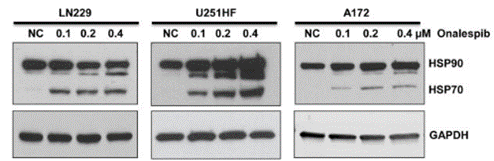
| Western blot | HSP90 / HSP70 EGFR / p-EGFR / AKT / p-AKT / ERK / p-ERK / S6 / p-S6 AXL / c-Myc / p-Mnk1 / Mnk1 / p-eIF4E / eIF4E |
|
28679777 |
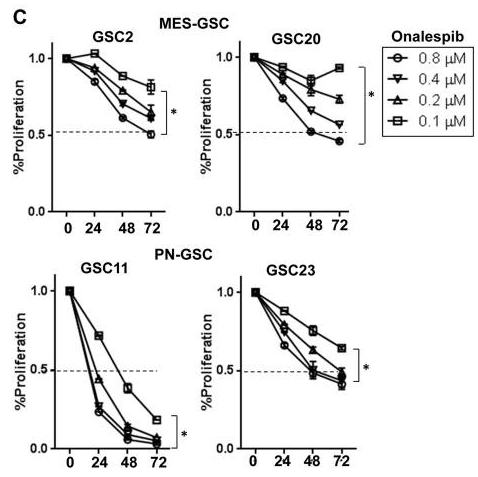
| Growth inhibition assay | Cell viability |
|
28679777 |
Klinische Studieninformationen
(Daten von https://clinicaltrials.gov, aktualisiert am 2024-05-22)
| NCT-Nummer | Rekrutierung | Erkrankungen | Sponsor/Kooperationspartner | Startdatum | Phasen |
|---|---|---|---|---|---|
| NCT02898207 | Completed | Metastatic High Grade Fallopian Tube Serous Adenocarcinoma|Metastatic Malignant Solid Neoplasm|Metastatic Primary Peritoneal Serous Adenocarcinoma|Metastatic Triple-Negative Breast Carcinoma|Platinum-Resistant Fallopian Tube Carcinoma|Platinum-Resistant Ovarian Carcinoma|Platinum-Resistant Primary Peritoneal Carcinoma|Recurrent Breast Carcinoma|Recurrent High Grade Fallopian Tube Serous Adenocarcinoma|Recurrent High Grade Ovarian Serous Adenocarcinoma|Recurrent Primary Peritoneal High Grade Serous Adenocarcinoma|Recurrent Triple-Negative Breast Carcinoma|Refractory Fallopian Tube Serous Adenocarcinoma|Refractory Ovarian Serous Adenocarcinoma|Refractory Primary Peritoneal Serous Adenocarcinoma|Refractory Triple-Negative Breast Carcinoma|Unresectable High Grade Fallopian Tube Serous Adenocarcinoma|Unresectable Malignant Solid Neoplasm|Unresectable Primary Peritoneal Serous Adenocarcinoma |
National Cancer Institute (NCI) |
May 19 2017 | Phase 1 |
Technischer Support
Tel: +1-832-582-8158 Ext:3
Wenn Sie weitere Fragen haben, hinterlassen Sie bitte eine Nachricht.
Häufig gestellte Fragen
Frage 1:
How to prepare it for in vivo studies?
Antwort:
It can be dissolved in 2% DMSO/30% PEG 300/ddH2O at 10 mg/ml as a clear solution. But after stayed for about 1 hour, the precipitation will goes out. So it is recommended to be prepared before use.

Produkte sind nur für Forschungszwecke bestimmt. Nicht für den menschlichen Gebrauch. Wir verkaufen nicht an Patienten.
©Copyright 2013 Selleck Chemicals. Alle Rechte vorbehalten.