
nur für Forschungszwecke
GANT61 Hedgehog/Smoothened Inhibitor
Kat.-Nr.S8075
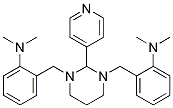
Chemische Struktur
Molekulargewicht: 429.6
Qualitätskontrolle
| Verwandte Ziele | JAK TGF-beta/Smad Wnt/beta-catenin ERK GSK-3 ROCK PKA Secretase STAT Casein Kinase |
|---|---|
| Weitere Hedgehog/Smoothened Inhibitoren | SAG (Smoothened Agonist) Hydrochloride Purmorphamine Cyclopamine (11-Deoxojervine) SAG (Smoothened Agonist) SANT-1 HPI-4 (Ciliobrevin A) BMS-833923 Taladegib (LY2940680) Ciliobrevin D PF-5274857 |
Zellkultur, Behandlung & Arbeitskonzentration
| Zelllinien | Assay-Typ | Konzentration | Inkubationszeit | Formulierung | Aktivitätsbeschreibung | PMID |
|---|---|---|---|---|---|---|
| Shh Light2 | Function assay | Inhibition of SHH in mouse Shh Light2 cells by GLI-responsive firefly luciferase reporter gene assay, IC50 = 5 μM. | 19309080 | |||
| Shh-L2 | Function assay | Inhibition of Hedgehog signaling in human Shh-L2 cells, IC50 = 5 μM. | 17494766 | |||
| NIH 3T3 | Function assay | Inhibition of Hh signaling pathway in Shh-LIGHT2 incorporated mouse NIH 3T3 cells assessed as downregulation of Gli1 gene expression by luciferase reporter gene assay, EC50 = 5 μM. | 26976215 | |||
| HeLa | Function assay | 4.5 hrs | Inhibition of Ebolavirus glycoprotein/matrix protein VP40 entry in human HeLa cells after 4.5 hrs beta-lactamase reporter assay, IC50 = 6.83 μM. | 29624387 | ||
| TM3 | Function assay | 48 hrs | Inhibition of Hh signaling pathway in mouse TM3 cells assessed as downregulation of Gli1 gene expression after 48 hrs by luciferase reporter gene assay, EC50 = 9.27 μM. | 26976215 | ||
| Rh30 | Function assay | 24 hrs | Inhibition of human Gli1-mediated transcriptional activity in human Rh30 cells after 24 hrs by luciferase reporter gene assay, IC50 = 40 μM. | 20605720 | ||
| HEK293 | Function assay | Reduction of GLI2 mediated transcription in HEK293 cells by luciferase reporter assay | 17494766 | |||
| NIH3T3 | Function assay | Inhibition of GLI1 induced hedgehog signaling in mouse NIH3T3 cells | 17494766 | |||
| HEK293 | Function assay | Inhibition of beta galactosidase in HEK293 cells | 17494766 | |||
| MEF | Function assay | Reduction in expression of Hedgehog target gene Hip1 in Sufu deficient mouse MEF cells | 17494766 | |||
| NIH3T3 | Function assay | 10 uM | Inhibition of Hedgehog/Gli1 mediated transformation in mouse NIH3T3 cells at 10 uM | 17494766 | ||
| PANC1 | Function assay | 5 uM | Reduction in GLI1 expression in human PANC1 cells at 5 uM | 17494766 | ||
| PANC1 | Function assay | 5 uM | Reduction in PTCH expression in human PANC1 cells at 5 uM | 17494766 | ||
| 22Rv | Function assay | 5 uM | Reduction in GlI1 expression in human 22Rv cells at 5 uM | 17494766 | ||
| 22Rv | Function assay | 5 uM | Reduction in PTCH expression in human 22Rv cells at 5 uM | 17494766 | ||
| 22Rv | Function assay | Reduction of expression of PTCH mRNA in human 22Rv cells | 17494766 | |||
| HEK293 | Function assay | Inhibition of nuclear accumulation of GLI mutant in HEK293 cells | 17494766 | |||
| HEK293 | Function assay | Inhibition of nuclear accumulation of wild type GLI in HEK293 cells | 17494766 | |||
| HEK293 | Function assay | Reduction of GLI1 mediated transcription in HEK293 cells by luciferase reporter assay | 17494766 | |||
| 22Rv | Antitumor assay | 50 mg/kg | 18 days | Antitumor activity in GLI1 positive human 22Rv cells xenografted mouse model at 50 mg/kg, sc after 18 days | 17494766 | |
| HEK293 | Function assay | 30 uM | Inhibition of GLI (unknown origin) expressed in HEK293 cells assessed as reduction in GLI-mediated transcription at 30 uM | 25581017 | ||
| A673 | qHTS assay | qHTS of pediatric cancer cell lines to identify multiple opportunities for drug repurposing: Primary screen for A673 cells | 29435139 | |||
| SK-N-MC | qHTS assay | qHTS of pediatric cancer cell lines to identify multiple opportunities for drug repurposing: Primary screen for SK-N-MC cells | 29435139 | |||
| NB-EBc1 | qHTS assay | qHTS of pediatric cancer cell lines to identify multiple opportunities for drug repurposing: Primary screen for NB-EBc1 cells | 29435139 | |||
| OHS-50 | qHTS assay | qHTS of pediatric cancer cell lines to identify multiple opportunities for drug repurposing: Primary screen for OHS-50 cells | 29435139 | |||
| RD | qHTS assay | qHTS of pediatric cancer cell lines to identify multiple opportunities for drug repurposing: Primary screen for RD cells | 29435139 | |||
| SK-N-DZ | Cytotoxicity assay | 72 hrs | Cytotoxicity against human SK-N-DZ cells after 72 hrs by fluorometric microculture cytotoxicity assay, GI50 = 5.82 μM. | ChEMBL | ||
| SK-N-SH | Cytotoxicity assay | 72 hrs | Cytotoxicity against human SK-N-SH cells after 72 hrs by fluorometric microculture cytotoxicity assay, GI50 = 5.82 μM. | ChEMBL | ||
| SK-N-FI | Cytotoxicity assay | 72 hrs | Cytotoxicity against human SK-N-FI cells after 72 hrs by fluorometric microculture cytotoxicity assay, GI50 = 5.82 μM. | ChEMBL | ||
| SK-N-AS | Cytotoxicity assay | 72 hrs | Cytotoxicity against human SK-N-AS cells after 72 hrs by fluorometric microculture cytotoxicity assay, GI50 = 5.82 μM. | ChEMBL | ||
| IMR32 | Cytotoxicity assay | 72 hrs | Cytotoxicity against human IMR32 cells after 72 hrs by fluorometric microculture cytotoxicity assay, GI50 = 5.82 μM. | ChEMBL | ||
| SK-N-BE(2) | Cytotoxicity assay | 72 hrs | Cytotoxicity against human SK-N-BE(2) cells after 72 hrs by fluorometric microculture cytotoxicity assay, GI50 = 5.82 μM. | ChEMBL | ||
| SH-SY5Y | Cytotoxicity assay | 72 hrs | Cytotoxicity against human SH-SY5Y cells after 72 hrs by fluorometric microculture cytotoxicity assay, GI50 = 5.82 μM. | ChEMBL | ||
| Klicken Sie hier, um weitere experimentelle Daten zu Zelllinien anzuzeigen | ||||||
Chemische Informationen, Lagerung & Stabilität
| Molekulargewicht | 429.6 | Formel | C27H35N5 |
Lagerung (Ab dem Eingangsdatum) | |
|---|---|---|---|---|---|
| CAS-Nr. | 500579-04-4 | SDF herunterladen | Lagerung von Stammlösungen |
|
|
| Synonyme | NSC 136476 | Smiles | CN(C)C1=CC=CC=C1CN2CCCN(C2C3=CC=NC=C3)CC4=CC=CC=C4N(C)C | ||
Löslichkeit
|
In vitro |
Ethanol : 85 mg/mL
DMSO
: Insoluble
Water : Insoluble |
Molaritätsrechner
|
In vivo |
|||||
In-vivo-Formulierungsrechner (Klare Lösung)
Schritt 1: Geben Sie die untenstehenden Informationen ein (Empfohlen: Ein zusätzliches Tier zur Berücksichtigung von Verlusten während des Experiments)
Schritt 2: Geben Sie die In-vivo-Formulierung ein (Dies ist nur der Rechner, keine Formulierung. Bitte kontaktieren Sie uns zuerst, wenn es im Abschnitt "Löslichkeit" keine In-vivo-Formulierung gibt.)
Berechnungsergebnisse:
Arbeitskonzentration: mg/ml;
Methode zur Herstellung der DMSO-Stammlösung: mg Wirkstoff vorgelöst in μL DMSO ( Konzentration der Stammlösung mg/mL, Bitte kontaktieren Sie uns zuerst, wenn die Konzentration die DMSO-Löslichkeit der Wirkstoffcharge überschreitet. )
Methode zur Herstellung der In-vivo-Formulierung: Nehmen Sie μL DMSO Stammlösung, dann hinzufügenμL PEG300, mischen und klären, dann hinzufügenμL Tween 80, mischen und klären, dann hinzufügen μL ddH2O, mischen und klären.
Methode zur Herstellung der In-vivo-Formulierung: Nehmen Sie μL DMSO Stammlösung, dann hinzufügen μL Maisöl, mischen und klären.
Hinweis: 1. Bitte stellen Sie sicher, dass die Flüssigkeit klar ist, bevor Sie das nächste Lösungsmittel hinzufügen.
2. Achten Sie darauf, das/die Lösungsmittel der Reihe nach hinzuzufügen. Sie müssen sicherstellen, dass die bei der vorherigen Zugabe erhaltene Lösung eine klare Lösung ist, bevor Sie mit der Zugabe des nächsten Lösungsmittels fortfahren. Physikalische Methoden wie Vortex, Ultraschall oder ein heißes Wasserbad können zur Unterstützung des Lösens verwendet werden.
Wirkmechanismus
| Targets/IC50/Ki |
GLI1
(HEK293T cells expressing GLI1) 5 μM
|
|---|---|
| In vitro |
GANT61 ist ein Inhibitor der GLI1- sowie GLI2-induzierten Transkription. Diese Verbindung hemmt die DNA-Bindungsfähigkeit von GLI1. Sie hemmt die hedgehog-Signalübertragung mit einer IC50 von 5 μM und zeigt Selektivität gegenüber anderen Signalwegen, wie der TNF-Signalübertragung/NFκB-Aktivierung, der Glucocorticoidrezeptor-Gen-Transaktivierung und der Ras–Raf–Mek–Mapk-Kaskade. Diese Chemikalie hemmte in vitro effizient die Tumorzellproliferation auf GLI-abhängige Weise. Sie induziert Apoptose in Zellen der chronischen lymphatischen Leukämie (CLL), jedoch nicht in normalen B-Lymphozyten. Diese Verbindung induziert eine robuste Zytotoxizität und unterdrückt die Klonogenität in menschlichen Kolonkarzinom-Zelllinien. Sie induziert die Hemmung der DNA-Replikation in der frühen S-Phase in menschlichen Kolonkarzinom-Zelllinien, was zu einer DNA-Schadenssignalübertragung unter Beteiligung einer ATM–Chk2-Achse und der Induktion des Zelltods führt. Diese Chemikalie (30 μM) verursacht Wachstumsstillstand und Apoptose in akuten myeloischen Leukämie (AML)-Zellen.
|
| Kinase-Assay |
Dual-Luciferase-Assay
|
|
HEK293-Zellen werden auf 10-cm-Platten (Tag 0) mit dem GLI1-Expressionsplasmid zusammen mit den Reporterplasmiden 12×GliBSLuc und R-Luc transfiziert. Vierundzwanzig Stunden später werden die Zellen in weißen 96-Well-Platten mit transparentem Boden in einer Dichte von 15.000 Zellen pro Well ausgesät. Die Zellen dürfen sich anheften, und diese Verbindung wird in einer Endkonzentration von 10 μM in DMSO (0,5 % finale DMSO-Konzentration) hinzugefügt (Tag 1,5). Die Zellen werden weitere 24 Stunden kultiviert, anschließend lysiert und dann mit dem Dual-Luciferase-Kit analysiert.
|
|
| In vivo |
In Nacktmäusen, denen GLI1-positive 22Rv1 Prostatakrebszellen injiziert wurden, induziert GANT61 eine Wachstumsregression, bis kein Tumor mehr tastbar ist. In Nacktmäusen mit SK-N-AS Neuroblastom-Xenotransplantaten hemmt diese Verbindung (orale Gabe, 50 mg/kg) das Tumorwachstum am Tag 12 signifikant, wobei das Tumorvolumen im Vergleich zu den Kontrollen um 63 % reduziert ist.
|
Literatur |
|
Anwendungen
| Methoden | Biomarker | Bilder | PMID |
|---|---|---|---|
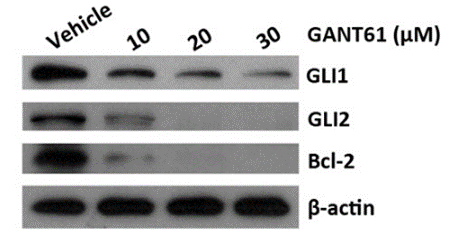
| Western blot | GLI2 / Bcl-2 GLI1 / p-STAT3 / STAT3 / SOCS3 |
|
25544756 |
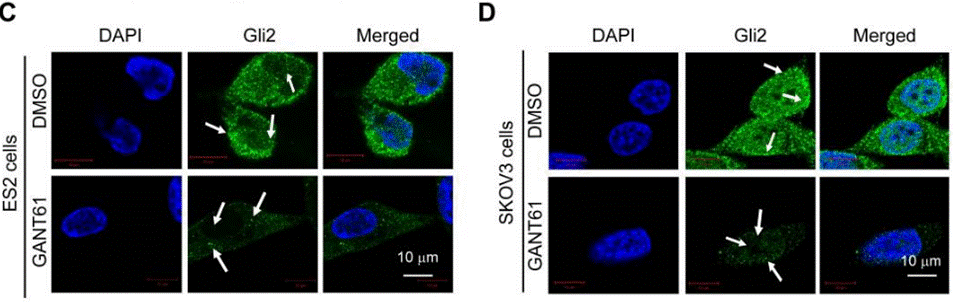
| Immunofluorescence | Gli2 |
|
24533083 |
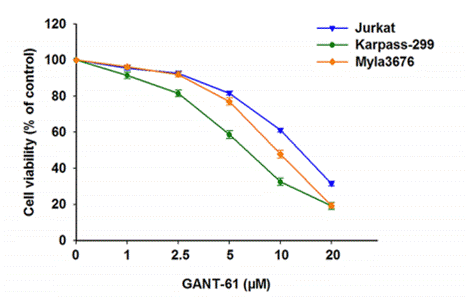
| Growth inhibition assay | Cell viability |
|
27275540 |
Technischer Support
Tel: +1-832-582-8158 Ext:3
Wenn Sie weitere Fragen haben, hinterlassen Sie bitte eine Nachricht.

Produkte sind nur für Forschungszwecke bestimmt. Nicht für den menschlichen Gebrauch. Wir verkaufen nicht an Patienten.
©Copyright 2013 Selleck Chemicals. Alle Rechte vorbehalten.