
nur für Forschungszwecke
ICG-001 Wnt/β-Catenin-Inhibitor
Kat.-Nr.S2662
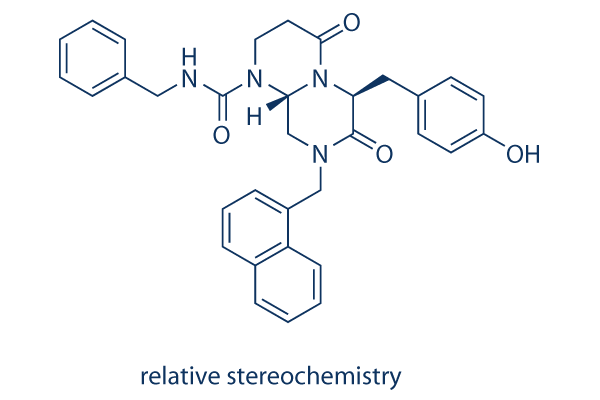
Chemische Struktur
Molekulargewicht: 548.63
Qualitätskontrolle
Produkte, die oft zusammen verwendet werden mit ICG-001
| Verwandte Ziele | JAK TGF-beta/Smad ERK GSK-3 ROCK Hedgehog/Smoothened PKA Secretase STAT Casein Kinase |
|---|---|
| Weitere Wnt/beta-catenin Inhibitoren | IWR-1-endo PRI-724 (Foscenvivint) IWP-2 Tegatrabetan (BC-2059) Isoquercitrin SKL2001 BML-284 Hydrochloride (Wnt agonist 1, AMBMP) PNU-74654 Salinomycin (Procoxacin) FH535 |
Zellkultur, Behandlung & Arbeitskonzentration
| Zelllinien | Assay-Typ | Konzentration | Inkubationszeit | Formulierung | Aktivitätsbeschreibung | PMID |
|---|---|---|---|---|---|---|
| SH-SY5Y | Apoptosis Assay | 50 μm | 24 h | DMSO | blocks the protective effect of melatonin against PrP (106–126)-induced apoptotic signals | 25251028 |
| AsPC-1 | Growth Inhibition Assay | 1-20 μM | 2/4/6 d | inhibits the cell growth in a dose-dependent manner | 25082960 | |
| MiaPaCa-2 | Growth Inhibition Assay | 1-20 μM | 2/4/6 d | inhibits the cell growth in a dose-dependent manner | 25082960 | |
| PANC-1 | Growth Inhibition Assay | 1-20 μM | 2/4/6 d | inhibits the cell growth in a dose-dependent manner | 25082960 | |
| L3.6pl | Growth Inhibition Assay | 1-20 μM | 2/4/6 d | inhibits the cell growth in a dose-dependent manner | 25082960 | |
| SH-SY5Y | Apoptosis Assay | 10 μM | 24 h | inhibits the neuroprotective effects of hypoxia against PrP (106-126)-mediated neuronal cell death | 23900566 | |
| HKC-8 | Function Assay | 10 µM | 24 h | abolishes β-catenin–mediated RAS induction | 25012166 | |
| HK-2 | Function Assay | 10 µM | 3 h | reduced the expression of TGF-β1, α-SMA, and CTGF after treatment with HHE | 23690997 | |
| HepT1 | Apoptosis Assay | 0-100 μM | 24 h | IC50=34 μM | 23266718 | |
| HuH6 | Apoptosis Assay | 0-100 μM | 24 h | IC50=39 μM | 23266718 | |
| MCF7 | Function Assay | 5 μm | inhibits leptin-mediated increased expression of Snail, Slug, and Zeb2 | 22270359 | ||
| RLE-6TN | Function Assay | 2.5/5/7.5 μM | 48 h | inhibits TGF-β1-induced α-SMA induction and EMT | 22241478 | |
| HKC-8 | Function Assay | 5/10/20 μM | 48 h | blocks β-catenin-driven gene expression | 21816937 | |
| SW480 | Growth Inhibition Assay | 2-100 μM | IC50=5.8±0.68 μM | 15782138 | ||
| SW480 | Function assay | Inhibition of CBP binding to beta-casein in human SW480 cells by immunoblot analysis, IC50 = 1.3 μM. | 23232060 | |||
| A549 | Antiproliferative assay | 72 hrs | Antiproliferative activity against human A549 cells after 72 hrs by MTT assay, GI50 = 6.1 μM. | 24950489 | ||
| HepG2 | Antiproliferative assay | 72 hrs | Antiproliferative activity against human HepG2 cells after 72 hrs by MTT assay, GI50 = 12.7 μM. | 24950489 | ||
| LoVo | Antiproliferative assay | 72 hrs | Antiproliferative activity against human LoVo cells after 72 hrs by MTT assay, GI50 = 15.6 μM. | 24950489 | ||
| HT-29 | Antiproliferative assay | 72 hrs | Antiproliferative activity against human HT-29 cells after 72 hrs by MTT assay, GI50 = 17.2 μM. | 24950489 | ||
| HT29 | Function assay | 24 hrs | Inhibition of Wnt signaling in human HT29 cells assessed as inhibition of beta-catenin-mediated Tcf/Lef transcriptional activity after 24 hrs by dual luciferase reporter gene assay relative to control, IC50 = 18.7 μM. | 24950489 | ||
| TC32 | qHTS assay | qHTS of pediatric cancer cell lines to identify multiple opportunities for drug repurposing: Primary screen for TC32 cells | 29435139 | |||
| A673 | qHTS assay | qHTS of pediatric cancer cell lines to identify multiple opportunities for drug repurposing: Primary screen for A673 cells | 29435139 | |||
| DAOY | qHTS assay | qHTS of pediatric cancer cell lines to identify multiple opportunities for drug repurposing: Primary screen for DAOY cells | 29435139 | |||
| BT-37 | qHTS assay | qHTS of pediatric cancer cell lines to identify multiple opportunities for drug repurposing: Primary screen for BT-37 cells | 29435139 | |||
| RD | qHTS assay | qHTS of pediatric cancer cell lines to identify multiple opportunities for drug repurposing: Primary screen for RD cells | 29435139 | |||
| MG 63 (6-TG R) | qHTS assay | qHTS of pediatric cancer cell lines to identify multiple opportunities for drug repurposing: Primary screen for MG 63 (6-TG R) cells | 29435139 | |||
| NB1643 | qHTS assay | qHTS of pediatric cancer cell lines to identify multiple opportunities for drug repurposing: Primary screen for NB1643 cells | 29435139 | |||
| OHS-50 | qHTS assay | qHTS of pediatric cancer cell lines to identify multiple opportunities for drug repurposing: Primary screen for OHS-50 cells | 29435139 | |||
| SJ-GBM2 | qHTS assay | qHTS of pediatric cancer cell lines to identify multiple opportunities for drug repurposing: Primary screen for SJ-GBM2 cells | 29435139 | |||
| SK-N-MC | qHTS assay | qHTS of pediatric cancer cell lines to identify multiple opportunities for drug repurposing: Primary screen for SK-N-MC cells | 29435139 | |||
| NB-EBc1 | qHTS assay | qHTS of pediatric cancer cell lines to identify multiple opportunities for drug repurposing: Primary screen for NB-EBc1 cells | 29435139 | |||
| LAN-5 | qHTS assay | qHTS of pediatric cancer cell lines to identify multiple opportunities for drug repurposing: Primary screen for LAN-5 cells | 29435139 | |||
| LoVo | Cytotoxicity assay | 10 uM | 72 hrs | Cytotoxicity against Wnt/beta-catenin signalling dependent human LoVo cells assessed as cell viability at 10 uM after 72 hrs by ATPlite assay | ChEMBL | |
| NCI-H1703 | Function assay | 10 uM | 24 hrs | Inhibition of TNIK in human NCI-H1703 cells transfected with lentiviral vector 7TFP assessed as reduction of GSK3 inhibitor X activated TNIK-mediated Wnt/TCF/beta-catenin-dependent transcription at 10 uM after 24 hrs by luciferase reporter assay | ChEMBL | |
| HCT116 | Cytotoxicity assay | 10 uM | 72 hrs | Cytotoxicity against Wnt/beta-catenin signalling dependent human HCT116 cells assessed as cell viability at 10 uM after 72 hrs by ATPlite assay | ChEMBL | |
| Klicken Sie hier, um weitere experimentelle Daten zu Zelllinien anzuzeigen | ||||||
Chemische Informationen, Lagerung & Stabilität
| Molekulargewicht | 548.63 | Formel | C33H32N4O4 |
Lagerung (Ab dem Eingangsdatum) | |
|---|---|---|---|---|---|
| CAS-Nr. | 780757-88-2 (relative stereochemistry); 847591-62-2 (absolute stereochemistry) | SDF herunterladen | Lagerung von Stammlösungen |
|
|
Löslichkeit
|
In vitro |
DMSO
: 30 mg/mL
(54.68 mM)
Water : Insoluble Ethanol : Insoluble |
Molaritätsrechner
|
In vivo |
|||||
In-vivo-Formulierungsrechner (Klare Lösung)
Schritt 1: Geben Sie die untenstehenden Informationen ein (Empfohlen: Ein zusätzliches Tier zur Berücksichtigung von Verlusten während des Experiments)
Schritt 2: Geben Sie die In-vivo-Formulierung ein (Dies ist nur der Rechner, keine Formulierung. Bitte kontaktieren Sie uns zuerst, wenn es im Abschnitt "Löslichkeit" keine In-vivo-Formulierung gibt.)
Berechnungsergebnisse:
Arbeitskonzentration: mg/ml;
Methode zur Herstellung der DMSO-Stammlösung: mg Wirkstoff vorgelöst in μL DMSO ( Konzentration der Stammlösung mg/mL, Bitte kontaktieren Sie uns zuerst, wenn die Konzentration die DMSO-Löslichkeit der Wirkstoffcharge überschreitet. )
Methode zur Herstellung der In-vivo-Formulierung: Nehmen Sie μL DMSO Stammlösung, dann hinzufügenμL PEG300, mischen und klären, dann hinzufügenμL Tween 80, mischen und klären, dann hinzufügen μL ddH2O, mischen und klären.
Methode zur Herstellung der In-vivo-Formulierung: Nehmen Sie μL DMSO Stammlösung, dann hinzufügen μL Maisöl, mischen und klären.
Hinweis: 1. Bitte stellen Sie sicher, dass die Flüssigkeit klar ist, bevor Sie das nächste Lösungsmittel hinzufügen.
2. Achten Sie darauf, das/die Lösungsmittel der Reihe nach hinzuzufügen. Sie müssen sicherstellen, dass die bei der vorherigen Zugabe erhaltene Lösung eine klare Lösung ist, bevor Sie mit der Zugabe des nächsten Lösungsmittels fortfahren. Physikalische Methoden wie Vortex, Ultraschall oder ein heißes Wasserbad können zur Unterstützung des Lösens verwendet werden.
Wirkmechanismus
| Targets/IC50/Ki |
CBP
(Cell-free assay) 3 μM
|
|---|---|
| In vitro |
ICG-001 hat keine Wirkung auf das zugehörige Reporterkonstrukt FOPFLASH, das mutierte TCF-Stellen enthält. Nach Behandlung mit 25 μM dieser Verbindung für 8 Stunden reduzieren SW480-Zellen die Steady-State-Spiegel von Survivin- und Cyclin D1-RNA und -Protein, die beide durch β-catenin hochreguliert werden können. Diese Verbindung induziert selektiv Apoptose in transformierten Zellen, aber nicht in normalen Darmzellen, und reduziert das In-vitro-Wachstum von Kolonkarzinomzellen. Es kann die normale Nervenwachstumsfaktor (NGF)-induzierte neuronale Differenzierung und Neuritenwachstum in Presenilin-1-Mutantenzellen phänotypisch retten, was die Bedeutung des TCF/β-catenin-Signalwegs für Neuritenwachstum und neuronale Differenzierung hervorhebt. Eine aktuelle Studie zeigt, dass 5 μM dieser Chemikalie die Leptin-induzierte EMT, Invasion und Tumorsphärenbildung in MCF7-Zellen hemmt. |
| Kinase-Assay |
DUAL-Luciferase Reporter Assay
|
|
Das Dual-Luciferase Reporter (DLR) Assay System bietet eine effiziente Möglichkeit zur Durchführung von Dual-Reporter-Assays. Im DLRTM Assay werden die Aktivitäten von Firefly (Photinus pyralis) und Renilla (Renilla reniformis, auch bekannt als Sea Pansy) Luciferasen nacheinander aus einer einzigen Probe gemessen. Der Firefly-Luciferase-Reporter wird zuerst gemessen, indem Luciferase Assay Reagent II (LAR II) hinzugefügt wird, um ein lumineszierendes Signal vom "Glow-Typ" zu erzeugen. Nach der Quantifizierung der Firefly-Lumineszenz wird diese Reaktion gelöscht, und die Renilla-Luciferase-Reaktion wird durch gleichzeitiges Hinzufügen von Stop & Glo® Reagent zum selben Röhrchen eingeleitet. Das Stop & Glo® Reagent erzeugt ebenfalls ein Signal vom "Glow-Typ" aus der Renilla-Luciferase, das im Verlauf der Messung langsam abnimmt. Im DLRTM Assay System liefern beide Reporter lineare Assays mit Subattomol (<10-18) Empfindlichkeiten und keiner endogenen Aktivität eines der Reporter in den experimentellen Wirtszellen. Darüber hinaus bietet das integrierte Format des DLRTM Assays eine schnelle Quantifizierung beider Reporter entweder in transfizierten Zellen oder in zellfreien Transkriptions-/Translationsreaktionen.
|
|
| In vivo |
Die Verabreichung eines wasserlöslichen Analogons von ICG-001 über 9 Wochen reduziert die Bildung von Polypen im Dick- und Dünndarm um 42 %, ebenso effektiv wie das nichtsteroidale entzündungshemmende Mittel, das in diesem Modell stets Wirksamkeit gezeigt hat. Während des gesamten Behandlungsverlaufs wird keine offensichtliche Toxizität festgestellt. Im SW620 Nacktmaus-Xenograft-Modell der Tumorrückbildung zeigt 150 mg/kg i.v. dieser Verbindung eine dramatische Reduktion des Tumorvolumens über den 19-tägigen Behandlungsverlauf, ohne Mortalität oder Gewichtsverlust. Diese Chemikalie (5 mg/kg pro Tag) hemmt signifikant die Beta-Catenin-Signalübertragung und mildert Bleomycin-induzierte Lungenfibrose bei Mäusen, während gleichzeitig das Epithel erhalten bleibt. |
Literatur |
|
Anwendungen
| Methoden | Biomarker | Bilder | PMID |
|---|---|---|---|
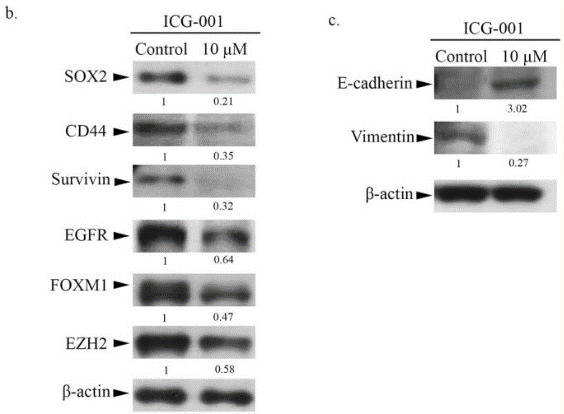
| Western blot | SOX-2 / CD44 / Survivin / EGFR / FOXM1 / EZH2 / Vimentin pβ-catenin beta-catenin / F-actin ABC / Beta-catenin / E-cadherin / N-cadherin / MMP-9 / c-MYC / Actin / Histone H3 CCNB1 / Cyclin D1 |
|
25897700 |
Technischer Support
Tel: +1-832-582-8158 Ext:3
Wenn Sie weitere Fragen haben, hinterlassen Sie bitte eine Nachricht.
Häufig gestellte Fragen
Frage 1:
If the compound is stored in DMSO at -80, how long would it be stable? For cell culture, how long should I change for the fresh medium with it?
Antwort:
It in DMSO solution can be stored at 4 degree for 1 week and -20 degree for 1 month. The best storage condition is solid powder, even at -80 the solution is not stable enough for long term storage. For cell culture, you need change medium every 48h.

Produkte sind nur für Forschungszwecke bestimmt. Nicht für den menschlichen Gebrauch. Wir verkaufen nicht an Patienten.
©Copyright 2013 Selleck Chemicals. Alle Rechte vorbehalten.