
nur für Forschungszwecke
Ruxolitinib (INCB18424) JAK1/2-Inhibitor
Kat.-Nr.S1378
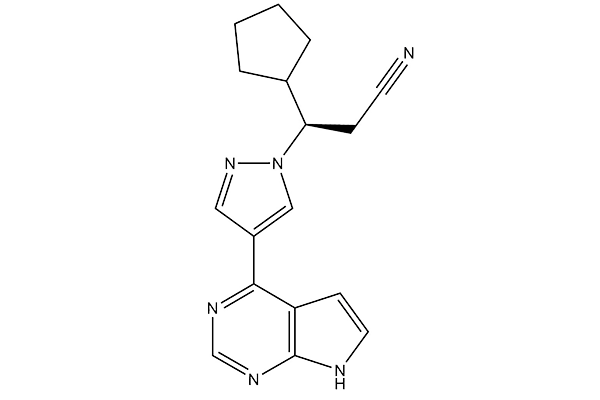
Chemische Struktur
Molekulargewicht: 306.37
Qualitätskontrolle
Produkte, die oft zusammen verwendet werden mit Ruxolitinib (INCB18424)
| Verwandte Ziele | EGFR STAT Pim |
|---|---|
| Weitere JAK Inhibitoren | BMS-986165 (Deucravacitinib) AZD1480 WP1066 Momelotinib (CYT387) Filgotinib (GLPG0634) AT9283 Gandotinib (LY2784544) Pacritinib TG101209 Cerdulatinib (PRT062070) hydrochloride |
Zellkultur, Behandlung & Arbeitskonzentration
| Zelllinien | Assay-Typ | Konzentration | Inkubationszeit | Formulierung | Aktivitätsbeschreibung | PMID |
|---|---|---|---|---|---|---|
| SNU423 | Function Assay | 50 μM | 24 h | DMSO | Inhibition of STAT1 and STAT3 phosphorylation significantly | 23941832 |
| SNU182 | Function Assay | 50 μM | 24 h | DMSO | Inhibition of STAT1 and STAT3 phosphorylation significantly | 23941832 |
| HuH7 | Function Assay | 50 μM | 24 h | DMSO | Inhibition of STAT1 and STAT3 phosphorylation significantly | 23941832 |
| SNU423 | Growth Inhibition Assay | 50 μM | 48 h | DMSO | >81% reduction | 23941832 |
| SNU182 | Growth Inhibition Assay | 50 μM | 48 h | DMSO | >64% reduction | 23941832 |
| HuH7 | Growth Inhibition Assay | 50 μM | 48 h | DMSO | >82% reduction | 23941832 |
| RKO | Apoptosis Assay | 25 μM | 48 h | DMSO | Induces apoptosis by activating caspase 3 | 24050550 |
| DLD-1 | Apoptosis Assay | 25 μM | 48 h | DMSO | Induces apoptosis by activating caspase 3 | 24050550 |
| DLD-1 | Growth Inhibition Assay | 50 μM | 48 h | DMSO | IC50=15.51 μM | 24050550 |
| RKO | Growth Inhibition Assay | 50 μM | 48 h | DMSO | IC50=14.76 μM | 24050550 |
| RKO | Kinase Assay | 25 μM | 48 h | DMSO | does not inhibit JAK1 phosphorylation | 24050550 |
| DLD-1 | Kinase Assay | 25 μM | 48 h | DMSO | Inhibition of JAK2 phosphorylation | 24050550 |
| RKO | Kinase Assay | 25 μM | 48 h | DMSO | Inhibition of JAK1 phosphorylation | 24050550 |
| DLD-1 | Kinase Assay | 25 μM | 48 h | DMSO | Inhibition of JAK1 phosphorylation | 24050550 |
| BaF3 | Kinase Assay | 80 nM | 6 h | DMSO | Reduces the phosphorylation of STAT5 in JAK2V617F-mutated BAF3-EPOR cell | 24237791 |
| Huh7 | Function Assay | 1 μM | 16 h | DMSO | Impaires the capacity of IHCA-associated gp130 mutants to signal to STAT3 | 24501689 |
| HepG2 | Function Assay | 1 μM | 16 h | DMSO | Impaires the capacity of IHCA-associated gp130 mutants to signal to STAT3 | 24501689 |
| Hep3B | Function Assay | 1 μM | 16 h | DMSO | Impaires the capacity of IHCA-associated gp130 mutants to active STAT3 with IC50 of ~50 μM | 24501689 |
| NCI-H2347 | Apoptosis Assay | 30 nM | 48 h | DMSO | Induction of apoptosis | 25213670 |
| NCI-H1299 | Apoptosis Assay | 30 nM | 48 h | DMSO | Induction of apoptosis | 25213670 |
| A549/DDP | Apoptosis Assay | 30 nM | 48 h | DMSO | Induction of apoptosis | 25213670 |
| NCI-H1299 | Function Assay | 30 nM | 48 h | DMSO | Down-regulation of STAT3 phosphorylation | 25213670 |
| NCI-H2347 | Function Assay | 30 nM | 48 h | DMSO | Decrease in Bcl2 expression | 25213670 |
| A549/DDP | Function Assay | 30 nM | 48 h | DMSO | Down-regulation of STAT3 phosphorylation | 25213670 |
| NCI-H2347 | Growth Inhibition Assay | DMSO | IC50=0.17 μM | 25213670 | ||
| NCI-H1299 | Growth Inhibition Assay | DMSO | IC50=0.28 μM | 25213670 | ||
| A549/DDP | Growth Inhibition Assay | DMSO | IC50=0.22 μM | 25213670 | ||
| A549 | Growth Inhibition Assay | DMSO | IC50=0.04 μM | 25213670 | ||
| NCI-H358 | Growth Inhibition Assay | DMSO | IC50=0.1 μM | 25213670 | ||
| NCI-H460 | Growth Inhibition Assay | DMSO | IC50=0.13 μM | 25213670 | ||
| CMK | Growth Inhibition Assay | Inhibition of CMK carrying the WT JAK cell proliferation with IC50 of 0.075 μM | 25352124 | |||
| CMK | Growth Inhibition Assay | Inhibition of CMK carrying the JAK3A63D mutation cell proliferation with IC50 of 0.163 μM | 25352124 | |||
| CMK | Growth Inhibition Assay | Inhibition of CMK carrying the JAK3A572V mutation cell proliferation | 25352124 | |||
| HT93A | Growth Inhibition Assay | 320 nM | 5 d | DMSO | Inhibition of GCS-F induced granulocytic differentiation | 25805962 |
| SET-2 | Cytotoxic Assay | 5 μM | 48 h | Cytotoxic index=18.7% | 25931349 | |
| HEL | Cytotoxic Assay | 5 μM | 48 h | Cytotoxic index=12.2% | 25931349 | |
| Human monocyte | Kinase Assay | Inhibition of JAK2/1 in human monocytes expressing CD14 assessed as inhibition of IFNgamma-stimulated STAT1 phosphorylation with IC50 of 0.031μM | 23540648 | |||
| Human monocyte | Kinase Assay | Inhibition of JAK2 in human monocytes expressing CD14 assessed as inhibition of GM-CSF-stimulated STAT5a phosphorylation with IC50 of 0.026μM | 23540648 | |||
| Human T cell | Kinase Assay | Inhibition of JAK3/1 in human T cells expressing CD3 assessed as inhibition of IL2-stimulated STAT5a phosphorylation with IC50 of 0.023μM | 23540648 | |||
| TF1 | Kinase Assay | 20 min | DMSO | Inhibition of JAK1 in human TF1 cells assessed as inhibition of IL6-induced STAT3 phosphorylation with IC50 of 0.024μM | 22698084 | |
| TF1 | Kinase Assay | 20 min | DMSO | Inhibition of JAK2 in human TF1 cells assessed as inhibition of EPO-induced STAT5 phosphorylation with IC50 of 0.012μM | 22698084 | |
| Sf9 cells | JAK inhibition assay | 1 h | Ki = 0.0001 μM | 23668484 | ||
| Sf9 cells | JAK inhibition assay | 1 h | Ki = 0.0002 μM | 23668484 | ||
| Sf9 cells | JAK inhibition assay | 1 h | Ki = 0.0005 μM | 23668484 | ||
| SET2 cells | JAK inhibition assay | IC50 = 0.00184 μM | 23061660 | |||
| Sf21 cells | JAK inhibition assay | 1 h | IC50 = 0.0028 μM | 22591402 | ||
| Sf21 cells | JAK inhibition assay | 60 min | IC50 = 0.003 μM | 27137359 | ||
| Sf9 cells | JAK inhibition assay | 1 h | Ki = 0.0032 μM | 23668484 | ||
| Sf21 cells | JAK inhibition assay | 1 h | IC50 = 0.0033 μM | 22591402 | ||
| TF1 cells | JAK inhibition assay | 30 min | IC50 = 0.00685 μM | 23061660 | ||
| CD34+ cells | JAK inhibition assay | IC50 = 0.008 μM | 26927423 | |||
| TF1 cells | JAK inhibition assay | 20 min | EC50 = 0.012 μM | 22698084 | ||
| Sf21 cells | TYK2 inhibition assay | 1 h | IC50 = 0.019 μM | 22591402 | ||
| T cells | JAK inhibition assay | IC50 = 0.023 μM | 23540648 | |||
| T cells | JAK inhibition assay | IC50 = 0.023 μM | 23540648 | |||
| TF1 cells | JAK inhibition assay | 20 min | EC50 = 0.024 μM | 22698084 | ||
| T cells | JAK inhibition assay | IC50 = 0.031 μM | 23540648 | |||
| T cells | JAK inhibition assay | IC50 = 0.031 μM | 23540648 | |||
| PBMC cells | JAK inhibition assay | IC50 = 0.04 μM | 26927423 | |||
| Sf21 cells | JAK inhibition assay | 1 h | IC50 = 0.428 μM | 22591402 | ||
| PBMC cells | STAT5 inhibition assay | IC50 = 0.448 μM | 26927423 | |||
| CD34+ cells | JAK inhibition assay | 45 min | IC50 = 0.677 μM | 24417533 | ||
| Klicken Sie hier, um weitere experimentelle Daten zu Zelllinien anzuzeigen | ||||||
Chemische Informationen, Lagerung & Stabilität
| Molekulargewicht | 306.37 | Formel | C17H18N6 |
Lagerung (Ab dem Eingangsdatum) | 3 years-20°C(in the dark) powder |
|---|---|---|---|---|---|
| CAS-Nr. | 941678-49-5 | SDF herunterladen | Lagerung von Stammlösungen |
|
|
| Synonyme | INCB018424 | Smiles | C1CCC(C1)C(CC#N)N2C=C(C=N2)C3=C4C=CNC4=NC=N3 | ||
Löslichkeit
|
In vitro |
DMSO
: 300 mg/mL
(979.2 mM)
Ethanol : 12 mg/mL Water : Insoluble |
Molaritätsrechner
|
In vivo |
|||||
In-vivo-Formulierungsrechner (Klare Lösung)
Schritt 1: Geben Sie die untenstehenden Informationen ein (Empfohlen: Ein zusätzliches Tier zur Berücksichtigung von Verlusten während des Experiments)
Schritt 2: Geben Sie die In-vivo-Formulierung ein (Dies ist nur der Rechner, keine Formulierung. Bitte kontaktieren Sie uns zuerst, wenn es im Abschnitt "Löslichkeit" keine In-vivo-Formulierung gibt.)
Berechnungsergebnisse:
Arbeitskonzentration: mg/ml;
Methode zur Herstellung der DMSO-Stammlösung: mg Wirkstoff vorgelöst in μL DMSO ( Konzentration der Stammlösung mg/mL, Bitte kontaktieren Sie uns zuerst, wenn die Konzentration die DMSO-Löslichkeit der Wirkstoffcharge überschreitet. )
Methode zur Herstellung der In-vivo-Formulierung: Nehmen Sie μL DMSO Stammlösung, dann hinzufügenμL PEG300, mischen und klären, dann hinzufügenμL Tween 80, mischen und klären, dann hinzufügen μL ddH2O, mischen und klären.
Methode zur Herstellung der In-vivo-Formulierung: Nehmen Sie μL DMSO Stammlösung, dann hinzufügen μL Maisöl, mischen und klären.
Hinweis: 1. Bitte stellen Sie sicher, dass die Flüssigkeit klar ist, bevor Sie das nächste Lösungsmittel hinzufügen.
2. Achten Sie darauf, das/die Lösungsmittel der Reihe nach hinzuzufügen. Sie müssen sicherstellen, dass die bei der vorherigen Zugabe erhaltene Lösung eine klare Lösung ist, bevor Sie mit der Zugabe des nächsten Lösungsmittels fortfahren. Physikalische Methoden wie Vortex, Ultraschall oder ein heißes Wasserbad können zur Unterstützung des Lösens verwendet werden.
Wirkmechanismus
| Targets/IC50/Ki |
JAK2
(Cell-free assay) 2.8 nM
JAK1
(Cell-free assay) 3.3 nM
|
|---|---|
| In vitro |
Ruxolitinib (INCB18424) hemmt potent und selektiv die JAK2V617F-vermittelte Signalgebung und Proliferation in Ba/F3-Zellen und HEL-Zellen. Diese Verbindung erhöht die Apoptosis in Ba/F3-Zellen dosisabhängig signifikant. Es (64 nM) führt zu einer Verdopplung der Zellen mit depolarisierten Mitochondrien in Ba/F3-Zellen. Diese Chemikalie hemmt die Proliferation von erythroiden Vorläuferzellen von Normalspendern und Patienten mit Polycythaemia vera mit einer IC50 von 407 nM bzw. 223 nM. Es zeigt eine bemerkenswerte Potenz gegen die Bildung von Erythroid-Kolonien mit einer IC50 von 67 nM.
|
| Kinase-Assay |
Bindungsassay
|
|
Rekombinante Proteine werden unter Verwendung von Sf21-Zellen und Baculovirus-Vektoren exprimiert und mittels Affinitätschromatographie gereinigt. JAK-Kinase-Assays verwenden einen homogenen zeitaufgelösten Fluoreszenz-Assay mit dem Peptidsubstrat (-EQEDEPEGDYFEWLE). Jede Enzymreaktion wird mit Ruxolitinib (INCB18424) oder Kontrolle, JAK-Enzym, 500 nM Peptid, Adenosintriphosphat (ATP; 1 mM) und 2 % Dimethylsulfoxid (DMSO) für 1 Stunde durchgeführt. Die 50%ige Hemmkonzentration (IC50) wird als die Konzentration dieser Verbindung berechnet, die für die Hemmung von 50 % des Fluoreszenzsignals erforderlich ist.
|
|
| In vivo |
INCB018424 (180 mg/kg, oral, zweimal täglich) führt zu einer Überlebensrate von über 90 % am Tag 22 in einem JAK2V617F-getriebenen Mausmodell. Diese Verbindung (180 mg/kg, oral, zweimal täglich) reduziert signifikant die Splenomegalie und die zirkulierenden Spiegel entzündlicher Zytokine und eliminiert bevorzugt neoplastische Zellen, was zu einem signifikant verlängerten Überleben ohne myelosuppressive oder immunsuppressive Effekte in einem JAK2V617F-getriebenen Mausmodell führt. In der doppelblinden Studie zur Myelofibrose wird der primäre Endpunkt bei 41,9 % der Patienten in der Ruxolitinib (INCB18424)-Gruppe erreicht, verglichen mit 0,7 % in der Placebogruppe. Es führt zu einer anhaltenden Reduktion des Milzvolumens und einer Verbesserung des Gesamtsymptomscores um 50 % oder mehr. Insgesamt 28 % der Patienten in der Gruppe, die diese Verbindung (15 mg zweimal täglich) erhielt, hatten eine Reduktion des Milzvolumens um mindestens 35 % in Woche 48 bei Patienten mit Myelofibrose, verglichen mit 0 % in der Gruppe, die die beste verfügbare Therapie erhielt. Die mittlere palpable Milzlänge hatte sich damit um 56 % verringert, aber mit der besten verfügbaren Therapie in Woche 48 um 4 % erhöht. Patienten in der Ruxolitinib-Gruppe zeigten eine Verbesserung der allgemeinen Lebensqualitätsmaße und eine Reduktion der mit Myelofibrose verbundenen Symptome.
|
Literatur |
|
Anwendungen
| Methoden | Biomarker | Bilder | PMID |
|---|---|---|---|
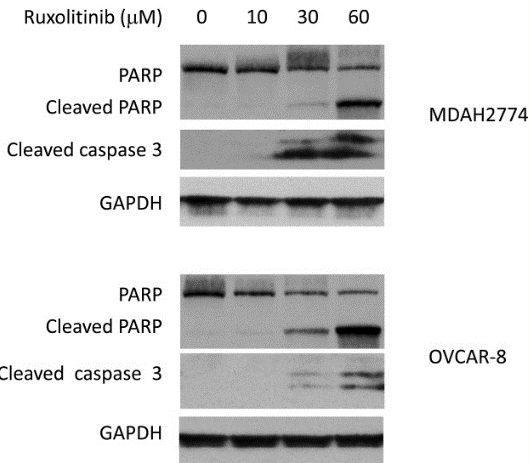
| Western blot | cleaved PARP / cleaved caspase3 p-JAK2 / p-AKT / p-MAPK / Bcl-xl / MCL-1 c-Myc / c-Jun / Cyclin B / Cyclin D / Bcl-2 / HIF-1α p-STAT3 |
|
29849942 |
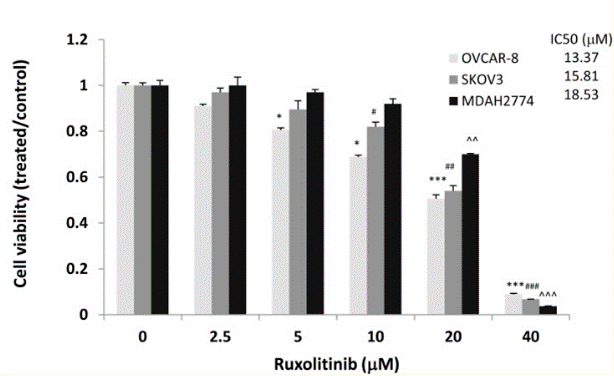
| Growth inhibition assay | Cell viability Cell apoptosis Cell proliferation |
|
29849942 |
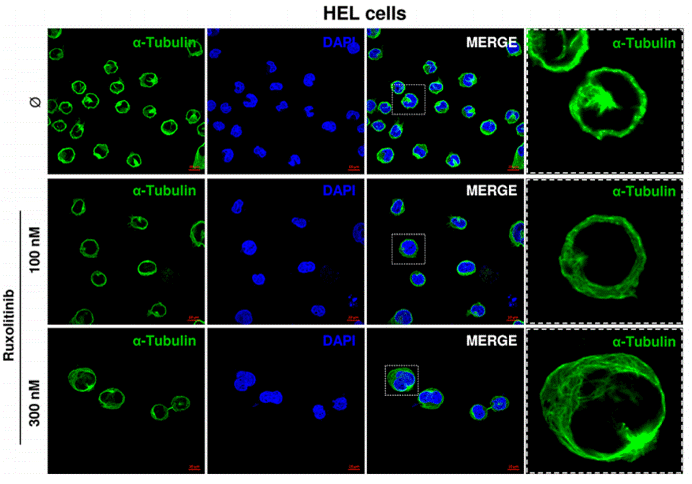
| Immunofluorescence | α-tubulin |
|
26356819 |
Klinische Studieninformationen
(Daten von https://clinicaltrials.gov, aktualisiert am 2024-05-22)
| NCT-Nummer | Rekrutierung | Erkrankungen | Sponsor/Kooperationspartner | Startdatum | Phasen |
|---|---|---|---|---|---|
| NCT06397313 | Not yet recruiting | Myelofibrosis |
Ryvu Therapeutics SA |
September 2024 | Phase 2 |
| NCT06388564 | Not yet recruiting | Chronic Graft-versus-host-disease |
Incyte Corporation |
July 8 2024 | Phase 2 |
| NCT06251102 | Not yet recruiting | Polycythemia Vera |
Gruppo Italiano Malattie EMatologiche dell''Adulto |
July 2024 | -- |
| NCT06343792 | Not yet recruiting | Steroid Refractory GVHD |
ReAlta Life Sciences Inc. |
May 2024 | Phase 2 |
Technischer Support
Tel: +1-832-582-8158 Ext:3
Wenn Sie weitere Fragen haben, hinterlassen Sie bitte eine Nachricht.
Häufig gestellte Fragen
Frage 1:
What is the difference between S2902 and S1378 which seem to have same structure formula according to the product information?
Antwort:
These two chemicals are the two different chiral forms of this compound. S2902 S-Ruxolitinib is the S form and S1378 Ruxolitinib is the D form. One of the carbon atoms in it is asymmetric, making the two molecules mirror images of each other. The biological activities of these two molecules can be very different because of the confirmation differences.
Frage 2:
How about the half-life of this compound? How long is the duration of its inhibitory effect on JAK-STAT signaling?
Antwort:
According to previous study, the half-life of this compound in body is about 2~3 hours. Generally, it is longer in vitro culture medium than in vivo. It was also used for 24 hours in paper. http://www.bloodjournal.org/cgi/pmidlookup?view=long&pmid=24711661.

Produkte sind nur für Forschungszwecke bestimmt. Nicht für den menschlichen Gebrauch. Wir verkaufen nicht an Patienten.
©Copyright 2013 Selleck Chemicals. Alle Rechte vorbehalten.