
nur für Forschungszwecke
Sapitinib (AZD8931) HER2 Inhibitor
Kat.-Nr.S2192
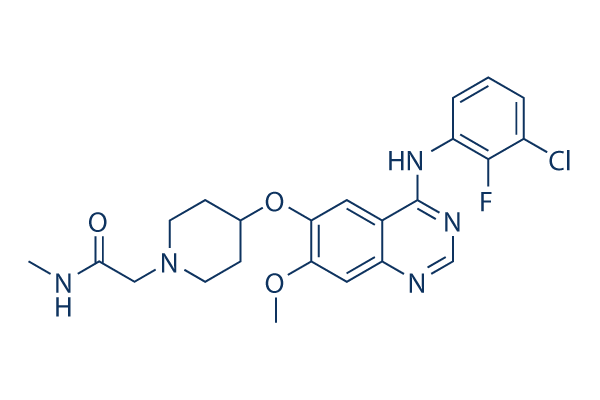
Chemische Struktur
Molekulargewicht: 473.93
Qualitätskontrolle
| Verwandte Ziele | EGFR VEGFR PDGFR FGFR c-Met Src MEK CSF-1R FLT3 c-Kit |
|---|---|
| Weitere HER2 Inhibitoren | CP-724714 Mubritinib (TAK 165) AC480 (BMS-599626) Tyrphostin AG 879 HER2-Inhibitor-1 TAS0728 Zongertinib |
Zellkultur, Behandlung & Arbeitskonzentration
| Zelllinien | Assay-Typ | Konzentration | Inkubationszeit | Formulierung | Aktivitätsbeschreibung | PMID |
|---|---|---|---|---|---|---|
| MCF7 | Function assay | Inhibition of heregulin-stimulated HER2 phosphorylation in human MCF7 cells, IC50 = 0.003 μM. | 24900741 | |||
| MCF7 | Function assay | Inhibition of heregulin-stimulated HER3 phosphorylation in human MCF7 cells, IC50 = 0.004 μM. | 24900741 | |||
| KB | Function assay | Inhibition of EGF-stimulated EGFR phosphorylation in human KB cells, IC50 = 0.004 μM. | 24900741 | |||
| MCF-7 | Function assay | 4 hrs | Inhibition of full-length HER2 phosphorylation transfected in in human MCF-7 cl.24 cells after 4 hrs by laser scanning fluorescence microplate cytometry, IC50 = 0.06 μM. | 24900741 | ||
| TC32 | qHTS assay | qHTS of pediatric cancer cell lines to identify multiple opportunities for drug repurposing: Primary screen for TC32 cells | 29435139 | |||
| DAOY | qHTS assay | qHTS of pediatric cancer cell lines to identify multiple opportunities for drug repurposing: Primary screen for DAOY cells | 29435139 | |||
| SJ-GBM2 | qHTS assay | qHTS of pediatric cancer cell lines to identify multiple opportunities for drug repurposing: Primary screen for SJ-GBM2 cells | 29435139 | |||
| SK-N-MC | qHTS assay | qHTS of pediatric cancer cell lines to identify multiple opportunities for drug repurposing: Primary screen for SK-N-MC cells | 29435139 | |||
| BT-37 | qHTS assay | qHTS of pediatric cancer cell lines to identify multiple opportunities for drug repurposing: Primary screen for BT-37 cells | 29435139 | |||
| NB-EBc1 | qHTS assay | qHTS of pediatric cancer cell lines to identify multiple opportunities for drug repurposing: Primary screen for NB-EBc1 cells | 29435139 | |||
| Saos-2 | qHTS assay | qHTS of pediatric cancer cell lines to identify multiple opportunities for drug repurposing: Primary screen for Saos-2 cells | 29435139 | |||
| SK-N-SH | qHTS assay | qHTS of pediatric cancer cell lines to identify multiple opportunities for drug repurposing: Primary screen for SK-N-SH cells | 29435139 | |||
| LAN-5 | qHTS assay | qHTS of pediatric cancer cell lines to identify multiple opportunities for drug repurposing: Primary screen for LAN-5 cells | 29435139 | |||
| BT-12 | qHTS assay | qHTS of pediatric cancer cell lines to identify multiple opportunities for drug repurposing: Primary screen for BT-12 cells | 29435139 | |||
| OHS-50 | qHTS assay | qHTS of pediatric cancer cell lines to identify multiple opportunities for drug repurposing: Primary screen for OHS-50 cells | 29435139 | |||
| RD | qHTS assay | qHTS of pediatric cancer cell lines to identify multiple opportunities for drug repurposing: Primary screen for RD cells | 29435139 | |||
| Rh41 | qHTS assay | qHTS of pediatric cancer cell lines to identify multiple opportunities for drug repurposing: Primary screen for Rh41 cells | 29435139 | |||
| NB1643 | qHTS assay | qHTS of pediatric cancer cell lines to identify multiple opportunities for drug repurposing: Confirmatory screen for NB1643 cells | 29435139 | |||
| SK-N-MC | qHTS assay | qHTS of pediatric cancer cell lines to identify multiple opportunities for drug repurposing: Confirmatory screen for SK-N-MC cells | 29435139 | |||
| LAN-5 | qHTS assay | qHTS of pediatric cancer cell lines to identify multiple opportunities for drug repurposing: Confirmatory screen for LAN-5 cells | 29435139 | |||
| NB-EBc1 | qHTS assay | qHTS of pediatric cancer cell lines to identify multiple opportunities for drug repurposing: Confirmatory screen for NB-EBc1 cells | 29435139 | |||
| BT-37 | qHTS assay | qHTS of pediatric cancer cell lines to identify multiple opportunities for drug repurposing: Confirmatory screen for BT-37 cells | 29435139 | |||
| TC32 | qHTS assay | qHTS of pediatric cancer cell lines to identify multiple opportunities for drug repurposing: Confirmatory screen for TC32 cells | 29435139 | |||
| Rh18 | qHTS assay | qHTS of pediatric cancer cell lines to identify multiple opportunities for drug repurposing: Confirmatory screen for Rh18 cells | 29435139 | |||
| Rh30 | qHTS assay | qHTS of pediatric cancer cell lines to identify multiple opportunities for drug repurposing: Confirmatory screen for Rh30 cells | 29435139 | |||
| Klicken Sie hier, um weitere experimentelle Daten zu Zelllinien anzuzeigen | ||||||
Chemische Informationen, Lagerung & Stabilität
| Molekulargewicht | 473.93 | Formel | C23H25ClFN5O3 |
Lagerung (Ab dem Eingangsdatum) | |
|---|---|---|---|---|---|
| CAS-Nr. | 848942-61-0 | SDF herunterladen | Lagerung von Stammlösungen |
|
|
| Synonyme | N/A | Smiles | CNC(=O)CN1CCC(CC1)OC2=C(C=C3C(=C2)C(=NC=N3)NC4=C(C(=CC=C4)Cl)F)OC | ||
Löslichkeit
|
In vitro |
DMSO
: 40 mg/mL
(84.4 mM)
Water : Insoluble Ethanol : Insoluble |
Molaritätsrechner
|
In vivo |
|||||
In-vivo-Formulierungsrechner (Klare Lösung)
Schritt 1: Geben Sie die untenstehenden Informationen ein (Empfohlen: Ein zusätzliches Tier zur Berücksichtigung von Verlusten während des Experiments)
Schritt 2: Geben Sie die In-vivo-Formulierung ein (Dies ist nur der Rechner, keine Formulierung. Bitte kontaktieren Sie uns zuerst, wenn es im Abschnitt "Löslichkeit" keine In-vivo-Formulierung gibt.)
Berechnungsergebnisse:
Arbeitskonzentration: mg/ml;
Methode zur Herstellung der DMSO-Stammlösung: mg Wirkstoff vorgelöst in μL DMSO ( Konzentration der Stammlösung mg/mL, Bitte kontaktieren Sie uns zuerst, wenn die Konzentration die DMSO-Löslichkeit der Wirkstoffcharge überschreitet. )
Methode zur Herstellung der In-vivo-Formulierung: Nehmen Sie μL DMSO Stammlösung, dann hinzufügenμL PEG300, mischen und klären, dann hinzufügenμL Tween 80, mischen und klären, dann hinzufügen μL ddH2O, mischen und klären.
Methode zur Herstellung der In-vivo-Formulierung: Nehmen Sie μL DMSO Stammlösung, dann hinzufügen μL Maisöl, mischen und klären.
Hinweis: 1. Bitte stellen Sie sicher, dass die Flüssigkeit klar ist, bevor Sie das nächste Lösungsmittel hinzufügen.
2. Achten Sie darauf, das/die Lösungsmittel der Reihe nach hinzuzufügen. Sie müssen sicherstellen, dass die bei der vorherigen Zugabe erhaltene Lösung eine klare Lösung ist, bevor Sie mit der Zugabe des nächsten Lösungsmittels fortfahren. Physikalische Methoden wie Vortex, Ultraschall oder ein heißes Wasserbad können zur Unterstützung des Lösens verwendet werden.
Wirkmechanismus
| Targets/IC50/Ki |
ErbB2
(Cell-free assay) 3 nM
EGFR
(Cell-free assay) 4 nM
ErbB3
(Cell-free assay) 4 nM
|
|---|---|
| In vitro |
Sapitinib (AZD8931) zeigt eine unterschiedliche Wirksamkeit gegenüber NSCLC- und SCCHN-Zelllinien, mit hoher Empfindlichkeit gegenüber PC-9-Zellen (EGFR-aktivierende Mutation) mit einem GI50 von 0,1 nM und geringer Aktivität gegenüber NCI-1437-Zellen mit einem GI50 über 10 μM. Diese Verbindung zeigt eine höhere Wirksamkeit gegen Phospho-EGFR, Phospho-erbB2 und Phospho-erbB3 in PE/CA-PJ41-, PE/CA-PJ49-, DOK- und FaDu-Zellen. |
| Kinase-Assay |
Isolierte Kinasen-Assays
|
|
Die intrazellulären Kinasedomänen von humanem EGFR und erbB2 werden im Baculovirus/Sf21-System kloniert und exprimiert. Mit der ELISA-Methode wird die hemmende Aktivität von Sapitinib (AZD8931) mit ATP in Km-Konzentrationen (0,4 mM für erbB2 und 2 mM für EGFR) bestimmt.
|
|
| In vivo |
Sapitinib (AZD8931) zeigt Antitumoraktivität in BT474c-, Calu-3-, LoVo-, FaDu- und PC-9-Xenografts. Es könnte die p-Akt-, Ki67-Expression und p-ERK in BT474c-Xenografts nach akuter Behandlung reduzieren. Diese Verbindung induziert auch den Apoptosemarker M30. Darüber hinaus zeigt sie eine stärkere proapoptotische Wirkung in LoVo-Xenografts. |
Literatur |
Anwendungen
| Methoden | Biomarker | Bilder | PMID |
|---|---|---|---|
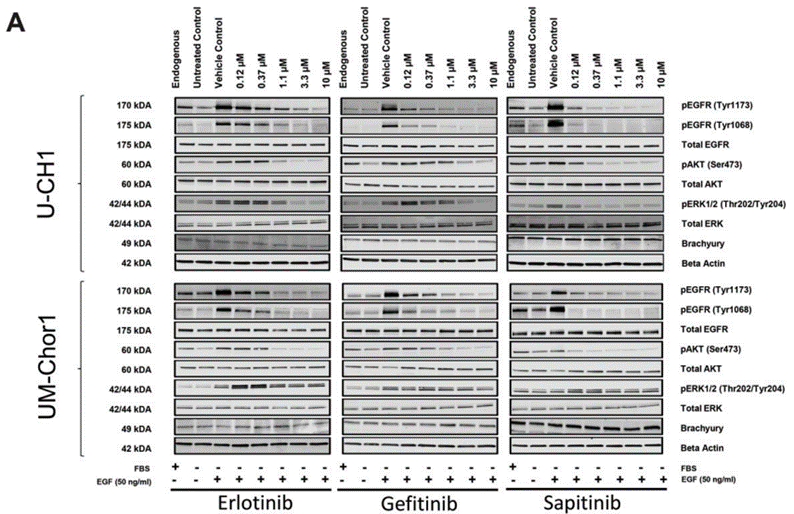
| Western blot | pEGFR / EGFR / pAKT / AKT / pERK / ERK HER3 / p-HER3 / HER2 / p-HER2 / p-PRAS40 / p-S6 / p-4EBP1 / p-FOXO / PARP / cleaved PARP |
|
27102572 |
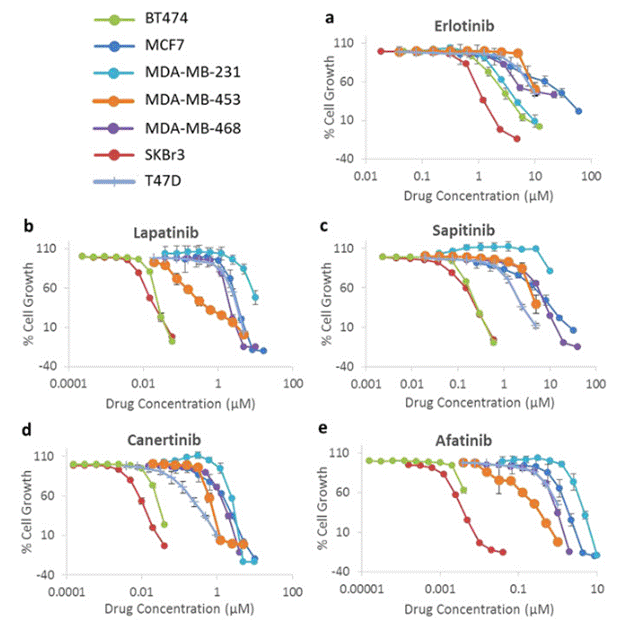
| Growth inhibition assay | Cell viability |
|
28638122 |
Klinische Studieninformationen
(Daten von https://clinicaltrials.gov, aktualisiert am 2024-05-22)
| NCT-Nummer | Rekrutierung | Erkrankungen | Sponsor/Kooperationspartner | Startdatum | Phasen |
|---|---|---|---|---|---|
| NCT01596530 | Terminated | Breast Neoplasm |
AstraZeneca |
June 2012 | Phase 1 |
| NCT01579578 | Terminated | Metastatic Gastric or Gastro-oesophageal Junction Cancer |
AstraZeneca |
April 2012 | Phase 2 |
| NCT01330758 | Completed | Healthy |
AstraZeneca |
April 2011 | Phase 1 |
| NCT01284595 | Completed | Healthy |
AstraZeneca |
March 2011 | Phase 1 |
| NCT01151215 | Terminated | Neoplasms|Breast Neoplasms|Breast Cancer |
AstraZeneca |
June 2010 | Phase 2 |
Technischer Support
Tel: +1-832-582-8158 Ext:3
Wenn Sie weitere Fragen haben, hinterlassen Sie bitte eine Nachricht.

Produkte sind nur für Forschungszwecke bestimmt. Nicht für den menschlichen Gebrauch. Wir verkaufen nicht an Patienten.
©Copyright 2013 Selleck Chemicals. Alle Rechte vorbehalten.