
nur für Forschungszwecke
Allopurinol ROS Inhibitor
Kat.-Nr.: S1630
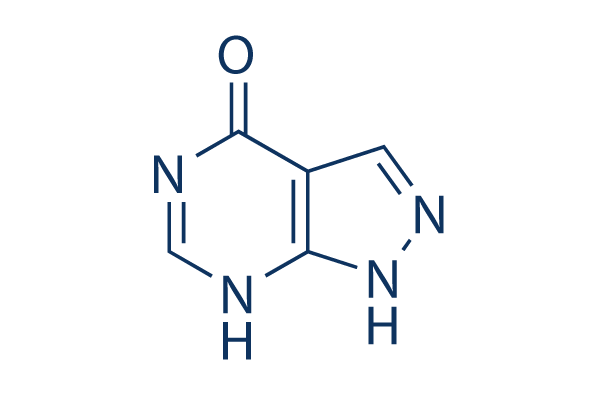
Chemische Struktur
Molekulargewicht: 136.11
Qualitätskontrolle (Quality Control)
Chemische Informationen, Lagerung & Stabilität (Chemical Information, Storage & Stability)
| Molekulargewicht | 136.11 | Formel | C5H4N4O |
Lagerung (Ab dem Eingangsdatum) | |
|---|---|---|---|---|---|
| CAS-Nr. | 315-30-0 | SDF herunterladen | Lagerung von Stammlösungen |
|
|
| Synonyme | N/A | Smiles | C1=NNC2=C1C(=O)NC=N2 | ||
Löslichkeit (Solubility)
|
In vitro |
DMSO
: 27 mg/mL
(198.36 mM)
Ethanol : 3 mg/mL Water : Insoluble |
Molaritätsrechner
|
In vivo |
|||||
In-vivo-Formulierungsrechner (Klare Lösung)
Schritt 1: Geben Sie die untenstehenden Informationen ein (Empfohlen: Ein zusätzliches Tier zur Berücksichtigung von Verlusten während des Experiments)
Schritt 2: Geben Sie die In-vivo-Formulierung ein (Dies ist nur der Rechner, keine Formulierung. Bitte kontaktieren Sie uns zuerst, wenn es im Abschnitt "Löslichkeit" keine In-vivo-Formulierung gibt.)
Berechnungsergebnisse:
Arbeitskonzentration: mg/ml;
Methode zur Herstellung der DMSO-Stammlösung: mg Wirkstoff vorgelöst in μL DMSO ( Konzentration der Stammlösung mg/mL, Bitte kontaktieren Sie uns zuerst, wenn die Konzentration die DMSO-Löslichkeit der Wirkstoffcharge überschreitet. )
Methode zur Herstellung der In-vivo-Formulierung: Nehmen Sie μL DMSO Stammlösung, dann hinzufügenμL PEG300, mischen und klären, dann hinzufügenμL Tween 80, mischen und klären, dann hinzufügen μL ddH2O, mischen und klären.
Methode zur Herstellung der In-vivo-Formulierung: Nehmen Sie μL DMSO Stammlösung, dann hinzufügen μL Maisöl, mischen und klären.
Hinweis: 1. Bitte stellen Sie sicher, dass die Flüssigkeit klar ist, bevor Sie das nächste Lösungsmittel hinzufügen.
2. Achten Sie darauf, das/die Lösungsmittel der Reihe nach hinzuzufügen. Sie müssen sicherstellen, dass die bei der vorherigen Zugabe erhaltene Lösung eine klare Lösung ist, bevor Sie mit der Zugabe des nächsten Lösungsmittels fortfahren. Physikalische Methoden wie Vortex, Ultraschall oder ein heißes Wasserbad können zur Unterstützung des Lösens verwendet werden.
Wirkmechanismus (Mechanism of Action)
| Targets/IC50/Ki |
xanthine oxidase
|
|---|---|
| In vitro |
Allopurinol reverses the increased xanthine oxidase activity in ischemia-reperfusion injury of neonatal rat hearts. This compound (10 mM) treatment suppresses xanthine oxidase activity induced by hypoxia-reoxygenation injury and the production of reactive oxygen species. It also decreases the concentration of intracellular Ca2+ increased by enhanced xanthine oxidase activity.
|
| In vivo |
Allopurinol shows abnormal pyrimidine metabolism together with renal toxicity which could be ameliorated by uridine, indicating that this compound essentially causes pyrimidine metabolism abnormality leading to renal impairment in normal mice. It increases urinary OD excretion to an extent similar to that in normal mice administered the same dose of this chemical in DNFB-sensitized mice. This compound promotes a clinical improvement which is accompanied by a reduction in the parasitic load in the blood, skin and lymph nodes but, even after long period of allopurinol administration alone, Leishmania may persist in dog tissues in Leishmania-infected dogs. It prevents early alcohol-induced liver injury in rats, most likely by preventing oxidant-dependent activation of NF-kappaB. This chemical protects dose-dependently against acetaminophen-induced cell injury, the loss of ATP and the increase of the GSSG content in the total liver and in the mitochondrial compartment without inhibiting reactive metabolite formation in mice. It almost completely inhibits hepatic xanthine oxidase and dehydrogenase activity, but only high doses prevents the increase of the mitochondrial GSSG content.
|
Literatur |
|
Klinische Studieninformationen (Clinical Trial Information)
(Daten von https://clinicaltrials.gov, aktualisiert am 2025-09-25)
| NCT-Nummer | Rekrutierung | Erkrankungen | Sponsor/Kooperationspartner | Startdatum | Phasen |
|---|---|---|---|---|---|
| NCT04875702 | RECRUITING | Gout |
Massachusetts General Hospital |
2024-02-22 | PHASE4 |
| NCT04875702 | RECRUITING | Gout |
Massachusetts General Hospital |
2024-02-22 | PHASE4 |
| NCT05943821 | RECRUITING | Cardiovascular Diseases; Uric Acid |
Poznan University of Medical Sciences |
2023-09-01 | PHASE3 |
| NCT05943821 | RECRUITING | Cardiovascular Diseases; Uric Acid |
Poznan University of Medical Sciences |
2023-09-01 | PHASE3 |
| NCT05536349 | RECRUITING | Leukemia |
M.D. Anderson Cancer Center |
2022-12-20 | PHASE2 |
| NCT05536349 | RECRUITING | Leukemia |
M.D. Anderson Cancer Center |
2022-12-20 | PHASE2 |

Produkte sind nur für Forschungszwecke bestimmt. Nicht für den menschlichen Gebrauch. Wir verkaufen nicht an Patienten.
©Copyright 2013 Selleck Chemicals. Alle Rechte vorbehalten.