
nur für Forschungszwecke
Celastrol Proteasome Inhibitor
Kat.-Nr.S1290
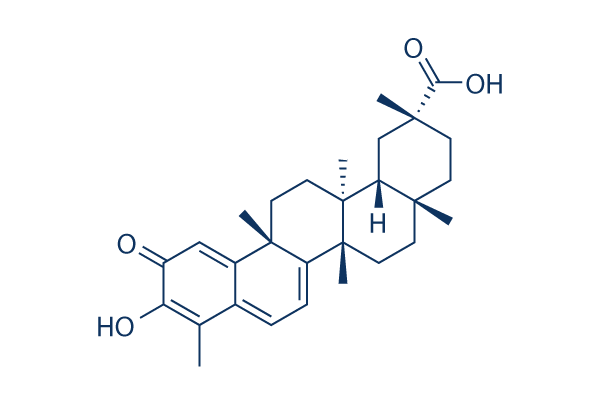
Chemische Struktur
Molekulargewicht: 450.61
Qualitätskontrolle
| Verwandte Ziele | HDAC Caspase Secretase MMP HCV Protease Cysteine Protease DPP Tyrosinase HIV Protease Serine Protease |
|---|---|
| Weitere Proteasome Inhibitoren | MG132 Epoxomicin (BU-4061T) ONX-0914 (PR-957) Oprozomib Delanzomib VR23 Marizomib (Salinosporamide A) PI-1840 KSQ-4279 (USP1-IN-1) Isoginkgetin |
Zellkultur, Behandlung & Arbeitskonzentration
| Zelllinien | Assay-Typ | Konzentration | Inkubationszeit | Formulierung | Aktivitätsbeschreibung | PMID |
|---|---|---|---|---|---|---|
| RAW264.7 | Antiinflammatory assay | 24 hrs | Antiinflammatory activity against mouse RAW264.7 cells assessed as inhibition of LPS-induced NO production treated 3 hrs before LPS challenge assessed after 24 hrs by Griess reagent assay, IC50 = 0.23 μM. | 11809076 | ||
| RAW264.7 | Antiinflammatory assay | 24 hrs | Antiinflammatory activity against mouse RAW264.7 cells assessed as inhibition of LPS-induced NF-kappaB activation treated 3 hrs before LPS challenge assessed after 24 hrs by SEAP reporter gene assay, IC50 = 0.27 μM. | 11809076 | ||
| RPMI8226 | Growth inhibition assay | Growth inhibition of human RPMI8226 cells, IC50 = 3 μM. | 18164197 | |||
| HeLa | Function assay | Inhibition of TNF-alpha-induced NF-kappaB activation in human HeLa cells by SEAP reporter gene assay, IC50 = 0.15 μM. | 18841906 | |||
| RAW264.7 | Function assay | Inhibition of LPS-induced NF-kappaB activation in mouse RAW264.7 cells by SEAP reporter gene assay, IC50 = 0.3 μM. | 18841906 | |||
| SH-SY5Y | Function assay | Neuroprotection against beta-amyloid peptide 1-42-induced toxicity in human SH-SY5Y cells assessed as lactate dehydrogenase release, EC50 = 0.03764 μM. | 19138859 | |||
| HeLa | Function assay | 2 hrs | Amplification of HSF1 transcriptional activity in human heat shock-induced HeLa cells assessed as granule formation treated 1 hr before heat shock challenge measured after 2 hrs without recovery time by immunocytochemical staining, EC50 = 1.1 μM. | 19502057 | ||
| SK-N-SH | Cytotoxicity assay | 72 hrs | Cytotoxicity against human SK-N-SH cells after 72 hrs by MTS assay, CC50 = 1.6 μM. | 19502057 | ||
| HeLa | Function assay | 3 hrs | Amplification of HSF1 transcriptional activity in human HeLa cells assessed as granule formation pretreated for 3 hrs by immunocytochemical staining, EC50 = 2.6 μM. | 19502057 | ||
| HeLa | Cytotoxicity assay | 72 hrs | Cytotoxicity against human HeLa cells after 72 hrs by MTS assay, CC50 = 3 μM. | 19502057 | ||
| HeLa | Function assay | Inhibition of NF-kappaB activity in human HeLa cells by SEAP reporter assay, IC50 = 0.15 μM. | 20469887 | |||
| LNCAP | Antitumor assay | Antitumor activity against human LNCAP cells, IC50 = 2.5 μM. | 20627556 | |||
| PC12 | Cytoprotective assay | Cytoprotective activity against t-BPH-induced cell damage in rat PC12 cells assessed as cell viability, IC50 = 3.15 μM. | 20627556 | |||
| PC12 | Cytoprotective assay | 1.6 uM | Cytoprotective activity against t-BPH-induced cell damage in rat PC12 cells assessed as cell viability at 1.6 uM | 20627556 | ||
| THP1 | Apoptosis assay | 24 hrs | Induction of apoptosis in TRAIL-resistant human THP1 cells after 24 hrs by annexin-V staining, EC50 = 15 μM. | 20864342 | ||
| 293T | Function assay | 30 mins | Inhibition of LPS-induced NF-kappaB activation in human 293T cells incubated for 30 mins followed by treated with LPS for 6 hrs by dual-luciferase reporter assay, IC50 = 0.17 μM. | 21393004 | ||
| 293T | Cytotoxicity assay | Cytotoxicity against human 293T cells assessed as cell viability by dual-luciferase reporter assay, IC50 = 0.67 μM. | 21393004 | |||
| RAW264 | Function assay | 24 hrs | Inhibition of LPS-induced NO production in mouse RAW264 cells after 24 hrs | 21393004 | ||
| NCI-H460 | Cytotoxicity assay | Cytotoxicity against human NCI-H460 cells after overnight incubation by MTT assay, IC50 = 12.3 μM. | 21942765 | |||
| RAW264.7 | Antiinflammatory assay | 24 hrs | Antiinflammatory activity in mouse RAW264.7 cells assessed as inhibition of LPS-induced NO production after 24 hrs by Griess reagent method, IC50 = 1 μM. | 21978676 | ||
| RAW264.7 | Antiinflammatory assay | 24 hrs | Antiinflammatory activity in mouse RAW264.7 cells assessed as inhibition of LPS-induced nitric oxide production after 24 hrs by griess assay, IC50 = 1 μM. | 22024033 | ||
| RAW264.7 | Function assay | 18 hrs | Inhibition of LPS-stimulated NFkappaB activation transfected in mouse RAW264.7 cells after 18 hrs by luciferase reporter gene assay, IC50 = 0.2 μM. | 22705020 | ||
| spleen adherent cells | Antiarthritic assay | 200 ug | Antiarthritic effect in Lewis rat adjuvant-induced arthritis model spleen adherent cells restimulated with sonicated Mtb post isolation assessed as reduction in CCR2 expression at 200 ug, ip starting from arthritis onset and continued uninterrupted until | 22854193 | ||
| spleen adherent cells | Antiarthritic assay | 200 ug | Antiarthritic effect in Lewis rat adjuvant-induced arthritis model spleen adherent cells restimulated with sonicated Mtb post isolation assessed as reduction in GRO/KC production at 200 ug, ip starting from arthritis onset and continued uninterrupted unti | 22854193 | ||
| spleen adherent cells | Antiarthritic assay | 200 ug | Antiarthritic effect in Lewis rat adjuvant-induced arthritis model spleen adherent cells restimulated with sonicated Mtb post isolation assessed as reduction in MCP1 production at 200 ug, ip starting from arthritis onset and continued uninterrupted until | 22854193 | ||
| spleen adherent cells | Antiarthritic assay | 200 ug | Antiarthritic effect in Lewis rat adjuvant-induced arthritis model spleen adherent cells restimulated with sonicated Mtb post isolation assessed as reduction in RANTES production at 200 ug, ip starting from arthritis onset and continued uninterrupted unti | 22854193 | ||
| spleen adherent cells | Antiarthritic assay | 200 ug | Antiarthritic effect in Lewis rat adjuvant-induced arthritis model spleen adherent cells restimulated with sonicated Mtb post isolation assessed as reduction in TNFalpha production at 200 ug, ip starting from arthritis onset and continued uninterrupted un | 22854193 | ||
| spleen adherent cells | Antiarthritic assay | 200 ug | Antiarthritic effect in Lewis rat adjuvant-induced arthritis model spleen adherent cells restimulated with sonicated Mtb post isolation assessed as reduction in CCR3 expression at 200 ug, ip starting from arthritis onset and continued uninterrupted until | 22854193 | ||
| spleen adherent cells | Antiarthritic assay | 200 ug | Antiarthritic effect in Lewis rat adjuvant-induced arthritis model spleen adherent cells restimulated with sonicated Mtb post isolation assessed as reduction in CCR6 expression at 200 ug, ip starting from arthritis onset and continued uninterrupted until | 22854193 | ||
| spleen adherent cells | Antiarthritic assay | 200 ug | Antiarthritic effect in Lewis rat adjuvant-induced arthritis model spleen adherent cells restimulated with sonicated Mtb post isolation assessed as reduction in CXCR1 expression at 200 ug, ip starting from arthritis onset and continued uninterrupted until | 22854193 | ||
| spleen adherent cells | Antiarthritic assay | 200 ug | Antiarthritic effect in Lewis rat adjuvant-induced arthritis model spleen adherent cells restimulated with sonicated Mtb post isolation assessed as reduction in CXCR2 expression at 200 ug, ip starting from arthritis onset and continued uninterrupted until | 22854193 | ||
| spleen adherent cells | Antiarthritic assay | 200 ug | Antiarthritic effect in Lewis rat adjuvant-induced arthritis model spleen adherent cells restimulated with sonicated Mtb post isolation assessed as reduction in CXCR4 expression at 200 ug, ip starting from arthritis onset and continued uninterrupted until | 22854193 | ||
| spleen adherent cells | Function assay | 200 ug | Increase in CCR1 expression in Lewis rat adjuvant-induced arthritis model spleen adherent cells restimulated with sonicated Mtb post isolation at 200 ug, ip starting from arthritis onset and continued uninterrupted until study end by qPCR relative baselin | 22854193 | ||
| spleen adherent cells | Antiarthritic assay | 200 ug | Antiarthritic effect in Lewis rat adjuvant-induced arthritis model spleen adherent cells restimulated with sonicated Mtb post isolation assessed as reduction in IL-1beta production at 200 ug, ip starting from arthritis onset and continued uninterrupted un | 22854193 | ||
| spleen adherent cells | Antiarthritic assay | 200 ug | Antiarthritic effect in Lewis rat adjuvant-induced arthritis model spleen adherent cells restimulated with sonicated Mtb post isolation assessed as reduction in CCR5 expression at 200 ug, ip starting from arthritis onset and continued uninterrupted until | 22854193 | ||
| spleen adherent cells | Function assay | 24 hrs | Increase in CCR1 protein surface expression in sonicated Mtb-stimulated spleen adherent cells isolated from Lewis rat adjuvant-induced arthritis model pre-incubated with 0.1 to 0.3 uM compound before stimulation with sonicated Mtb for 24 hrs by flow cytom | 22854193 | ||
| RAW264.7 | Antiinflammatory assay | 24 hrs | Antiinflammatory activity in mouse RAW264.7 cells assessed as inhibition of LPS-induced NO production after 24 hrs by Griess method, IC50 = 1 μM. | 23127886 | ||
| RAW264.7 | Antiinflammatory assay | 24 hrs | Antiinflammatory activity in mouse RAW264.7 cells assessed as inhibition of LPS-induced TNFalpha production incubated for 24 hrs by ELISA, IC50 = 0.8 μM. | 23234407 | ||
| RAW264.7 | Antiinflammatory assay | 24 hrs | Antiinflammatory activity in mouse RAW264.7 cells assessed as inhibition of LPS-induced nitric oxide generation incubated for 24 hrs, IC50 = 1 μM. | 23234407 | ||
| RAW264.7 | Antiinflammatory assay | Anti-inflammatory activity in mouse RAW264.7 cells assessed as inhibition of LPS-induced nitric oxide production by Griess reaction based method, IC50 = 1 μM. | 25637363 | |||
| MCF7 | Cytotoxicity assay | 72 hrs | Cytotoxicity against human MCF7 cells assessed as growth inhibition after 72 hrs by MTS/PMS assay, IC50 = 0.153 μM. | 25756299 | ||
| MCF7 | Function assay | 24 hrs | Inhibition of HSP90 in human MCF7 cells assessed as pAkt degradation at 5 times IC50 after 24 hrs by Western blot analysis | 25756299 | ||
| MCF7 | Function assay | 24 hrs | Inhibition of HSP90 in human MCF7 cells assessed as Her2 degradation at 5 times IC50 after 24 hrs by Western blot analysis | 25756299 | ||
| MCF7 | Function assay | 24 hrs | Inhibition of HSP90 in human MCF7 cells assessed as Cdk6 degradation at 5 times IC50 after 24 hrs by Western blot analysis | 25756299 | ||
| MCF7 | Function assay | 24 hrs | Inhibition of HSP90 in human MCF7 cells assessed as Raf degradation at 5 times IC50 after 24 hrs by Western blot analysis | 25756299 | ||
| MCF7 | Function assay | 24 hrs | Change in Cdc37 expression in human MCF7 cells at 5 times IC50 after 24 hrs by Western blot analysis | 25756299 | ||
| MCF7 | Function assay | 24 hrs | Change in p23 expression in human MCF7 cells at 5 times IC50 after 24 hrs by Western blot analysis | 25756299 | ||
| MCF7 | Function assay | 24 hrs | Inhibition of HSP90 in human MCF7 cells assessed as disruption of interaction with Cdc37 at 5 times IC50 after 24 hrs by co-immunoprecipitation assay | 25756299 | ||
| MCF7 | Function assay | 24 hrs | Inhibition of HSP90 in human MCF7 cells assessed as disruption of interaction with p23 at 5 times IC50 after 24 hrs by co-immunoprecipitation assay | 25756299 | ||
| SGC7901 | Anticancer assay | 48 hrs | Anticancer activity against human SGC7901 cells assessed as cell survival after 48 hrs by MTT assay, IC50 = 0.15 μM. | 25812966 | ||
| SMMC7721 | Anticancer assay | 48 hrs | Anticancer activity against human SMMC7721 cells assessed as cell survival after 48 hrs by MTT assay, IC50 = 0.58 μM. | 25812966 | ||
| MGC803 | Anticancer assay | 48 hrs | Anticancer activity against human MGC803 cells assessed as cell survival after 48 hrs by MTT assay, IC50 = 1.55 μM. | 25812966 | ||
| HepG2 | Anticancer assay | 48 hrs | Anticancer activity against human HepG2 cells assessed as cell survival after 48 hrs by MTT assay, IC50 = 4.01 μM. | 25812966 | ||
| A549 | Antiproliferative assay | 48 hrs | Antiproliferative activity against paclitaxel-resistant human A549 cells assessed as reduction in cell viability after 48 hrs by MTT assay, IC50 = 2.01 μM. | 27647369 | ||
| A549 | Antiproliferative assay | 48 hrs | Antiproliferative activity against human A549 cells assessed as reduction in cell viability after 48 hrs by MTT assay, IC50 = 2.02 μM. | 27647369 | ||
| MCF7 | Antiproliferative assay | 48 hrs | Antiproliferative activity against human MCF7 cells assessed as reduction in cell viability after 48 hrs by MTT assay, IC50 = 2.13 μM. | 27647369 | ||
| PANC1 | Antiproliferative assay | 48 hrs | Antiproliferative activity against human PANC1 cells assessed as reduction in cell viability after 48 hrs by MTT assay, IC50 = 2.48 μM. | 27647369 | ||
| LNCAP | Function assay | 5 uM | 24 hrs | Antagonist activity at AR in human LNCAP cells assessed as suppression of DHT-induced receptor transcriptional activity at 5 uM after 24 hrs by dual luciferase reporter gene assay | 27994731 | |
| A549 | Growth inhibition assay | 6 days | Growth inhibition of human A549 cells measured every 2 hrs over 6 days by live cell imaging based method, IC50 = 0.69 μM. | 28621943 | ||
| HEK293 | Function assay | 10 uM | 20 mins | Inhibition of Galphao interaction with GFP-fused RGS17 (unknown origin) deltaN mutant expressed in HEK293 cells assessed as increase in RGS17 deltaN mutant localization at cytoplasm at 10 uM up to 20 mins by confocal microscopic analysis | 28621943 | |
| HEK293 | Function assay | 100 uM | 5 mins | Inhibition of Galpha0 interaction with GFP-fused RGS17 (unknown origin) deltaN mutant expressed in HEK293 cells assessed as increase in RGS17 deltaN mutant localization at cytoplasm at 100 uM up to 5 mins by confocal microscopic analysis | 28621943 | |
| HEK293 | Function assay | 10 uM | 5 mins | Inhibition of Galphao interaction with GFP-fused RGS17 (unknown origin) deltaN mutant expressed in HEK293 cells assessed as increase in RGS17 deltaN mutant localization at cytoplasm at 10 uM up to 5 mins by confocal microscopic analysis | 28621943 | |
| MIAPaCa2 | Antiproliferative assay | 72 hrs | Antiproliferative activity against human MIAPaCa2 cells after 72 hrs by MTT assay, IC50 = 0.46 μM. | 28688281 | ||
| SKBR3 | Antiproliferative assay | 72 hrs | Antiproliferative activity against human SKBR3 cells after 72 hrs by MTT assay, IC50 = 0.72 μM. | 28688281 | ||
| SKOV3 | Antiproliferative assay | 72 hrs | Antiproliferative activity against human SKOV3 cells after 72 hrs by MTT assay, IC50 = 1.16 μM. | 28688281 | ||
| MDA-MB-231 | Antiproliferative assay | 72 hrs | Antiproliferative activity against human MDA-MB-231 cells after 72 hrs by MTT assay, IC50 = 1.32 μM. | 28688281 | ||
| A549 | Antiproliferative assay | 72 hrs | Antiproliferative activity against human A549 cells after 72 hrs by MTT assay, IC50 = 1.56 μM. | 28688281 | ||
| BJ | Cytotoxicity assay | 72 hrs | Cytotoxicity against human BJ cells assessed as reduction in cell viability after 72 hrs by MTT assay, IC50 = 2.74 μM. | 28688281 | ||
| NCI-H460 | Function assay | 1 uM | 12 hrs | Activation of HSF1 in human NCI-H460 cells assessed as upregulation of HSP25 protein levels at 1 uM after 12 hrs by Western blot analysis | 28737916 | |
| NCI-H460 | Function assay | 1 uM | 12 hrs | Activation of HSF1 in human NCI-H460 cells assessed as upregulation of HSP70 protein levels at 1 uM after 12 hrs by Western blot analysis | 28737916 | |
| NCI-H1299 | Cytotoxicity assay | Cytotoxicity in human NCI-H1299 cells assessed as reduction in cell viability, IC50 = 1 μM. | 28754470 | |||
| BCP-ALL | Cytotoxicity assay | Cytotoxicity in human BCP-ALL cells assessed as reduction in cell viability, IC50 = 1 μM. | 28754470 | |||
| T-ALL | Cytotoxicity assay | Cytotoxicity in human T-ALL cells assessed as reduction in cell viability, IC50 = 1 μM. | 28754470 | |||
| Daudi | Cytotoxicity assay | Cytotoxicity in human Daudi cells assessed as reduction in cell viability, IC50 = 1 μM. | 28754470 | |||
| HL60 | Cytotoxicity assay | Cytotoxicity in human HL60 cells assessed as reduction in cell viability, IC50 = 1 μM. | 28754470 | |||
| TC32 | qHTS assay | qHTS of pediatric cancer cell lines to identify multiple opportunities for drug repurposing: Primary screen for TC32 cells | 29435139 | |||
| DAOY | qHTS assay | qHTS of pediatric cancer cell lines to identify multiple opportunities for drug repurposing: Primary screen for DAOY cells | 29435139 | |||
| SJ-GBM2 | qHTS assay | qHTS of pediatric cancer cell lines to identify multiple opportunities for drug repurposing: Primary screen for SJ-GBM2 cells | 29435139 | |||
| A673 | qHTS assay | qHTS of pediatric cancer cell lines to identify multiple opportunities for drug repurposing: Primary screen for A673 cells | 29435139 | |||
| SK-N-MC | qHTS assay | qHTS of pediatric cancer cell lines to identify multiple opportunities for drug repurposing: Primary screen for SK-N-MC cells | 29435139 | |||
| BT-37 | qHTS assay | qHTS of pediatric cancer cell lines to identify multiple opportunities for drug repurposing: Primary screen for BT-37 cells | 29435139 | |||
| NB-EBc1 | qHTS assay | qHTS of pediatric cancer cell lines to identify multiple opportunities for drug repurposing: Primary screen for NB-EBc1 cells | 29435139 | |||
| Saos-2 | qHTS assay | qHTS of pediatric cancer cell lines to identify multiple opportunities for drug repurposing: Primary screen for Saos-2 cells | 29435139 | |||
| SK-N-SH | qHTS assay | qHTS of pediatric cancer cell lines to identify multiple opportunities for drug repurposing: Primary screen for SK-N-SH cells | 29435139 | |||
| NB1643 | qHTS assay | qHTS of pediatric cancer cell lines to identify multiple opportunities for drug repurposing: Primary screen for NB1643 cells | 29435139 | |||
| LAN-5 | qHTS assay | qHTS of pediatric cancer cell lines to identify multiple opportunities for drug repurposing: Primary screen for LAN-5 cells | 29435139 | |||
| BT-12 | qHTS assay | qHTS of pediatric cancer cell lines to identify multiple opportunities for drug repurposing: Primary screen for BT-12 cells | 29435139 | |||
| Rh18 | qHTS assay | qHTS of pediatric cancer cell lines to identify multiple opportunities for drug repurposing: Primary screen for Rh18 cells | 29435139 | |||
| OHS-50 | qHTS assay | qHTS of pediatric cancer cell lines to identify multiple opportunities for drug repurposing: Primary screen for OHS-50 cells | 29435139 | |||
| RD | qHTS assay | qHTS of pediatric cancer cell lines to identify multiple opportunities for drug repurposing: Primary screen for RD cells | 29435139 | |||
| MG 63 (6-TG R) | qHTS assay | qHTS of pediatric cancer cell lines to identify multiple opportunities for drug repurposing: Primary screen for MG 63 (6-TG R) cells | 29435139 | |||
| Rh30 | qHTS assay | qHTS of pediatric cancer cell lines to identify multiple opportunities for drug repurposing: Primary screen for Rh30 cells | 29435139 | |||
| Rh41 | qHTS assay | qHTS of pediatric cancer cell lines to identify multiple opportunities for drug repurposing: Primary screen for Rh41 cells | 29435139 | |||
| NB1643 | qHTS assay | qHTS of pediatric cancer cell lines to identify multiple opportunities for drug repurposing: Confirmatory screen for NB1643 cells | 29435139 | |||
| A673 | qHTS assay | qHTS of pediatric cancer cell lines to identify multiple opportunities for drug repurposing: Confirmatory screen for A673 cells) | 29435139 | |||
| SK-N-MC | qHTS assay | qHTS of pediatric cancer cell lines to identify multiple opportunities for drug repurposing: Confirmatory screen for SK-N-MC cells | 29435139 | |||
| BT-12 | qHTS assay | qHTS of pediatric cancer cell lines to identify multiple opportunities for drug repurposing: Confirmatory screen for BT-12 cells | 29435139 | |||
| LAN-5 | qHTS assay | qHTS of pediatric cancer cell lines to identify multiple opportunities for drug repurposing: Confirmatory screen for LAN-5 cells | 29435139 | |||
| DAOY | qHTS assay | qHTS of pediatric cancer cell lines to identify multiple opportunities for drug repurposing: Confirmatory screen for DAOY cells | 29435139 | |||
| NB-EBc1 | qHTS assay | qHTS of pediatric cancer cell lines to identify multiple opportunities for drug repurposing: Confirmatory screen for NB-EBc1 cells | 29435139 | |||
| SJ-GBM2 | qHTS assay | qHTS of pediatric cancer cell lines to identify multiple opportunities for drug repurposing: Confirmatory screen for SJ-GBM2 cells | 29435139 | |||
| BT-37 | qHTS assay | qHTS of pediatric cancer cell lines to identify multiple opportunities for drug repurposing: Confirmatory screen for BT-37 cells | 29435139 | |||
| TC32 | qHTS assay | qHTS of pediatric cancer cell lines to identify multiple opportunities for drug repurposing: Confirmatory screen for TC32 cells | 29435139 | |||
| MG 63 (6-TG R) | qHTS assay | qHTS of pediatric cancer cell lines to identify multiple opportunities for drug repurposing: Confirmatory screen for MG 63 (6-TG R) cells | 29435139 | |||
| fibroblast cells | qHTS assay | qHTS of pediatric cancer cell lines to identify multiple opportunities for drug repurposing: Confirmatory screen for control Hh wild type fibroblast cells | 29435139 | |||
| U-2 OS | qHTS assay | qHTS of pediatric cancer cell lines to identify multiple opportunities for drug repurposing: Confirmatory screen for U-2 OS cells | 29435139 | |||
| Rh41 | qHTS assay | qHTS of pediatric cancer cell lines to identify multiple opportunities for drug repurposing: Confirmatory screen for Rh41 cells | 29435139 | |||
| RD | qHTS assay | qHTS of pediatric cancer cell lines to identify multiple opportunities for drug repurposing: Confirmatory screen for RD cells | 29435139 | |||
| Rh18 | qHTS assay | qHTS of pediatric cancer cell lines to identify multiple opportunities for drug repurposing: Confirmatory screen for Rh18 cells | 29435139 | |||
| Rh30 | qHTS assay | qHTS of pediatric cancer cell lines to identify multiple opportunities for drug repurposing: Confirmatory screen for Rh30 cells | 29435139 | |||
| Saos-2 | qHTS assay | qHTS of pediatric cancer cell lines to identify multiple opportunities for drug repurposing: Confirmatory screen for Saos-2 cells | 29435139 | |||
| OHS-50 | qHTS assay | qHTS of pediatric cancer cell lines to identify multiple opportunities for drug repurposing: Confirmatory screen for OHS-50 cells | 29435139 | |||
| SK-N-SH | qHTS assay | qHTS of pediatric cancer cell lines to identify multiple opportunities for drug repurposing: Confirmatory screen for SK-N-SH cells | 29435139 | |||
| HCT116 | Antiproliferative assay | 48 hrs | Antiproliferative activity against human HCT116 cells after 48 hrs by MTT assay, IC50 = 5.26 μM. | 29486954 | ||
| HepG2 | Antiproliferative assay | 48 hrs | Antiproliferative activity against human HepG2 cells after 48 hrs by MTT assay, IC50 = 6.17 μM. | 29486954 | ||
| A549 | Antiproliferative assay | 48 hrs | Antiproliferative activity against human A549 cells after 48 hrs by MTT assay, IC50 = 6.59 μM. | 29486954 | ||
| MCF7 | Antiproliferative assay | 48 hrs | Antiproliferative activity against human MCF7 cells after 48 hrs by MTT assay, IC50 = 6.84 μM. | 29486954 | ||
| HEK293 | Cytotoxicity assay | Cytotoxicity against HEK293 cells (CO-ADD:MA_007); CC50 by cell viability assay in DMEM (10% FBS) media using TC plates, by Resazurin F(560/590), CC50 = 0.837 μM. | ChEMBL | |||
| Klicken Sie hier, um weitere experimentelle Daten zu Zelllinien anzuzeigen | ||||||
Chemische Informationen, Lagerung & Stabilität
| Molekulargewicht | 450.61 | Formel | C29H38O4 |
Lagerung (Ab dem Eingangsdatum) | |
|---|---|---|---|---|---|
| CAS-Nr. | 34157-83-0 | SDF herunterladen | Lagerung von Stammlösungen |
|
|
| Synonyme | NSC 70931, Tripterine | Smiles | CC1=C(C(=O)C=C2C1=CC=C3C2(CCC4(C3(CCC5(C4CC(CC5)(C)C(=O)O)C)C)C)C)O | ||
Löslichkeit
|
In vitro |
DMSO
: 90 mg/mL
(199.72 mM)
Water : Insoluble Ethanol : Insoluble |
Molaritätsrechner
|
In vivo |
|||||
In-vivo-Formulierungsrechner (Klare Lösung)
Schritt 1: Geben Sie die untenstehenden Informationen ein (Empfohlen: Ein zusätzliches Tier zur Berücksichtigung von Verlusten während des Experiments)
Schritt 2: Geben Sie die In-vivo-Formulierung ein (Dies ist nur der Rechner, keine Formulierung. Bitte kontaktieren Sie uns zuerst, wenn es im Abschnitt "Löslichkeit" keine In-vivo-Formulierung gibt.)
Berechnungsergebnisse:
Arbeitskonzentration: mg/ml;
Methode zur Herstellung der DMSO-Stammlösung: mg Wirkstoff vorgelöst in μL DMSO ( Konzentration der Stammlösung mg/mL, Bitte kontaktieren Sie uns zuerst, wenn die Konzentration die DMSO-Löslichkeit der Wirkstoffcharge überschreitet. )
Methode zur Herstellung der In-vivo-Formulierung: Nehmen Sie μL DMSO Stammlösung, dann hinzufügenμL PEG300, mischen und klären, dann hinzufügenμL Tween 80, mischen und klären, dann hinzufügen μL ddH2O, mischen und klären.
Methode zur Herstellung der In-vivo-Formulierung: Nehmen Sie μL DMSO Stammlösung, dann hinzufügen μL Maisöl, mischen und klären.
Hinweis: 1. Bitte stellen Sie sicher, dass die Flüssigkeit klar ist, bevor Sie das nächste Lösungsmittel hinzufügen.
2. Achten Sie darauf, das/die Lösungsmittel der Reihe nach hinzuzufügen. Sie müssen sicherstellen, dass die bei der vorherigen Zugabe erhaltene Lösung eine klare Lösung ist, bevor Sie mit der Zugabe des nächsten Lösungsmittels fortfahren. Physikalische Methoden wie Vortex, Ultraschall oder ein heißes Wasserbad können zur Unterstützung des Lösens verwendet werden.
Wirkmechanismus
| Merkmale |
A potent antioxidant and anti-inflammatory drug.
|
|---|---|
| Targets/IC50/Ki |
20S proteasome
(Cell-free assay) 2.5 μM
|
| In vitro |
Celastrol hemmt bei einer Konzentration von 5 μM die Chymotrypsin-, PGPH- und Trypsin-ähnlichen Aktivitäten des gereinigten 20S-Proteasoms um 80 %, 5 % bzw. <1 %, während es bei einer Konzentration von 10 μM diese drei Proteasomaktivitäten um ca. 90 %, 15 % bzw. <1 % hemmt. Es hemmt die proteasomale Chymotrypsinaktivität in PC-3-Zellen in konzentrationsabhängiger Weise signifikant. Bei 2,5 μM bis 5 μM induziert es die Caspase-3-Aktivität in PC-3-Zellen um das 4,7- bis 5,5-fache. In mit dieser Chemikalie (5 μM) behandelten Zellen sind die Konzentrationen der Proteasom-Zielproteine IκB-α und Bax nach 1 Stunde erhöht und steigen weiter an, bis sie nach 4 bis 12 Stunden ihren Höchstwert erreichen. Die Behandlung mit dieser Verbindung (2,5 μM) induziert eine Proteasom-Hemmung um 40 %, was sich in einer Abnahme der Chymotrypsin-ähnlichen Aktivität und einer erhöhten Akkumulation von ubiquitinierten Proteinen in LNCaP-Zellen zeigt. Es (2,5 μM) induziert Apoptose in den mit Celastrol behandelten LNCaP-Zellen, was sich in erhöhten Werten der Caspase-3-Aktivität (bis zum 3,5-Fachen), PARP-Spaltung und apoptotischer Morphologie zeigt. Es wurde festgestellt, dass diese Verbindung (300 nM) die LPS-induzierte Produktion von TNF-alpha und IL-1beta durch menschliche Monozyten und Makrophagen unterdrückt. Sie (100 nM) verringert auch die LPS-induzierte Expression von MHC-Molekülen der Klasse II durch Mikroglia. Diese Chemikalie hemmt stark die LPS- und IFN-y-induzierte NO-Produktion mit einer IC50 von 200 nM in Zellen der Makrophagenlinie. Sie hemmt stark die TNF-α- und IFN-γ-induzierte NO-Produktion mit einer IC50 von 200 nM in Endothelzellen.Diese Verbindung (2,5 μM) potenziert die durch TNF und Chemotherapeutika induzierte Apoptose und hemmt die Invasion, die beide durch die NF-κB-Aktivierung reguliert werden, in KBM-5-Zellen. Es (2,5 μM) unterdrückt die durch TNF induzierte Expression von Genprodukten, die an der Antiapoptose (IAP1, IAP2, Bcl-2, Bcl-XL, c-FLIP und Survivin), der Proliferation (Cyclin D1 und COX-2), der Invasion (MMP-9) und der Angiogenese (VEGF) in KBM-5-Zellen beteiligt sind. Es wurde festgestellt, dass diese Chemikalie (5 μM) die TNF-induzierte Aktivierung der IkappaBalpha-Kinase, die IkappaBalpha-Phosphorylierung, den IkappaBalpha-Abbau, die p65-Kern-Translokation und -Phosphorylierung sowie die NF-kappaB-vermittelte Reportergenexpression hemmt. Sie hemmt die Proliferation von RPMI 8226-, KATOIII-, UM-SCC1-, U251MG- und MDA-MB-231-Zellen mit einer IC50 von 0,52 μM, 0,54 μM, 0,76 μM, 0,69 μM bzw. 0,67 μM. Die Verbindung (1 μM) hemmt das Wachstum von RPMI 8226 mit einer Abnahme der Konzentrationen von Cyclin D1 und Cyclin E, aber einer gleichzeitigen Zunahme der Konzentrationen von p21 und p27. Es induziert Apoptose in RPMI-8226-Zellen, was durch die Aktivierung von Caspase-8, Bid-Spaltung, Caspase-9-Aktivierung, Caspase-3-Aktivierung, PARP-Spaltung und durch die Herunterregulierung von anti-apoptotischen Proteinen angezeigt wird. Die Substanz (1 μM) unterdrückt den Akt-Signalweg und aktiviert die JNK-Kinase in RPMI-8226-Zellen.
|
| Kinase-Assay |
Hemmung der Aktivität von gereinigtem 20S-Proteasom
|
|
Ein gereinigtes 20S-Proteasom aus Kaninchen (0,1 μg) wird mit 40 μM verschiedener fluorogener Peptidsubstrate in 100 μL Assay-Puffer (20 mM Tris-HCl (pH 7,5)) in Gegenwart von Celastrol in verschiedenen Konzentrationen oder im Lösungsmittel DMSO 2 Stunden lang bei 37 °C inkubiert, Anschließend wird die Hemmung der jeweiligen Proteasomaktivität gemessen.
|
|
| In vivo |
Celastrol (3 mg/kg) führt zu einer signifikanten Hemmung (bis zu 70 %) des Tumorwachstums bei männlichen Nacktmäusen mit PC-3-Tumoren, verbunden mit erhöhten p27- und Bax-Spiegeln. Es führt zu mehr apoptotischen Tumorzellen mit dem Auftreten verschiedener PARP-Spaltfragmente im Tumor von männlichen Nacktmäusen mit PC-3-Tumoren. Es bewirkt eine 35-prozentige Hemmung des Tumors, verbunden mit einer verminderten Proteasomaktivität und einer verminderten Expression des AR-Proteins in Nacktmäusen mit C4-2B-Tumoren.Es wurde festgestellt, dass diese Chemikalie Gelenkschwellungen und andere Manifestationen der Adjuvansarthritis bei Mäusen stark unterdrückt. Die Substanz (0,2 mg/kg) verbessert die Leistung in Gedächtnis-, Lern- und psychomotorischen Aktivitätstests bei Ratten signifikant.
|
Literatur |
|
Anwendungen
| Methoden | Biomarker | Bilder | PMID |
|---|---|---|---|
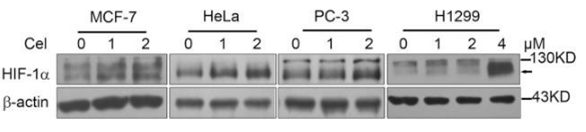
| Western blot | HIF-1α Akt / p-Akt / p-p70S6K PARP / p53 / p21 / cIAP1 / Bcl-xl / Bcl-2 IκBα / p-IKKα/β iNOS / COX-2 / Arg-1 Chk2 / p-Chk2 / Cyclin B1 / Cdc25c / p-Cdc25c |
|
25383959 |
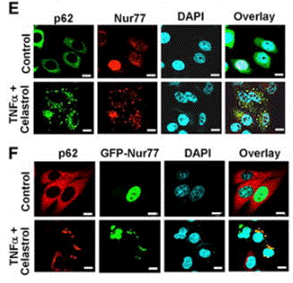
| Immunofluorescence | p21 / Nur77 |
|
28388439 |
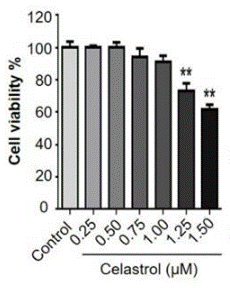
| Growth inhibition assay | Cell viability |
|
29040966 |
Klinische Studieninformationen
(Daten von https://clinicaltrials.gov, aktualisiert am 2024-05-22)
| NCT-Nummer | Rekrutierung | Erkrankungen | Sponsor/Kooperationspartner | Startdatum | Phasen |
|---|---|---|---|---|---|
| NCT05494112 | Recruiting | Safety |
Legend Labz Inc. |
May 25 2022 | Not Applicable |
| NCT05413226 | Recruiting | Safety Issues |
Legend Labz Inc. |
September 28 2021 | Not Applicable |
Technischer Support
Tel: +1-832-582-8158 Ext:3
Wenn Sie weitere Fragen haben, hinterlassen Sie bitte eine Nachricht.

Produkte sind nur für Forschungszwecke bestimmt. Nicht für den menschlichen Gebrauch. Wir verkaufen nicht an Patienten.
©Copyright 2013 Selleck Chemicals. Alle Rechte vorbehalten.