
nur für Forschungszwecke
Delanzomib Proteasome Inhibitor
Kat.-Nr.: S1157
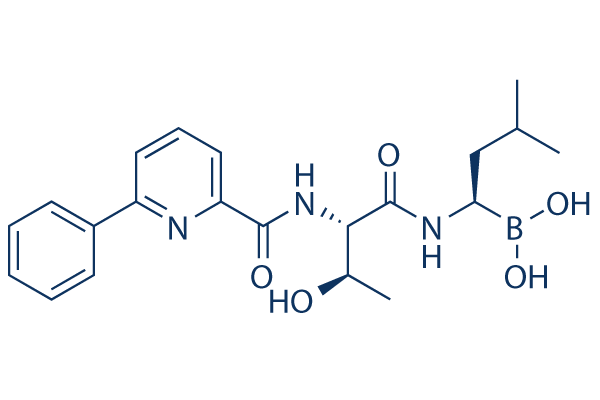
Chemische Struktur
Molekulargewicht: 413.28
Qualitätskontrolle (Quality Control)
- In Nature Medicine für seine erstklassige Qualität zitiert
- COA
- NMR
- HPLC
- SDS
- Datenblatt
| Verwandte Ziele | HDAC Caspase Secretase MMP HCV Protease Cysteine Protease Tyrosinase HIV Protease DPP Serine Protease |
|---|---|
| Weitere Proteasome Inhibitoren | MG132 Epoxomicin (BU-4061T) ONX-0914 (PR-957) Oprozomib VR23 PI-1840 Marizomib (Salinosporamide A) KSQ-4279 (USP1-IN-1) MG-115 Isoginkgetin |
Chemische Informationen, Lagerung & Stabilität (Chemical Information, Storage & Stability)
| Molekulargewicht | 413.28 | Formel | C21H28BN3O5 |
Lagerung (Ab dem Eingangsdatum) | |
|---|---|---|---|---|---|
| CAS-Nr. | 847499-27-8 | SDF herunterladen | Lagerung von Stammlösungen |
|
|
| Synonyme | CEP-18770 | Smiles | B(C(CC(C)C)NC(=O)C(C(C)O)NC(=O)C1=CC=CC(=N1)C2=CC=CC=C2)(O)O | ||
Löslichkeit (Solubility)
|
In vitro |
DMSO
: 83 mg/mL
(200.83 mM)
Ethanol : 83 mg/mL Water : Insoluble |
Molaritätsrechner
|
In vivo |
|||||
In-vivo-Formulierungsrechner (Klare Lösung)
Schritt 1: Geben Sie die untenstehenden Informationen ein (Empfohlen: Ein zusätzliches Tier zur Berücksichtigung von Verlusten während des Experiments)
Schritt 2: Geben Sie die In-vivo-Formulierung ein (Dies ist nur der Rechner, keine Formulierung. Bitte kontaktieren Sie uns zuerst, wenn es im Abschnitt "Löslichkeit" keine In-vivo-Formulierung gibt.)
Berechnungsergebnisse:
Arbeitskonzentration: mg/ml;
Methode zur Herstellung der DMSO-Stammlösung: mg Wirkstoff vorgelöst in μL DMSO ( Konzentration der Stammlösung mg/mL, Bitte kontaktieren Sie uns zuerst, wenn die Konzentration die DMSO-Löslichkeit der Wirkstoffcharge überschreitet. )
Methode zur Herstellung der In-vivo-Formulierung: Nehmen Sie μL DMSO Stammlösung, dann hinzufügenμL PEG300, mischen und klären, dann hinzufügenμL Tween 80, mischen und klären, dann hinzufügen μL ddH2O, mischen und klären.
Methode zur Herstellung der In-vivo-Formulierung: Nehmen Sie μL DMSO Stammlösung, dann hinzufügen μL Maisöl, mischen und klären.
Hinweis: 1. Bitte stellen Sie sicher, dass die Flüssigkeit klar ist, bevor Sie das nächste Lösungsmittel hinzufügen.
2. Achten Sie darauf, das/die Lösungsmittel der Reihe nach hinzuzufügen. Sie müssen sicherstellen, dass die bei der vorherigen Zugabe erhaltene Lösung eine klare Lösung ist, bevor Sie mit der Zugabe des nächsten Lösungsmittels fortfahren. Physikalische Methoden wie Vortex, Ultraschall oder ein heißes Wasserbad können zur Unterstützung des Lösens verwendet werden.
Wirkmechanismus (Mechanism of Action)
| Targets/IC50/Ki |
Chymotrypsin-like proteasome
3.8 nM
|
|---|---|
| In vitro |
CEP-18770 demonstrates marginal prevention of the tryptic and peptidyl gultamyl activities of the protesome. CEP-18770 inhibits A2780 ovarian cancer cells, PC3 prostate cancer, H460, LoVo colon cancer, RPMI8226 multiple myeloma cancer and HS-Sultan anaplastic non-Hodgkin lymphoma with IC50 values of 13.7, 22.2, 34.2 11.3, 5.6 and 8.2 nM, respectively. CEP-18770 blocks the ubiquitin-proteasome pathway in several MM and in the chronic myelogenous leukemia cell line, K562. CEP-18770 causes an accumulation of ubiquitinated proteins over 4 to 8 hours. IκBα degradation is completely blocked by pretreatment with CEP-18770. CEP-18770 significantly inhibits high levels of NF-κB activity in both RPMI-8226 and U266 cells. The time- and concentration-dependent suppression of NF-kB DNA-binding activity in MM cell lines by CEP-18770 leads to a decrease of expression of several NF-κB-modulated genes mediating the growth and survival of tumor cells including IkBα itself, the X-chromosome-linked inhibitor-of-apoptosis protein (XIAP), the pro-inflammatory cytokines TNF-α and interleukin-1β (IL-1β), the intracellular adhesion molecule (ICAM1), and the pro-angiogeneic factor vascular endothelial growth factor. The expression of these NF-κB–mediated genes are associated with more favorable clinical responsiveness to this agent, highlighting their potential prognostic value in response to CEP-18770 exposure. The proapoptotic activity of CEP-18770 against MM is not limited solely to tumor-derived MM cell lines, but extends to primary MM explants from relapsed or refractory patients. In addition, CEP-18770 in combination produces synergistic inhibition of MM cell viability in vitro. |
| Kinase-Assay |
Sondierung der Proteasome-Aktivität in Zellextrakten
|
|
Menschliche multiple Myelomzellen werden zweimal mit kalter phosphatgepufferter Salzlösung gewaschen, pelletiert und mit einem Volumen Glasperlen (<106 Mikrometer, säuregewaschen) und einem gleichen Volumen Homogenisierungspuffer (50 mM Tris (pH 7,4), 1 mM Dithiothreit, 5 mM MgCl2, 2 mM ATP und 250 mM Saccharose) durch Vortexen bei hoher Geschwindigkeit für 15-30 Minuten bei 4 °C lysiert. Perlen, Membranfraktionen, Kerne und Zelltrümmer werden dann aus dem Überstand durch Zentrifugation bei 16.000 g für 5 Minuten entfernt. Der Proteingehalt der Extrakte wird mit dem Bradford-Assay quantifiziert. Die Proteasome-Aktivität wird wie unten beschrieben untersucht. Gleiche Mengen (typischerweise 60 g) Protein werden durch Kochen in reduzierendem Probenpuffer denaturiert, durch 12,5% SDS-PAGE getrennt und auf Polyvinylidendifluorid (PVDF)-Membranen elektrotransferiert. Immunoblotting wird unter Verwendung eines Dansyl-Sulfonamidohexanoyl-polyklonalen Antikörpers (1:7.500, Kaninchen) und eines Meerrettichperoxidase-gekoppelten Ziegen- oder Schweine-Anti-Kaninchen-Sekundärantikörpers, gefolgt von verbesserter Chemilumineszenz, durchgeführt.
|
|
| In vivo |
CEP-18770 reveals sustained dose-related relative tumor weight inhibition. CEP-18770 leads to dose-related complete tumor regressions, which results in a 50% incidence of CR at its maximally tolerated dose (MTD) of 1.2 mg/kg intravenously. CEP-18770 reveals dose-related increase in the incidence of tumor-free mice by the completion of these studies (120 days after tumor transplantation). Oral administration of CEP-18770 produces a marked decrease in tumor weight and notable dose-related incidence of complete tumor regression with minimal changes in animal body weight over the course of the 120 day studies. Equiactive doses of CEP-18770 reveal a greater and more sustained dose-related inhibition of tumor proteasome activity, corresponding temporarily with maximum induction of caspase-3 and 7 activity. The maximum apoptotic signal is 2.5 fold greater for CEP-18770. In contrast, proteasome inhibition profiles of CEP-18870 are comparable in the normal peripheral mouse tissues examined (liver, lungs, whole blood, and brain [no activity]) in both their magnitude and their duration. No proteasome inhibition is detected in brain tissue at any time point for either CEP-18770 or. Single agent CEP-18770 PO also shows marked anti-MM effects in these xenograft models |
Literatur |
|
Klinische Studieninformationen (Clinical Trial Information)
(Daten von https://clinicaltrials.gov, aktualisiert am 2024-05-22)
| NCT-Nummer | Rekrutierung | Erkrankungen | Sponsor/Kooperationspartner | Startdatum | Phasen |
|---|---|---|---|---|---|
| NCT01348919 | Completed | Multiple Myeloma |
Teva Branded Pharmaceutical Products R&D Inc. |
2011-08-03 | Phase 1|Phase 2 |
| NCT01023880 | Terminated | Multiple Myeloma |
Cephalon|Teva Branded Pharmaceutical Products R&D Inc. |
2010-01 | Phase 1|Phase 2 |
| NCT00572637 | Completed | Solid Tumors|Lymphoma Non-Hodgkin |
Ethical Oncology Science |
2007-11 | Phase 1 |

Produkte sind nur für Forschungszwecke bestimmt. Nicht für den menschlichen Gebrauch. Wir verkaufen nicht an Patienten.
©Copyright 2013 Selleck Chemicals. Alle Rechte vorbehalten.